
Want to bet on influencers in Europe? Get these numbers straight first
A data-driven walkthrough of influencer marketing in Europe, covering market size, country-by-country platform choices, and AI's growing role in creator screening and budget decisions.
An old friend of mine who runs a cross-border e-commerce business sent me a WeChat message a few nights ago: should he put part of his budget on influencers in Europe? He asked me to take a look for him.
I said: whether to invest is another matter — first, look at the numbers.
I went through a set of statistics on influencer marketing in Europe. A few of the numbers are quite interesting. Let me share them with you.
First set of numbers: this business stopped being "a trial run" long ago
What is influencer marketing, exactly?
Put simply: you don't praise your own product yourself — content creators do the talking for you. They post on social media every day, and their followers watch every day. The followers trust them, and by extension, they trust whatever those creators are holding.
Some people say: isn't that just celebrity endorsement?
It's not the same thing. Celebrities hang up in the sky; influencers live in your following list. With a celebrity endorsement, you look up at it. An influencer's recommendation is something you stumble onto while scrolling — like a knowledgeable friend mentioning it in passing.
That difference alone puts influencer marketing far closer to the checkout than any ad. And in certain niche circles your ads can't reach at all, one line from a creator gets straight in.
So how big is this market?
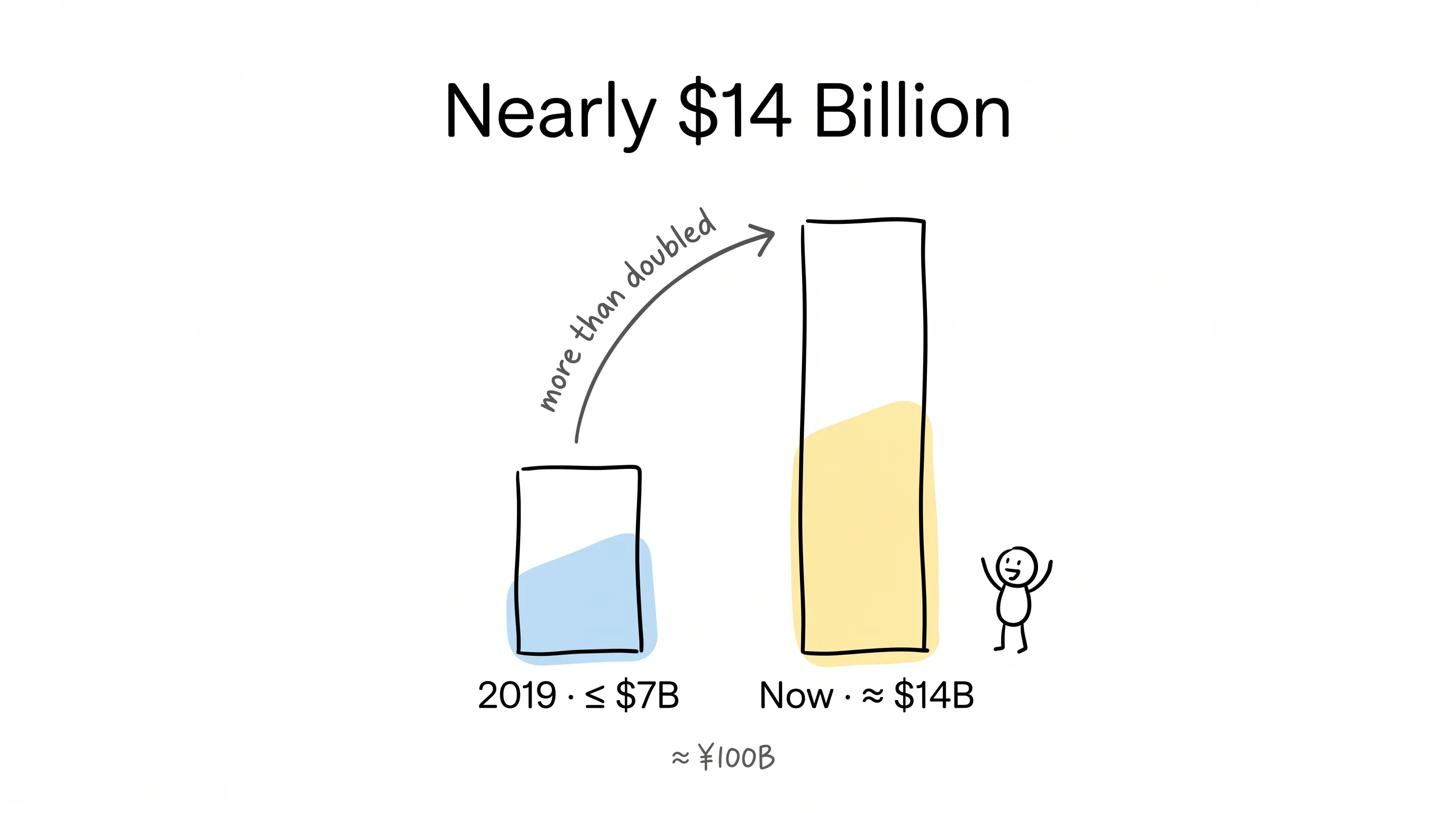
The statistics use this basis: global brand spending on influencer marketing has more than doubled compared to 2019, reaching nearly $14 billion.
Fourteen billion US dollars — convert it to RMB, and a rough calculation puts it at around 100 billion yuan.
Even I did a double take the first time I saw it.
What does 100 billion mean? Work backwards and it becomes clear. Since it is "more than doubled," back in 2019 the whole market was, at most, six or seven billion US dollars. In just a few years, it has been somersaulting upward.
By the way, change the methodology of a statistic like this and the numbers change completely. Everything below speaks only to this one basis.
When a market doubles within a few years, it no longer lives on early-mover tailwinds. The next contest is fought over the fine details of the accounts.
Why Europe, of all places?
You might want to ask: China and the US already play this game well, so why keep staring at Europe?
Two reasons.
First, Europe is no small cake. Several of the world's largest digital advertising markets sit right in Europe. The plate is big, the water is big — only then can the fish be big.
Second, and more concrete: European companies are allocating a bigger share of budget to creator partnerships than ever before.
In plain language: more and more companies serving the European market have already voted with real money.
The statistics also contain several finer sets of numbers. Europe's creator marketing spending was recorded year by year from 2016 to 2020, plus a dedicated chart of its growth rate. By 2025, the share of active social media users in each European country was pulled out for its own round of country-by-country statistics.
Raising the stakes year after year — what does that tell you?
That this is no impulsive bet on a passing fad. Money that chases a fad arrives fast and leaves just as fast. Where budgets stack up year after year is where the business has truly taken root.
Where to invest? Don't take one map across Europe
The platform question is an interesting one.
Which is the number one platform for influencer marketing?
In a global survey as early as the start of 2020, the answer was already Instagram.
By October 2025, another survey covering Western Europe asked marketing decision-makers in each country: for influencer marketing, which platform do you use most? This survey was tallied country by country — the answer for Germany, the answer for France, the answer for the Netherlands, each laid out separately.
Why look at them separately?
Because the platform game stops at national borders. Your experience in your home market may not hold in Europe; your experience in Germany may not hold in France either.
There's another detail. A global survey in early 2026 did two things at once: it ranked the social media platforms marketers consider most important, and it asked about their plans for the next 12 months — for the organic reach that doesn't depend on paid traffic, should the platform mix be adjusted?
Put the two questions together and the meaning is very clear: answers are useful, but answers also expire. Today's board position only guarantees today.
A new variable: AI has entered the field
There's one more variable I want to flag for you.
In mid-2025, a survey of US marketers asked one pointed question: what are you all using AI for in influencer marketing?
The specific answers don't matter. What matters is that this question itself has already entered the questionnaire.
What a questionnaire asks shows what the industry is thinking. Steps like creator screening and running the numbers — AI taking them over is only a matter of time.
This means the barrier to finding influencers is falling. In the past, the contest was "do you know the right people"; from now on, it is "how fast do you screen, how finely do you count." The data team that only big companies could once afford — now a small team with a few tools can run the numbers just as clearly.
Tools are leveling the playing field.
Back to my friend's question
After all this, should my friend invest or not?
The data has already answered half for him: the market is doubling, budget shares keep climbing, and the platform trail is there to follow. The other half he has to answer himself: can his product fit, seamlessly, with a certain kind of creator in a few specific countries?
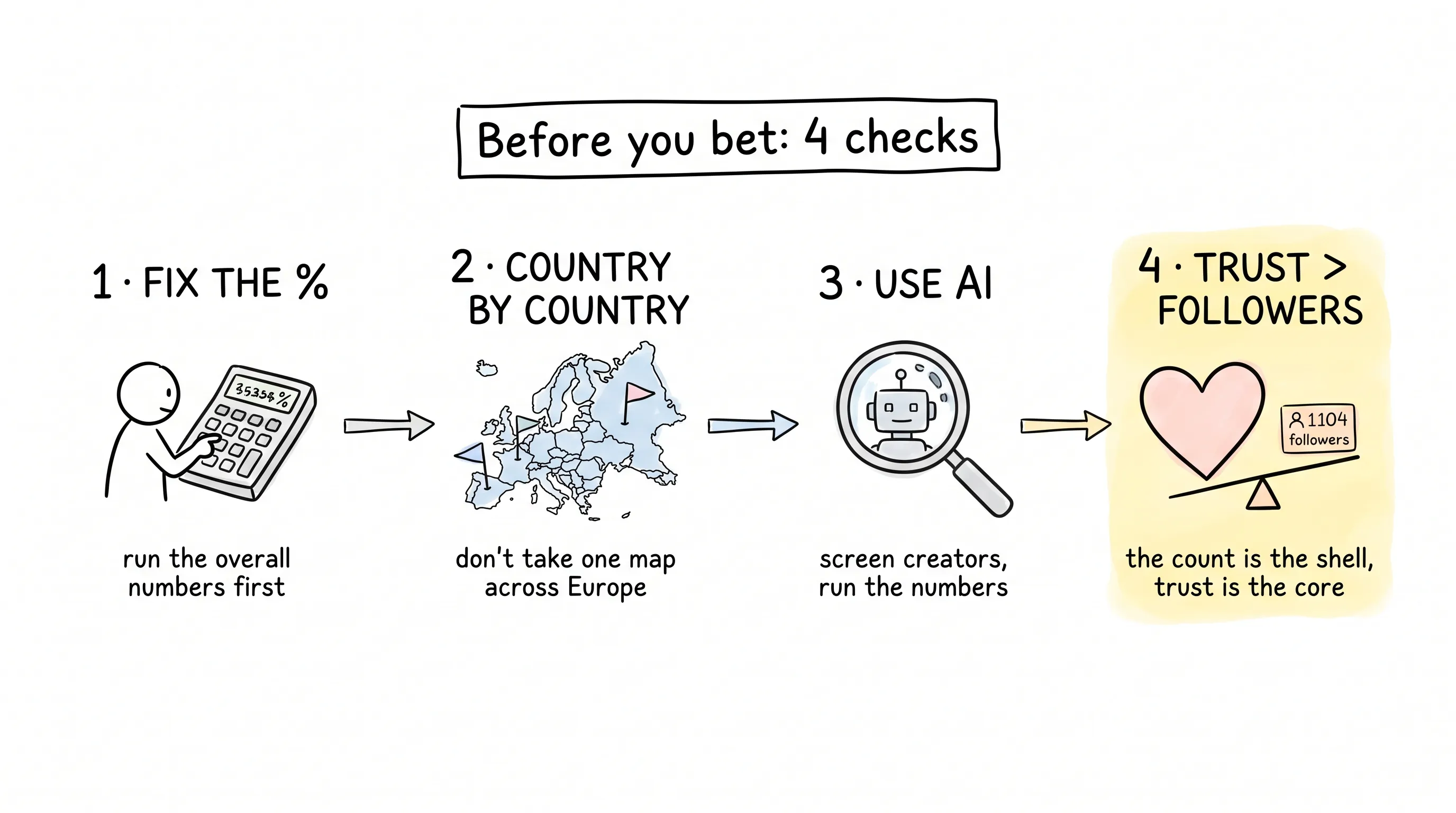
If he asked me what exactly to do, I would probably say four things:
- Run the overall numbers first. Fix the percentage for influencers — don't decide on gut feel.
- Pick platforms country by country — don't take one map across Europe.
- For screening creators and running the numbers, put AI to use.
- Don't look only at follower counts. The follower count is the shell; trust is the core.
The fourth point is the one I most want to make. What an influencer truly sells you is that bit of trust between them and their followers. You can farm the numbers; you can't farm trust.
That night, I replied to my friend: invest. But run the numbers in fine detail first.
He answered with a single word: "Okay."
Here's hoping you, too, find in Europe that one person willing to speak for you.
Continue reading
Related articles

Cross-Border Business: Time to Upgrade Your AI Toolbox
A learn article explaining how AI tools help cross-border e-commerce sellers clear five hurdles: language, regulation, logistics, payments, and fraud. It outlines a five-compartment toolbox, a five-step adoption path, and metrics such as conversion rate and CLV, while cautioning against over-reliance on AI.

AI Is Taking Over the Dirty Work of Social Media Marketing, One Task at a Time
This learn article outlines four social media marketing tasks AI can handle — audience analytics, content drafting and design, ad targeting and creative testing, and spam moderation — and cautions that taste, judgment, and data security remain human responsibilities.

AI Is Already This Good — Why Is Your Social Media Marketing Still Pure Manpower?
An overview of 18 AI tools for social media marketing, organized into six categories covering audience research, content creation, scheduling, comment and DM handling, ad management, and visual production, plus notes on personalization, prediction, and emerging trends.