
Want AI to Delight Your Customers? Clear These Three Hurdles First
A learn article on AI in customer experience: it surveys AI capabilities from recommendation systems to IoT, then covers three hurdles — prioritizing critical journeys with a CX team, pairing personalization with clear privacy promises, and using real-time feedback plus customer segmentation to address churn.
A few days ago, I bought a coffee machine.
The next day, I opened my shopping app, and the whole screen was coffee beans, grinders, and milk pitchers. Even the ads inserted into my short videos were pour-over tutorials.
How did it know I had just bought a coffee machine?
Artificial intelligence.
None of this is unusual today. Companies are throwing more money at AI every year, and the goal is remarkably consistent: serve customers better.
And is it working?
Unevenly. Some have turned the experience into magic; others have spent plenty, only to watch customers keep voting with their feet.
Where does the problem lie? I recently traced this whole matter from start to finish, and found the hurdles boil down to three. Let's take them one at a time.
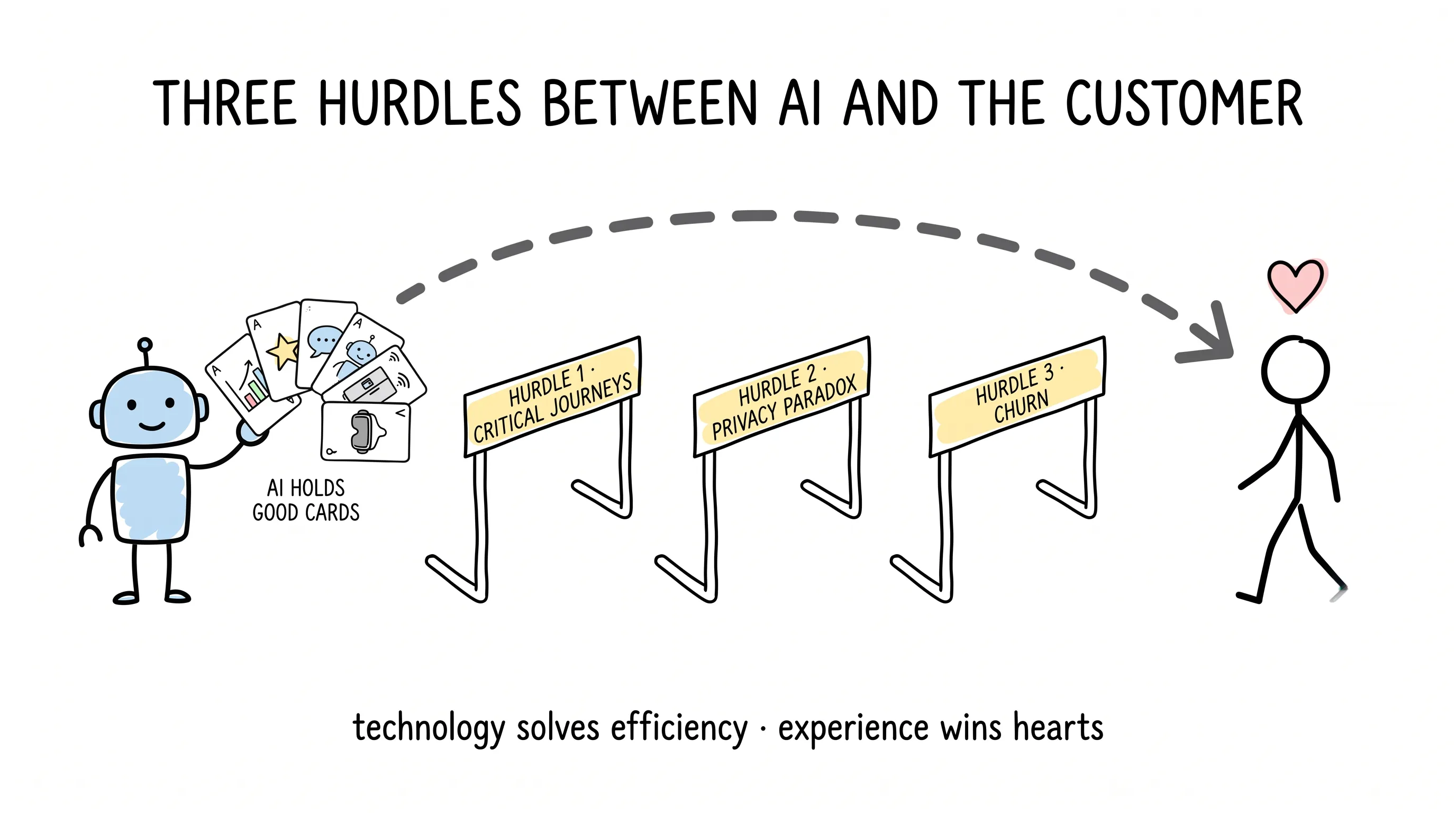
First, Look at the Cards AI Holds
Before the hurdles, a look at the arsenal. Otherwise you won't understand why everyone is in such a rush.
Let me count off a few.
First, big data analytics. What is big data? Every trace you leave online: what you've bought, where you've been, when you placed an order, what reviews you gave. These things used to scatter with nobody picking them up; now they all get funneled into a warehouse. For what? To run the numbers. To predict what you will buy next.
Amazon plays it even bolder. There's a thing called anticipatory shipping: before you've placed an order, it has already guessed what you'll buy and moved the goods toward a warehouse near you. When you actually order, delivery takes a day.
Impressive.
Second, recommendation systems. The biggest trouble in e-commerce isn't lack of goods; it's too many goods. Too much choice wears people out, and worn out, they simply don't buy. What a recommendation system does is cut out the noise for you. It comes in three approaches: those that watch your own behavior to guess your tastes are called content-based; those that look at what "people like you" bought are called collaborative; those that mix both are called hybrid. No need to memorize the names. Remember one sentence: it has already walked that store for you.
Third, AI that can talk. Siri, Alexa, Google Assistant — you see these every day. PwC published a report in 2021 showing that people are already used to ordering food, listening to music, and shopping through voice assistants. This kind of assistant is becoming the new front door between brands and customers. You used to open an app and hunt for the feature; now you just say the word.
Fourth, robots. In malls, hospitals, and airports, you can now install holographic service robots dedicated to answering questions like "Where is the restroom?" Interestingly, the holographic kind takes up no floor space and doesn't need particularly expensive hardware. There are also meal-delivery drones and delivery robots that bring light parcels straight to your doorstep — low cost, and environmentally friendly.
Fifth, the Internet of Things (IoT). What is IoT? Things connecting to things by themselves. Imagine: your fridge notices the milk is running low and orders a fresh carton on its own; the eggs hit bottom, and they go straight into the shopping cart. You do nothing at all, and by the next morning, the milk is already at your door.
Sixth, extended reality (XR) — the family of AR, VR, and MR. AR overlays information on the real world: Instagram filters, IKEA's furniture-placement app, Lenskart's 3D virtual try-on — all of these. VR moves you wholesale into another world: playing games, even "touring" a country you've never visited while sitting at home. MR is the most interesting: it kneads the real and the fake together. Someone has imagined a supermarket like this: you walk into the vegetable section, look up, and find yourself in a farm field, able to reach out and pick apples from the trees. When you check out, the apples are fake, and the experience is real.
Any one of these six cards is striking enough on its own.
But holding good cards doesn't mean knowing how to play them.
Hurdle One: Don't Rebuild the Whole System on Day One
Bringing in AI means touching the entire system. It costs money, changes processes, and requires persuading a crowd of people to give up habits they've held for over a decade. Swapping every link for AI in one go is basically impossible. Force it, and you will most likely make a mess.
Then where do you start?
Start from the journey. What is a journey? The complete process of a customer going from "I want something" to "I bought it, I'm using it, and I'm satisfied." Many companies slice their processes into segments: customer service handles complaints, warehousing handles shipping, the app handles ordering. Each segment looks fine on its own; pieced together, they run the customer ragged.
McKinsey ran a North American customer experience survey in 2018, and the conclusion was interesting: in any industry, the critical journeys that truly decide customer satisfaction are usually just a few types. For an energy company, the critical four are: paying bills, checking usage, reporting outages, and resolving billing disputes. The rest, however much you do, customers won't remember.
So the first step is to lay the process out end to end, find the few journeys that truly make or break the experience, and work on those first.
How? Take one already in the field: payments. Biometric checkout — scan your face and go — is exactly what Amazon's cashierless convenience store Amazon Go does. Another example: real-time refunds after purchase, and online loans and insurance built on customer data. All of these strike at critical journeys.
As for the biggest lever, many have verified the same answer: let customers see, in real time, where their order is.
Just this one small feature lifts satisfaction more than many big overhauls do. Why? Because what customers fear most isn't slowness — it's not knowing.
A Map Alone Isn't Enough — You Need a Team
Finding the critical journeys is not a job one person can do. It needs a cross-functional team: people who understand data, processes, the business, and technology — all present. This is what many companies call a CX (customer experience) team.
What does this team do? Watch customers' real behavior, respond in real time, adjust the process on the fly.
Let me tell you a true story. A study observed a large fast-food chain and noticed one detail: when a customer dropped food on the floor while eating, the server would bring over a brand-new portion right away, free of charge.
Why? Because on the chain's journey map, this is a serious accident point. Rather than let the customer walk away carrying a bad memory, better to remedy it on the spot — turning a bad moment into a memory of "this place is really good."
You see, this is the payoff of watching the journey. Looked at individually, each touchpoint scores decently; looked at together, the customer is still unsatisfied. Experience is never decided by a single touchpoint — it's decided by the full journey.
Hurdle Two: The More Thoughtful, the More Alarming
The second hurdle is subtler.
The Boston Consulting Group (BCG) ran a 2021 survey in which two numbers, placed side by side, positively glare: only 29% of consumers feel that handing over data buys them better service, while 75% of consumers have already begun limiting the personal information they share online.
What is personalization? Before I've said a word, you already understand me.
What is a privacy worry? Before I've said a word — how do you know?
The same act, two feelings. This is the personalization–privacy paradox: the thoughtfulness a company shows you and the unease you feel are made from the same set of data.
What to do? Someone has drawn this as a matrix with two axes: one for convenience, one for the sense of losing control — that feeling of "my information isn't mine to decide." Use customer data, and four outcomes result.
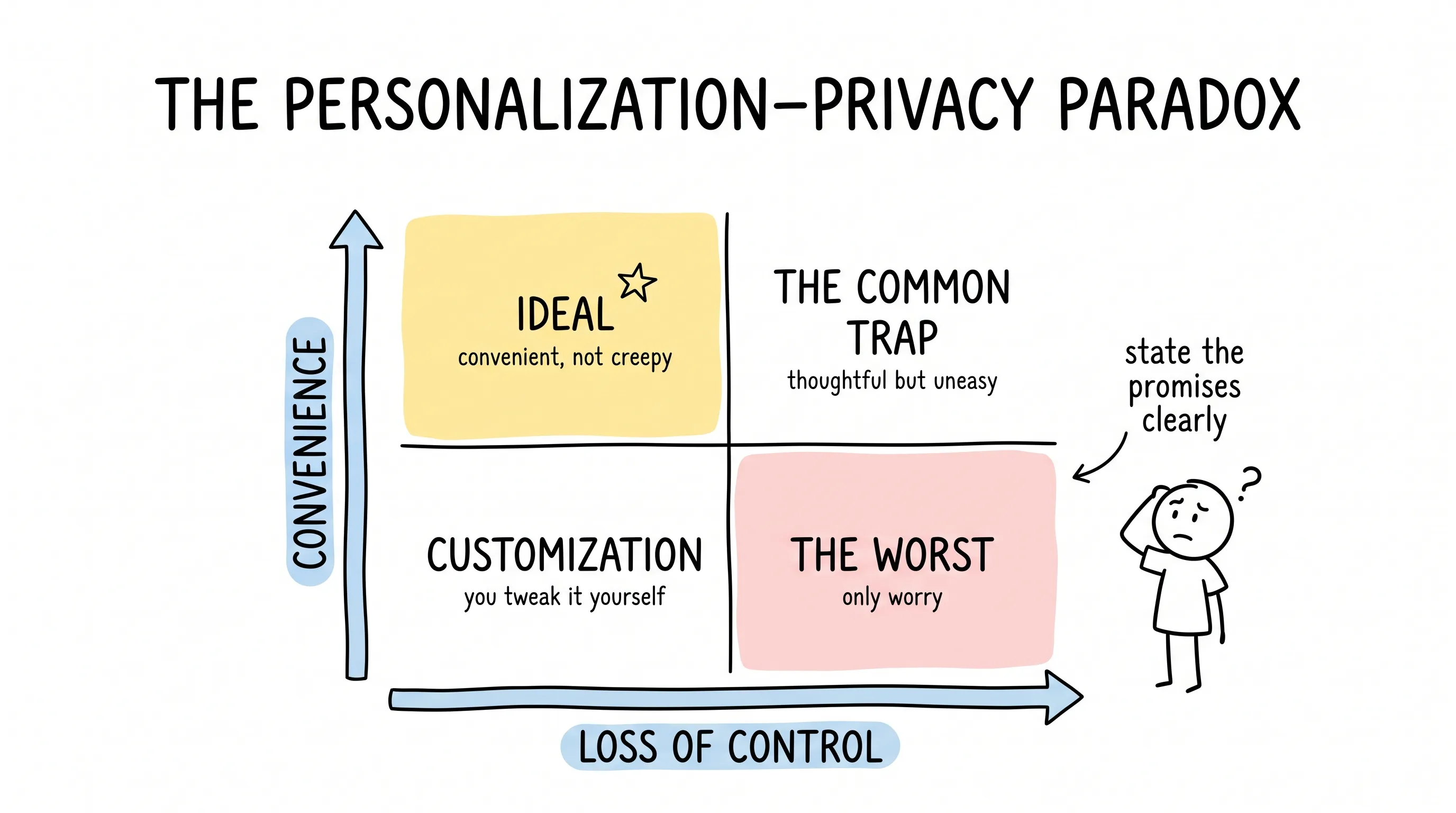
Low convenience, high loss of control. The service isn't much better, and customers feel flayed. The worst of the four — all that's left in the customer's mind is worry.
High convenience, high loss of control. This is the most common state: the service is genuinely thoughtful, but the more customers think about it, the less at ease they feel, and little by little they no longer dare to hand over data. Trading trust for thoughtfulness is a bad deal.
Low convenience, low loss of control. This one has a name: customization. Note that customization and personalization are not the same thing: customization is you modifying things yourself — choosing configurations, picking colors — the company never touches your data, so naturally you don't worry; personalization is you doing nothing at all while it automatically arranges everything for you.
High convenience, low loss of control. The ideal state. Customers feel the convenience without feeling offended.
Now the key question: how do you reach the fourth quadrant?
The answer is almost insultingly simple: state the promises clearly.
"We do not collect your data without your consent." "We will not give your information to any third party." "We will protect your personal information."
Don't underestimate these sentences. Research has verified that when a company makes clear privacy commitments, customers' sense of losing control drops noticeably, worry follows it down, and they become more willing to hand over data.
Put plainly, customers aren't refusing to let you use their data — they fear losing control. Return the sense of control to them, and they'll gladly make that trade with you.
Hurdle Three: The Money Is Spent, and the Customer Still Leaves
The third hurdle stings the most — right in the wallet.
Every technology above has to reach scale, and reaching scale means throwing serious money at it. But once the money is spent, you'll find that customers who were going to leave still leave. The competitor next door cuts prices 10%, and they're gone the next day, without even a goodbye.
What is churn? It's customers leaving quietly. What stings more: before they leave, you don't know it's coming; after they leave, you don't know why.
So what do you do? Two things.
The first, let the journey speak for itself. Place real-time feedback points at the journey's key positions; the moment a customer is frustrated at any stop, the system knows immediately, and the staff at the next stop get an instant alert: this customer ran into a problem at the last stop — find a way to make it up.
Make it up with what? Small gestures will do. One airline does exactly this: upon discovering a customer has just experienced a delay or a service failure, it immediately offers some compensation and rescues the relationship. Spend a little, and what you preserve is all the business that follows.
The second, use machine learning to segment customers. The customer data is all there; let the algorithm work out who is about to leave, why they're leaving, and what could keep them. When the calculation is done, customers sort into three piles.
Red-light customers have just been through an unsatisfying experience, satisfaction is very low, and they could leave at any moment. Green-light customers are highly satisfied — solid. In between are yellow-light customers, sitting on the fence.
The task is clear: move the red lights and yellow lights toward green. Compensate red-light customers first; tend to yellow-light customers proactively.
The precondition for this whole playbook is still the journey map. Without a whole-journey view, you don't even know at which stop the customer got angry.
Finally, Connect the Three Hurdles
Step back and string the three hurdles into one line:
The first: don't spread yourself thin — find the critical journeys and act on those first, then assemble a CX team to watch them. The second: pair personalization with promises, and hand the sense of control back to the customer. The third: lay feedback points across the whole journey, sort customers red-yellow-green, and keep them before they walk.
Add the few foundational things underneath: understand what customers really want, pull out the pain points at every touchpoint one by one, and keep watching the whole system run — with data.
You will find that behind the three hurdles is actually one sentence:
Technology solves efficiency; experience wins hearts.
Back to that coffee machine at the beginning. The algorithm that made it show up really is clever. But what truly decides whether I buy next time isn't whether it guessed accurately — it's whether someone steps up when the package arrives dented, and whether customer service treats me like a person.
AI has rebuilt the business of serving customers from the ground up. The tools are all in place; what remains is who actually takes customers seriously.
May your customers never feel "served by an algorithm" — only "remembered."
Continue reading
Related articles

Cross-Border Business: Time to Upgrade Your AI Toolbox
A learn article explaining how AI tools help cross-border e-commerce sellers clear five hurdles: language, regulation, logistics, payments, and fraud. It outlines a five-compartment toolbox, a five-step adoption path, and metrics such as conversion rate and CLV, while cautioning against over-reliance on AI.

AI Is Taking Over the Dirty Work of Social Media Marketing, One Task at a Time
This learn article outlines four social media marketing tasks AI can handle — audience analytics, content drafting and design, ad targeting and creative testing, and spam moderation — and cautions that taste, judgment, and data security remain human responsibilities.

AI Is Already This Good — Why Is Your Social Media Marketing Still Pure Manpower?
An overview of 18 AI tools for social media marketing, organized into six categories covering audience research, content creation, scheduling, comment and DM handling, ad management, and visual production, plus notes on personalization, prediction, and emerging trends.