
Video Didn't Kill the Radio Star, and AI Won't Kill Your Craft Either
An opinion essay arguing that AI relocates human skills rather than eliminating them, drawing on the WYSIWYG-to-CMS history, IKEA and Best Buy retraining cases, and a ski resort's AEO/GEO playbook, with habit-building and visibility advice for marketing professionals.
A few days ago I was driving, and my phone on shuffle threw up an old song: "Video Killed the Radio Star" by The Buggles.
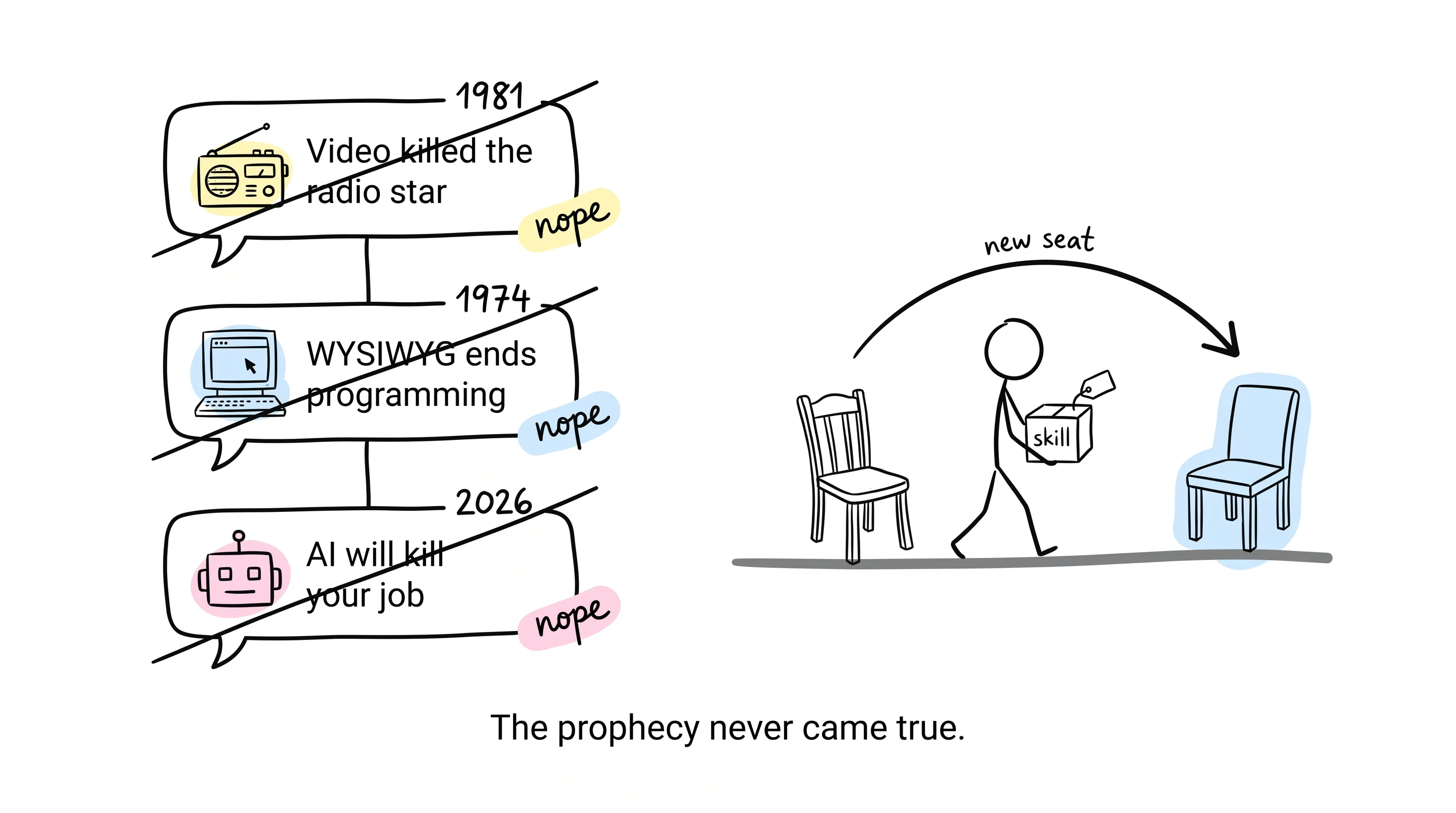
Video killed the radio star.
That title sounds like a verdict.
That song was the first music video MTV ever played when it launched in 1981. For a brand-new channel to open with a "prophecy song" like that — there's some real self-awareness in it.
So what happened after forty-plus years?
Radio didn't die. Podcasts and audiobooks, if anything, turned audio into big business.
The prophecy never came true.
I wrote this down, because for the past two years, the prophecy I've heard most often is: AI is going to kill your job. Every time I hear it, I think of that old song from forty-some years ago.
What Is WYSIWYG?
First, let me tell you an old story from our own line of work.
There's a word you probably see every day: WYSIWYG.
What does WYSIWYG mean? The full name is What You See Is What You Get. What you see on the screen is exactly what the finished page will look like — without touching a single line of code.
This thing has been around since at least 1974.
And what was the prophecy back then? With it, ordinary people could do layout and build pages themselves, and programmers would be out of a job.
And the result?
Later, content management systems (CMS) carried the WYSIWYG editor into millions of homes, and yes, anyone could build a website. But the work involving HTML, CSS, PHP, and JavaScript — not one bit less of it got done. The content-management profession, if anything, only grew.
Programmers didn't die. They just changed seats: from "writing it for everyone" to "making it possible for everyone to write."
What technology kills is never human skill. It just moves that skill to a new seat.
From Writer to Editor
Now, on to today.
What is vibe coding? It's when a person who knows nothing about programming talks to AI in plain words: "Build me a page like this." And the AI really does spit out the code.
That should finish programmers off for good, right?
No.
But the seats did move again. The programmer's job is turning from writer into editor: AI writes the first draft, and the human judges, revises, and is the gatekeeper.
You might say: isn't that great?
For the individual, it's another story. This is a real shake-up. Software engineering has long been seen as the closest thing to a guaranteed career: high pay, stability. Now the ground under it is moving.
One tech journalist sat down with software engineers across the industry and came back with this picture: frustration, anxiety, scrambling to adapt to a new reality where "the value of skills has suddenly become hard to see." Some went back to grind the fundamentals, some frantically chased new skills, some organized collectively to demand protection, and some were simply thinking about quitting the field.
Yes, some people won't make it across. It depends on your skill mix, on what you care about — not something a lofty speech can carry you over. That much has to be said.
But the road across the river? Someone really is building it.
Someone Is Building the Road
Start with organizations.
In the U.S. there's a nonpartisan organization called Raise U.S., led by two people: former U.S. Commerce Secretary Gina Raimondo and former Indiana Governor Eric Holcomb. The question they want to answer: can the great job migration of the AI era avoid replaying the manufacturing exodus at the end of the last century? We're still paying off the economic and human cost of that one today.
There's also a more grassroots one called What Will We. Its founder, Kaitlin Cort, was herself a software engineer. When AI changed her own job, she simply turned around and started helping others whose work had been changed the same way: a community job board, layoff crisis support, co-learning tools, a job-search tracker, public-interest tech projects, resource libraries — built up one by one. As of mid-2026, they were also preparing a basic-income pilot and a mutual-aid fund.
Individual anxiety is being organized into answers.
Smart Companies Are Marking People Up
Now, companies. The stories at this level are my favorite.
IKEA did something. It went through its customer-service Q&A logs with a fine-tooth comb, hunting for exactly one kind of question: ones the bot couldn't answer but customers genuinely wanted answered.
What they found was a gold mine: interior design consultation.
So IKEA retrained 8,500 customer-service staff into design consultants, selling high-end design services.
Let's run the numbers: in 2024, this new business line did $1.7 billion in sales, 3.3% of total revenue. By 2028, it's projected to climb to 10%.
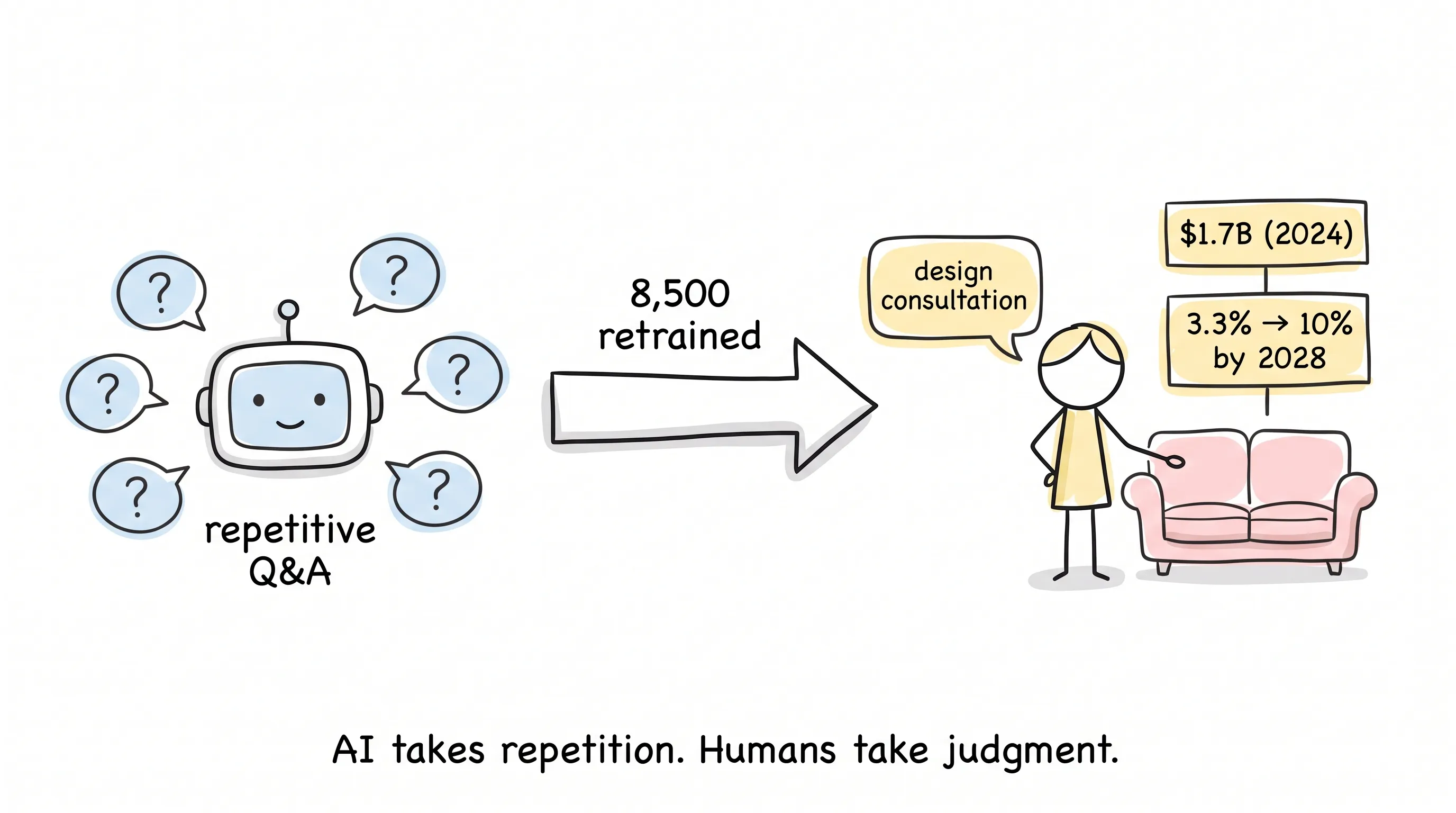
Unbelievable. Sit with this move for a second: AI took away the repetitive Q&A, and people weren't thrown away — they were moved to where AI can't reach: taste, and trust built face to face. Even better: if customers want to meet a design consultant, they have to walk into a store. And once they're in the store, you really think they'll walk out without a sofa?
Best Buy plays from the same playbook. Sangeet Paul Choudary broke it down in his book Reshuffle: the more complex the electronics, the more customers need someone to talk human to them. Best Buy trains its store employees specifically to help customers get through complicated purchase decisions. However fiercely online and offline rivals fight, the real human advisor is the foot traffic.
The two companies did the same thing: AI and websites took over the repetitive labor, and the companies rode the moment to move the value of people up a notch.
AI takes over repetition. Humans take over judgment.
Gartner twists the knife: many companies that did AI-driven layoffs have come to regret it.
Why the regret? AI's knowledge is broad; its judgment is poor.
Why Humans Can't Be Deleted
Some will say: you're too optimistic. AI hallucinates.
Right, it hallucinates. And hallucination is exactly what proves there's a slot for humans.
Today's AI models, every few days, will serve up complete nonsense with a perfectly straight face. Even the platforms themselves hang a warning right in the interface: outputs should be reviewed by a human.
Think about it: if the platforms themselves require human review, then people who know how to review are obviously not going away.
Judgment is the new job.
There's another layer that's easy to overlook: old knowledge doesn't go out of date. Quite a few U.S. federal government systems still run on COBOL from the 1950s. That creaky old language needs people who understand it to keep it humming. People who know COBOL haven't been eliminated — they're scarce.
And old knowledge is often the kindling for new technology. Many breakthroughs happen when a deep old foundation collides with a new tool.
Two Moves and a Story
So for those of us working in marketing technology — what exactly to do?
Two moves, plus one story.
First move: build the habit. If you're a mid-career professional like me, what you're most likely missing is a reflex: "think AI first" whenever something comes up. Don't aim for something grand. Pick a few small tasks, use company-approved tools, and let AI be your assistant every single day. Once the habit takes hold, the brain changes, and new skills grow right along with the new habit.
Second move: speak up. When you've delivered results, don't bottle them up — tell your boss. A former VP of mine once told me something I've never forgotten: self-promotion is not selfishness. If you don't say it, how does the company know who the next opportunity should go to?
Now, that story.
Snowbasin, a ski resort in Utah. Marketing director Michael Rueckert noticed something: ask an AI chatbot "where's good to ski," and it recommends somewhere else in a heartbeat — everyone but Snowbasin.
Anyone else might curse the algorithm a couple of times and move on.
Rueckert didn't. He used Claude to build a whole playbook with one goal: getting AI models to actually recommend Snowbasin.
Then he went a step further: he went ahead and founded a company, Centium, helping other businesses win AI visibility — the business being AEO (Answer Engine Optimization) and GEO (Generative Engine Optimization).
See? The same "AI changed my work": some people get changed, and some people turn the change into a business.
Who's Going to Buy What You Sell?
Finally, back to that anxiety.
Our first reaction to change is always resistance. That's normal — it has nothing to do with whether the change is good or bad.
But I want to give you the plainest, most hard-headed reason for optimism. A piece of arithmetic:
For a company to survive, someone has to buy what it sells. Employees are the biggest customer group there is. If every company used AI to swap out all its employees, then tell me — who is going to buy what they sell?
So the "replace everyone" strategy doesn't work economically. In the end, companies still have to hire people and pay wages, so people can afford the things they produce.
This isn't sentiment. This is arithmetic.
AI can't kill human skill — it just moves that skill to a new seat.
So the next time someone goes on about "AI is going to kill your job," don't rush to argue. Play them that old song from 1981.
Video didn't kill the radio star.
AI won't kill you either.
Here's wishing you're the one who moves your seat to the new place.
Continue reading
Related articles

Cross-Border Business: Time to Upgrade Your AI Toolbox
A learn article explaining how AI tools help cross-border e-commerce sellers clear five hurdles: language, regulation, logistics, payments, and fraud. It outlines a five-compartment toolbox, a five-step adoption path, and metrics such as conversion rate and CLV, while cautioning against over-reliance on AI.

AI Is Taking Over the Dirty Work of Social Media Marketing, One Task at a Time
This learn article outlines four social media marketing tasks AI can handle — audience analytics, content drafting and design, ad targeting and creative testing, and spam moderation — and cautions that taste, judgment, and data security remain human responsibilities.

AI Is Already This Good — Why Is Your Social Media Marketing Still Pure Manpower?
An overview of 18 AI tools for social media marketing, organized into six categories covering audience research, content creation, scheduling, comment and DM handling, ad management, and visual production, plus notes on personalization, prediction, and emerging trends.