
Using AI for Brand Content? 8 Hurdles to Clear First
The article outlines risks of using generative AI for brand content — hallucinated statistics, plagiarism, and bias — and summarizes a study comparing 33 AI ethics guidelines across eight conditions, highlighting intellectual property as a common gap, with a checklist on disclosure, fact-checking, and human review.
A while back, an old friend of mine who works in branding invited me out for tea.
His team is just three people. They started using AI to write content last year, and output has quadrupled — still the same three people.
He said the highs are real highs. But lately he's been losing sleep.
I asked what was wrong.
He said one of the AI-written articles had cited a set of statistics — really compelling ones, the kind readers love. Then a sharp-eyed reader went to check them. The numbers didn't exist.
The post came down. But people in the comments had already started asking: can anything you publish still be trusted?
I walked away with a single thought: this worry is not an overreaction. Not even a little.
So What Is Generative AI?
Let's get the concept straight first.
The old AI helped you analyze, recommend, rank. Generative AI is different: it does the work for you — writing articles, drawing images, making videos, doing voiceovers.
In November 2022, ChatGPT launched, and only then did this truly go mainstream. You give it a sentence; a few seconds later it hands you back a draft.
What does that mean for people in content marketing?
Here's the thing: content marketing is, at its core, manual labor. Daily publishing, multi-platform distribution, staying on-brand everywhere — and the costliest resource is human time. Once AI shows up, everything speeds up: headlines, outlines, first drafts, illustrations.
In 2023, the Capgemini Research Institute surveyed 1,800 chief marketing officers across 14 countries and interviewed 25 industry experts in depth. The conclusion at the time was clear: the momentum behind generative AI for content was only going to grow. And marketers' state of mind was just as honest — embracing it while quietly feeling uneasy.
So, Had Your Fun — Now What?
The unease is justified. The ways it can blow up are sitting right out in the open.
First: hallucination.
What's a hallucination? The AI makes things up — with a completely straight face. The data is invented, the quotes are invented, even the sources can be fabricated convincingly. That's exactly how my friend's article happened.
And here's the key: once false information carries your brand, consumers won't blame the AI. They'll blame you.
Second: plagiarism.
An AI's training data is nothing but human work, so what it generates can collide with existing creations — without any credit given.
Third: bias.
Models carry the social stereotypes in their training data straight through. A review published in 2025 combed through dozens of studies and found that generative AI reliably reproduces these stereotypes. If your content unintentionally offends a group of people, it's your followers who walk.
Reputation takes ten years to build and one moment to destroy.
So Many Guidelines — Why Don't They Work?
You might say: aren't there plenty of AI ethics guidelines already?
There are. As far back as 2019, scholars counted 84 AI ethics guidelines published by institutions around the world. And the corporate world isn't shy about it either — Google, Microsoft, IBM, and OpenAI each have their own set of principles.
But here come two buckets of cold water.
One study that evaluated 22 guidelines found they generally lack enforcement mechanisms. Ethics becomes a soft requirement — something to do "when there's time" — and when deadlines press, it's the first thing to be sacrificed.
Another study looked at 47 guidelines and put it more bluntly: in real business decisions, they're essentially unusable. The principles look beautiful. They just don't land.
And there's another layer: most of these guidelines are generic. They tackle grand topics like algorithmic decision-making and self-driving cars. The specific potholes of brand content creation? Those, they don't cover.
33 Guidelines, Laid Out Side by Side
So what do you do? Take the unglamorous route: compare.
A study published in 2025 did the painstaking version of this. The researchers collected 33 representative AI ethics guidelines — from governments: the EU AI Act, GDPR, the US NIST Risk Management Framework, California's privacy law; from international organizations: OECD and UNESCO; from companies: the principles of Google, Microsoft, IBM, and OpenAI. Then they cross-checked these guidelines, one by one, against the ethical concerns most discussed in content marketing.
The method is called Qualitative Comparative Analysis. The name sounds intimidating; the idea isn't.
It doesn't ask which factor matters most. It asks which combination of conditions has to be in place for something to work. Like a recipe: leave out one ingredient and the flavor is off.
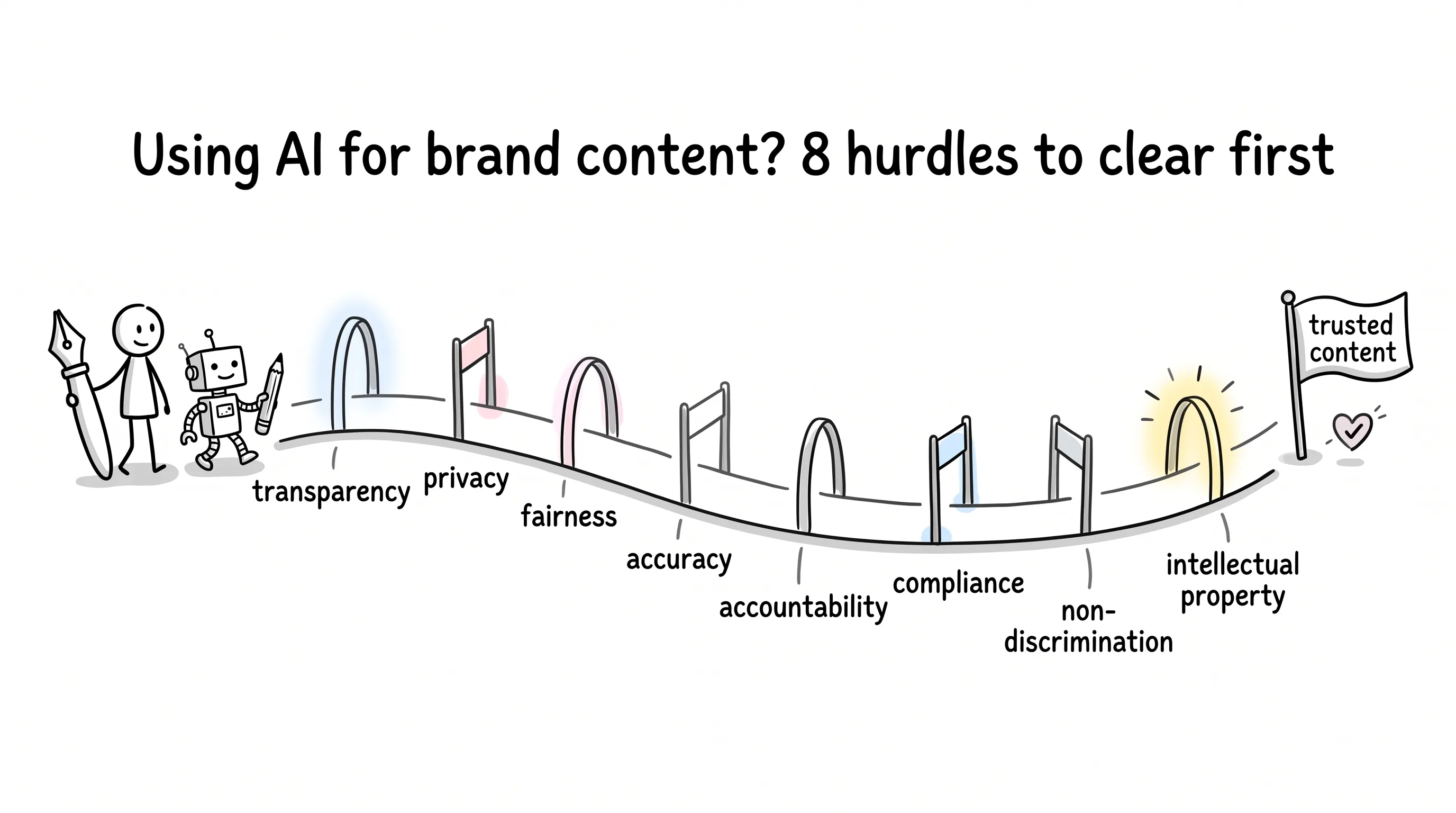
First, the researchers pulled 8 ethical conditions that came up again and again in the literature: transparency, privacy, fairness, accuracy, accountability, compliance, non-discrimination, and intellectual property. Then they scored all 33 guidelines, one by one: fully covered, 1 point; largely covered, 0.67; touched on, 0.33; not mentioned at all, 0.
With the scores in, they looked at the distribution first. And that's where it gets interesting.
Transparency, privacy, and compliance: full marks in all 33 guidelines. Fairness, accountability, non-discrimination, and accuracy all averaged above 0.95.
Only intellectual property averaged 0.69 — with the widest spread of all. Some guidelines covered it thoroughly; others never breathed a word about it.
Hold onto that detail. There'll be a test later.
The Most Unexpected Answer
So if all 8 conditions are in place, does that do it?
The comparison split the guidelines into two cleanly separated groups.
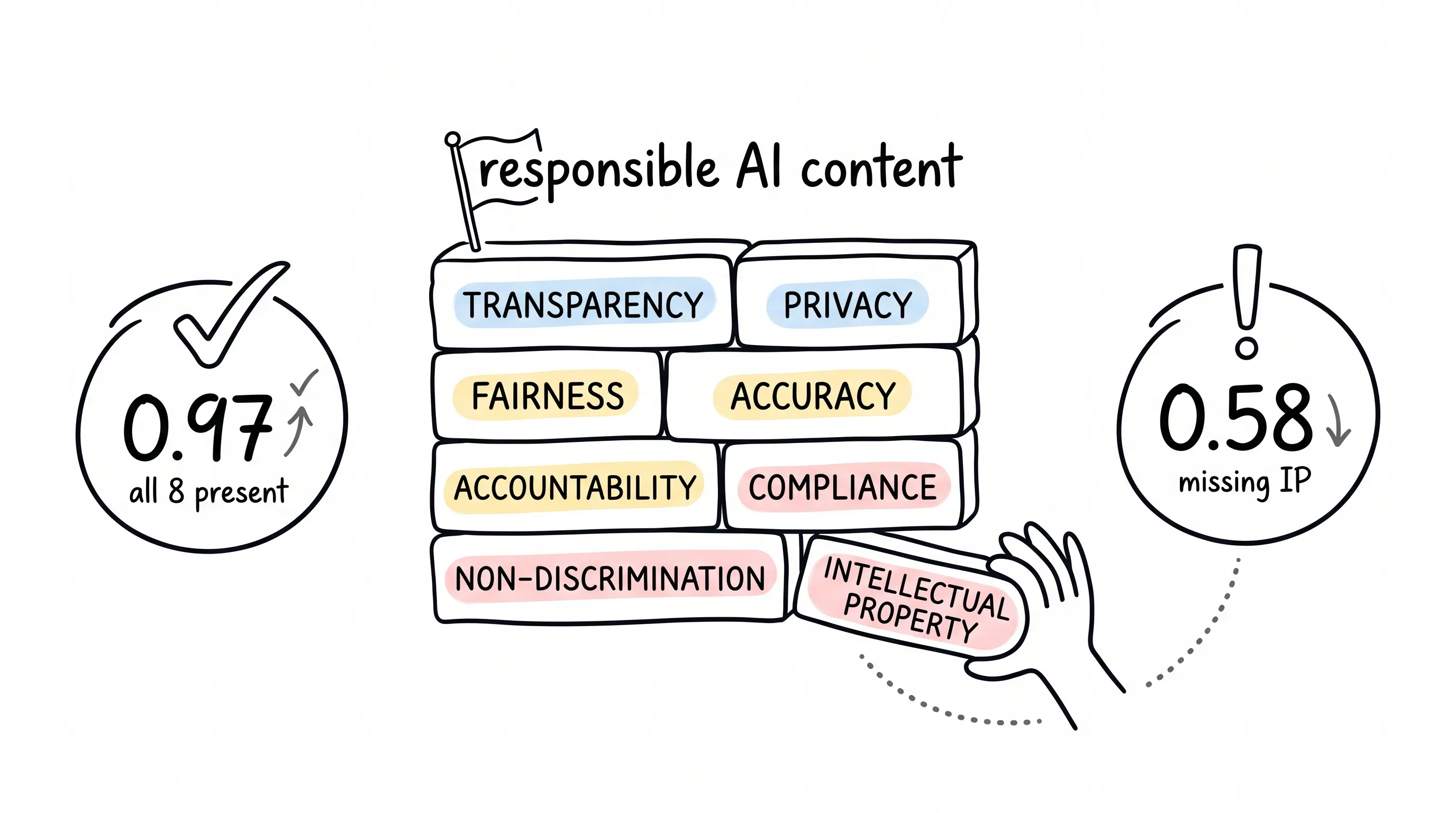
Twenty-six guidelines had all 8 conditions present, and every one of them pointed to the same outcome: using AI responsibly holds up. Consistency 0.97 — read that as "very solid."
The other 7 had all the other 7 conditions but lacked intellectual property. The outcome fell apart; consistency dropped to 0.58.
Same foundation, pull out one brick, and the house collapses. That brick is called intellectual property.
Let's run the numbers. What does a fall from 0.97 to 0.58 mean? Roughly, it's the difference between "this is basically settled" and "this is probably not going to hold." It's a hole that all 7 conditions in place couldn't plug — only filling in intellectual property plugs it.
Why this one condition, of all of them?
Think about what brand content actually is. When consumers trust you, a large part of that trust is believing there's something of yours in the words: your judgment, your taste. The moment AI-generated content lifts someone else's work or mimics someone else's voice, the first person hurt is the original creator. The second is you. Consumers start to feel that your content is borrowed. And borrowed things can't hold up a brand.
So the study's most striking conclusion is this: intellectual property — the condition most often missing from generic AI ethics guidelines — is precisely the fatal weak spot of brand content creation.
The Rules Differ from Place to Place
What's more, the same activity plays by different rules in different places.
The EU is the strictest. GDPR and the AI Act lay out intellectual property and data protection in explicit terms; copyright compliance is a hard requirement.
The US leans the other way. California's privacy law is all about data privacy; the protection of creative rights in AI-generated content barely gets a mention.
Japan takes yet another approach. Its 2019 Social Principles of Human-Centric AI emphasize innovation and human values, treating intellectual property more flexibly — as a direction to follow, not a legal red line.
What does that mean? What's routine in one place may be illegal in the next. Brand content goes out for the whole world to see — you have no excuse to pretend you didn't know.
Eight Conditions Are Actually One Thing
Some might think: fine, I'll focus on what matters — just nail intellectual property. Would that work?
No.
These 8 conditions are gears meshed together, not 8 independent switches.
Without transparency, accountability is hard. If you can't explain how the content was produced, who takes the blame when something goes wrong?
Without fairness, you slide toward discrimination — and straight into compliance red lines. In many places, anti-discrimination law is written down in black and white.
And privacy and intellectual property get tangled up together all the time. Personal data and proprietary content: protect one at the expense of the other — it happens constantly.
The study issues a specific warning: when all 8 conditions are only "partially met," the risks multiply.
So don't look for shortcuts. Eight conditions are one thing, not eight.
The Idea Underneath
The theoretical foundation of this study is a word that sounds very academic: deontology.
What's deontology? In plain English: some things you must do whether or not doing them benefits you. Because they're duties.
In deontology, protecting user privacy is a duty. Disclosing AI's involvement clearly is a duty. Respecting other people's creative work is a duty, too. It's not about the benefits. It's about right and wrong.
It's that simple.
On the Ground: 8 Things to Do
Enough theory — here's the part you can copy outright. The study ends with a checklist; here it is in plain English:
-
Disclose. If AI took part in creating the content, say so openly. A tag, a statement — either works. Internally, keep records of the tools and processes you used.
-
Guard your data. Don't feed customers' sensitive information into AI tools. Anonymize what should be anonymized, and go through your prompt history regularly to see what's been left behind.
-
Check for bias. Before publishing, give it a pass: any stereotypes? Anything that could offend a group?
-
Fact-check. Treat every statistic and every quote the AI gives you as possibly invented until proven otherwise. Critical facts must be verified by a human.
-
Assign accountability. For every piece of content AI touched, put in writing who reviews it, who signs off, who answers for it.
-
Stay compliant. Advertising law, copyright law, consumer protection — requirements differ by market. Train the team, and keep records of prompts and outputs.
-
Screen for discrimination. Before publishing, run a dedicated check across dimensions like race, gender, age, and disability.
-
Protect others' creative work. Don't use prompts to replicate copyrighted works, and don't imitate another brand's voice without permission. When choosing an AI platform, prefer ones with copyright-protection terms — and when in doubt, ask legal.
One Last Thing
As that tea meeting was wrapping up, I asked my friend: so what happened next?
He said every piece of content now goes through one extra step before it goes out: a human review. They still use the tools — but responsibility now sits with a named person.
I said: that's exactly right.
AI can write for you, draw for you, publish daily for you. What it can't do is take the blame for you.
The pen has changed hands. The responsibility for the words is still in your hands.
Here's wishing you AI that's fast and steady — and may you never have to pull a post again.
Continue reading
Related articles

Cross-Border Business: Time to Upgrade Your AI Toolbox
A learn article explaining how AI tools help cross-border e-commerce sellers clear five hurdles: language, regulation, logistics, payments, and fraud. It outlines a five-compartment toolbox, a five-step adoption path, and metrics such as conversion rate and CLV, while cautioning against over-reliance on AI.

AI Is Taking Over the Dirty Work of Social Media Marketing, One Task at a Time
This learn article outlines four social media marketing tasks AI can handle — audience analytics, content drafting and design, ad targeting and creative testing, and spam moderation — and cautions that taste, judgment, and data security remain human responsibilities.

AI Is Already This Good — Why Is Your Social Media Marketing Still Pure Manpower?
An overview of 18 AI tools for social media marketing, organized into six categories covering audience research, content creation, scheduling, comment and DM handling, ad management, and visual production, plus notes on personalization, prediction, and emerging trends.