
Uploading Ads Is the Lowest-ROI Task in the Media-Buying Workflow
An article on the launch-day problem in media buying, where manual ad uploading consumes team time. It describes bulk launching via official platform APIs, a paused-launch review flow, saved naming and UTM rules, and an AI-drafts-humans-approve workflow.
A few days ago, I had dinner with a friend who runs a cross-border brand.
His team is a dozen or so people, and they burn tens of millions of dollars a year in ad spend across Meta, TikTok, and Google. I asked him: what do your media buyers dread most, day to day?
I expected him to say creative, or the algorithm, or which channel has the cheapest traffic.
He said: uploading.
The creative didn't come together until Friday night, and the launch date was locked for Monday morning — immovable. So the whole weekend, the team sat in the ads backend building campaigns one by one. Naming them, pasting links, picking placements, filling in UTMs. Three hundred ads. By hand.
I was taken aback. It sounded so trivial — hardly something worth whole weeks of actual human beings' time.
But when I thought it over seriously, and looked at the state of this industry, I found something fascinating: in the media-buying business, buying traffic was automated long ago, and reporting too. Only the most unglamorous step of all — stuffing ads into the backend — still ran on hands.
What is the launch-day problem?
If you buy media, you know it by heart.
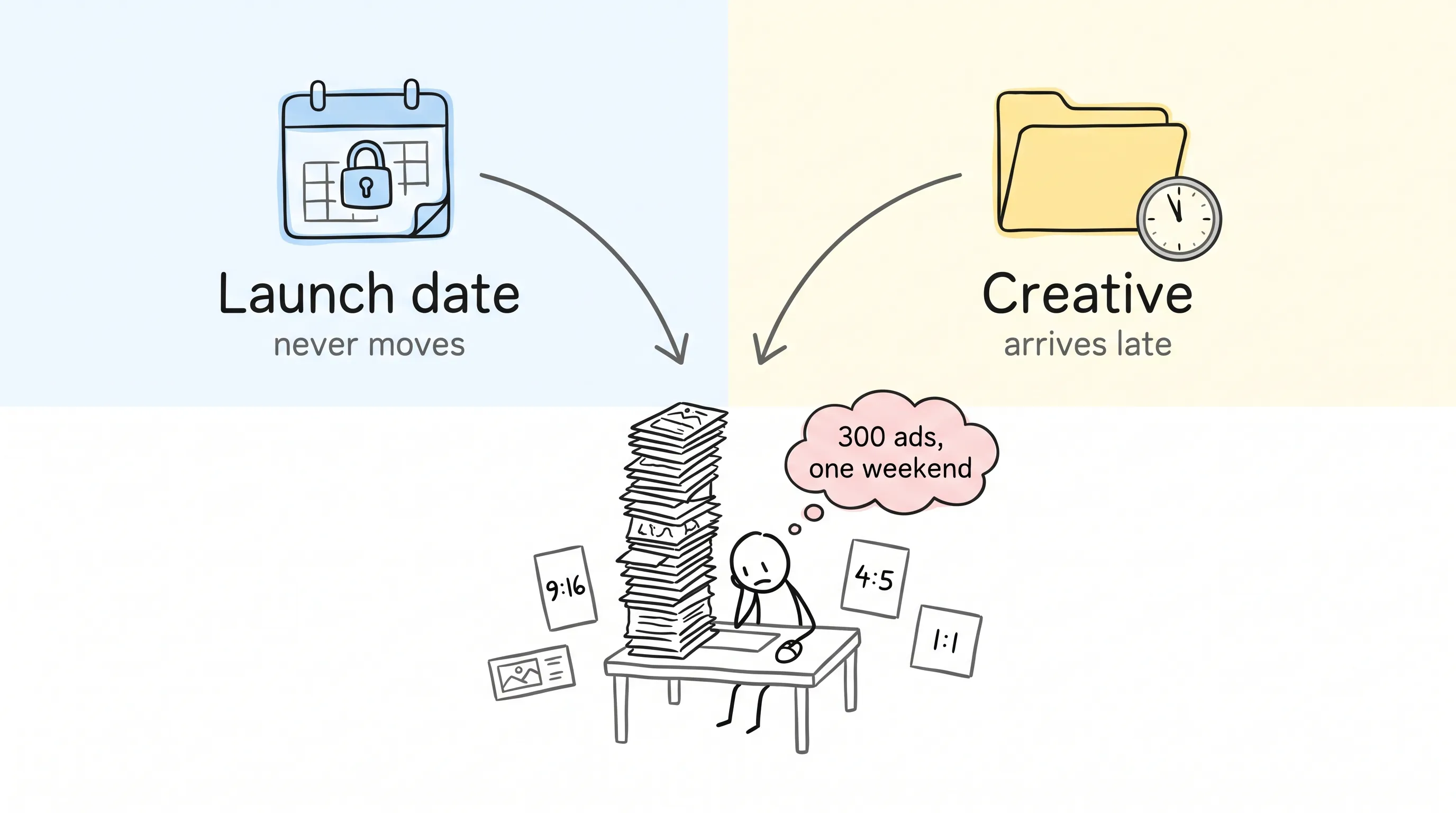
The creative comes from the content team, and it's often late. The launch date is set by the client or a major promo, and it never moves. Stuck in the middle, the media-buying team has to turn several hundred pieces of creative into several hundred ads in a single weekend — uniformly named, links correct, placements complete.
A single ad looks simple. The sizes have to be right — 9:16, 4:5, 1:1, not one can be missing. Links have to be checked one by one; get one wrong and you're burning money for nothing. Naming has to follow the account's conventions, or the reports become unreadable. UTMs have to be attached correctly, or attribution turns into a muddled mess.
None of this work requires creativity.
But every bit of it requires a person.
This is the launch-day problem: creative always arrives late, and launch dates are never late.
What is bulk launching?
Imagine shipping parcels. For one package, hand-writing one waybill is fine. What about three hundred?
Bulk launching is putting a single master waybill on the whole shipment.
There's a tool on the market called AdManage that does exactly this: on one screen, you drag in creative from your cloud drive all at once, pick the accounts, set up ad sets, copy, and naming rules; the system automatically groups the 9:16, 4:5, and 1:1 sizes, applies the naming conventions, attaches the UTMs, and then pushes everything with one click to Meta, TikTok, Google, Snapchat, Pinterest, Reddit, X, LinkedIn, and more — 15 channels in total.
Two details strike me as genuinely smart.
First, it doesn't run on shared logins and passwords. It is an official Meta Marketing Partner, and all 15 channels go through each platform's official API. In a tooling category as mixed as this one, that's a serious barrier to entry.
Second, it lets you pause before you launch. A few hundred ads get built in bulk and all stay in paused status; you go into the platform backend and verify every one with your own eyes, and only then switch them on with a single click. Like the first product off a new production line: quality check first, then scale.
The vendor confident enough to let you inspect the goods first is the one with real confidence.
How much is this worth? Let's run the numbers
First, the big ledger.
Today, more than 1,300 teams and over 10,000 ad accounts run on it, handling more than $8 billion in Meta ad spend a year, with over 7.7 million ads launched to date. In the last 30 days alone: more than 1 million.
Now the small ledger — yours.
Pricing starts at £199.99 per month, charged by the number of accounts, not as a cut of ad spend. If you skipped it and tried to assemble this capability yourself, you'd need a bulk upload tool, a creative analytics suite, a competitor ad library, an AI image generator, a comment auto-hiding tool, plus an automation rules engine. Someone priced out that six-piece set in late October 2026: £2,000 a month or more.
And there's one detail worth chewing on: each of those six tools, taken on its own, does its single job more deeply than AdManage does. But does your team need six tools? What it needs is six jobs done.
Now run it again from a headcount perspective. Assume 500 ads a month, 3 accounts, and one media buyer on a £45,000 salary: the repetitive setup before each launch eats roughly £23,000 a year — about 36% of a full-time role. Hand it to the tool instead, and it's £6,000 a year.
Tools save you money. Process saves you people.
More valuable than saving money: banking the craft
Everything above is about "fast." But once enough people use it, what really makes them stay is something else.
There's a small subscription e-commerce brand built around football shirts, called Shirt in a Box. Their founder once said something that stings: uploading ads is the lowest-ROI task in our workflow. Once they removed that task, the team got to work on the things that actually matter. Today they launch more than 1,000 ads a month across two markets, without adding a single hire.
The clever part is how they did it: they baked their naming conventions, UTM rules, and default settings into the system, once. When the second batch of ads went live, there was no configuring from scratch. You tune the first batch by hand; by the thousandth batch, it stands guard for you.
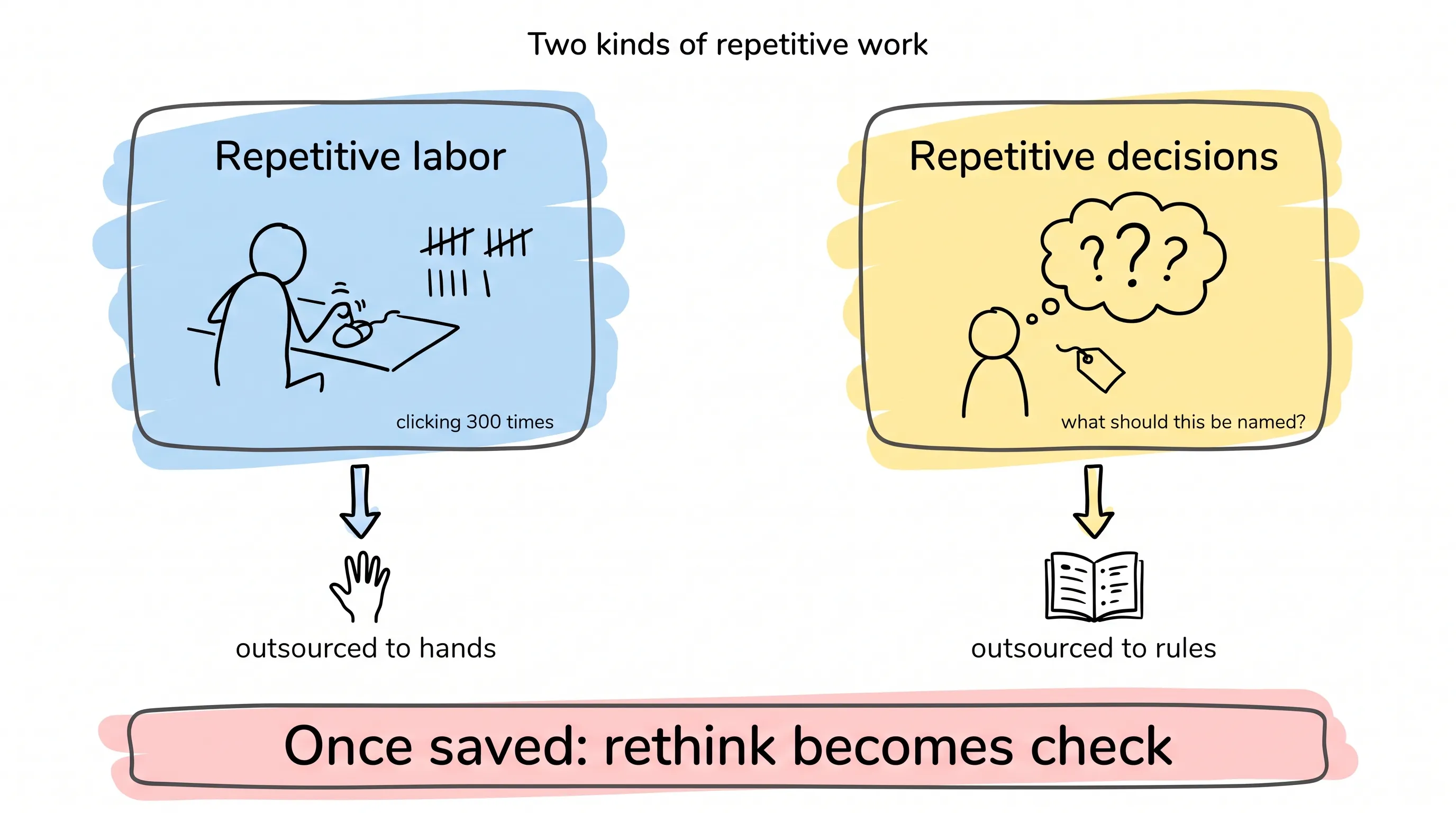
The principle underneath goes like this. Repetitive work comes in two kinds: repetitive labor, like clicking 300 times; and repetitive decisions, like what this ad should be named. What wears people out is mostly the second kind — because labor can be outsourced to hands, but decisions can only be outsourced to rules.
Once a rule is saved, every new launch turns from "thinking it through all over again" into "checking it over."
The numbers back this up. MoneyGram, the cross-border remittance company, launched more than 7,400 ads and saved 866 hours of setup time. A two-person growth team shipped more than 3,200 Meta ads in six weeks. And one company ran the numbers internally: 80 to 100 hours saved every month.
Eighty to a hundred hours — what does that mean? It's half a full-time employee, free, every month. An employee who takes no salary, no leave, and never slacks off.
So where does AI fit into this?
It's 2026 — you'd be embarrassed to ship a product without mentioning AI. This tool has AI in it too, but the way it's used feels refreshingly restrained: AI drafts, humans sign off.
In the dialog box, you can say: take the approved creative from this folder in my cloud drive and build me a draft — use this account's naming and UTM defaults, group the sizes, and don't publish anything yet. The AI lays the draft out. You confirm accounts, links, and copy one by one, and only when you're satisfied do you let it go live in paused status, for one last human check.
The more advanced play is to plug it, via its API, into the general-purpose AI assistant you already use, and drive your accounts, drafts, and reports directly.
Media buying means spending money. One misconfigured ad burns real cash. The right way to put AI to work: it drafts, you sign.
So is your account safe?
The question every media buyer asks instinctively: will bulk operations get my account shut down?
The answer comes in three layers.
Layer one, already covered above: official partner, official APIs, no data scraping, no touching your passwords.
Layer two, data and compliance. Data is encrypted in transit and at rest, and a data processing agreement is signed. Its SOC 2 Type II audit is still in progress; once the report is complete, it can be reviewed under NDA.
Layer three is that "launch paused" flow itself. It guarantees that before any real money is spent, you always get the chance to inspect every single ad with your own eyes.
By the way: the company was founded by two brothers, both career media buyers. The people building tools for media buyers are media buyers themselves. Whether a tool in this category truly nails the pain points often hinges on exactly this.
Finally, back to that dinner
Toward the end of the meal, my friend asked me: is this something every media-buying team goes through sooner or later?
I said: most likely, yes.
At bottom, the division of labor in media buying is changing. What humans should do is come up with ideas, read the data, make judgment calls. What machines should do is name ads, paste links, click mice. The day the smartest person on your team is still working overtime over a mislabeled UTM, that's not diligence. That's waste.
Later I heard his team adopted the tool. Day one: half an hour, more than 80 ads uploaded. His exact words, in the message he sent me: "This is a game changer."
Here's hoping your team, too, gets its mouse back soon — and keeps the brains.
Continue reading
Related articles

Did the Money You Spent on AI Marketing Ever Come Back?
A guide to measuring AI marketing ROI across three layers: ad reports, sales pipeline, and the financial ledger. Covers metrics such as ROAS and CPA, eight dashboard metrics, industry benchmarks, and common measurement mistakes.

How to Pick a Creative Automation Platform: First, Figure Out What These Eleven Actually Do
A learn article sorts eleven creative automation platforms — including Bannerflow, Celtra, Smartly.io, and Storyteq — into four functional groups and proposes five evaluation questions covering publishing reach, automation depth, ease of adoption, team fit, and verifiable evidence.
How to Choose a Creative Ad Tech Platform: Put 8 Side by Side, and the Gap Isn't Features — It's How Far the AI Actually Goes
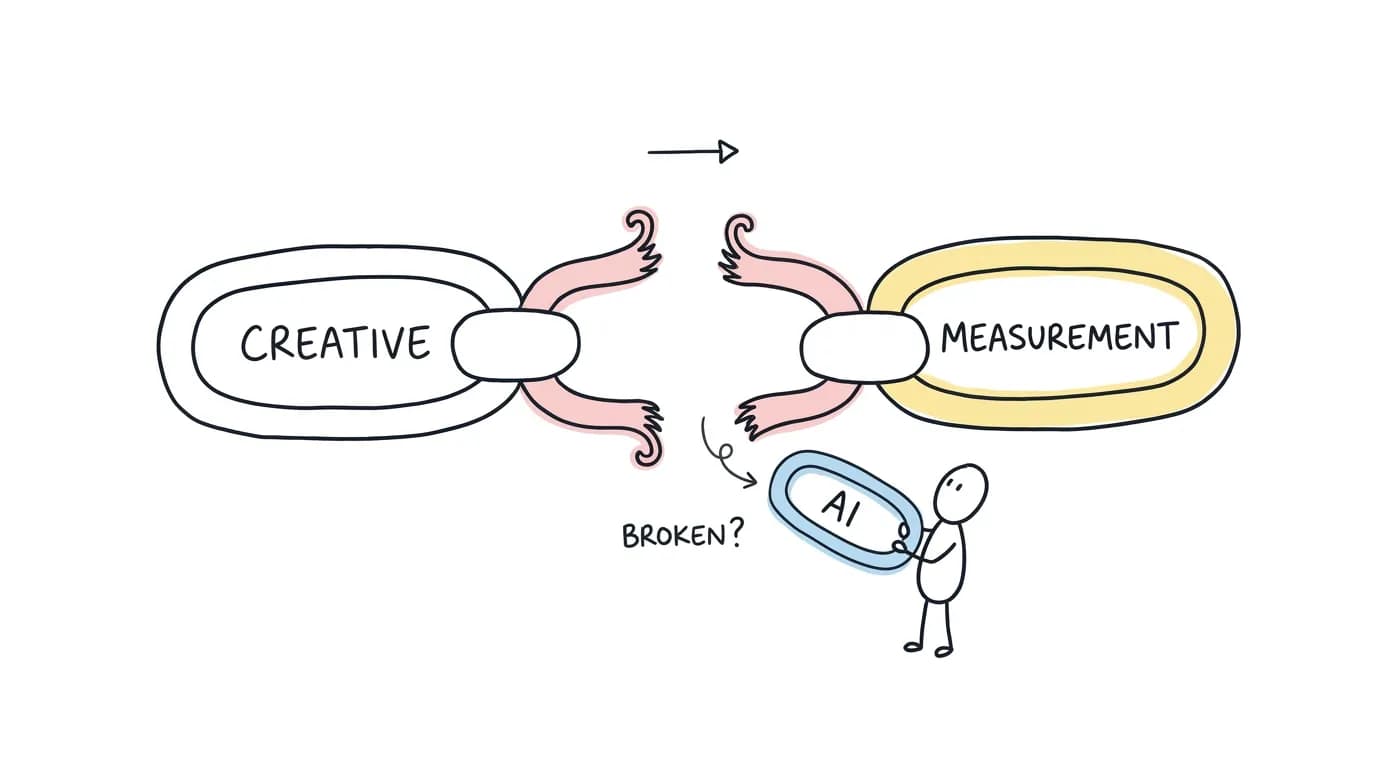
This article compares eight creative ad tech platforms—Innovid, Smartly, Clinch, Jivox, Celtra, Bannerflow, Google CM360, and VidMob—on channel coverage, creative production, ad serving, measurement, and AI agent capabilities. It suggests matching the platform to the broken link in the creative-to-media chain.