
Upfluence: An Influencer Marketing Platform That Bets Everything on Shopify
An analysis of Upfluence, an influencer marketing platform founded in 2013 that built native Shopify integrations for promo codes, affiliate tracking, and attribution, and how its ecosystem positioning compares with GRIN, Aspire, and IZEA.
A while back, a friend who runs a DTC brand invited me to dinner. His store lives on Shopify, selling small home goods with tens of millions in annual revenue, and lately he wants to get serious about influencer marketing. He asked me: with so many tools out there — GRIN, Aspire, IZEA... — which one should I actually pick?
I said, don't rush to compare feature tables. First answer me one question: what soil is your business rooted in?
He paused for a beat.
What do you mean?
Look — that wave of DTC brands from 2018 to 2022, Allbirds, Glossier, Warby Parker, Casper... almost without exception opened their e-commerce on Shopify. For these brands, influencer marketing means very concrete tasks: generating promo codes, tracking affiliate links, doing attribution, calculating conversions, settling buyers into their own audience.
If there's a layer between your marketing tool and Shopify, every one of these tasks is a struggle.
There's a company, founded in 2013, called Upfluence. Early on, it placed a bet on one judgment: creator marketing performance data should grow natively together with the e-commerce platform — not stand beside it as a plugin.
That judgment looked unremarkable at first. Later, when DTC brands gathered wholesale onto Shopify, it became a structural advantage.
What is a structural advantage? An advantage that lives in the structure — something others can't copy in the short term.
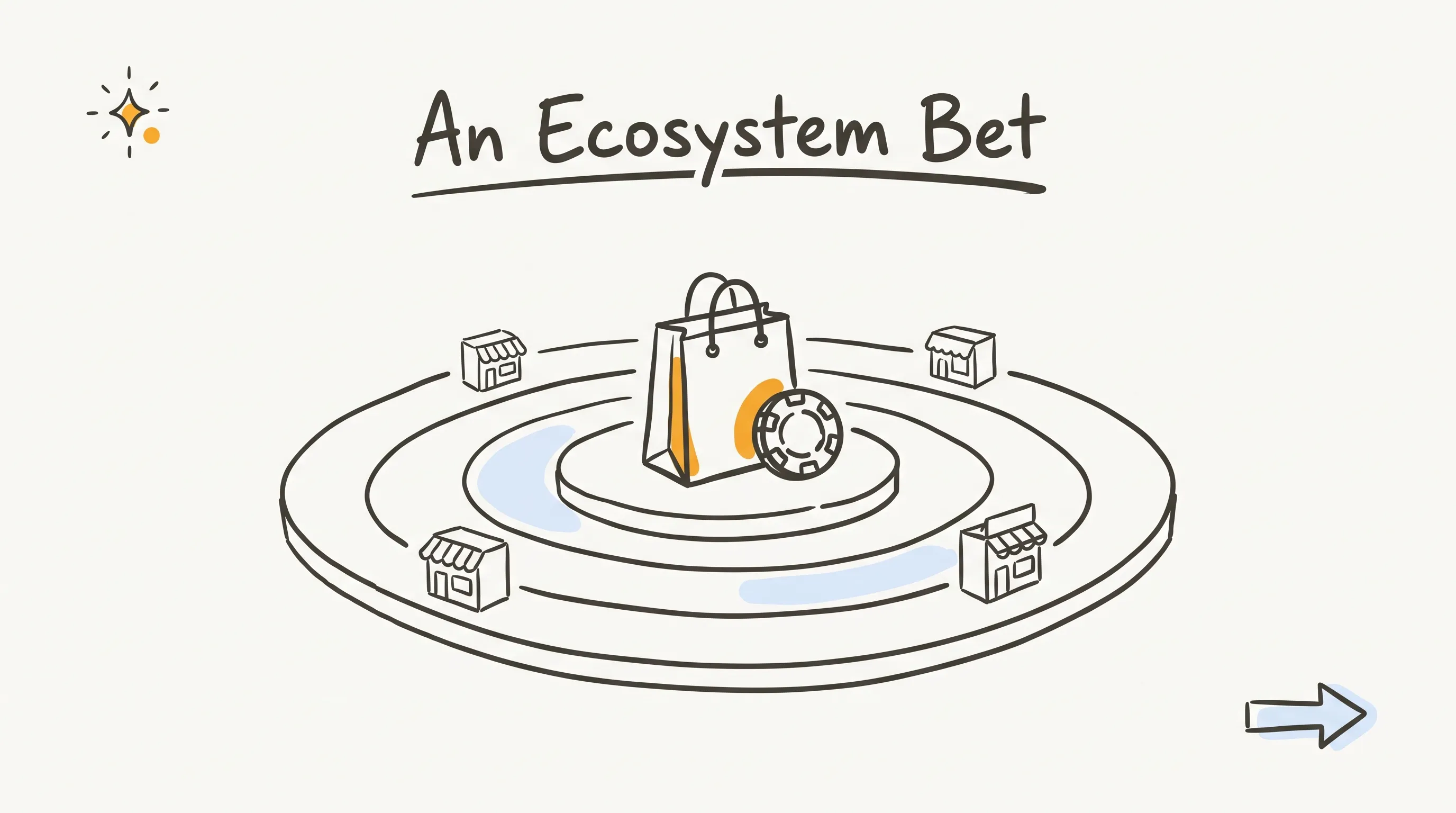
Choosing a marketing tool is, at bottom, choosing an ecosystem.
What Does "Growing Inside the Ecosystem" Mean?
Think about it: a growth team on Shopify needs marketing tools. Where do they look?
Most likely the Shopify App Store, or the ecosystem's validated partners.
It's like walking through a mall. You wouldn't make a special trip to the wholesale market for a pair of socks — whatever the mall has, you buy in passing.
Upfluence embedded itself deep into the Shopify ecosystem — which means placing its shelf right on the mall's main thoroughfare. Brands stroll by and stroll right into it.
And this advantage compounds. The bigger the Shopify ecosystem, the more foot traffic on that main thoroughfare, the more valuable its position.
Squeezing the Bubble Squeezes Out Customers Instead
Some will say: didn't that 2022-to-2024 DTC shakeout cripple the Shopify ecosystem?
Quite the opposite.
Those years, a pile of early DTC brands either collapsed, restructured, or gave up on pure DTC altogether. Sounds brutal, right?
But look from another angle: who survived?
The ones whose unit economics penciled out — the veterans whose growth toolbox was sharpest.
These people stayed on Shopify, still needing influencer marketing infrastructure natively wired to the platform. What the bubble squeezed out was customer quantity; what it left behind was customer quality.
Upfluence's customer base swapped its blood naturally — from trend-chasers to people who count the money.
The bubble killed brands. The businesses survived.
Paris Plus New York: One Card, Two Hemispheres
Upfluence has another uncommon trait: it's half in Paris, half in New York.
Since founding in 2013, European business runs from Paris, American business from New York — both fully staffed operations, not office-letterhead props.
What good is that?
One: compliance. European brands face GDPR, the EU Digital Services Act, and each country's own consumer protection rules. Dealing with a team that swims in those rules daily, versus one that only knows the American market — the pitfalls you step into are entirely different.
Two: the influencer database. Build a database on a purely American platform and your eyes hold mostly American influencers. In Upfluence's database, European influencer density is visibly higher. If you're a European brand looking for local creators, your filtering space is far larger.
One card, two hemispheres. That's something most purely American peers can't offer.
Where Does It Stand?
So where exactly does Upfluence sit? Let me set up a few reference points.
Serving the same mid-market, IZEA's route is marketplace matching plus managed services — the old-school play. Upfluence sells Shopify-integrated software — it competes on depth.
GRIN and Aspire also serve DTC brands, but the three walk different roads. GRIN digs deep into the P&L — CAC, LTV, attribution, conversion tracking, all the way down. Aspire wins on match speed — brands find creators, fast. Upfluence competes on how tightly it interlocks with the Shopify tech stack: promo codes, affiliate tracking, attribution, conversion measurement, post-purchase audiences — all running natively inside the system.
And industry attention? One firm has counted each platform's share of citations in AI answers: Upfluence holds 2.9%, ranking 11th. Ahead are CreatorIQ, Aspire, GRIN and the other heads; behind trails a long line of new entrants.
Not at the tip of the tower. But standing very steady.
An ecosystem player doesn't win on volume. It wins on stickiness.
Back to That Dinner
Near the end of that meal, my advice to my friend was: stop reading feature tables. Look at where your lifeline is rooted.
Your store is on Shopify. Your influencer marketing tool had better grow on Shopify too.
He nodded and closed the seven comparison spreadsheets on his phone.
For me, what's really worth pondering in the Upfluence case isn't the company itself — it's the principle behind it:
In a converging ecosystem, embedding yourself one step early beats everything.
Maybe your own business is standing at some ecosystem's doorstep right now. Walk in, or stand outside watching? That question is worth thinking about.
Continue reading
Related articles

Cross-Border Business: Time to Upgrade Your AI Toolbox
A learn article explaining how AI tools help cross-border e-commerce sellers clear five hurdles: language, regulation, logistics, payments, and fraud. It outlines a five-compartment toolbox, a five-step adoption path, and metrics such as conversion rate and CLV, while cautioning against over-reliance on AI.

AI Is Taking Over the Dirty Work of Social Media Marketing, One Task at a Time
This learn article outlines four social media marketing tasks AI can handle — audience analytics, content drafting and design, ad targeting and creative testing, and spam moderation — and cautions that taste, judgment, and data security remain human responsibilities.

AI Is Already This Good — Why Is Your Social Media Marketing Still Pure Manpower?
An overview of 18 AI tools for social media marketing, organized into six categories covering audience research, content creation, scheduling, comment and DM handling, ad management, and visual production, plus notes on personalization, prediction, and emerging trends.