
Up at 2 A.M. Scheduling Content Calendars? Time to Let AI Do the Work
A learn article introducing AI social media marketing: why data volume makes it necessary, four underlying capabilities, seven practical use cases, a tool list, key limitations, and future trends.
A while back, a friend of mine who runs a cross-border e-commerce business took me out to dinner. Halfway through the meal, he pulled out his phone and showed me: post after post, scheduled all the way to next Wednesday.
Last week, he'd stayed up until 2 a.m. just to build the content calendar for his three platforms.
I said, that's not marketing. That's working for the algorithm.
He froze for a second and didn't reply.
I kept going: most of this work, AI can do for you. Want to bet?
Of course he didn't believe it. So that day, I walked him through the whole thing, start to finish. Today, I'll walk you through it too: What is AI social media marketing? What can it actually do for you? And what can it never do for you?
1. Why Is AI Non-Negotiable?
Start with a question: how much data does social media generate every second?
Likes, comments, shares, scrolls, dwell time, clicks. Every single action is data.
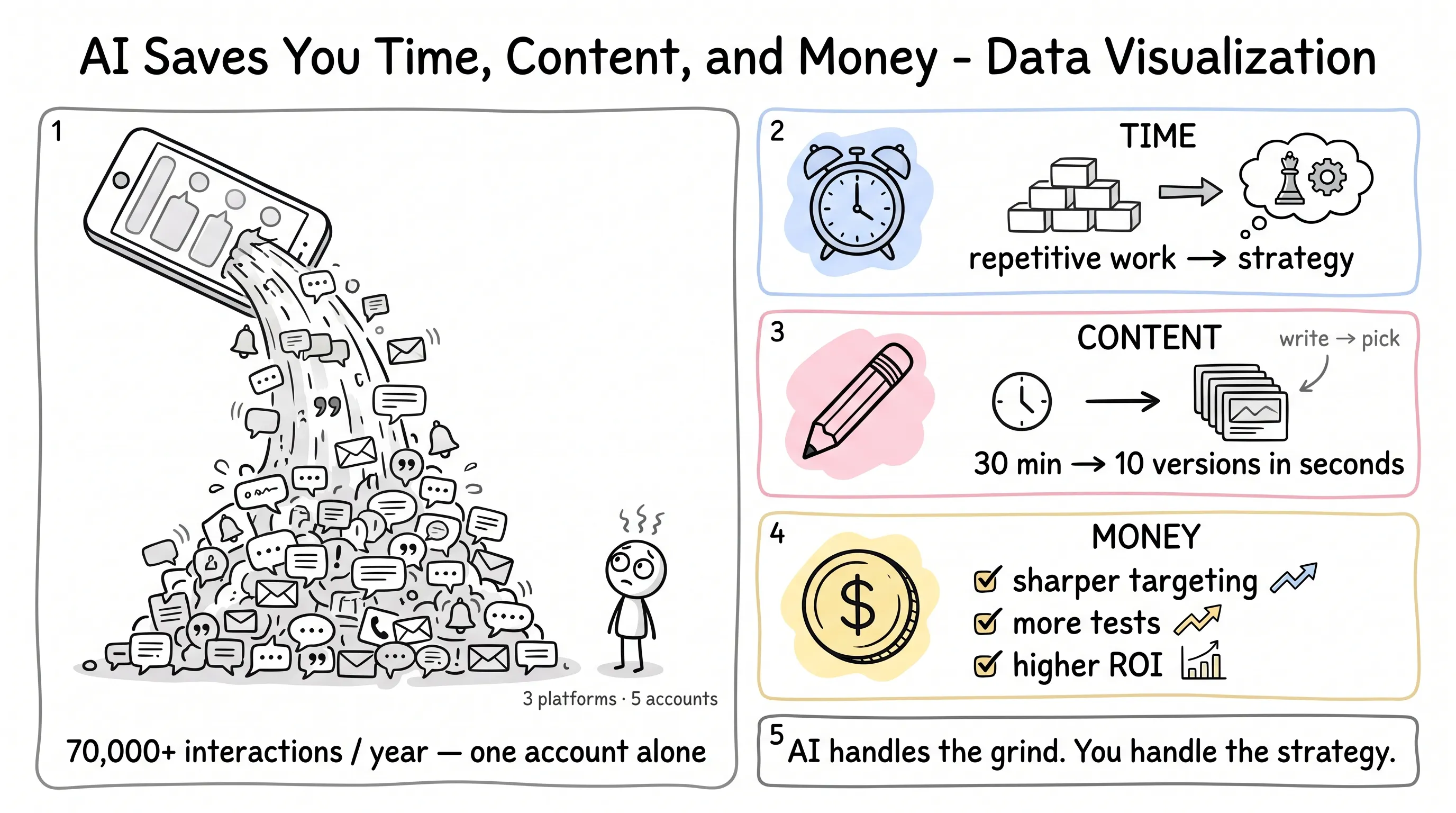
Do the math. A mid-sized account gets, say, two or three hundred comments and DMs a day. That's not much, right? Multiply by 365 days, and that's more than seventy thousand a year. And that's one account. What if you've got three platforms and five accounts?
Reading every item, let alone analyzing it, is impossible.
There's your answer. Nobody is chasing the AI trend for fun. The data volume leaves you no choice.
What exactly does it save you? Let me run the numbers three ways.
First, time. Scheduling, posting, watching comments, writing weekly reports — AI takes all of that repetitive work off your hands. And what do you do with the time you save? Think strategy. That's the job that belongs to humans.
Second, content. Writing a single piece of copy used to take half an hour. Now AI hands you ten versions in seconds. You go from someone who writes to someone who picks. And picking is always faster than writing.
Third, money. Sharper targeting, more versions tested, so the same ad spend comes back with more. How does ROI go up? Like that.
2. How Does It Work? Four Underlying Capabilities
You might ask: is AI really that powerful? What is it actually built on?
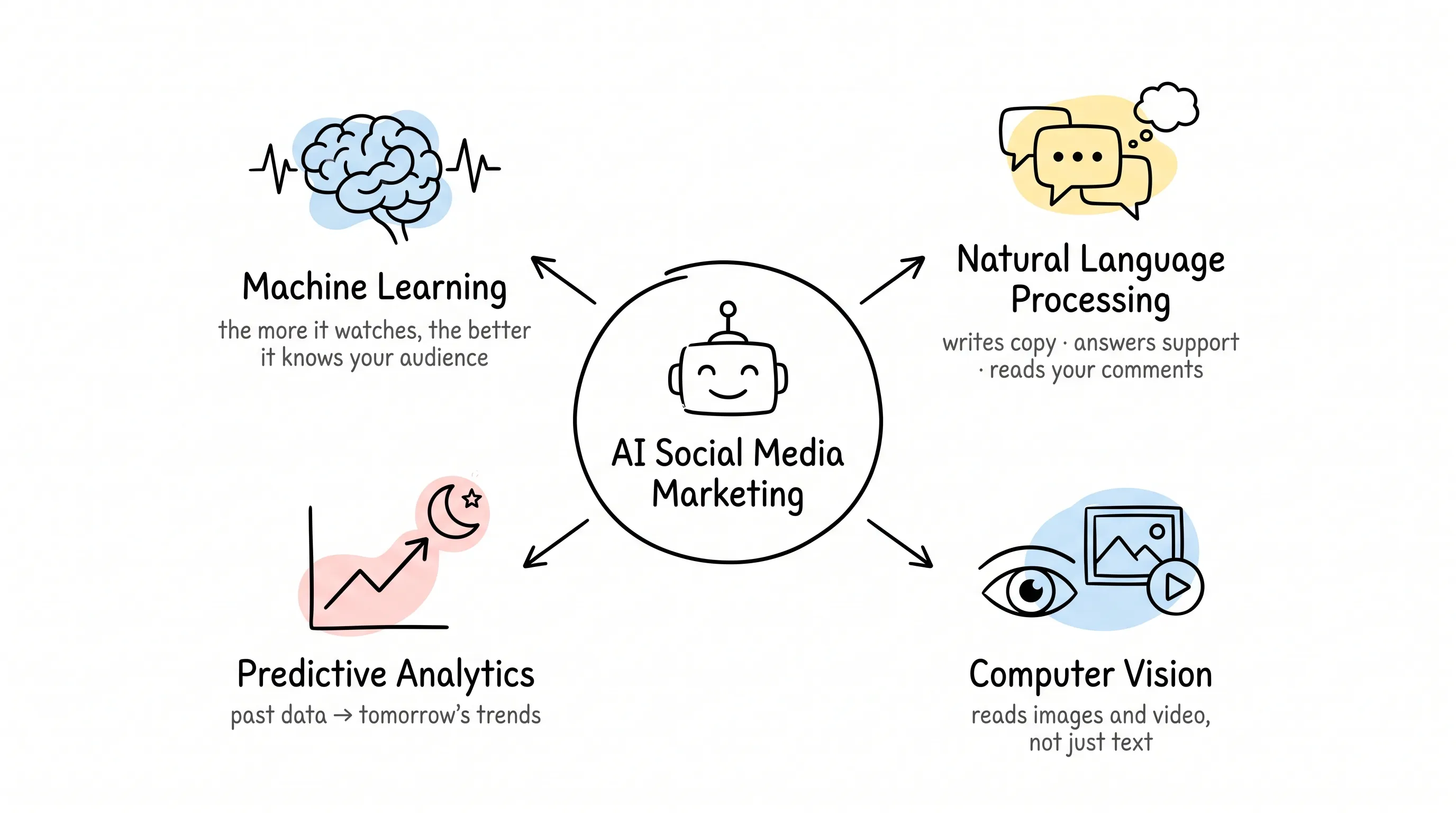
Four things. Let me translate each one into plain language.
First, machine learning. What is machine learning? The more it watches your audience, the better it understands them. Like a seasoned doctor who has taken enough pulses to read them right.
Second, natural language processing. Machines can now understand human language — and produce it. So they can write copy, run customer service, and read through your comment section to tell you whether people are praising you or roasting you.
Third, predictive analytics. Dig through historical data, project tomorrow's trends. When your followers are most active, which topics will take off next month — it gives you a call that's close enough to act on.
Fourth, computer vision. Machines don't just read text anymore; they understand images and video. Which of two covers gets more clicks, and why — it can show you the mechanics behind it.
3. On the Ground: Seven Places It Helps
Enough theory. Let's talk specifics. I counted the places this technology actually earns its keep — seven of them.
One, writing content. Copy, video scripts, topic ideas — it drafts, you bring the soul. Your content calendar never gaps again.
Two, timing. Stop guessing when your followers are online. AI reads the historical data and tells you. Guessing is gambling; reading data is playing chess.
Three, listening. Who's mentioning you, who's praising you, who's roasting you, what your competitors did today — AI keeps watch for you. The industry term is social listening. Sounds mystical, but really it's just a scout that never sleeps.
Four, sentiment. Thousands of comments, automatically sorted into positive, negative, and neutral. Want to know how your brand reputation is doing? No need to pay anyone to read every line — you see it at a glance. If a negative flare-up starts, you handle it that same day.
Five, customer service. Chatbots on Messenger, Instagram, and WhatsApp — online 24/7, instant replies. A customer shows up at midnight with a question and doesn't have to wait until morning. And your support costs go down.
Six, advertising. Find the right audience, allocate budget, test several creative versions at once, predict performance. Every dollar, well spent.
Seven, personalization. It reads purchase history, browsing trails, interaction habits — and shows each person something different.
Let me linger on number seven.
Consumers today have been spoiled rotten by the platforms. If what you push at them isn't relevant, they swipe away in a second without looking back. AI personalization is, at its core, treating every user differently.
Yes — differently. And here, that's a compliment.
4. A Quick Tool List, Since You Asked
By now someone is surely asking: which tools, exactly?
Here are the mainstream ones, laid out by what they're for.
For copywriting and idea generation, ChatGPT — frighteningly fast. For images and design, Canva AI — you describe the idea, it produces the finished piece. For scheduling and analytics, Hootsuite and Buffer, both of which will free up your hands. For audience analysis and engagement monitoring, that's Sprout Social. And for producing content at volume, Jasper AI — it never runs dry.
The tools themselves don't matter much. What matters is knowing this: find your bottleneck, and plug that first.
5. But Every Coin Has a Back Side
Hold on before you get too excited. AI can do a lot — but there are four things you need to keep in mind.
First, it has no soul. What AI writes is fast, and it sounds close, but the one note that truly moves people still isn't quite there. A brand's real warmth comes from your understanding of your users. That, AI cannot give you.
Second, data privacy. Using AI means using data. Where the data came from, how it's used — the compliance line is one you never cross. Not once.
Third, don't hand it everything. When every brand uses AI and optimizes toward the same signals, everything starts to look the same. Differentiation is exactly what you must defend with your own hands.
Fourth, there's a learning curve. Tools aren't buy-and-done. Your team has to train, your processes have to adjust. Don't expect results the day after you sign up.
One-line summary: AI handles the efficiency. Humans handle the soul.
6. Where Is This Headed?
Now let's look further out.
Hyper-personalization will only get more aggressive. AI-generated video will keep multiplying. Voice search is territory you should claim now. And a new species is emerging: AI influencers, virtual brand ambassadors. No moods, no scandals to crash and burn, open for business 24/7.
Honestly, the first time I saw a brand selling products through a virtual avatar on a livestream, my reaction was two words: "No. Way."
This era is actually here.
7. Want to Start? Start Small
Last, one piece of honest advice for anyone ready to jump in: don't get greedy.
Start with AI writing copy and managing schedules — give it the most time-consuming work first. Once that runs smoothly, move on to the complex stuff: ad optimization, sentiment analysis. Run it, watch the data, adjust when the numbers dip. Tools iterate fast; just keep learning.
Back to That Dinner
After that dinner, my friend went home and handed his content scheduling over to AI.
Last week he told me: he's asleep by 10 p.m. every night now, and his numbers are better than before.
See — tools never steal your business. They steal your excuses.
May every dollar of your ad spend be a dollar well spent.
Continue reading
Related articles

Cross-Border Business: Time to Upgrade Your AI Toolbox
A learn article explaining how AI tools help cross-border e-commerce sellers clear five hurdles: language, regulation, logistics, payments, and fraud. It outlines a five-compartment toolbox, a five-step adoption path, and metrics such as conversion rate and CLV, while cautioning against over-reliance on AI.

AI Is Taking Over the Dirty Work of Social Media Marketing, One Task at a Time
This learn article outlines four social media marketing tasks AI can handle — audience analytics, content drafting and design, ad targeting and creative testing, and spam moderation — and cautions that taste, judgment, and data security remain human responsibilities.

AI Is Already This Good — Why Is Your Social Media Marketing Still Pure Manpower?
An overview of 18 AI tools for social media marketing, organized into six categories covering audience research, content creation, scheduling, comment and DM handling, ad management, and visual production, plus notes on personalization, prediction, and emerging trends.