
Treasure AI Dropped Two Big Moves Yesterday, Taking Aim at Marketers' Two Most Stubborn Headaches
The article reports two Treasure AI announcements from its Agentic World conference: Personalization Studio, which lets marketers build real-time on-site personalization on top of its unified customer data, and email pricing billed by customer clicks instead of messages sent.
Yesterday, at its own annual Agentic World conference, Treasure AI announced two things in one go.
A new product, called Personalization Studio. A new pricing model, charging by the click.
On their own, each one is ordinary enough. Put them side by side, and things get interesting — because they each hit one of the two most stubborn headaches of marketing teams.
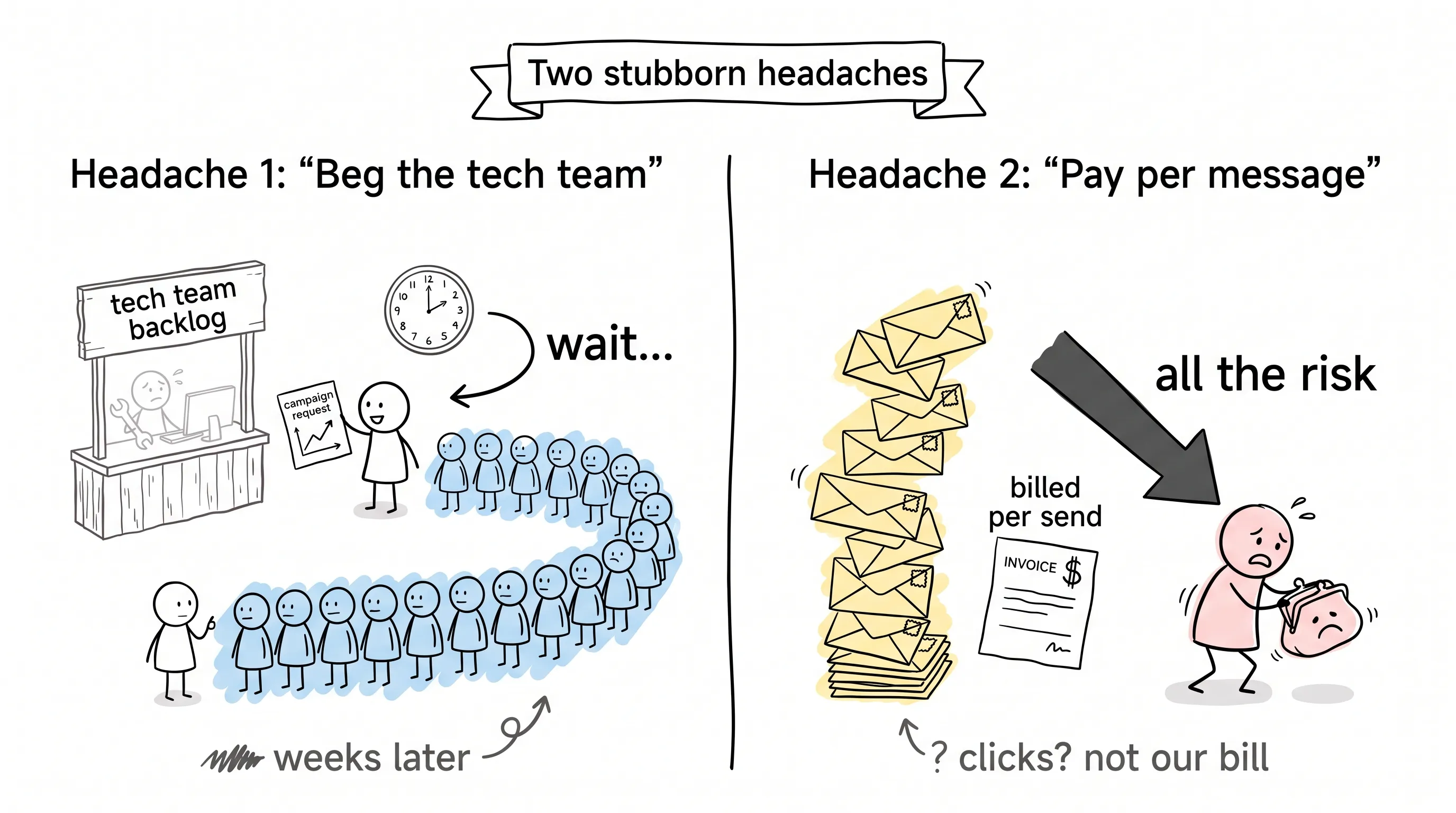
The first headache: to run a campaign, you first have to beg the tech team
What is real-time personalization?
It means the user is on your site right now, and the page changes for them right now. They've just added a product to the cart but haven't checked out yet — and the page immediately slides a coupon across.
Sounds lovely. But think about how this actually happens at most companies.
The marketing manager writes up a request, gets it queued in the data and web teams' backlog, and then waits — for a slot, for integration testing, for launch. By the time everything is ready, the user may have forgotten the very product they originally had their eye on.
Why not simply let marketers do it themselves?
Because most personalization tools on the market are "standalone plugins." They need their own separate data connections, their own separate profile storage — every step stuck in the tech team's hands.
Treasure AI's Chief Product Officer Rafa Flores put it bluntly: you can't do real-time personalization sitting inside a data warehouse, because a data warehouse can't do real-time in the first place.
What Personalization Studio does is move this work back onto marketers' own computers. It sits on top of Treasure AI's unified customer data, is part of the company's own personalization AI suite, and underneath it all is the marketing platform they call the Agentic Experience Platform (AEP).
The underlying logic is to blend two kinds of data together. One is slow data: user segments, membership tiers, purchase history. The other is fast data: the browsing and clicking happening right now. Slow data answers "who is this person"; fast data answers "what do they want at this moment." Put the two together, and the page transforms in under a second.
Flores gave a number: a marketer walks in and builds a campaign with personalization in 10 minutes.
Ten minutes. Not long ago, that might have been one full scheduling cycle.
The second headache: email billed per message, with all the risk on you
This one is even more interesting.
The traditional billing logic is simple: the more you send, the more you pay. As for whether anyone clicks or buys after the send — that has nothing to do with the bill.
Put plainly, the platform charges for the work, not the outcome, and all the performance risk sits on the marketer's shoulders.
This time, Treasure AI changed the game: email is billed by the customer's actions — clicks, for instance — rather than by the number of messages sent.
What does billed-by-the-click mean? Fewer clicks, less money collected; clicks, more money collected.
Sound a bit familiar? Right — it puts itself and its customers in the same boat.
Flores says this pricing is essentially a wager — a bet that Treasure AI's intelligence can genuinely bring customers better results. His exact words: "We're betting on the click rate."
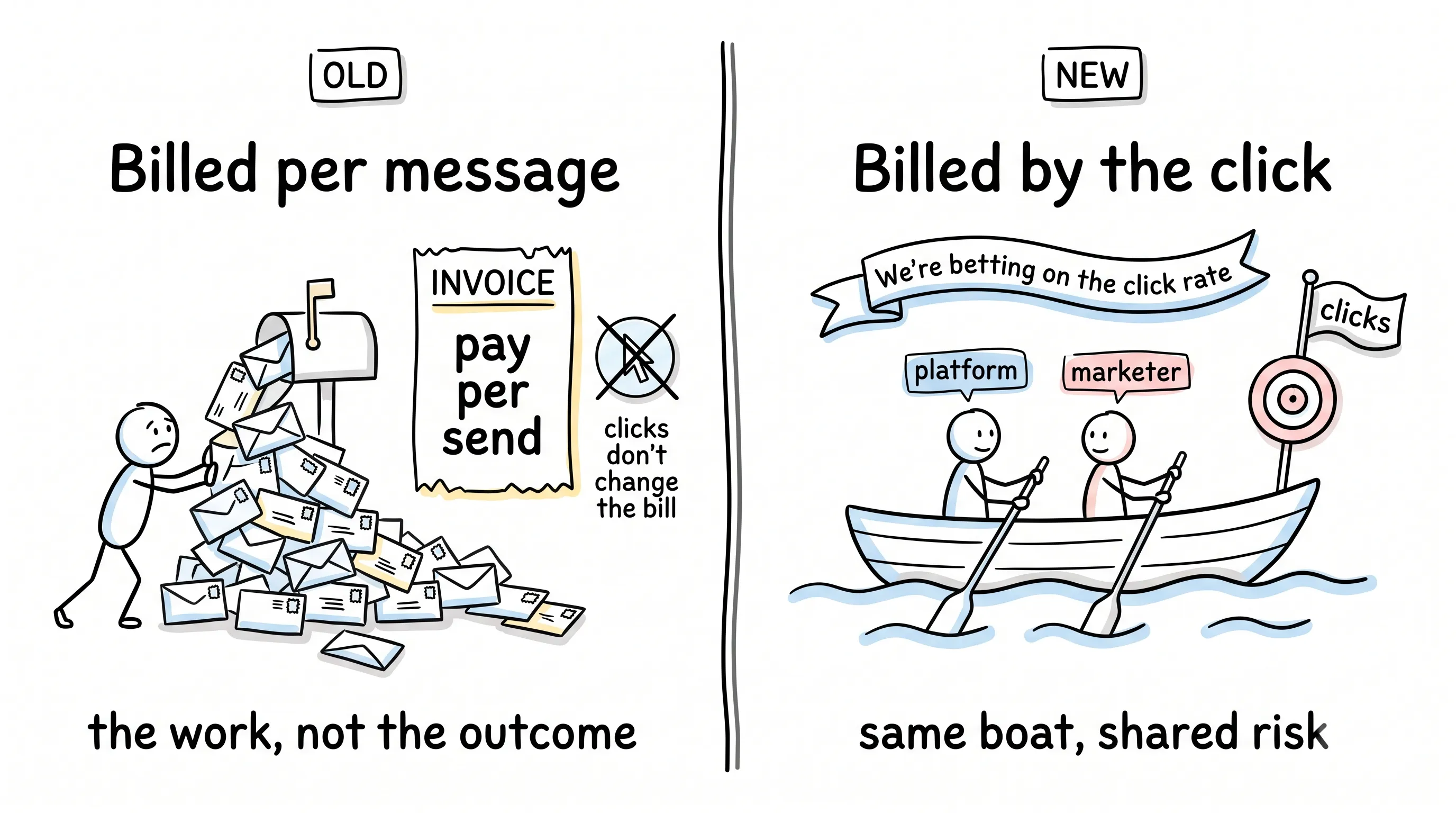
I especially love that line. Daring to say "we're betting on the click rate" out loud is laying your cards face-up on the table: I'm confident in what my product delivers — that's the only reason I dare to charge this way.
This isn't just a new price list — it's putting its own chips on the table.
By the way, it isn't the only one doing this. HubSpot recently switched new customers in EMEA (Europe, the Middle East and Africa) over to a new pricing structure; Salesforce's Agentforce has also gone through several rounds of adjustments since launch. Once AI moves into the platform, the old pay-by-volume billing logic genuinely can't hold up much longer.
Two moves, one direction
Looking back at these two things: one frees marketers from the tech team's queue, and the other ties the platform's revenue to marketers' results.
The direction is the same: Let the people who do the marketing call the shots.
Here's hoping you, too, don't have to wait long for the day when you can launch a campaign in 10 minutes.
Continue reading
Related articles

Cross-Border Business: Time to Upgrade Your AI Toolbox
A learn article explaining how AI tools help cross-border e-commerce sellers clear five hurdles: language, regulation, logistics, payments, and fraud. It outlines a five-compartment toolbox, a five-step adoption path, and metrics such as conversion rate and CLV, while cautioning against over-reliance on AI.

AI Is Taking Over the Dirty Work of Social Media Marketing, One Task at a Time
This learn article outlines four social media marketing tasks AI can handle — audience analytics, content drafting and design, ad targeting and creative testing, and spam moderation — and cautions that taste, judgment, and data security remain human responsibilities.

AI Is Already This Good — Why Is Your Social Media Marketing Still Pure Manpower?
An overview of 18 AI tools for social media marketing, organized into six categories covering audience research, content creation, scheduling, comment and DM handling, ad management, and visual production, plus notes on personalization, prediction, and emerging trends.