
Translated Right, Still Not Buying: The Real Barrier in Cross-Border E-Commerce
A learn article arguing that accurate machine translation only makes cross-border shoppers understand a product page, while localization across payments, logistics, and trust is what drives purchases. Covers neural machine translation quality, market selection, per-market metrics, and native-speaker review.
Let me start you off with a joke.
A buyer in Tokyo has his eye on an athletic top. The seller is in Manchester, and the product page describes it crystal-clear: moisture-wicking fabric — a material that pulls sweat away from the skin and keeps you dry all day long.
The buyer opens the page. The machine-translated version he receives calls it "wet escape cloth."
Funny, right? Funny. But people who actually do cross-border business can't laugh. Because this isn't a joke — it's a deal-killing accident that happens every single day: the customer is sold at first sight, then, as he keeps reading, his mind wanders, he closes the tab, and he doesn't buy.
More troubling is another thought many sellers carry: translate it well enough, and the business will follow.
That thought is more dangerous than "wet escape cloth."
Is Today's Machine Translation Actually Good Enough?
Short answer: it works. And it works much better than most people assume.
Here's a true story. A clothing retailer started out with an old-fashioned rules engine for translation, and it rendered slim fit (a slim-fitting cut) into French as ajustement mince. Every word was correct, and the grammar was fine too. The problem is that French people simply don't talk like that in daily life. It's like talking to a friend and saying, "This item has been presented to you by our store."
Later they switched to neural machine translation. The system's suggested phrase was coupe ajustée. That is what French people actually say in the fitting room.
Just by changing that one expression. The French site's conversion rate rose 23%.
What is neural machine translation? The old machines worked like someone holding a dictionary, checking word by word, piecing a sentence together bit by bit. Today's systems first read and understand the entire sentence, then retell it in their own words.
Think about it: in English, the word bank — how does the system know whether it means a financial institution or a riverbank? As it writes each word, it glances back at the context, pulling in the related words to confirm. The jargon for this mechanism is attention — attentiveness. You don't need to memorize the term; just remember one line: it listens first, then speaks.
One level deeper, the technology underneath belongs to the same family as the chatbot in your phone: both are called transformer. In other words, translation and large models — these two crafts — are lifting each other higher. Today's mainstream systems handle more than a hundred language pairs reliably, and quality climbs year after year.
So do you just buy one, hook it up, and everything is settled?
No. The real traps come later.
Translated Right — So Why Still No Sales?
Let me tell you two more stories.
The first is about exam scores. Machine translation has a metric called BLEU; think of it as machine translation's standardized-exam score: compare the machine output against human reference translations and score the overlap. 0.4 counts as passing, and above 0.6 counts as excellent. One company's German site had always posted a respectable BLEU score.
But its return rate ran 40% higher than the English site's.
The investigation traced it to a cause so plain it makes you sigh: the translation followed Austrian German habits, while the customers were mostly in Germany. Grammar all correct, word choice refined, score pretty. But to German readers everything read just a touch off; after buying, the more they thought about it, the more something felt wrong. Return.
BLEU tests words. Business tests people.
The second story is harsher. A British furniture retailer translated its website into Swedish — quality beyond reproach — and opened for business with a splash.
Then it sold almost nothing.
Why? They accepted credit cards only. But many Swedes habitually pay with local methods like Klarna and Swish. The site promised delivery in 5 to 7 business days; local competitors arrived the next day. The Swedish shopper opens the site, understands every sentence — and then closes it.
Put the two stories together and one sentence tells it all:
Translation solves "I understand." Localization solves "I want to buy."
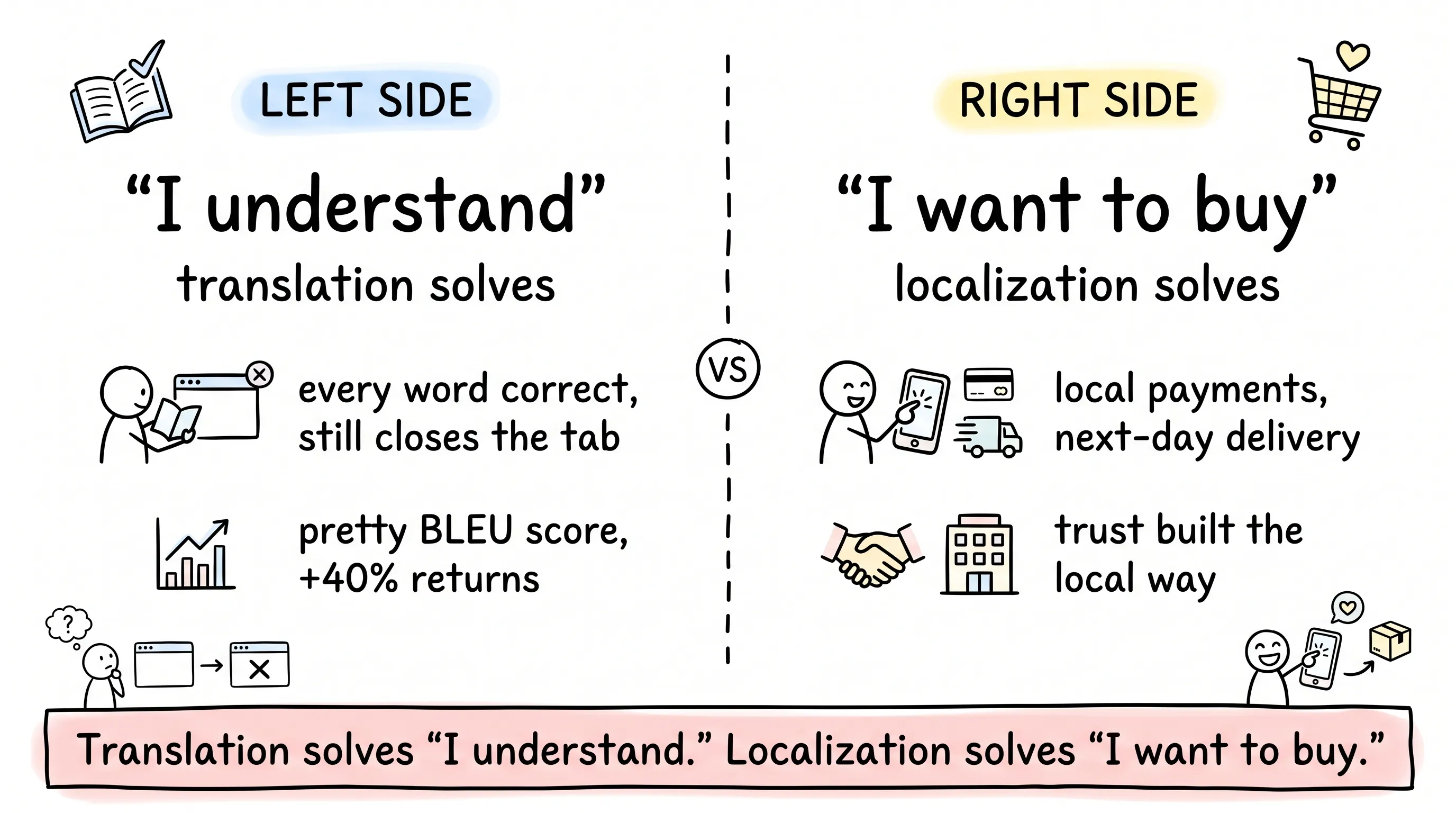
Between "I understand" and "I want to buy" lies a whole street: payments, logistics, trust.
What Is Localization, Exactly?
Many people read localization as "translation Plus." Not even close. Localization is reopening your business the way local people would run it. Here are the three layers that matter most.
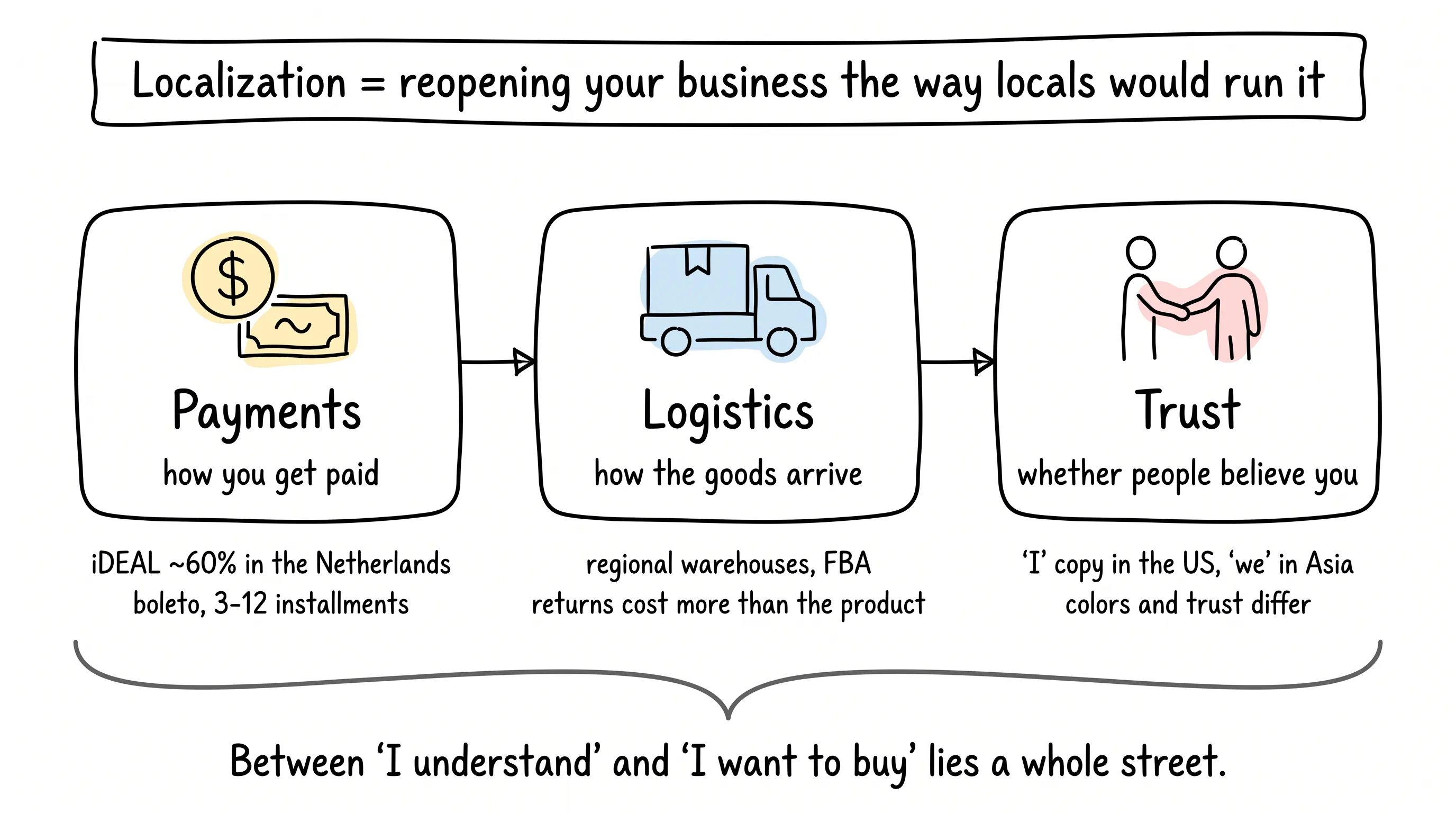
First: how you get paid.
You think the whole world swipes credit cards? Look at a few numbers: nearly 60% of online purchases in the Netherlands run through iDEAL, a local bank transfer system. Brazilians love boleto — print a payment slip and pay at a convenience store; for big-ticket items they buy in installments — 3, 6, or 12 payments, often interest-free. That's their daily routine — hardly financial innovation. India has UPI, and many first-time customers still ask for cash on delivery. The Nordics like to receive the goods first and pay after. China belongs to Alipay and WeChat Pay.
Then there's "I have PayPal — surely that works?" It doesn't. PayPal holds its own in European and American markets, but in China it's nearly unusable, and in quite a few emerging markets hardly anyone opens an account. In one line: If you can't take the money your customers are used to paying with, they can't do business with you.
While we're at it, run the numbers. The EU capped credit card fees at 0.3%. The US? Commonly 2% to 3%. Cross-border margins are thin to begin with; acquiring costs alone differ by nearly ten times. If pricing doesn't fold these in, you're working for the payment channels.
There's also a small trap called dynamic currency conversion: at checkout, it offers to let customers pay in their own currency. Looks considerate, but the exchange rate usually runs 3% to 5% worse than the bank's, and savvy customers steer clear. The feature can stay — just don't make it the default.
Next: how the goods arrive.
Direct cross-border shipping is slow and expensive. For low-priced small items, the freight can cost more than the goods themselves. To make this work, there are basically three roads: ship from your home country, stock regional warehouses in the target market, or hand it to third-party logistics providers. Amazon's FBA is a middle ground — they handle warehousing and fulfillment, and they set the rules.
There's one link almost everyone forgets: returns. An Australian customer sends goods back to your UK warehouse, and the return freight can cost more than the product itself. Skip international returns and conversion drops; offer them, and the cost has to be built into the model in advance. Think it through on opening day — don't patch it after things break.
The last layer: whether people believe you.
This layer is the most elusive, and the most valuable. The same sentence carries completely different weight in different cultures.
Cross-cultural research has an old framework for exactly this: Hofstede's cultural dimensions theory. Different societies stand at different positions along one axis after another. Take individualism versus collectivism. In markets like the US, UK, and Australia, copy should speak to "I": express your unique style. In markets like China, Japan, and Korea, what works is "we": the shared choice of millions of families.
Take attitudes toward uncertainty. German consumers want parameters, certifications, guarantees — and they read the fine print line by line; Brazilian consumers are more easily moved by emotional appeals. Nobody is shrewd and nobody is naive — each weighs different things.
Colors do math too. White, in the West, is purity — wedding dresses; in much of East Asia, it's associated with funerals. Red, in the West, often means danger; in China, celebration. The same red "Buy Now" button may earn points in Shanghai; in Stockholm, it's hard to say.
The sources of trust differ too. American customers will trust strangers' reviews; Chinese customers trust recommendations from people they know; Middle Eastern customers trust figures with standing in the community. Your review system has to be built around the local trust structure.
Customer service has its own local tempers as well. Japanese customers almost never complain face to face — but disappoint them once, and they never come back. American customers are loud, but fix it fast and they turn the page just as fast.
Has anyone truly pulled this layer off? Yes — and beautifully.
Airbnb entering China was never a matter of translating the website. Its name became Aibiying (爱彼迎), meaning "let love bring people to each other"; it plugged into WeChat and Alipay; it launched group bookings, because Chinese travelers often travel as a whole extended family; it hired local photographers and reshot the listing photos to match Chinese aesthetics.
The result: China became one of its fastest-growing markets.
See? That's what localization is. Become a local company — and live your business all over again.
Where Do You Start?
At this point you may feel tempted and intimidated at once: with this much to do, how does a small team ever finish?
So where to start? Three pieces of plain talk.
First: don't try to conquer the whole world at once. Pick the one or two markets you're most confident in, and go deep. Statista tallied cross-border orders across 41 countries; Chinese sellers accounted for nearly four in ten. Cross-border long ago stopped being a question of whether to make the trip — only of who makes it professionally.
Second: keep the books market by market. Conversion rate, average order value, return rate, cart abandonment rate, repeat purchase — break every one down to the market dimension. Two diagnostic patterns are especially handy: Japanese customers spend at high order values yet keep contacting support — most likely the product descriptions don't tell the whole story; Brazilian customers keep running away at the checkout page — eight times out of ten, the payment methods aren't wired up right. The data will bill you, item by item, for what your localization owes. And note one number along the way: in China, 87% of orders happen on the phone; in India, it's 91%. If your pages were designed for desktop screens, then in those two markets you've opened your shop in a desert.
Third: technology is a lever, not the answer. For translation APIs, the mainstream few are Google, Microsoft, DeepL, and Amazon; integration plugins for major e-commerce platforms are ready-made. Every second slower a page loads, conversion drops about 7% — add a CDN when it's due. Europe also has GDPR sitting there, with fines capped at €20 million, or 4% of global annual revenue — whichever is higher. Hire professionals for these, and it all gets set up properly in a single day.
But there is one thing machines can't replace you at: native-speaker review. Your high-stakes content — product descriptions, checkout flow, after-sales promises — must go word by word through a native speaker. And don't rush to judgment on experiments: if Japan accounts for only 2% of your traffic, you'll need to run the same A/B test far longer than anyone else before the sample is big enough.
Oh, and don't take channels for granted either. Search — the whole world doesn't use Google: China has Baidu, Russia has Yandex, South Korea has Naver. Social: Facebook is the main battlefield in many countries, yet can't get traction in China. You think you're running one global business; take it apart, and it's actually many local businesses.
Finally, a Few Words
Machine translation keeps getting stronger: real-time translation, with context, carrying your brand's voice — the gap between humans and machines shrinks year by year. Voice shopping, visual search, social commerce — these new plays are rolling out market by market too.
But at bottom, what technology shortens is only the distance of "being understood." Which market to pick, how to collect the money, why people should trust you — the machine won't answer those three for you.
Back to the joke at the beginning. That Tokyo buyer, reading "wet escape cloth," still put the product in the cart. Guess why? Because that top — he truly wanted it.
The machine has knocked the door open for you. Once you're inside, whether they pour you tea is up to you.
Translation gets you seen. Localization gets you trusted.
Here's to your first voyage overseas — just don't set sail with nothing but a translation app.
Continue reading
Related articles

Cross-Border Business: Time to Upgrade Your AI Toolbox
A learn article explaining how AI tools help cross-border e-commerce sellers clear five hurdles: language, regulation, logistics, payments, and fraud. It outlines a five-compartment toolbox, a five-step adoption path, and metrics such as conversion rate and CLV, while cautioning against over-reliance on AI.

AI Is Taking Over the Dirty Work of Social Media Marketing, One Task at a Time
This learn article outlines four social media marketing tasks AI can handle — audience analytics, content drafting and design, ad targeting and creative testing, and spam moderation — and cautions that taste, judgment, and data security remain human responsibilities.

AI Is Already This Good — Why Is Your Social Media Marketing Still Pure Manpower?
An overview of 18 AI tools for social media marketing, organized into six categories covering audience research, content creation, scheduling, comment and DM handling, ad management, and visual production, plus notes on personalization, prediction, and emerging trends.