
TikTok Tore Down the Barrier to Running Ads — So What Will You Compete On?
A learn article explaining TikTok's AI advertising stack: the MCP protocol for connecting AI assistants to Ads Manager, official AI skills, Symphony Creative Studio video generation, and the Content Suite creative library, with advice on making ad content feel more human.
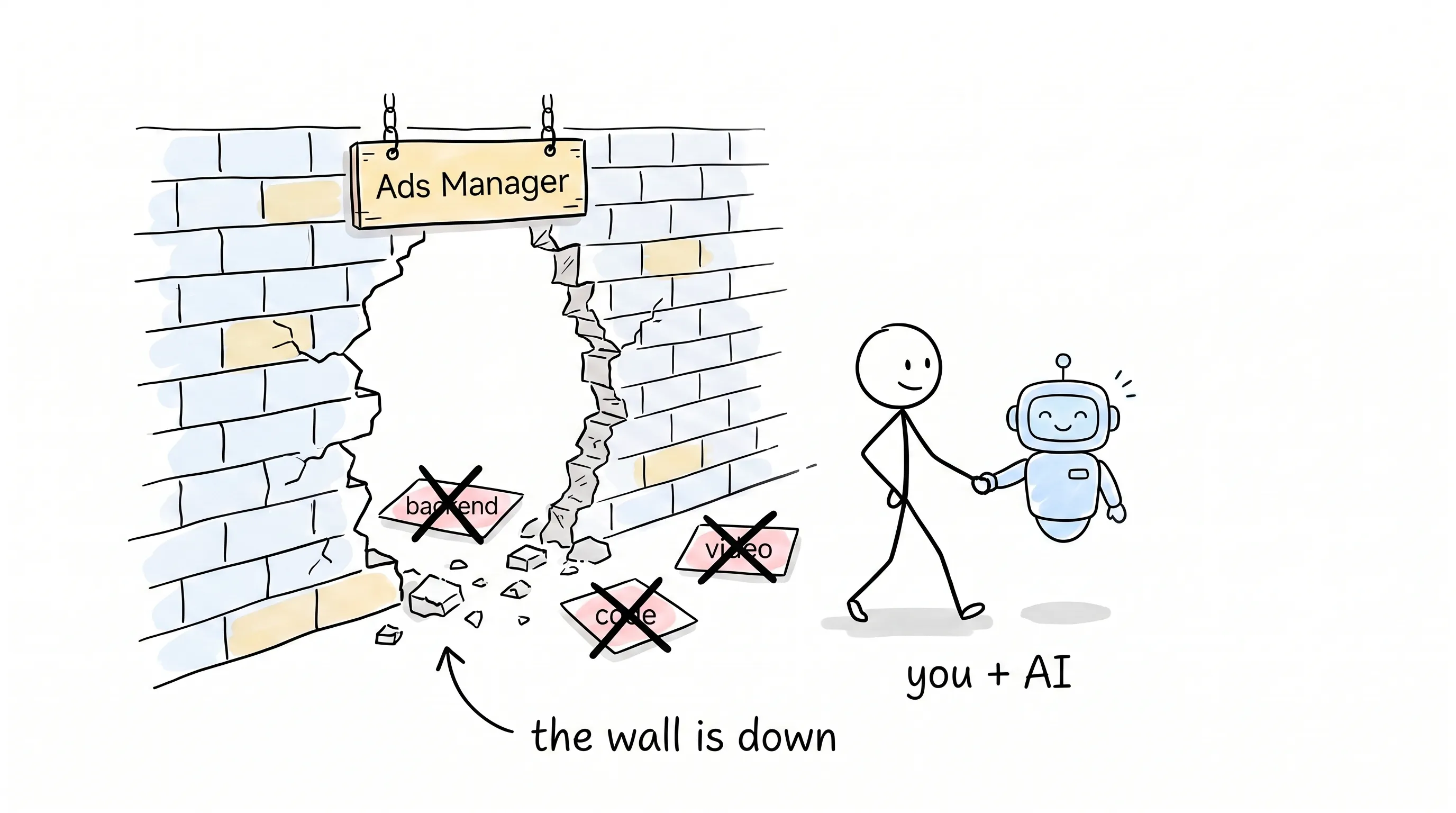
A few days ago, an old friend of mine in cross-border e-commerce reached out to chat.
He said TikTok's traffic is ferocious, and he had long wanted to run ads. But the moment he opened the ads backend and faced layer after layer of menus and settings, he closed it again.
It wasn't the money that scared him off, he said. It was that thing — he couldn't make sense of it.
I said, buddy, that impression can be updated. TikTok has now stuffed AI into every step of running ads: if you don't understand the backend, that's fine; if you can't write code, that's fine; even if you can't shoot video, there's a way.
He was happy for about three seconds, then asked: so what's left that's actually mine?
That question hit the mark.
Today, let's get all the way to the bottom of it — starting with a protocol called MCP.
First, Open an Ordering Window at the Kitchen Door
What is MCP?
TikTok for Business has released a protocol called MCP (Model Context Protocol, a standard that lets AI assistants plug directly into external tools and services). Put simply, they installed an ordering window at the door of the "kitchen" that is Ads Manager.
In the past, if you wanted AI to help you run ads, you had to hire developers to do API integration, apply for credentials, and write code. It was like wanting to eat a dish and having to break into the kitchen and cook it yourself.
Now there's a window. You place your order in plain language, and AI goes in and places the order for you. ChatGPT or Claude — ask it how the ads are running, have it pull a report; talking like a human is all it takes.
And this window is two-way. Read: pull reports, run analysis. Write: draft ad plans, change settings — all done directly inside your AI. Some connections are read-only, some read and write; your choice.
Around this protocol, TikTok has also built a marketplace called Agentic Hub, with a row of AI tools sitting there — plug in and use.
This is huge. It means a boss who has never opened Ads Manager can hook up AI, have it walk him through the data, or teach him step by step how to set up the backend.
The wall called "I can't make sense of an ads backend" — genuinely torn down.
But hold on. Don't treat the AI's advice as gospel.
A friend who makes short videos told me about a pitfall: your new creative has run for just a few days when the AI suggests pausing it, saying it performs worse than the old creative. Sounds perfectly reasonable. But there's one thing it isn't accounting for: the platform naturally favors ads that have run longer. Three days of creative clashing head-on with three months of creative is a certain loss.
What do you do then? Push back. Ask it, "Are there other approaches?" "Is there anywhere I could do better?"
Strangely, the moment you press, the AI often changes its tune.
AI does the work; the judgment is still your own.
Plug "Expert Plug-ins" Into Your AI
There's an even more interesting layer.
TikTok officially built a batch of "AI skills." What's a skill? A stack of instruction files you load into ChatGPT or Claude that teach the AI to do one specific job at an expert's level.
For example: Viral Video Creator, which teaches the AI to make viral videos; Ad Group Optimizer, which optimizes ad groups; Account Diagnosis Co-pilot, which diagnoses your account; there's even one called C-Dance, built by ByteDance, TikTok's parent company. Search "TikTok AI skills" online and you'll find them all.
The most formidable one, to me, is Viral Video Creator.
Think about it: how many videos does TikTok process every day? Tens of millions. This skill has, in effect, digested the patterns across all of them — and then tells you: the ads that ran best, here's what their openings look like, their middles, their calls to action. Just build yours on that model.
One commonly cited estimate: it can get your creative to 70 out of 100.
The remaining 30 points are your product's selling points, your differentiation — only you understand them, and you have to supply them yourself.
Seventy is already a lot. But here's my point: the real paradigm shift isn't in the 70.
A skill is just a file. Files can be edited, copied, stacked. You can add your own instructions on top of the official skills, set up fixed tasks that run automatically every day, and build your own small assembly line.
What's even less expected: skills don't carry "passports." TikTok's copywriting skill can be taken over to write Meta's ads; Meta's set of Instagram copywriting skills might work even better on TikTok. Every platform used to be a walled garden, locking you inside.
Now the walls leak everywhere.
To get started, I suggest three small things first: one, have the AI push you a campaign report every day; two, ask it daily which creative has the strongest opening; three, have it watch for creative fatigue. Once you're comfortable, go build campaigns — tell it directly, "I have a $5,000 budget and want to reach such-and-such goal," and let it draw up the configuration for you.
AI Video Has One Fatal Flaw
Next, video.
TikTok has an AI video production hub called Symphony Creative Studio. Give it a brief, plus your brand guidelines, and it generates storyboards, scripts, and digital avatars in one go — all the way to a finished cut. Then you take the stage: change scenes, add voiceover, adjust the call to action.
The interface is the prompt box you already know.
What is it best at right now? Product showcases. One furniture company used it to produce 100 videos a week, each promoting one piece of furniture. No person on camera, no physical shoot. Something traditional production teams wouldn't even dare imagine.
Another example, beauty: the texture of a lip glaze, the sheen as it spreads — AI can render all of it. Low-hanging fruit like this, if you sell things, go pick it now.
But let me pour some cold water on this.
AI playing a human isn't there yet.
An AI digital avatar tells you, with a face full of sincerity, "everyone around me is using this" — the audience freezes on the spot. The trust barrier can't be crossed. Quite a few big brands have evaluated this, and the conclusions are strikingly consistent: AI faces, for now, cannot fool anyone.
There's one exception: mascots, or cartoon virtual spokescharacters deliberately made fake-looking. The fakeness is the charm. That one works.
So what are the reliable routes right now? Two.
One: real-person filming with AI adding the effects. There's a 3M mop that does exactly this: the person films their own mopping demonstration, AI adds animation into the frame — a swarm of angry germs — making the before-and-after especially dramatic. The real person handles trust; AI handles the polish.
The other: product showcases with no person on camera — the 100-a-week kind just mentioned.
One more thing: don't assume AI means less work. Filming videos used to test production craftsmanship; now it tests your prompt-craft. Fixing frame by frame, adjusting scene by scene — the hours are the same hours, you've just switched swimming pools.
The work hasn't disappeared. It just changed its name.
The Homework to Do Before Spending Money
If you've never run a TikTok ad and want to try, which tool should you start with?
My advice: start with Content Suite, not by funding an ad account first.
Content Suite is the library of ad creatives running on the platform — heavy on UGC (user-generated content)-style videos. Since the AI search upgrade, it's genuinely easy to use: search by keyword, filter by industry (aviation, beauty, either works), by time (last 30 days), by campaign objective (sales, lead generation, awareness), by region. A bit like Facebook's Ad Library, but far more usable.
How to search? First search your own brand name, then look at competitors' products, then zoom out to the whole category. You'll see what creatives your peers are running, what their approach is, where the money goes.
These are open-book materials laid on the table.
I told that friend: you haven't spent a single cent yet; brew a cup of coffee and go through this library properly first. One cup of coffee's worth of time can save you more tuition than you could count.
The Barrier Is Gone — Now You Compete on Who Feels More Human
The tools are covered now. But the most important part comes after this.
AI tools have spread, everyone can make ads — what happens?
The floor rises. The content floor of the whole platform has risen.
And as the floor rises, the content that wins moves in the opposite direction: it looks more and more human.
Why do I say so? Let's take apart a high-performing TikTok video.
What's the first frame? The video's very first frame. Note: the first frame, not the first 3 seconds. On the subway, on the bus, a thumb sweeps past your video — that single frame decides whether the thumb stops. And your competition isn't just your peers; the whole feed is your competition, including the big influencers with professional teams behind them.
Ask yourself: on this first frame alone, why would anyone stop?
Only after they stop does the billboard text get its turn. That line of large text on screen works like a highway billboard: the viewer gives you one glance, and you must land the value in that one glance.
If there's a voiceover, the first sentence out of the mouth has to grab people immediately.
Then comes the "glue." Glue is the thing between the opening hook and the middle content that keeps people stuck. Without it, the viewer finishes the hook, feels it's nothing much, and leaves.
The middle delivers tips, in groups of 3 or 5. Three is best — compact.
Finally, the ending. Cut it off cleanly; don't decelerate. Many people speak slower and slower toward the end, the voice wilting too; viewers hear that "it's about to end" signal and swipe away immediately. Cut it clean, and the viewer watches to the end, the algorithm registers a full watch, and distribution climbs.
You see: first frame, billboard text, glue, clean ending — in this whole set, not one thing is something AI can decide for you.
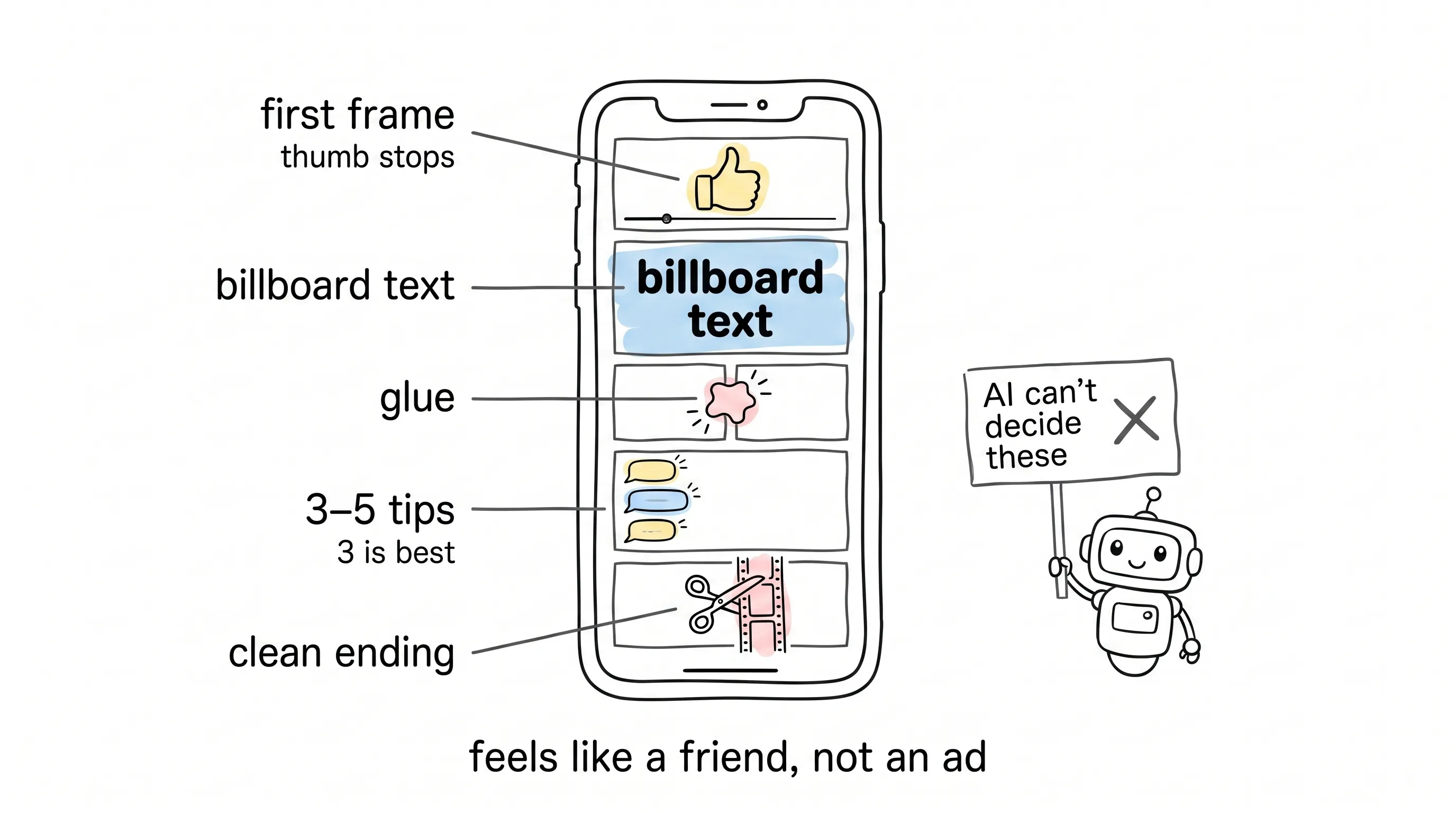
Because they all test the same thing: whether it feels like a real person.
What kind of video runs well? Videos that look like content a friend sent you. A young guy standing on the street selling hair-care products, buses roaring and traffic streaming behind him — it feels like a friend recommending, not a brand placing ads. Viewers can smell an ad coming from a mile away.
Here's a concrete suggestion: don't stand bolt upright talking at the camera. Talk while doing something else — pick up a water bottle, put on makeup, push open a door. On TikTok there's a lawyer who answers legal questions while doing her makeup; that transformation happening on her face is itself the reason viewers can't leave.
When editing, add captions — many people scroll on mute — and add a few jump cuts. Each cut tells the brain: something's about to happen, keep watching.
One more trick: don't announce the answer up front. Say a platform has shipped a new feature — don't open with "a new feature just launched." Open with "this update will change the way you do such-and-such," speak the impact first, and reveal the answer in the middle or at the end. With the answer at the front, viewers have no reason to keep watching.
And yes — even these "natively rough" videos need an outline written before shooting: what's the hook, where's the glue, how many points to make. Being on camera is like the gym — it's all reps. Get the reps in, and the speed comes.
Finally, Back to My Friend
Later I sent him two messages.
First: TikTok isn't the cheapest platform to advertise on; there's a minimum spend. But if you've run Meta's ads, many of the concepts connect, and the cost of getting started is lower than you imagine.
Second: agencies won't disappear. It's like taking a plane — economy, business, first class all reach the destination; some companies just want the full set of services, the reassurance of having everything handled. What changes is economy class — the DIY-plus-AI route — which has gone from "barely rideable" to "genuinely rideable."
He replied: then I'll go browse that creative library first.
Exactly — that's the move.
The tools leveled the playing field on "how to run ads"; they did not level it on "what to run, and how to run it well."
The barrier is down. The floor is up. What remains at the end are still the people who understand users and are willing to sweat the details.
May your videos stop the scrolling thumb — sooner rather than later.
Continue reading
Related articles

Cross-Border Business: Time to Upgrade Your AI Toolbox
A learn article explaining how AI tools help cross-border e-commerce sellers clear five hurdles: language, regulation, logistics, payments, and fraud. It outlines a five-compartment toolbox, a five-step adoption path, and metrics such as conversion rate and CLV, while cautioning against over-reliance on AI.

AI Is Taking Over the Dirty Work of Social Media Marketing, One Task at a Time
This learn article outlines four social media marketing tasks AI can handle — audience analytics, content drafting and design, ad targeting and creative testing, and spam moderation — and cautions that taste, judgment, and data security remain human responsibilities.

AI Is Already This Good — Why Is Your Social Media Marketing Still Pure Manpower?
An overview of 18 AI tools for social media marketing, organized into six categories covering audience research, content creation, scheduling, comment and DM handling, ad management, and visual production, plus notes on personalization, prediction, and emerging trends.