
TikTok Is Coming for Google's Lunch
A learn-style analysis of TikTok's push into search advertising: its 2022 closed beta and 2023 rollout signals, how video-based results differ from traditional search engines, and hurdles such as unproven performance, video production workload, and brand safety.
A while back, I had dinner with an old friend who runs ad campaigns for a living.
We got to talking about which kinds of business do well on which platforms, and he suddenly came out with this: these days, when a lot of young people want to find somewhere to eat, their first instinct isn't to open a search engine anymore. It's to scroll TikTok.
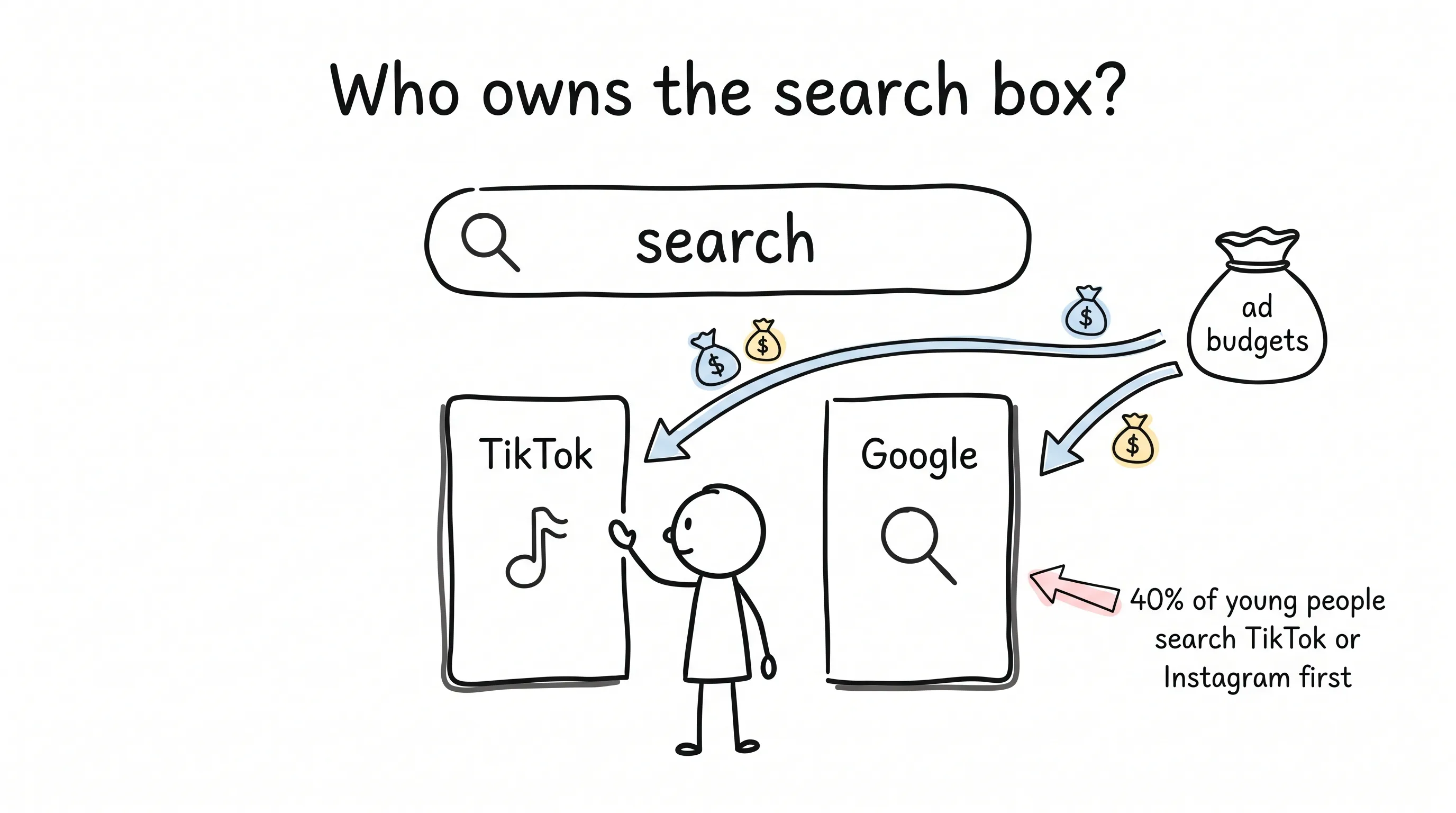
That rang a bell. In 2022, a Google executive in charge of knowledge and information cited the company's own research: nearly 40% of young people, when they want to find a place to eat, go search TikTok or Instagram first instead of opening Google Maps.
Your own backyard is on fire, and you're the one holding the torch to tell the whole world.
My friend laughed: money drifts wherever the wind blows.
A few days ago, while sorting through my notes, I dug up an old story from early 2023 about TikTok quietly preparing search ads. Almost nobody took it seriously at the time. But put it next to what my friend said, and you notice something really interesting:
Someone had been eyeing Google's lunch for a long time. The one eyeing it most intently goes by the name of TikTok.
Just How Big Is This Business?
What is search advertising?
Type a few words into a search box, and you're effectively announcing to the whole world what you want at that very moment. That is the most valuable intent on earth. Advertisers dream of standing right next to you — if you're about to buy shoes, that's when they show you shoes.
How big is it? The research firm Insider Intelligence estimated in 2023 that the global search advertising market for that year was around $112 billion.
Microsoft once ran an even starker calculation: for every percentage point of search share Bing grabs from Google, its ad revenue grows by about $2 billion.
One percentage point, two billion dollars. Brutal, right?
That's why Google and Microsoft have fought this battle tooth and nail. And while those two were locked in combat, TikTok stood to the side, quietly sharpening its knife.
How Did TikTok Make Its Move?
Lay the timeline out, and things come into focus.
Starting in March 2022, TikTok began testing search ads with a small closed beta. Invite-only; only a handful of people got to play. By early 2023, several ad agencies noticed that their TikTok sales contacts had suddenly become much more diligent: pitches one after another, plus invitations for advertisers to take part in case studies.
Think about it: when a platform invites you to be a case study, it usually means only one thing — the product is about to launch officially, and they're stockpiling ammunition.
An even more direct signal came from hiring. Among the positions TikTok posted that year, a search ads engineer role appeared, with duties including building "large-scale advertising systems."
At the time, an executive running paid social at the agency Jellyfish offered a judgment: a full rollout would most likely land in Q3 2023. Why that timing? Because Q4 is the highest-spending season of the year, and platforms all need to stock their shelves with new goods before the rush.
He had a line that stung even more: young people already search on TikTok about as often as they use Google. If that search volume could be turned into ad revenue, it would be a whole new stream of cash.
TikTok itself played it cautious — a spokesperson would say only that it couldn't share much about the testing phase. But its sales materials laid the real intentions bare: search ads are a new entrance into a "familiar content community."
In plain language: you search for something on TikTok, and what comes back is still those short videos — except now, there's an ad mixed in.
What Makes TikTok's Search Different?
Let me tell you a real case from that year.
In early 2023, over Austin Marathon weekend, a user searched "sneakers" on TikTok. An ad popped up: a shoe brand called Kane Footwear, using a video that running influencer Matt Choi had posted not long before.
The format itself wasn't complicated. Advertisers flipped a switch inside their existing TikTok campaigns, and the ad would show up as a thumbnail mixed into the search results.
But notice one detail: that ad appeared there not because someone paid big money for a prime slot. TikTok didn't let advertisers pick placements at all back then. It looked at only two things: who you wanted to reach, and what the user searched. The rest, it handed to the algorithm.
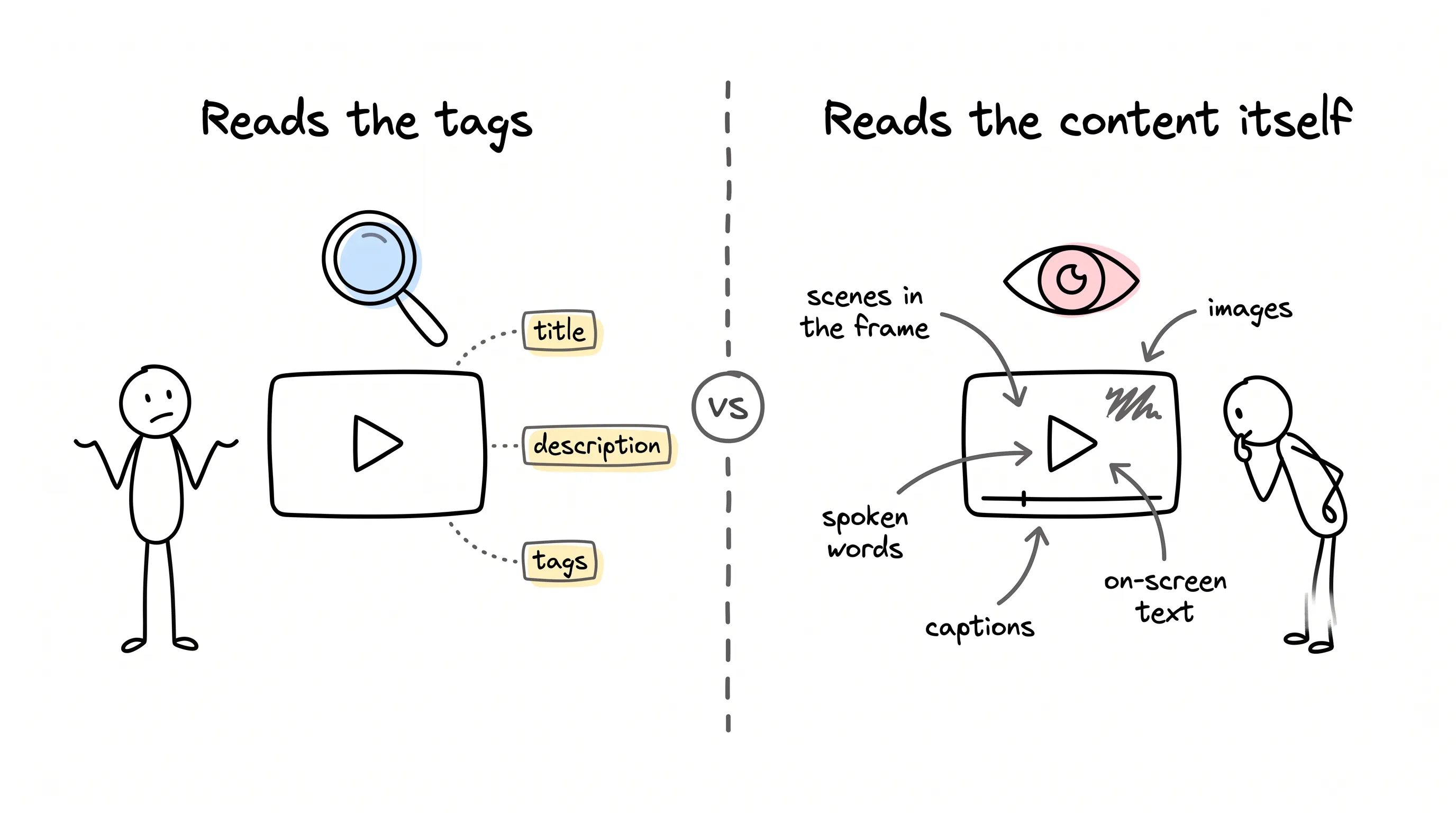
An executive at the agency VaynerX looked into it and found that a more fundamental difference lay underneath: a traditional search engine reading a video mainly reads its title, description, and tags; TikTok reading a video reads the scenes in the frame, the images, the words transcribed from speech, the captions — even the text written on a green-screen effect.
Doesn't that sound exactly like hiring? One screens résumés for keywords; the other asks you to do a piece of real work on the spot. Which one judges people better is obvious at a glance.
Search engines are reading tags. TikTok is reading the content itself.
That's what makes TikTok bold enough to storm the search business: ads can travel with the content and ride along with each user's interests, pulling off personalization that traditional engines can't match.
But Everything Has a Flip Side
Taking meat from Google's mouth was never going to come easy.
Hurdle one: the product was unproven. Search ads were still a closed-beta product, and nobody dared to guarantee the results.
Hurdle two: the workload. Advertising on traditional search engines just takes money; advertising on TikTok search means you first have to shoot decent short videos. To put it bluntly, this isn't buying an ad slot — it's opening a store first, then stocking it. Plenty of brands got stuck right at this step.
Hurdle three: regulators. In those years, TikTok faced more and more restrictions across multiple countries, with a sword hanging over its head the whole time.
Hurdle four: rivals. YouTube and Instagram were both doubling down on short video, straining to pull users and advertisers back.
Hurdle five, the most practical: brand safety. An executive at the agency Barbarian said it bluntly at the time: as far as they knew, TikTok's search ads hadn't yet built out the full brand-safety setup, and quite a few of their clients had simply marked this budget as "off-limits."
What is brand safety? It means an advertiser's ads must not appear next to terrible content. Yesterday you were earnestly selling kids' shoes; today your ad might end up next to a borderline video, and that's money spent for nothing. Yet in TikTok's search results, what your ad sits next to isn't your call.
TikTok's answer was negative keywords: advertisers could submit a blacklist of search terms and declare, don't place my ads next to these.
The direction was right. But many advertisers felt it wasn't enough.
Your Search Box Is the Battlefield
At the end of that dinner, I remarked to my friend: search looks like a technology on the surface, but underneath, it's the human heart.
Where users search, money follows.
Whoever users hand their search box to, advertisers hand their budgets to.
As for how much ground TikTok ended up taking, that's another story. But this early-2023 knife-sharpening at least proves one thing: no one's position comes by birthright — including Google's.
Next time you're looking for somewhere to eat, pay attention to which app your fingers open first.
That one small gesture of yours is the deciding move in a business worth over a hundred billion dollars.
Continue reading
Related articles

Cross-Border Business: Time to Upgrade Your AI Toolbox
A learn article explaining how AI tools help cross-border e-commerce sellers clear five hurdles: language, regulation, logistics, payments, and fraud. It outlines a five-compartment toolbox, a five-step adoption path, and metrics such as conversion rate and CLV, while cautioning against over-reliance on AI.

AI Is Taking Over the Dirty Work of Social Media Marketing, One Task at a Time
This learn article outlines four social media marketing tasks AI can handle — audience analytics, content drafting and design, ad targeting and creative testing, and spam moderation — and cautions that taste, judgment, and data security remain human responsibilities.

AI Is Already This Good — Why Is Your Social Media Marketing Still Pure Manpower?
An overview of 18 AI tools for social media marketing, organized into six categories covering audience research, content creation, scheduling, comment and DM handling, ad management, and visual production, plus notes on personalization, prediction, and emerging trends.