
TikTok Advertising: Which Jobs Can You Hand Over to the Machines?
A guide to TikTok ad automation in three layers: Smart+ built-in execution, third-party tools like Revealbot and Smartly, and competitive intelligence from monitoring agents. It separates tasks to automate, like bidding and creative rotation, from judgment calls like creative strategy.
A while back, I had dinner with a friend who runs a cross-border e-commerce business. He told me a story that nearly made me slam the table.
Last quarter, the best-performing video in their TikTok ad account almost got killed before it ever ran.
Fourteen seconds. A user unboxes their product, complaining the whole way through: this box is way too hard to open. Then, once it's open, a pause — hey, the thing is actually pretty good.
No polished camera work. No script. It even carries a whiff of a bad review. And yet this clip acquired customers at one-sixth the cost of the one their professional team had carefully produced.
Counterintuitive, right?
Can't blame you. TikTok just works this way, and it makes no apologies: the more something looks like an ad, the fewer people watch it. Users punish ads, and so does the algorithm.
Which creates a genuinely awkward tension. Media buying is begging for automation — bidding, budget allocation, creative rotation, audience testing — even a full-time hire can't keep pace with the algorithm. But the more systematically you produce creatives, the more polished and predictable they become, and polish and predictability are exactly what the TikTok ecosystem rejects.
So what do you actually do?
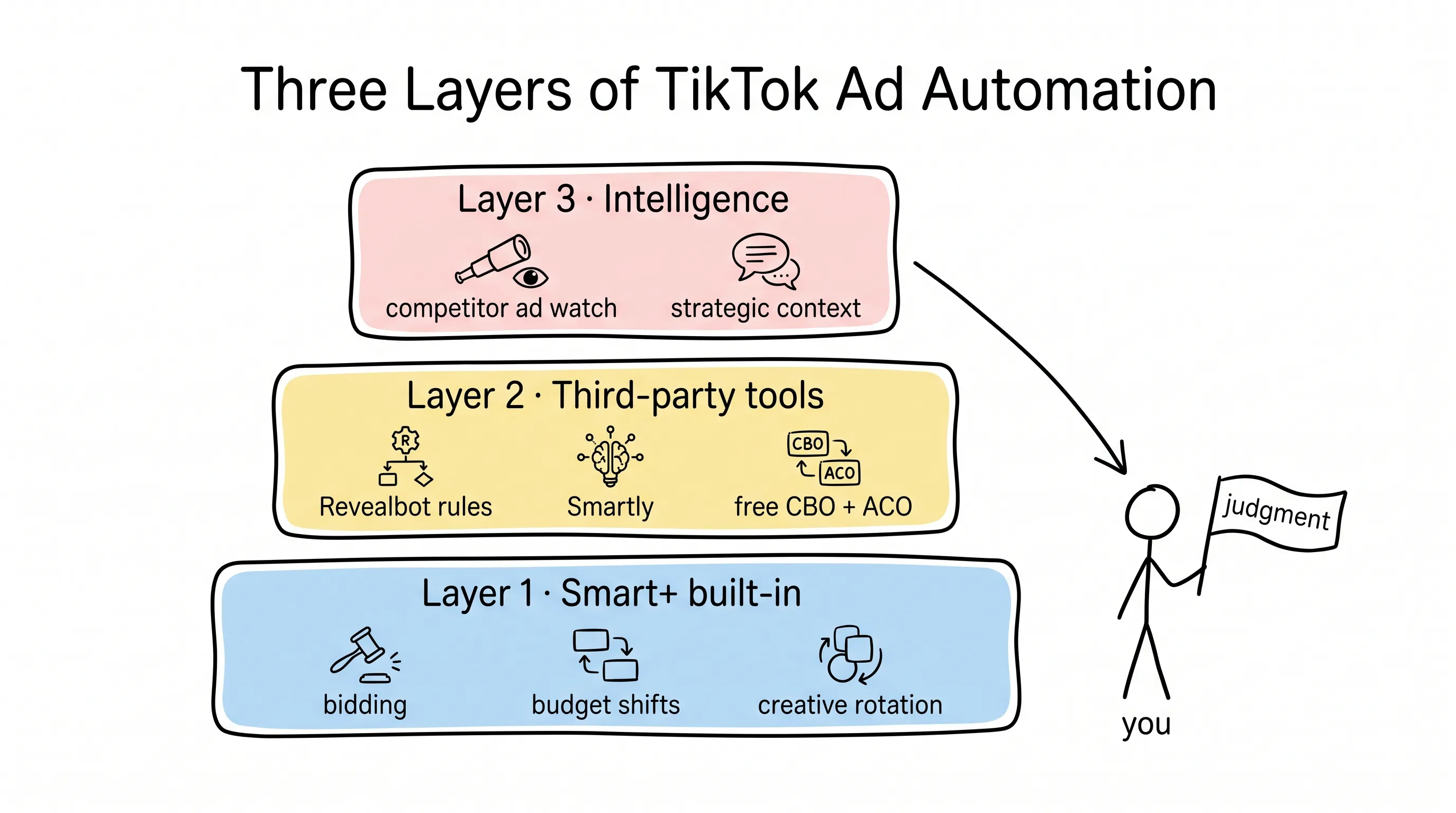
He and I walked through every pitfall of the past two years and landed on one conclusion: automation in TikTok advertising comes in three layers. Let's take them one at a time.
Layer 1: The Platform's Built-In Automation
What is Smart+? It's TikTok's answer to Meta's Advantage+ and Google's Performance Max. The pitch is simple: you hand over your creatives, budget, and conversion goal, and the algorithm takes care of targeting, bidding, and placements.
Where it genuinely shines is moving money and rotating creatives.
Think about how wide TikTok's ad network now stretches: the For You feed, search results, TikTok Lite, the Pangle ad network, plus a pile of other feed placements. Split budgets across them by hand and you're basically guessing. Smart+ shifts money in real time. The wildest case my friend has seen: mid-campaign, the search placement started winning, and Smart+ moved 70% of the budget over on the spot. No human buyer reacts that fast.
Creative rotation is even more striking. A viral hit on TikTok has a lifespan of roughly 5 to 7 days, sometimes shorter. Hand ten creatives to Smart+ and it quickly picks the ones that can fight, pours impressions their way, and cuts the fading ones automatically. By the time you're scrolling the dashboard with your morning coffee, it's old news.
But.
Smart+'s fatal flaw is opacity, and lack of control.
Which audiences are converting? You can't see. Want to exclude a certain kind of person? You can't. The narrower your buyer profile, the more it spends your money on tuition: the budget burned during the learning phase comes out of your pocket.
And there's another layer, easier to overlook. Smart+ can only optimize the hand you deal it — it will never tell you that you're playing the wrong hand entirely. Ten creatives, all polished product demos? It picks the best demo for you. It will never say: hey, try a raw, user-shot video instead.
Layer 2: Third-Party Tools
One level up sit the tools wedged between you and TikTok's ads platform.
Take Revealbot, starting at $99 a month — a rules engine. You write the conditions: if customer acquisition cost (CPA) exceeds $15 for 24 hours straight, cut the budget 20%; if click-through rate (CTR) drops below 1%, pause the ads. Then it obeys. Costs spiking at 3 a.m.? You're sound asleep while it hits the brakes for you.
But be clear about one thing: rules are hindsight. By the time a condition triggers, the money is already spent.
Then there's Smartly — enterprise-grade, generally starting north of $2,000 a month. Dynamic templates, creative automation, one dashboard running four platforms: TikTok, Meta, Pinterest, and Snap. It only makes sense for teams spending $50,000 or more per month. The learning curve is steep too: it assumes you can carry a full media-buying team.
Oh, and the most overlooked tier of all: free. Inside TikTok's own Ads Manager: bulk creation, CBO (budgets automatically distributed across ad groups), and ACO (your assets automatically mixed, matched, and recombined). If you're spending under $10,000 a month, master these three first and you'll get roughly 80% of what third-party tools deliver. Really.
But whether native or third-party, all of these tools share one blind spot.
What is management? Executing bidding, budgets, and rotation fast and steady. What is intelligence? Knowing what your competitors are running, which opening hook worked, and what to test next.
On management, these tools deliver in spades. On intelligence, not a single one.
Layer 3: Intelligence
You run TikTok ads, and so do your competitors. You're both burning money on creative experiments. Yet you can only see your own data.
TikTok's Creative Center lets you browse trending ads by industry and hunt for inspiration — useful. But it won't tell you: what new ads did your competitor launch this week? Has his creative strategy shifted since last month? Which new hook is he testing? And it certainly won't connect any of this to your own data and tell you what to do next.
Let me tell you about someone. Rafael, a mid-sized DTC brand — the kind that runs its own store and sells directly to consumers. Every week, without fail, he spent 3 hours in Creative Center: screenshotting competitors' ads, noting patterns, compiling them into creative briefs. The quality was genuinely good. The problem was endurance. He lasted about 6 weeks; then other work piled up and the routine died.
So he changed his approach: he set up a brand-mention monitor plus a competitor ad analysis agent. The first watches for anyone mentioning his brand or his category in TikTok content — and it happens far more often than you'd imagine, especially in review and comparison videos. The second tracks competitors' ad play across platforms, including which creative angles they're testing on TikTok.
Just like that, he had something money can't buy: strategic context.
Powerful. What does that mean? He knows Competitor A just pivoted from product demos to creator partnerships; Competitor B ran 15-second ads for months and has started testing 60-second ones; and a new player is out there running comparison ads that call out his brand by name.
All of this directly decides what he shoots next week.
And on TikTok, creative decisions are exactly the decisions that matter most.
What to Hand Over, What to Keep in Your Own Hands
Two years, every automation on the market tried at least once, plenty of money burned. In the end, he kept a list.
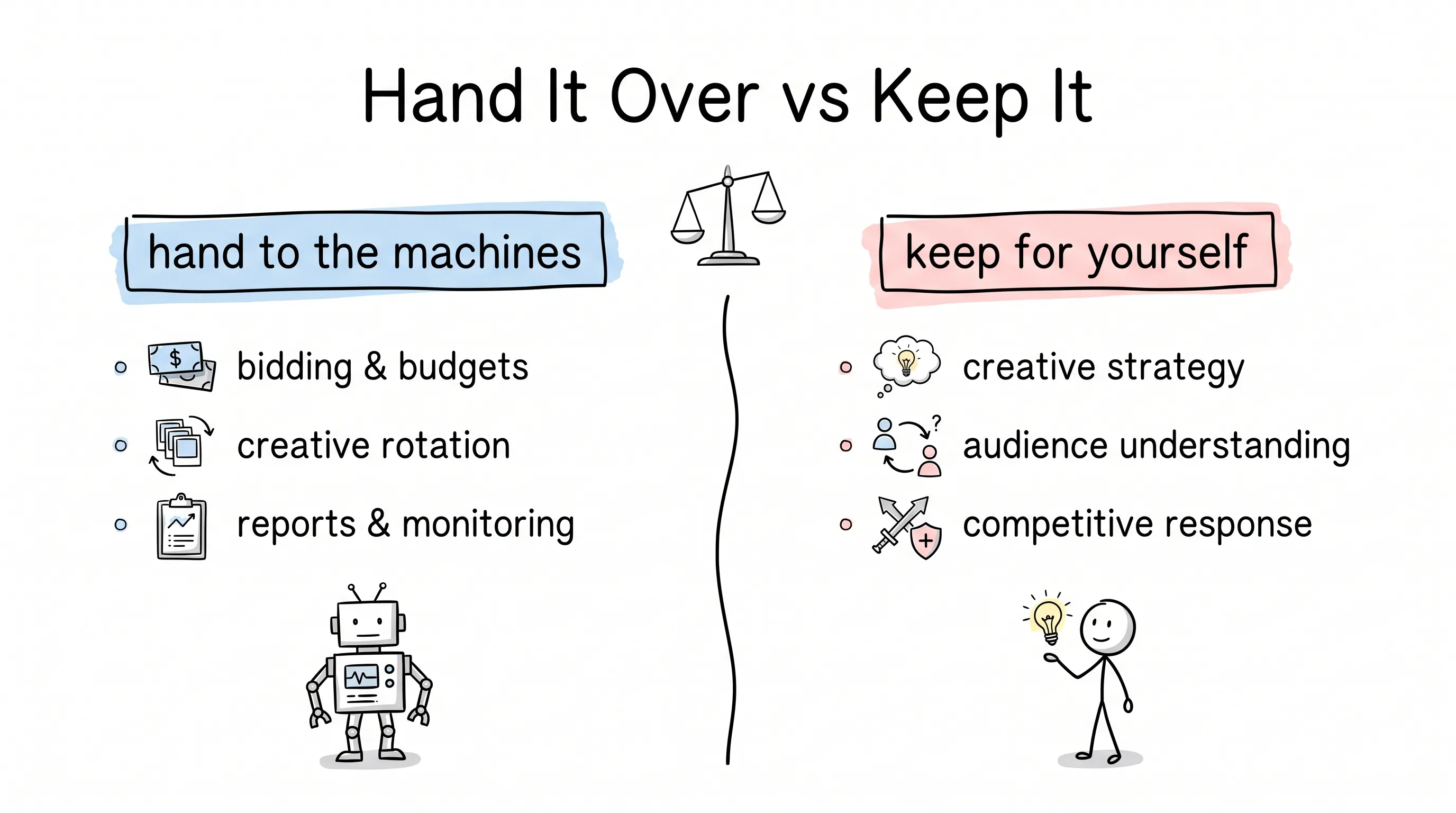
What to hand to the machines:
Bidding and budget allocation. Pure math. Machines do math faster than you, with more data and less mercy. Smart+, Revealbot rules, CBO — take your pick; they almost always beat human hands.
Creative rotation and fatigue detection. Hits burn out fast — let the machine watch for decay and move impressions from ads that can't hold up to fresh ones. Pausing ads by gut feel? Don't.
Reporting and monitoring. Pulling data, flagging anomalies, producing weekly reports — not one second of this needs a human. If you're still manually exporting CSVs from Ads Manager today, we need to talk.
What not to hand to the machines:
Creative strategy. A machine can tell you which of ten creatives is best; it will never know what the eleventh should be. Which hooks to test, raw user-shot footage or polished production, which trend to ride, what story to tell — these call for cultural instinct and brand judgment.
Audience understanding. Smart+ can find who buys your product. But why them? What words will hit home? How do you expand from this crowd to the one next door? That takes a person who genuinely understands the market.
Competitive response. When a competitor comes after you by name, you need judgment, you need speed, and you need a couple of unorthodox moves no rules engine can contain. A monitoring agent lets you see it coming; how you answer the punch is up to you.
One Last Thing
Back to that 14-second video from the beginning.
Today, in his ad operation, machines handle execution, agents handle intelligence, and he handles judgment. The agents don't bid for him, Smart+ doesn't know what competitors are doing, and he finally doesn't have to spend 3 hours a week scrolling Creative Center.
Three layers, each minding its own job, none stepping on another's toes.
Let machines take all of execution and data — and leave creative strategy to someone who actually scrolls TikTok.
Here's hoping you, too, get to spend your precious time on the one thing machines can't do.
Continue reading
Related articles

Cross-Border Business: Time to Upgrade Your AI Toolbox
A learn article explaining how AI tools help cross-border e-commerce sellers clear five hurdles: language, regulation, logistics, payments, and fraud. It outlines a five-compartment toolbox, a five-step adoption path, and metrics such as conversion rate and CLV, while cautioning against over-reliance on AI.

AI Is Taking Over the Dirty Work of Social Media Marketing, One Task at a Time
This learn article outlines four social media marketing tasks AI can handle — audience analytics, content drafting and design, ad targeting and creative testing, and spam moderation — and cautions that taste, judgment, and data security remain human responsibilities.

AI Is Already This Good — Why Is Your Social Media Marketing Still Pure Manpower?
An overview of 18 AI tools for social media marketing, organized into six categories covering audience research, content creation, scheduling, comment and DM handling, ad management, and visual production, plus notes on personalization, prediction, and emerging trends.