
This Influencer with 390,000 Followers Isn't Human
An analysis of AI-generated virtual influencers, covering brand campaigns, cost and control trade-offs, digital twins, and the trust challenges facing influencer marketing.
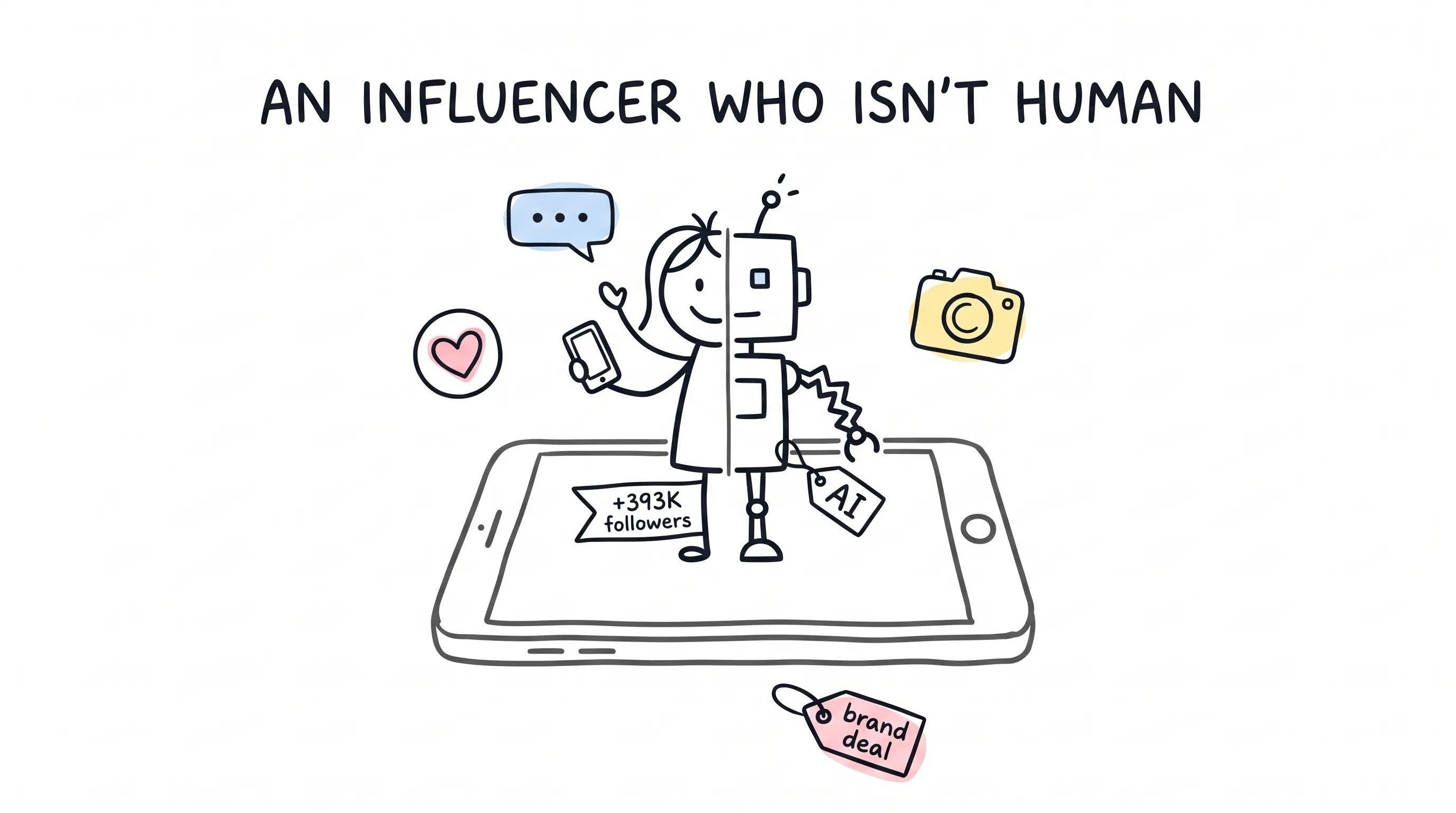
A few days ago, an influencer popped up on my Instagram feed.
She shoots editorial campaigns, lands brand deals, attends events. She has 393,000 followers and a comment section that's always buzzing.
Then I spotted the small print: she's AI-generated.
Not a real person. A "person who doesn't exist."
My first reaction wasn't fear — it was to run the numbers: how does someone who doesn't exist build a business this big?
What Is an AI Influencer?
Let's get the concept straight first. What is an AI influencer?
A virtual persona generated entirely by AI and operated by a real human team. She looks human — personality, persona, backstory — posting content and taking brand deals on social platforms just like a human influencer. You'll never touch her, but she's open for business every single day.
None of this is actually new. The most famous virtual influencer, Lil Miquela, landed on Instagram back in 2016. In 2025, another one, Mia Zelu, went viral overnight for "sitting" in the stands at Wimbledon watching tennis.
That's ten years. Over that decade, brands went from watching the show to betting real money on it.
And the math on those bets is staggering.
Let Me Tell You 3 Stories
The first story is Hyundai selling cars in Morocco.
When launching the Hyundai Kona, Hyundai brought in the AI influencer agency Pixel.ai and partnered with virtual influencer Kenza Layli. They squeezed every drop out of this influencer: YouTube ads, social posts, even a chatbot that talked with potential customers in up to 8 languages at once.
The result?
More than 2,000 chat conversations running simultaneously. A 20x return on investment for the whole campaign. Hyundai itself admitted it was the most successful influencer product launch in its history.
The second story is L'Oréal.
They partnered with virtual influencer Kyra and published just 3 posts. Three posts, 100 million views. 90% of Kyra's audience is between 18 and 30, with an average engagement rate of 5%. If you work in marketing, those two numbers should already have you shifting in your seat.
The third story takes us to Dubai.
A restaurant called WooHoo — Lewis Davey, co-founder of Pixel.ai, calls it "the first AI-themed restaurant in Dubai." On New Year's Eve, it ran a collaboration with virtual influencer Aitana López. On Instagram: 105,000 views, 46,000 accounts reached, over 1,300 interactions.
One restaurant, with help from someone who doesn't exist, pushed its New Year's Eve buzz to the very top.
Others have run the same numbers. H&M teamed up with virtual influencer Kuki to promote the "Innovation Metaverse Design Story" collection: when the virtual influencer ran alongside the campaign videos, ad recall was 11 times higher than campaign videos alone.
Why Would Brands Pay for a "Person Who Doesn't Exist"?
You might ask: with thousands of human influencers out there, why hire a fake one?
Because every pain point of human influencers simply doesn't exist for AI influencers.
Think about it. Human influencers show up late, hit booking conflicts, attract negative headlines, and say the wrong thing beyond what the contract covers. An AI influencer, by contrast, offers fully controllable content, fully customized messaging, and far lower reputational risk. In Davey's own words: AI talent gives brands complete control, customized messaging, and lower reputational risk.
Gökhan Girmez, Chief Brand Officer of WooHoo's parent company Gastronaut Hospitality, goes even further. AI influencers, he says, make brands "globally relevant, without being limited by geography, scheduling, and traditional formats."
For brands, an AI influencer isn't a face — it's a digital asset that can be licensed without limit.
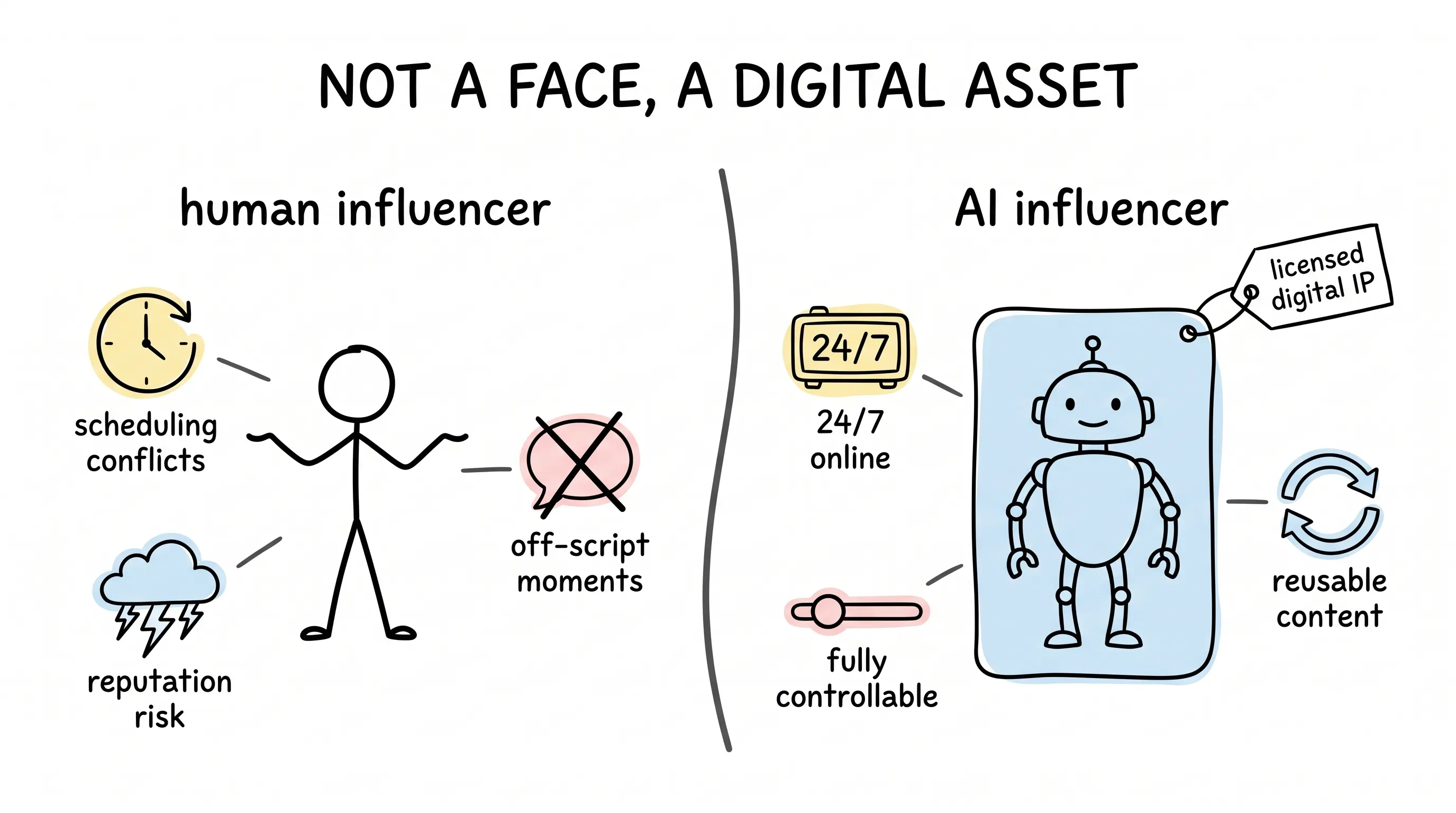
Girmez even gets into the contract details: in the contract itself, an AI influencer is more like "licensed digital IP" than an individual. No recurring appearance fees, content that can be reused again and again, and scale that can stretch as far as you want. Over the long run, it often actually ends up cheaper.
Of course, he doesn't oversell it. High-quality AI talent demands no less upfront investment in creative and technical work.
And the performance?
WooHoo's numbers: compared to typical brand content, AI influencer content drives 2 to 3 times higher engagement, plus stronger video completion rates — especially reels and short narrative content. Girmez's summary is blunt: "AI-driven campaigns consistently outperform traditional static content."
But my favorite line of his is this:
"AI represents the brand's brain, and humans represent the soul of the experience. Together, they make a credible ecosystem."
How Hot Is This Business, Exactly?
Numbers don't lie.
In a survey by influencer agency Billion Dollar Boy at the end of 2025: 76% of consumers trust product recommendations from virtual influencers, and 68% would let them influence their purchase decisions.
On the marketer side, it's even more dramatic. 77% of marketers plan to shift more ad budget from other channels to AI-generated creator content. In 2023, that number was still 65%.
Twelve points in two years.
But Davey offers one caution. Around 12 to 18 months ago, he says, a wave of brands "charged in without thinking it through." It's different now: people are getting serious about strategy — should this AI influencer be posting content, or running a chatbot?
The real value of AI creators isn't producing "good-looking content" — it's solving specific business problems.
So What About Human Influencers?
It's the question you can't dodge.
From the same survey: 62% of creators worry virtual influencers make competition fiercer, and 59% worry they'll flood consumers' feeds.
But there's another side: 85% of creators would be willing to build their own digital twin with a brand. An extra income stream, a little less workload.
The pie is growing too. McKinsey projects the digital twin technology market to grow at roughly 60% a year, reaching $73.5 billion by 2027. Scott Guthrie, Director General of influencer marketing industry body IMTB, notes that the use of AI creators is rising, with both Meta and TikTok pushing it. In China, some influencers already livestream themselves by day, then let their "digital twins" take over the stream at night and keep the money coming.
Twenty-four hours a day. The human sleeps four; the twin works the rest.
Katrine Rasmussen, CMO of digital twin agency Pixelz, says digital twins put brands "at ease," because they're still anchored to a real person — not an image generated 100% out of thin air. They also cut costs and boost efficiency, and the more content you roll out, the higher conversion rates climb. Her team is about to launch a tool that turns images directly into videos.
So, will humans lose their jobs?
Rasmussen pushes back hard: "The work is evolving. AI campaigns aren't simple, easy, or fast — it's not like you sit down, type a prompt, and it's done. There are a lot of truly talented people behind it. At this stage, it's not cheaper, and it's not faster. You still need people who truly know the ins and outs."
Exactly. Machines take over the output. They can't take over the judgment.
The Toughest Hurdle Is Trust
The real weak spot of this business isn't technology. It's the human heart.
Back to Billion Dollar Boy's data: only 31% of consumers approve of creators partnering with brands on digital twins. 57% believe digital twins will erode their trust in creator content.
Distrust from a majority. That's a hurdle you can't go around.
Media lawyer Kelsey Farrant, who specializes in AI, says the legal industry is scrambling to catch up, moving "slowly but surely." Then she drops a brutal line:
"The problem is, the industry itself doesn't know what it's doing. How are legislators supposed to know what they're doing?"
She compares AI to a prism: shine a flashlight at it, and out comes the whole rainbow. Not just copyright. Privacy too. Reputation too. The brand itself.
Digital twins are an especially gray area. Deepfake laws don't cover them. Say someone edits a video to make a twin "commit a crime" — the only recourse is existing laws like theft statutes, stretched to cover that specific harm.
Farrant's advice is pragmatic: brands shouldn't be pushed into using AI, but they must be clear about where they stand on it — and say so publicly.
So where's the way out? A few signals are worth watching.
H&M partnered with 30 models to turn them into AI digital twins — but the models own their likenesses, and they can even license their twins to other brands.
Davey has observed that content explicitly labeled "AI-generated" actually builds better relationships with consumers. Rasmussen says many brands see digital twins as the "Wild West," with legislators "falling behind" on AI — but she's counting on the EU's unfolding AI legislation to sweep away the uncertainty in Europe. Davey also notes that the UAE is standing in the "front row" of AI strategy and innovation, and with Pixel.ai setting up in Dubai, brands there are far more receptive to AI.
The answer to the trust problem is transparency, not concealment.
2030: Will Every Brand Keep an "AI Ambassador"?
Looking ahead, Davey makes a bold prediction.
Brands, he says, won't stop at "partnering with AI influencers" — they'll turn an "AI ambassador" into the brand's around-the-clock face.
"I really do predict that by 2030, a large number of brands will have their own AI ambassador virtual talent."
The Clueless agency in Barcelona is the creator of Aitana López. A team of about 10 people operates this virtual influencer with 393,000 followers. Founders Rubén Cruz and Diana Núñez say building an AI influencer means defining the personality and tone first, then generating the imagery. On ethics, they clearly label her a digital identity, never pass her off as a real person, and keep clear boundaries around body representation, diversity, and messaging.
Aitana's fees are comparable to human influencers of the same tier — even higher, especially for strategic projects and long-term ambassador roles. Brands come to them for both short-term and long-term work, and long-term digital ambassador agreements keep growing.
The two of them said something that stopped me for a second:
"Audiences connect with coherent stories, refined aesthetics, and distinct personalities. The point isn't that she's AI — it's that she has an identity."
Whether a persona is real and whether a person is real are two different things.
Finally, Back to That "Not Human" Influencer from the Start
Now think again about the influencer flooding your feed at the start of this piece.
She doesn't eat, doesn't sleep, never makes the tabloids, and is online 365 days a year. She'll keep getting more human-like. And human influencers are learning to use digital twins to "extend their own run."
Two forces are converging. Davey says the future is a "fusion of worlds," where human and AI influencers co-create content together. Girmez says WooHoo's future is hybrid too: AI runs the brain, humans bring the soul.
This isn't a story of one replacing the other.
Control goes to AI; warmth stays human. Whoever can twist the two into a single rope will own the next decade of attention.
The next time a "perfect influencer" scrolls onto your screen, may you see at a glance whether what's standing on the other side is a person — or an asset.
Look closely first. Then let your heart follow.
Continue reading
Related articles

Cross-Border Business: Time to Upgrade Your AI Toolbox
A learn article explaining how AI tools help cross-border e-commerce sellers clear five hurdles: language, regulation, logistics, payments, and fraud. It outlines a five-compartment toolbox, a five-step adoption path, and metrics such as conversion rate and CLV, while cautioning against over-reliance on AI.

AI Is Taking Over the Dirty Work of Social Media Marketing, One Task at a Time
This learn article outlines four social media marketing tasks AI can handle — audience analytics, content drafting and design, ad targeting and creative testing, and spam moderation — and cautions that taste, judgment, and data security remain human responsibilities.

AI Is Already This Good — Why Is Your Social Media Marketing Still Pure Manpower?
An overview of 18 AI tools for social media marketing, organized into six categories covering audience research, content creation, scheduling, comment and DM handling, ad management, and visual production, plus notes on personalization, prediction, and emerging trends.