
The Stronger the Tools, the Pricier the Human: The Creator Economy's AI Math
Let me start with something I came across recently.
Let me start with something I came across recently.
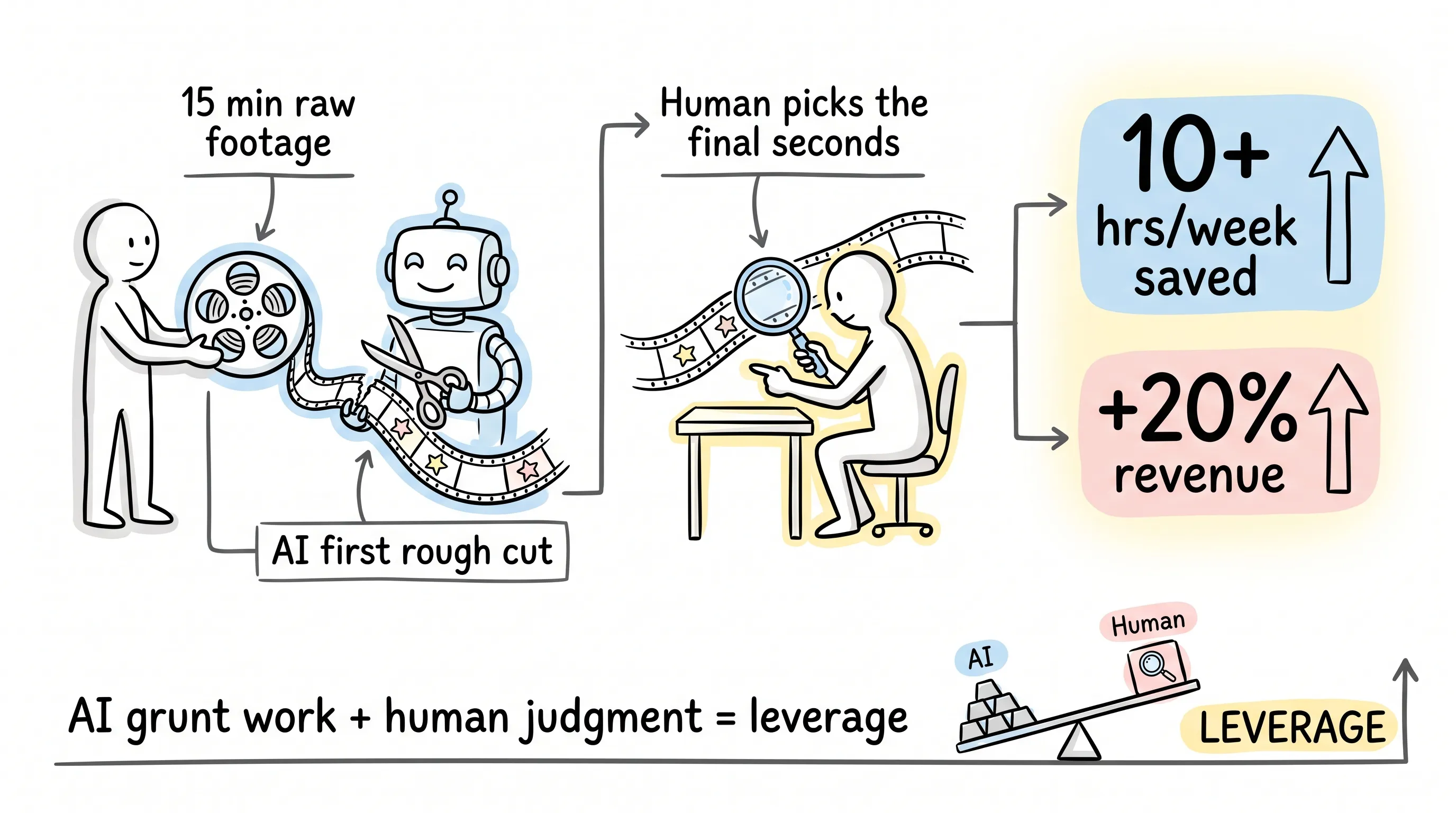
Gigi Robinson is a content creator who also runs her own social media consultancy, called Hosts of Influence. Her team has a fixed routine: any raw footage over 15 minutes goes, in full, to an AI video tool for a first rough cut. The machine picks the standout moments — the ones worth writing home about — and a human editor then decides which seconds make the final edit.
She has run the numbers: AI saves her more than 10 hours a week, and her revenue is up over 20%.
Impressive.
A few years ago, a story like this would have set the comment section on fire: AI is stealing editors' jobs — where's the justice in that? Tell the same story to any creator today, and odds are you'll get one reply: "That's it? I'm using it too."
Fear didn't disappear. It just changed direction.
1. They Used to Fear Replacement. Now They Fear Falling Behind.
Social Docket is a company that handles contracts and legal issues for creators. Its founder, Kameron Buckner, is blunt about this turn.
Last year, when creators talked about AI, the mood came down to one word: fear. The talk was all "this thing is coming to replace us."
This year, the conversation became: how do we put it to work?
A small change of words, a total change of mood.
At this year's Cannes Lions International Festival of Creativity, AI was the one topic nobody could dodge. Buckner says she talked with a whole circle of creators, consultants, and founders — and felt no fear. Everyone was using AI. Some measured, some all-in.
But the outcomes vary wildly. Those who use it well pull ahead; those using it blindly are drowning in the very same tools.
What separates the two? I'd say three words: do the math.
2. What Exactly Is Leverage?
What is leverage? You put in one unit of effort, and it puts in a hundred on your behalf.
DonYé Taylor offered an analogy I love. She used to run marketing campaigns for LVRN, Amazon, Nike, and Essence; today she runs her own brand, Nuclei, and writes a newsletter. AI, she says, is like a calculator: being handed a TI-89 doesn't mean you'll get the right answer. Wrong input, wrong output — and wrong at higher speed, with more confidence.
Fair point.
Alicia Richardson goes a step further. She heads community and brand partnerships at the social media agency FiveTwoNine and founded Black Create Connect. Her verdict: AI can amplify your creativity, but it cannot produce your creativity. With creator content especially, audiences can tell at a glance who's standing behind the camera.
Buckner's advice to clients is practical: treat AI as the starting point, never the finished product. Instead of staring at a blank page, let it hand you a first outline. She also picked up an unexpected bonus: to brief AI clearly, she was forced to pin down her own thinking first — and even her people-management skills got sharper. She herself also keeps watch with HubSpot's AEO (Answer Engine Optimization) tool, checking whether Social Docket shows up when someone searches "creator contract tools."
Lindsey Gamble, VP of creator strategy and innovation at IZEA, sees a different play. Creators feed years of accumulated newsletters and old copy into AI and build a searchable content library. Before writing anything new, they ask one question: have I already written about this?
Have you noticed what these uses share? AI does the grunt work on the sidelines, and the core judgment stays in human hands.
What no tool can replace is depth of knowledge and years of accumulated craft.
That's a direct quote from Buckner, and I agree completely.
3. There's Gunpowder in the Fine Print
Tool problems are the easy ones. Rules are the trouble.
Buckner also works as legal counsel. The law's progress bar, she says, lags far behind technology. How far? Court cases are still citing precedent from 1963.
Wherever the rules haven't been written yet, someone will try to grab a little more than their share.
Buckner recently came across a new kind of clause: a brand allows the creator to use AI — on one condition. Hand over your conversations with the AI, your prompts, your entire working process.
Her response was blunt: No. That's unnecessary access.
Why? A finished video or a written post is the deliverable they paid for. Behind your prompts sits your entire thinking process. Hand over your prompts, and you're letting the brand look straight into your brain. That has nothing to do with what the contract says.
Clauses run the other way, too. Gamble has seen brands go blanket-ban: no AI software, tools, or technology of any kind without written consent. His prediction: sooner or later, creators will flip this around and write their own AI clauses into contracts — to keep brands from casually reworking their content and voice with AI, rather than only guarding against creators.
More tangled still are the platforms. Girl Power Marketing founder Annie-Mai Hodge points to a paradox: platforms ship AI tools straight into creators' dashboards, while throttling the reach of content those same tools produce. The result: creators either don't dare use the tools they've been handed, or use them and won't admit it.
One more real-world pitfall, again from Robinson. A creator signed with a brand — and two weeks later posted content for the brand's direct competitor. Most brand deals carry exclusivity periods well beyond two weeks. A clear breach. Robinson later wondered: could AI be the culprit? The contract arrives, the creator doesn't understand it, and tosses it to AI with one line: "Negotiate this for me."
By the way: paste a confidential contract into a public tool like ChatGPT, and with a strict enough brand legal team, that act alone can constitute a breach.
That's why Buckner insists on reading creators' contracts herself. AI can tell you how "perpetual rights" is defined, she says; it doesn't know what the term means once it lands in your particular situation. Translating definitions into consequences — that job, for now, still takes a human.
4. The Bar Just Dropped. Now What?
Many people call AI a great equalizer.
Fair. Working with newly arrived creators, Gamble has seen it up close: what used to take a hired team — scripting, copywriting, rough cuts, graphics — now takes a laptop and a subscription, done in minutes. Small creators are touching, for the first time, tools that only big teams could reach.
But have you thought about what happens when everyone holds the same batch of tools?
Gamble's observation: everyone uses the same tools, types near-identical prompts, even thinks along the same lines — and the content comes out looking the same. A thousand-plus creators, facing the same few AIs, typing almost the same questions, getting almost the same answers.
The floor dropped. So did the ceiling.
Here's another set of numbers worth a look. Hodge has cited a Lean In survey: in the workplace, women are 22% less likely than men to use AI regularly, and 32% more likely to worry that "using AI will be seen as cheating."
Hodge herself chooses to keep AI out of her core workflow — her call. But the question she raises cuts deeper: why should a woman have to run a guilt check before using a tool?
That said, AI has leveled one thing for real: negotiating price.
In this line of work, the rate card has always been the biggest taboo. Nobody knows what anyone else charges; everything runs on guesswork. Now, one question to an AI chatbot and you have industry benchmark rates. It may not get brands to pay more, but it gives creators solid ground: is the price you're asking worth it? Now you know where you stand.
5. The Priciest Thing Is Still the Human
At this year's Cannes, the word Robinson heard most wasn't AI. It wasn't even creator.
It was human. As in, people.
When even a conference about marketing keeps saying "human" out loud, the signal is worth chewing on: on stage and off, everyone was talking tools — but underneath, everyone was asking the same question: whose work is this, really?
Taylor's answer is the most direct: AI has no feelings, no emotions, and it cannot replace the connection between people.
On LinkedIn, Gamble sees the cautionary tale: a feed full of posts that all taste the same. Because everything people write grows out of the same place.
So his advice is a periodic detox: every so often, use no tools at all — write something yourself, shoot something yourself, think something through, the way it was before AI. Creativity is a muscle; stop using it and it atrophies, just like the body. He also flags one thing to watch: content that is obviously AI-generated yet undeclared draws audience revulsion almost instantly.
From the brand side, Richardson lands on the same conclusion: rough AI animation has its uses, but in the creator-content business, audiences come for the human. That part doesn't change.
Finally, back to Hodge. Every week, she reads all the platform updates herself, then summarizes them in her own words. Some say she's crazy. Her answer is interesting: "ChatGPT and Claude can't do this part of my job."
So she has drawn a boundary for her tools: fine, use them, let them carry more of the load. But there's one thing you have to be clear on first.
Tools can do your work. They can never become you.
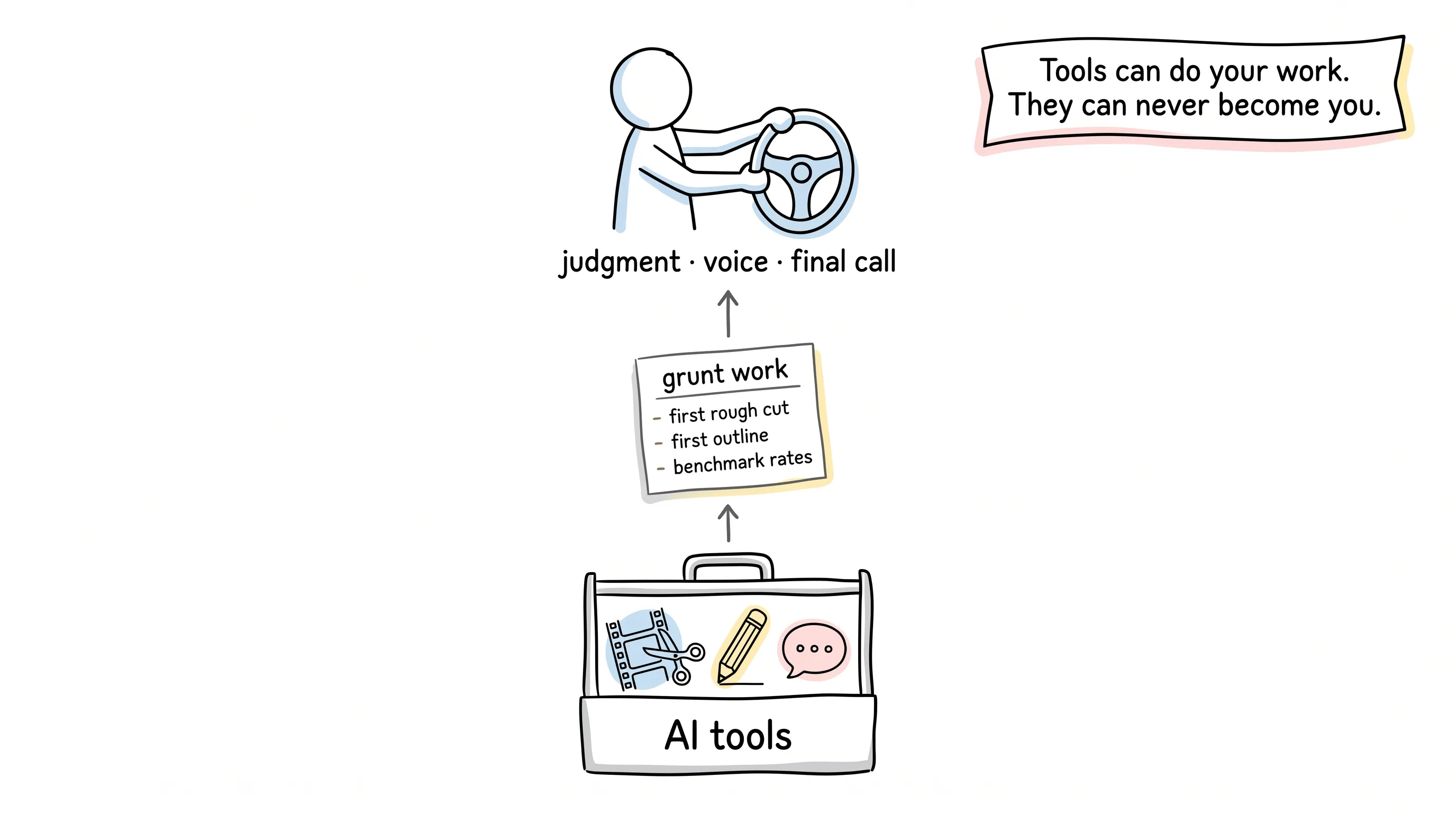
Back to those 15 minutes of raw footage from the opening. The rough cut was made by a machine — but the one pressing "use this version" is still a person.
That, roughly, is the AI answer in the creator economy: take the 10 hours you saved, and spend them on what only you can do.
And here's a bigger wish for you: may you always be the one who calls the shots.
Continue reading
Related articles

Cross-Border Business: Time to Upgrade Your AI Toolbox
A learn article explaining how AI tools help cross-border e-commerce sellers clear five hurdles: language, regulation, logistics, payments, and fraud. It outlines a five-compartment toolbox, a five-step adoption path, and metrics such as conversion rate and CLV, while cautioning against over-reliance on AI.

AI Is Taking Over the Dirty Work of Social Media Marketing, One Task at a Time
This learn article outlines four social media marketing tasks AI can handle — audience analytics, content drafting and design, ad targeting and creative testing, and spam moderation — and cautions that taste, judgment, and data security remain human responsibilities.

AI Is Already This Good — Why Is Your Social Media Marketing Still Pure Manpower?
An overview of 18 AI tools for social media marketing, organized into six categories covering audience research, content creation, scheduling, comment and DM handling, ad management, and visual production, plus notes on personalization, prediction, and emerging trends.