
The Stronger AI Gets, the More Your Human Touch Is Worth: Five Changes in Marketing over the Next Five to Ten Years
A commentary on the AMA 2026 Future Trends in Marketing Report outlining five shifts: autonomous AI agents, discovery moving from search to scrolling, portfolio careers, sustainability as a requirement, and trust growing scarcer across fragmented channels.
A while back, I spent the better part of an evening reading a report from the American Marketing Association (AMA): the 2026 Future Trends in Marketing Report.
Honestly, over the past few years, anything labeled a "trends report" is something I'd typically skim and set aside. Most trend reports on the market work the same way: blast out a pile of questionnaires, average a few hundred or a few thousand responses, and conclude with "what people care most about right now." That kind of report tells you about today — and more often than not, about yesterday.
This report is different.
This time, AMA ran no survey. They brought in more than 30 marketing practitioners and put them through the paces from May to August 2025: first strategic foresight training, then independent trend nomination from each person, then round after round of voting and discussion. They borrowed technique from the Delphi method and the foresight toolkit of the Institute for the Future, and used five dimensions — social, technological, economic, environmental, and political — to extrapolate future scenarios.
What's the Delphi method? In plain terms: put a roomful of experts to work scoring with their backs to each other. Nobody sees what anyone else wrote, so the loudest voice in the room doesn't win. Opinions come in, get aggregated and anonymized, then go back out — round after round of grinding, until the consensus that's left is what gets to stand as the conclusion.
The 30-plus experts came from Google, Ogilvy, and Uber, and from New York University — mostly people who actually run marketing on the front lines, with real decision-making power.
They had one question to answer: what will marketing look like five to ten years from now?
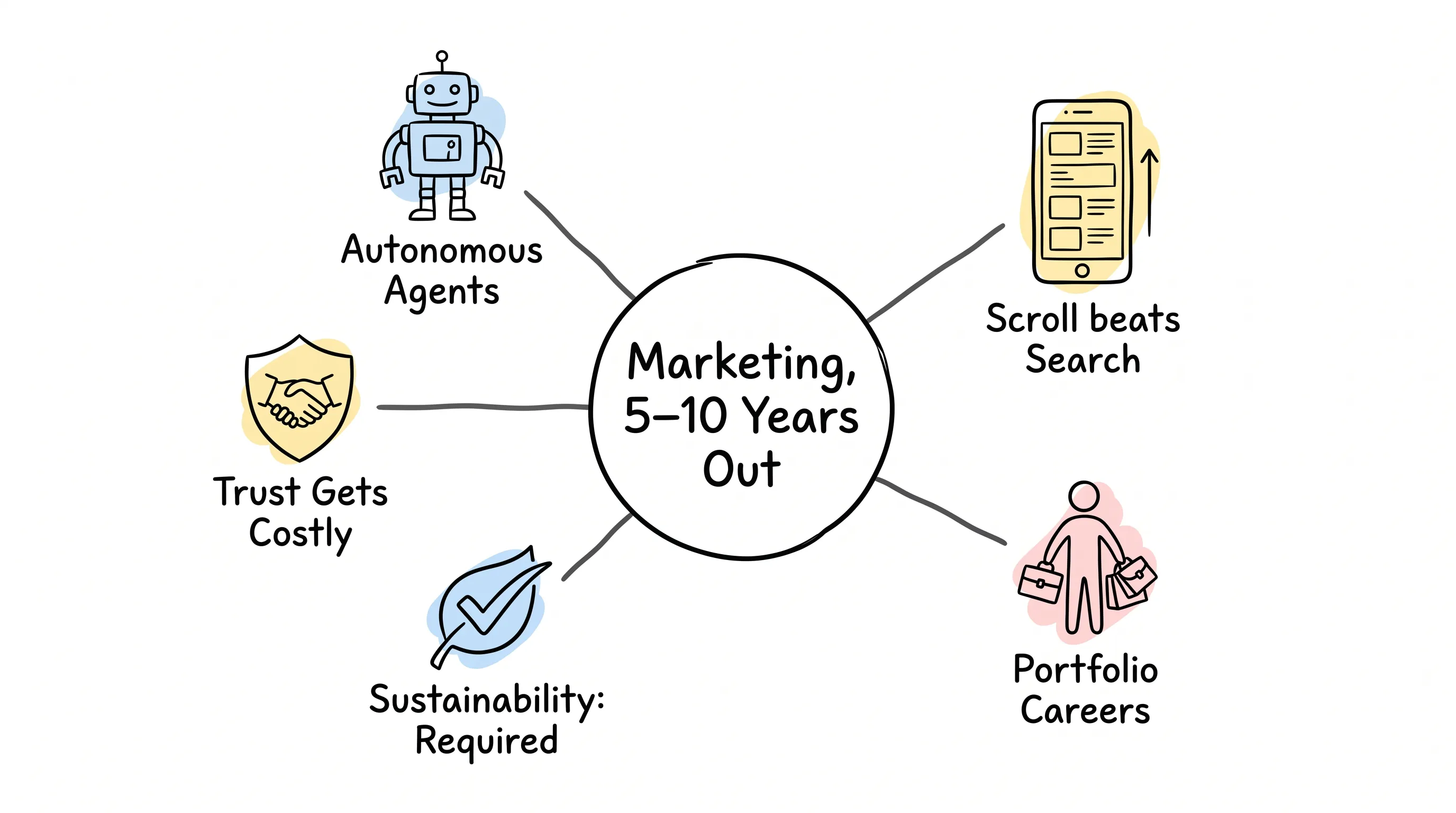
The answer came back as five changes. Let me take them one at a time.
Shift One: AI Has Started Doing Marketing on Its Own
The report names the first shift "The Age of Autonomous Agents."
What's an autonomous agent? An AI you don't have to babysit. AI used to be a tool: you put something in, it puts something out, and when you clock out, it clocks out too. An agent is an employee: you give it a goal, and it breaks the work into tasks, executes, and reports back — all on its own.
Picture it: ad buying, pricing, customer service, replying to comments — these could all end up running on agents. While you sleep, they're still adjusting budgets, still answering messages.
So is this good for marketers, or bad?
I see it as a dividing line. Whatever can be written down as a process, agents will take; whatever can't be written down as a process becomes more valuable than ever.
Shift Two: From Searching to Scrolling
The second change: how consumers find things has changed — and they've noticed.
Buying used to follow a clear path: a need comes up, you open a search engine, type in keywords, flip through results. The marketer's job was to fight for the top rankings.
Now? A lot of people scroll along and, somewhere along the way, buy. Demand isn't there first and then acted on — it grows while you're scrolling.
What does that mean?
It means the business of "being searched" is turning into the business of "being scrolled." Whether your content can make someone stop matters far more than where your keywords rank.
Shift Three: A Career Is Becoming a Portfolio
For the third change, the report chose its words carefully: "portfolio careers" and "a fluid workforce."
What does that mean?
A life used to look roughly like this: graduate, join a company, stay until retirement. One person, one job.
Now the math is changing for more and more young people: one main gig, one side hustle, one consulting arrangement, plus a personal brand they build up for themselves. One person, one portfolio.
On the company side, the logic is shifting too. The skills you need keep changing, and keeping do-everything people on the permanent payroll gets costlier by the day. Core roles you staff yourself; the capabilities on the periphery you rent from the market as needed. Labor flows like water, from where it sits to where it's needed.
That's why I keep reminding friends: over the next few years, your résumé has to turn from a list of job history into a portfolio of capabilities.
Shift Four: Sustainability Went from Slogan to Exam Question
The fourth change is sustainability.
The word got talked to death over the past decade. Plenty of companies used it for PR, for posters, for one page in the annual report. But this report puts it among its five major trends, and the verdict is blunt: from here on, sustainability is no longer a bonus question — it's a required one.
Why? Because consumers will audit you, regulators will audit you, and so will everyone up and down the supply chain. Green that's only talk will get harder and harder to pass off.
The real opportunity belongs to people who treat sustainability as an innovation brief: new materials, new processes — bring the costs down, lift the experience up. The ones faking it will be pushed out by the ones actually doing it.
Shift Five: The More Fragmented the Channels, the Costlier Trust Becomes
The fifth change is the one that hit me hardest reading it: building brand trust in a world that keeps fragmenting.
Consumer attention today has been sliced into countless pieces. Short video, communities, livestreams, private-domain channels, podcasts — there are more channels than anyone can stand guard over.
The more fragmented the channels, the more easily the fake stuff travels, and the scarcer trust becomes. And what's scarce is expensive.
The remedy this report prescribes matches my own read exactly: honest storytelling, cultural sensitivity, and genuine creativity will become a brand's biggest differentiator.
One Underlying Judgment
That's the five changes. Beneath them, the report carries one overarching judgment, and I'm pulling it out on its own because I think it's the single most valuable sentence in the whole thing:
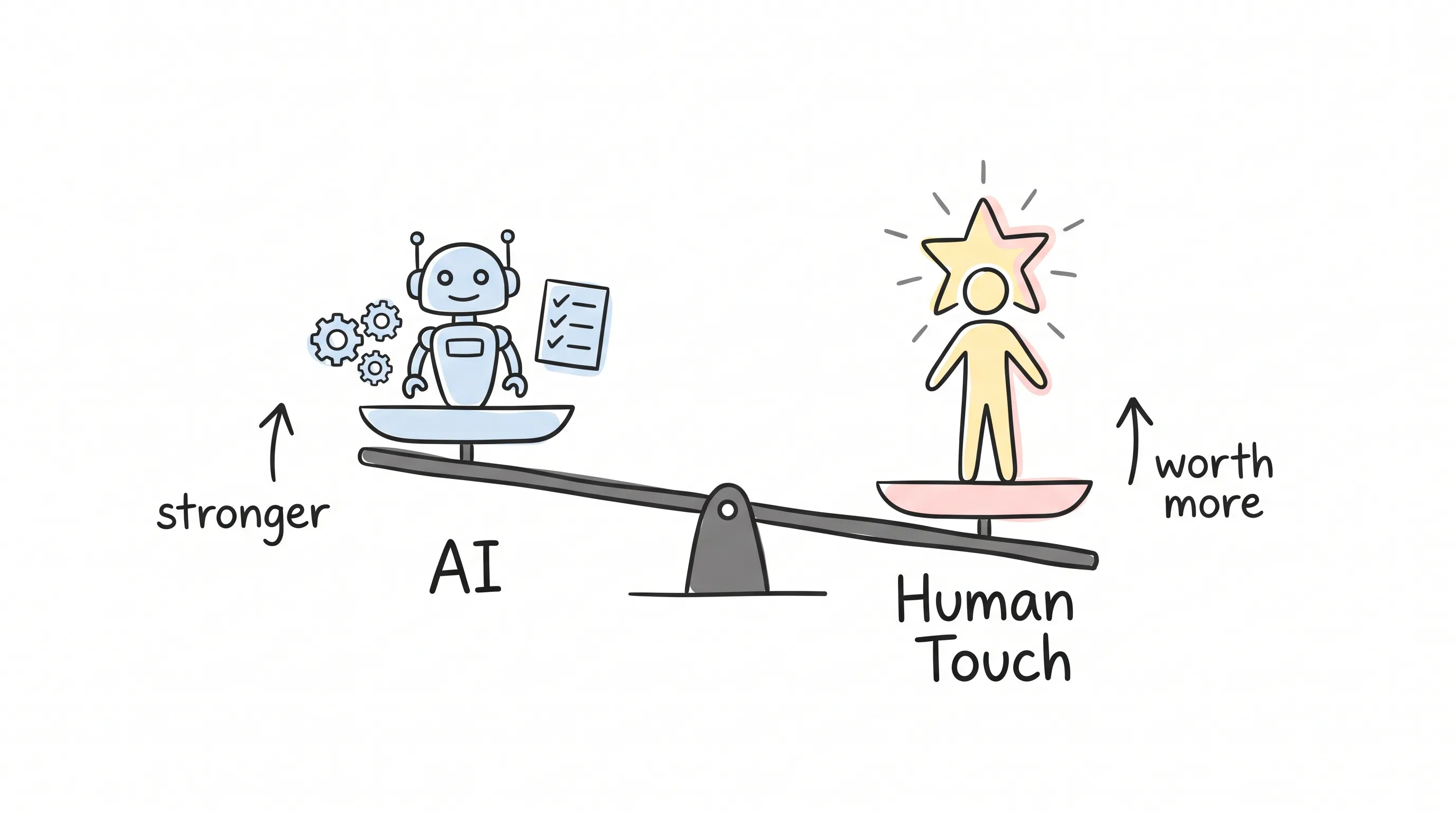
AI will take over most transactional marketing, while human creativity, cultural feel, and honest storytelling become the brand's true moat.
To put it plainly: whatever can be standardized goes to AI; whatever has no standard is yours.
So stop asking "Will AI replace marketers?" That's the wrong question. The right one is: once the transactional work is all taken, what's left in you that a machine can't give?
That night, when I closed the report, this was the line turning over in my head.
Over the next five to ten years, the tools will keep getting smarter. Here's hoping your human touch keeps getting more expensive, too.
Continue reading
Related articles

Cross-Border Business: Time to Upgrade Your AI Toolbox
A learn article explaining how AI tools help cross-border e-commerce sellers clear five hurdles: language, regulation, logistics, payments, and fraud. It outlines a five-compartment toolbox, a five-step adoption path, and metrics such as conversion rate and CLV, while cautioning against over-reliance on AI.

AI Is Taking Over the Dirty Work of Social Media Marketing, One Task at a Time
This learn article outlines four social media marketing tasks AI can handle — audience analytics, content drafting and design, ad targeting and creative testing, and spam moderation — and cautions that taste, judgment, and data security remain human responsibilities.

AI Is Already This Good — Why Is Your Social Media Marketing Still Pure Manpower?
An overview of 18 AI tools for social media marketing, organized into six categories covering audience research, content creation, scheduling, comment and DM handling, ad management, and visual production, plus notes on personalization, prediction, and emerging trends.