
The Second Half of Search: Getting Cited by AI
A learn article introducing GEO (Generative Engine Optimization): why AI-generated answers and zero-click search reduce site visits, how AI reads content, and practical steps such as question-style headings, E-E-A-T signals, and structured data to get cited in AI answers.
A few nights ago, my son woke up in the middle of the night with an earache, crying hard and refusing to settle. I grabbed my phone and searched: what do you do when a child has an earache in the middle of the night?
Right at the top of the results page sat one neat, tidy answer. Possible causes, what to do first, which situations mean you must go to the ER. I read it, put the phone down, and went back to soothing my kid.
I didn't open a single website.
That moment stopped me cold. After all these years working in content, it was the first time I'd seen it with my own eyes: search has really changed.
What Is GEO?
Let me throw out a term first: GEO, Generative Engine Optimization — optimizing your content for generative engines.
Sounds intimidating. Don't worry, let me break it down.
What's a generative engine? Things like Google's AI Overviews and Bing Copilot. They don't hand you a page of blue links. They hand you an answer.
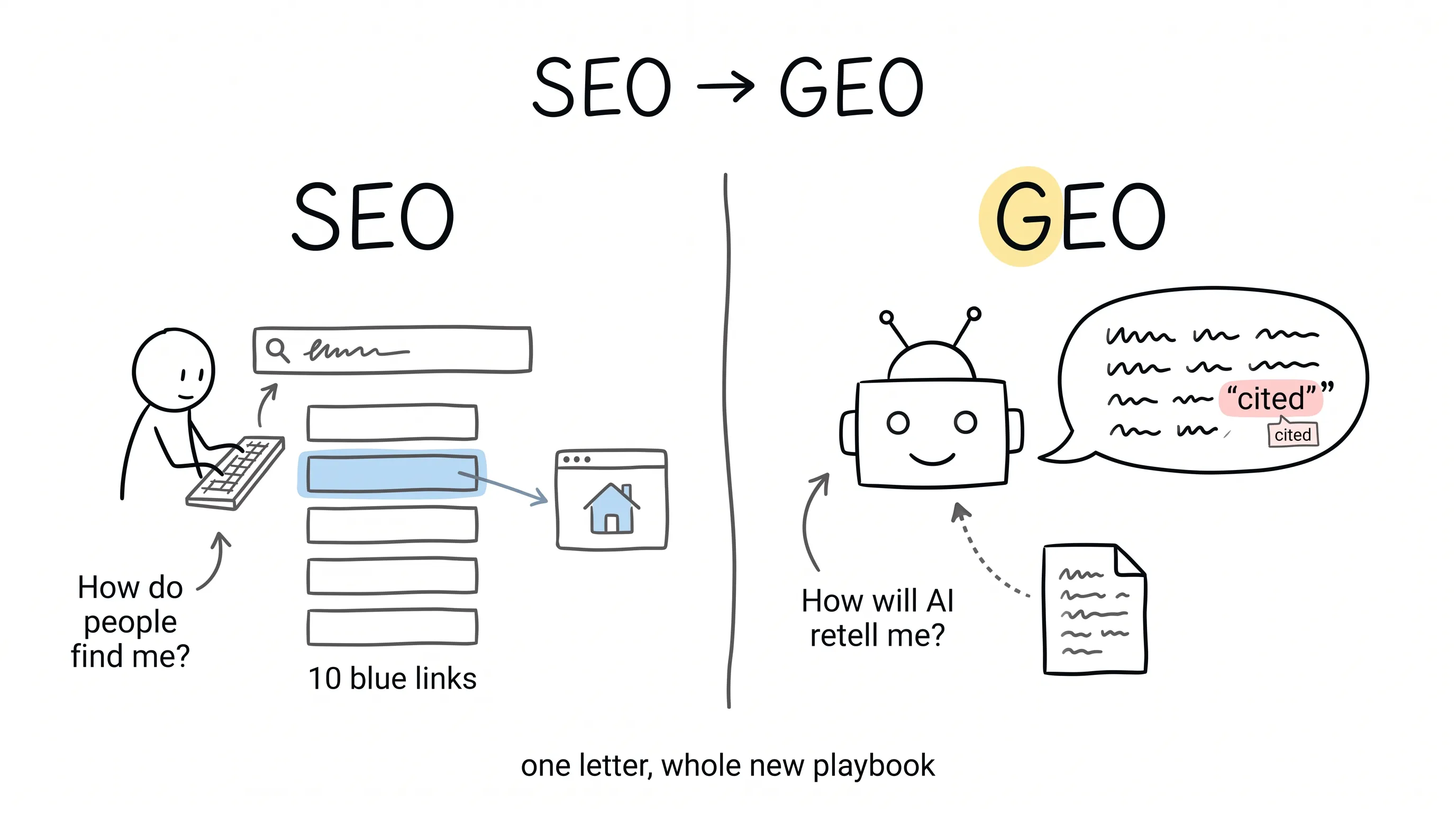
So what is GEO? Put simply, it's writing your content so that AI can understand it, wants to cite it, and feels safe citing it.
In the SEO era, you asked yourself, "How do people find me?" In the GEO era, you ask, "How will AI retell me?"
One letter's worth of difference — and the whole playbook changes.
Does Ranking First Still Matter?
Yes. But it's no longer enough.
Think about it. In the old days, a user searched, a human scrolled the results page, a human picked a link, a human clicked through to your site. At every step, you had a chance.
And now? The user asks one question, and the AI answers with a paragraph. And the whole way through, your website may never show up at all.
That's what people call zero-click search. The user got an answer. As for whose content contributed to it — they don't know, and they don't care.
Here's an analogy: when ten people searched the same question, six or seven of them might click through to some website. Today, maybe fewer than one. That's how traffic to any single site gets thinned out.
So what do you do?
Start by getting one thing straight: ranking is the entry ticket; being cited is the score. Back in 2025, plenty of people were still sitting on the fence, calling AI summaries a gimmick. Today, for many informational searches, the default experience already starts with an AI answer. This window isn't waiting for anyone.
How Does AI "Read" Content?
By now you're probably asking: okay, so what exactly should I change?
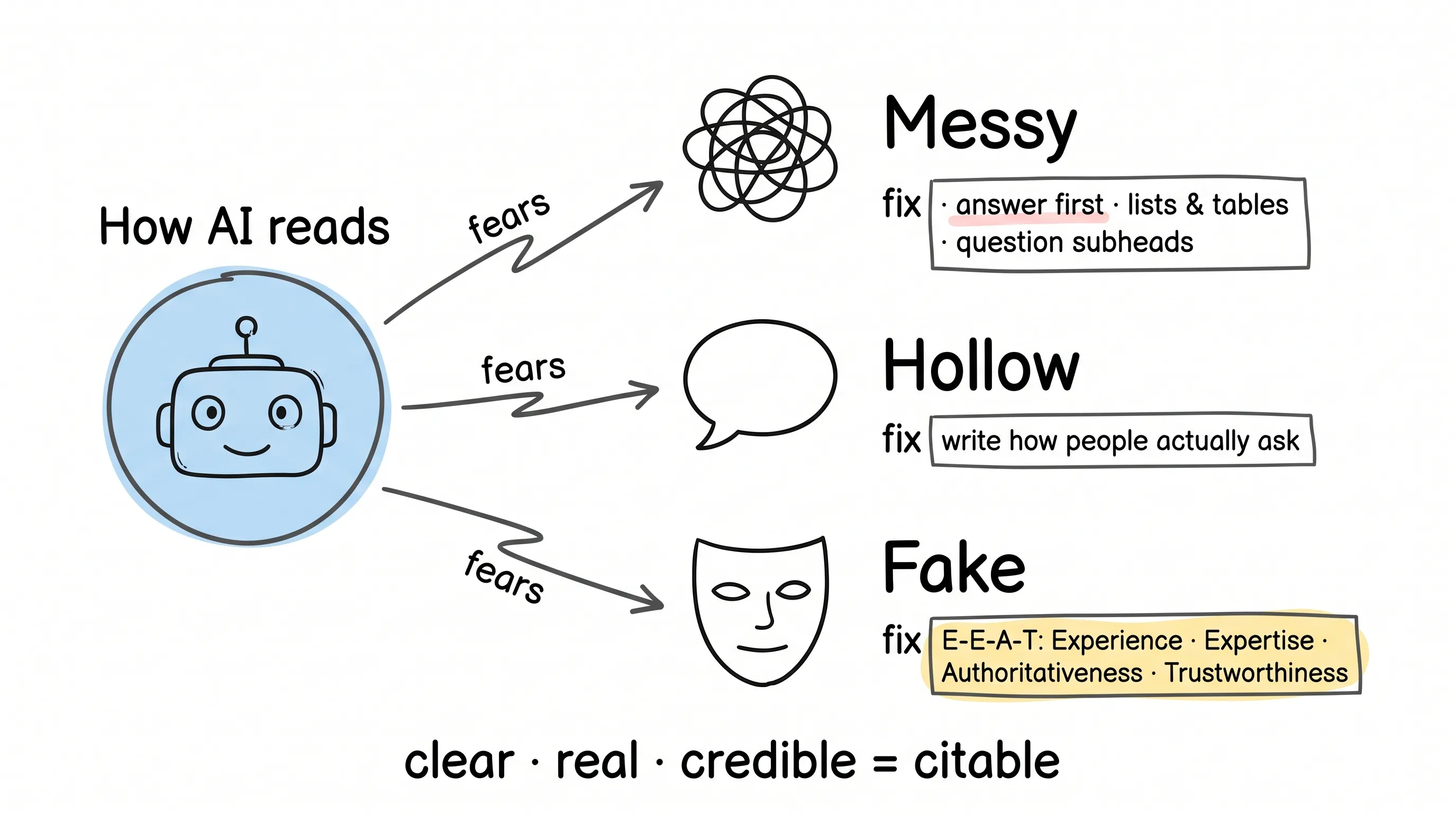
Hold on. First we need to understand how AI reads. It's not like a human, and it fears three things: messy, hollow, and fake.
First, it fears messy.
AI ingests content paragraph by paragraph. The clearer your structure, the less effort it spends extracting an answer. So write your subheadings as questions — "What is generative engine optimization?" — not "A Deep Dive." Open each section with a direct answer, then expand. Use lists for points, tables for comparisons.
Second, it fears hollow.
People now ask AI in complete, full sentences: "What do I do when my child has an earache at night?" "Which project management software is worth it for a small team?" Your content has to be written in that same language to match. Don't pile up keywords. Write the way people actually talk.
Third, it fears fake.
When AI cites you, it's putting its own credibility on the line for you. Why would it trust you? It looks at who the author is, whether there are real case examples, whether the data has a source. That's what Google means by E-E-A-T: Experience, Expertise, Authoritativeness, Trustworthiness. Four words, and not one of them can be faked.
An Overlooked Lever
Let me give you something concrete: structured data.
What is structured data? It's marking up your page's code in an agreed format — schema types such as FAQ and HowTo — telling the AI: this section answers that question.
Here's an analogy. You run a restaurant, and your menu is gorgeous — but if the waiter can't read it, it's useless. Structured data is like giving the AI a waiter who can read the menu.
Once you've written it, run it through Google's Rich Results Test to confirm that AI and search engines can correctly read your markup. This step isn't hard — ten minutes, tops — yet the overwhelming majority of websites never bother.
Oh, and video and images too. Add captions and transcripts to videos, write clear descriptions for images. Only when AI can understand what a video says might it get mentioned in an answer.
The Metrics Need to Change Too
What did we used to watch? Rankings, click-through rates, backlink counts.
What do we need to watch now? Whether your content shows up in AI answers. When you do get cited, whether it's your brand being mentioned. Which long-form questions users ask that get you picked.
Your ranking number hasn't moved — that doesn't mean nothing happened to you. Your name appearing in the answer — that's the new traffic.
We used to read the report. Now we read the answer.
Finally, Some Hard Truths
First: don't game it. Using AI to mass-produce rehashed content, or shredding your articles into keyword salad just to get cited — neither goes far. AI engines will only get stricter about originality and facts, and if readers can't make sense of it, the AI won't buy it either. At the end of the day, quality is the only moat.
Second: disclose when it's due. If AI assisted in creating the content, say so honestly, per the platform's requirements. Hide it, get identified once, and trust collapses faster than anything else.
One Last Thing
Remember that midnight earache from the beginning?
Later I went back and looked at that AI answer properly. It cited a hospital's health-education page and an article by a pediatrician. The people who wrote that content will probably never know that, late one night, in a stranger's home, the AI called their name.
In the second half of search, the contest is no longer just about ranking above or below someone. It's about whether the AI, when it opens its mouth to answer, is willing to quote you.
Write your content clearly. Write it credibly. Write it into the AI's answer.
Here's to you getting cited, too.
Continue reading
Related articles

Cross-Border Business: Time to Upgrade Your AI Toolbox
A learn article explaining how AI tools help cross-border e-commerce sellers clear five hurdles: language, regulation, logistics, payments, and fraud. It outlines a five-compartment toolbox, a five-step adoption path, and metrics such as conversion rate and CLV, while cautioning against over-reliance on AI.

AI Is Taking Over the Dirty Work of Social Media Marketing, One Task at a Time
This learn article outlines four social media marketing tasks AI can handle — audience analytics, content drafting and design, ad targeting and creative testing, and spam moderation — and cautions that taste, judgment, and data security remain human responsibilities.

AI Is Already This Good — Why Is Your Social Media Marketing Still Pure Manpower?
An overview of 18 AI tools for social media marketing, organized into six categories covering audience research, content creation, scheduling, comment and DM handling, ad management, and visual production, plus notes on personalization, prediction, and emerging trends.