
The Second Half of Marketing: AI Drives, You Steer
An analysis of how AI is reshaping marketing foundations: semantic layers for data, AI-driven analytics, and campaign automation, with human judgment kept in the driver's seat.
A while back, two sets of numbers popped up in my WeChat Moments feed.
The first: Heinz let AI paint its ketchup. That single campaign racked up 850 million impressions on social media.
The second: Coca-Cola built a platform called Create Real Magic, inviting people to use AI to generate art in the Coca-Cola style. Fans went on to create more than 120,000 pieces on their own — with each visitor averaging seven minutes on the platform.
Seven minutes. In an era when attention is priced by the second, seven minutes is a luxury.
Impressive.
When I saw these two cases, my first reaction was the same as most people's: wow — so this is how you play AI marketing.
But once the excitement wore off, the more I thought about it, the clearer it became: these headline-grabbing plays are not the point.
The point is the things that never make headlines. It's AI quietly burrowing into the foundation of marketing: how data gets organized, how analysis gets done, how campaigns get run.
Going viral is fireworks. The foundation is the house.
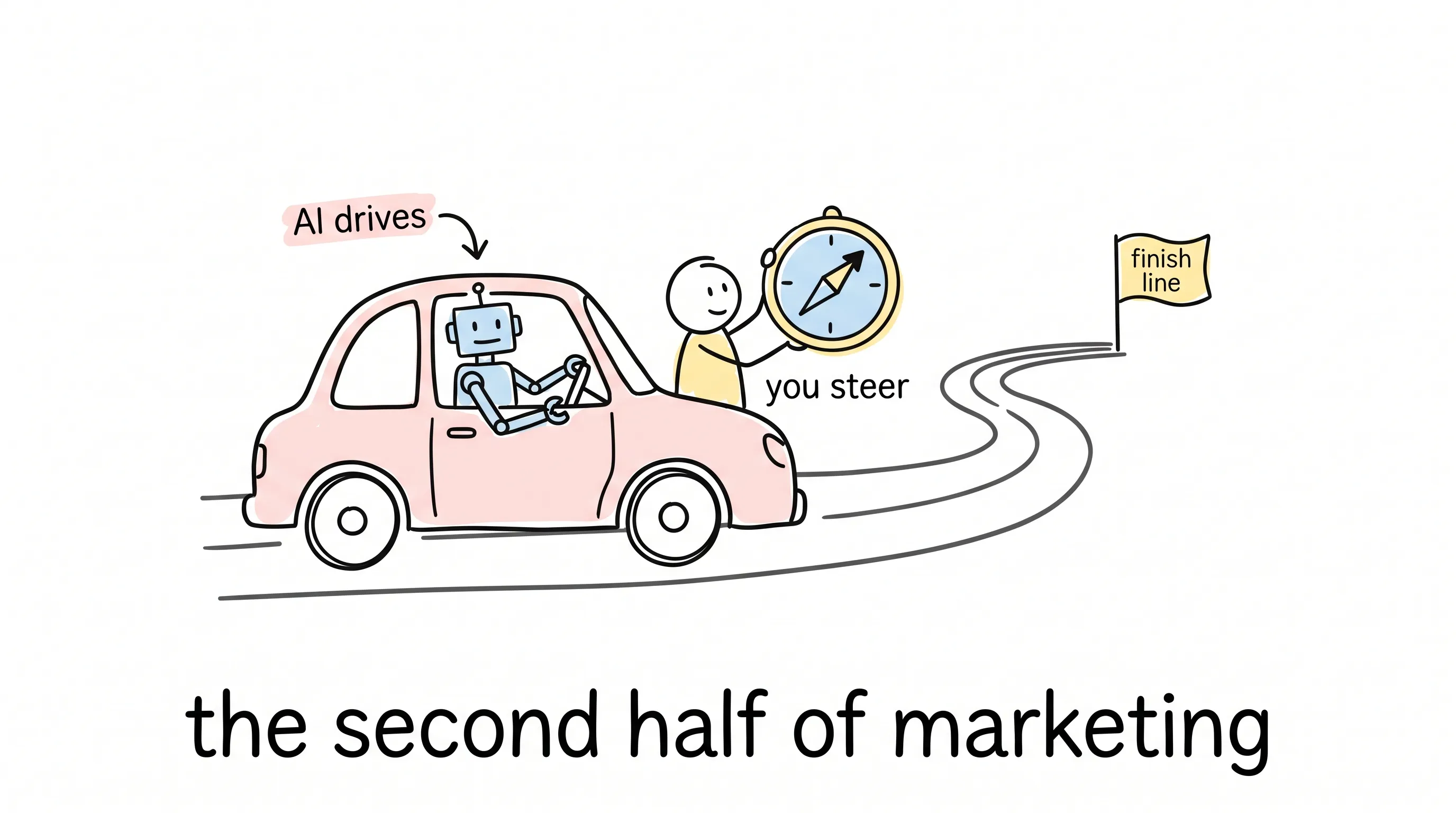
So how do you lay this foundation? Three steps. Let me walk you through them, one at a time.
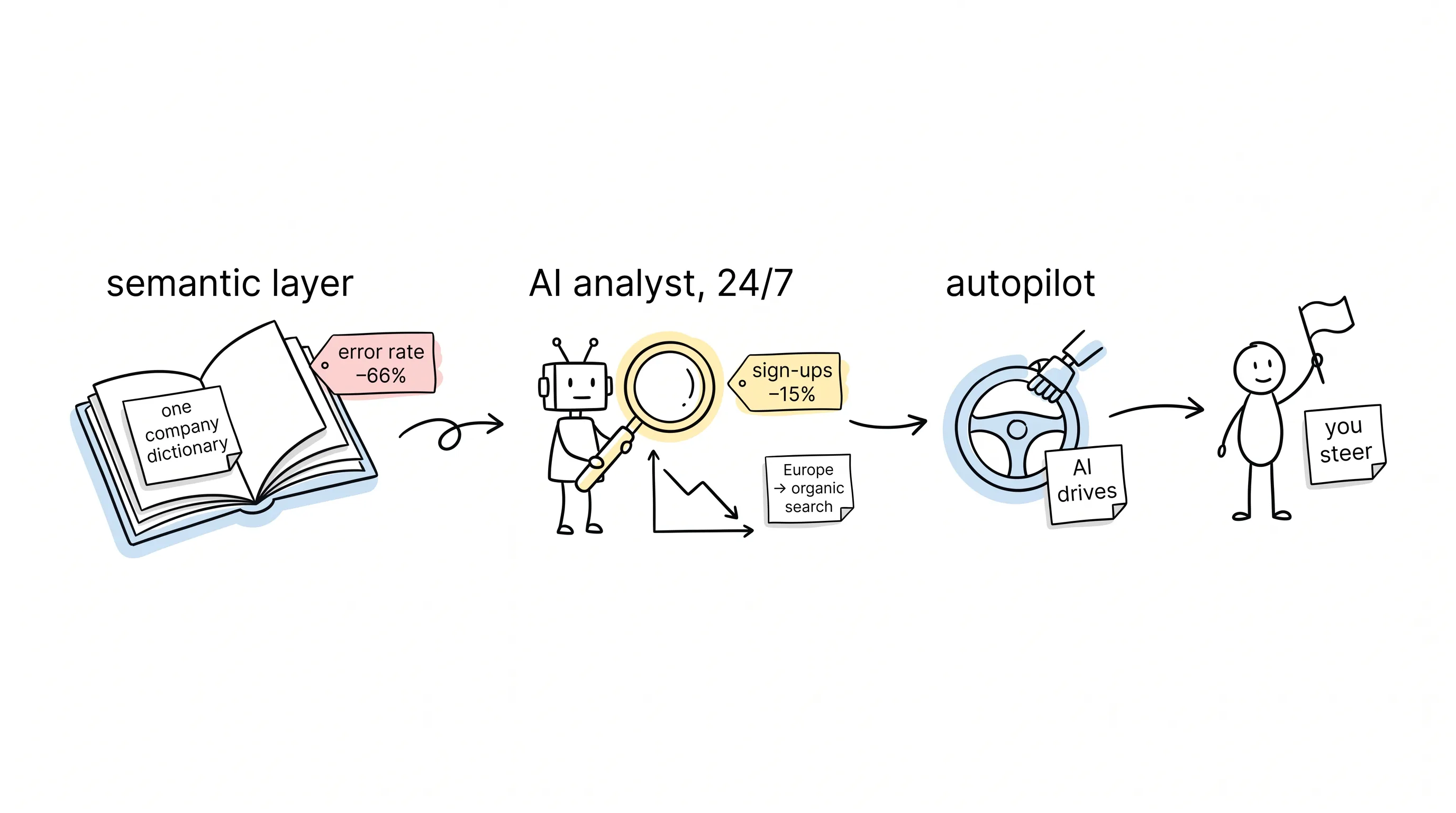
Step One: Hand AI a "Company Dictionary"
Plenty of companies excitedly bought an AI analytics assistant, only to watch it crash on the very first question.
You ask it: "What was our revenue last quarter?"
The AI is supremely confident. It adds up every column in the database that contains numbers, then solemnly reports a figure back to you.
Wrong.
It's not that the AI can't calculate. It's that it has no idea which field actually represents "revenue." Inventory amounts, refund amounts, test data... it can't tell them apart. This is what's called a hallucination. To put it bluntly: pretending to understand what it doesn't — with total confidence.
So what is a semantic layer?
It's a "business dictionary" built on top of raw data, defining every metric in plain language. For example, in black and white: total revenue equals the sum of sales amounts marked "completed."
From then on, whether it's your analysts or the AI pulling numbers, everyone works from the same definitions. One place calls the shots.
Google ran the test itself: after hooking generative AI up to Looker's semantic layer, the error rate in AI data lookups dropped by about two-thirds.
Two-thirds. What does that mean? Six or seven out of every ten mistakes the AI makes, gone.
And Google isn't the only one betting on this. Snowflake, Databricks, dbt — these data platforms are all building semantic layers into their products, precisely so AI stops guessing when it queries data.
From what I've observed, the companies that run digital marketing well all share one trait: before bringing in AI, they clean their data first and define their metrics clearly.
AI is not a miracle worker you hire; it's an employee you raise. If the foundation is shaky, even miracle workers crash.
Step Two: Hire an Analyst Who Never Sleeps
With the foundation laid, what can AI actually do?
It becomes an analyst on call around the clock.
In the past, to pull a number, you'd either wrestle with SQL yourself or submit a request, queue up, and wait for the data team's schedule. Now? You just ask in plain words: "Which campaign had the highest ROI last month?" A few seconds later, the answer arrives — with charts.
But that's still not the most impressive part. The most impressive part is that AI keeps digging on its own.
Let me give you a scenario.
Say the AI notices sign-ups dropped 15% this week. It won't stop and wait for you. It keeps asking itself: which regions dropped? Turns out Europe fell hardest. Which channel in Europe? Organic search. One more check: Google had just adjusted its search rankings those few days.
A few minutes later, it hands you a complete report: the sign-up decline comes mainly from European organic search, traffic down about 25%, possibly related to the recent search-ranking adjustment.
This kind of layer-by-layer attribution, done by a human, could take days to untangle. AI does it in minutes.
Add to that its 24/7 vigilance — it never closes its eyes, watching the backend at all times. There's a whole class of AI agents built to patrol: today, a certain ad's cost per click suddenly jumps 20%. It doesn't just flag it — it tells you which audience, which campaign, and the likely cause.
In a survey by the American Marketing Association (AMA), 71% of marketers said they use generative AI every week, and 85% of them reported a significant boost in productivity.
Why? Because pulling numbers, watching dashboards, tracing attribution — AI does these jobs fast and well, and never asks for overtime pay.
AI finds out what happened; you decide what happens next. The stronger AI gets, the more valuable people who ask good questions become.
Step Three: Hand Over the Wheel
In the first two steps, AI is still your advisor. Step three is where the real ambition lies: letting AI drive.
What does campaign autopilot look like?
You state only the goal: "Target young urban audiences, monthly budget of $100,000, ROI no lower than a threshold you set." AI handles the rest on its own: generating different ad creatives for different audiences, placing them across channels, adjusting budgets, swapping creatives, and rewriting copy in real time. Whatever performs best gets more money.
A media team glued to dashboards all day used to manage about that much — and that was the ceiling. Now a single AI agent covers all of it.
Adobe has launched AI Agent Orchestrator, and IBM is building marketing automation into its Watson line. The big players are all charging in this direction, because what brands want is a copilot of their own.
How well does it work? Let me share two results that stuck with me.
Klarna, the fintech company, put its AI copilot in charge of a large share of marketing tasks: agency spend cut by 25%, saving roughly $10 million — and note, that's with output up, not down.
Headway, a startup, leaned on AI-generated content plus automated ad optimization to rack up 3.3 billion impressions in six months, lifting video ad ROI by 40%.
3.3 billion impressions in six months. No amount of manpower stacks up to that.
By now you might be feeling a little uneasy: are marketers about to lose their jobs?
Not so fast. Handing over the wheel doesn't mean you can get out of the car.
AI Will Sprint, but Only You Know Where the Finish Line Is
AI has one defining trait: for the sake of the goal, it will use any means.
Tell it to chase click-through rate, and it writes clickbait. Tell it to chase short-term ROI, and it burns the entire budget on whichever audience shows quick results. Long-term brand value? It doesn't care — and it doesn't understand it either.
It's just like a self-driving car. You can hand it the wheel, but the speed limit is yours to set, the no-go zones are yours to draw, and a human must stay in the driver's seat, ready to hit the brakes at any moment.
Mature teams do it this way: start with a small test — let AI run one project head-to-head against a human-run one. If it performs, delegate more, step by step. Brand red lines, budget caps, review processes — all hard-coded in advance. Coca-Cola's head of global marketing put it bluntly: AI is a tool, and human wisdom matters just as much as AI. They even coined a term for it: HI (short for Human Intelligence).
So you see, the logic of the marketing organization has changed:
AI handles speed and scale; people handle judgment and taste. Entry-level jobs will hold less and less data-shuffling, and more and more interpreting insights, defining problems, and guarding the brand. Some put it even more starkly: companies may not need a "VP of AI," because AI will be woven into every job — the way electricity once was.
Finally, a Story About Seven Million Jar Labels
Truth be told, the warning signs were there long ago.
In 2017, Nutella did something remarkable in Italy: an algorithm generated 7 million one-of-a-kind jar labels — every single jar different. Seven million versions. One month. Sold out.
In a pre-AI era, you could hire the world's best designer, and they couldn't draw 7 million labels in a lifetime.
Yet even so, the most valuable part of that campaign — the insight that "every jar is one of a kind" — was human. AI handled the execution; a human made it worth executing.
This is how I understand the division of labor in AI-era marketing:
The heavy lifting of science, give to AI. The soul of art, keep for yourself.
Picture it: maybe within a few years, your workday will look like this. You arrive at the office in the morning, and AI has already mined all the data overnight — an insight digest sitting quietly in your inbox. At noon, you and your team pick one of the AI-prepared proposals and make the call. In the afternoon, the campaign goes live, with AI adjusting bids and swapping creatives in real time behind the scenes. At month's end, you flip through AI's action logs, see why it made each change, and feed the lessons into the next round.
AI will drive the car fast and steady. But where you're going is still your call.
A sense of direction is something machines can't learn.
Here's to finding your own AI copilot — soon.
Continue reading
Related articles

Cross-Border Business: Time to Upgrade Your AI Toolbox
A learn article explaining how AI tools help cross-border e-commerce sellers clear five hurdles: language, regulation, logistics, payments, and fraud. It outlines a five-compartment toolbox, a five-step adoption path, and metrics such as conversion rate and CLV, while cautioning against over-reliance on AI.

AI Is Taking Over the Dirty Work of Social Media Marketing, One Task at a Time
This learn article outlines four social media marketing tasks AI can handle — audience analytics, content drafting and design, ad targeting and creative testing, and spam moderation — and cautions that taste, judgment, and data security remain human responsibilities.

AI Is Already This Good — Why Is Your Social Media Marketing Still Pure Manpower?
An overview of 18 AI tools for social media marketing, organized into six categories covering audience research, content creation, scheduling, comment and DM handling, ad management, and visual production, plus notes on personalization, prediction, and emerging trends.