
The Real Way AI Will Change Marketing Hides in a Telescope
A learn article argues AI works like a telescope for marketing: machines absorb execution-level ad decisions while humans set intent and guardrails. It covers bias amplification, open versus closed platforms, conversational AI interfaces, and cites The Trade Desk's DSP and Koa.
A few days ago, I had dinner with an old friend who has spent more than a decade in marketing.
He was anxious: AI can already run ad campaigns on its own. Is our industry about to disappear?
I didn't answer right away. I asked him a question back: you can have AI run the ads — but can it actually "see"?
He froze for a second.
This article was born from that pause.
Marketing Has Always Been the Art of Seeing
What is marketing, really?
At its core, it's judgment. Pick the right audience, the right context, the right moment — and at exactly the right moment, put the right thing in front of the right person.
In the past, all of that judgment came from people. Running one campaign meant a team making hundreds of decisions — already intense work by any standard.
And now? Machines make more than 20 million of those decisions every second.
I did the math: 20 million-plus per second adds up to over 1.7 trillion decisions in a single day.
At that volume, no human team could even look at it all — let alone judge it.
The signals were always there. Audience, context, content, results — never in short supply. So what was missing? The ability to see. The volume grew so vast that the best any human team could do was stand by, overwhelmed.
The essence of marketing hasn't changed. What has changed is the range of what you can see.
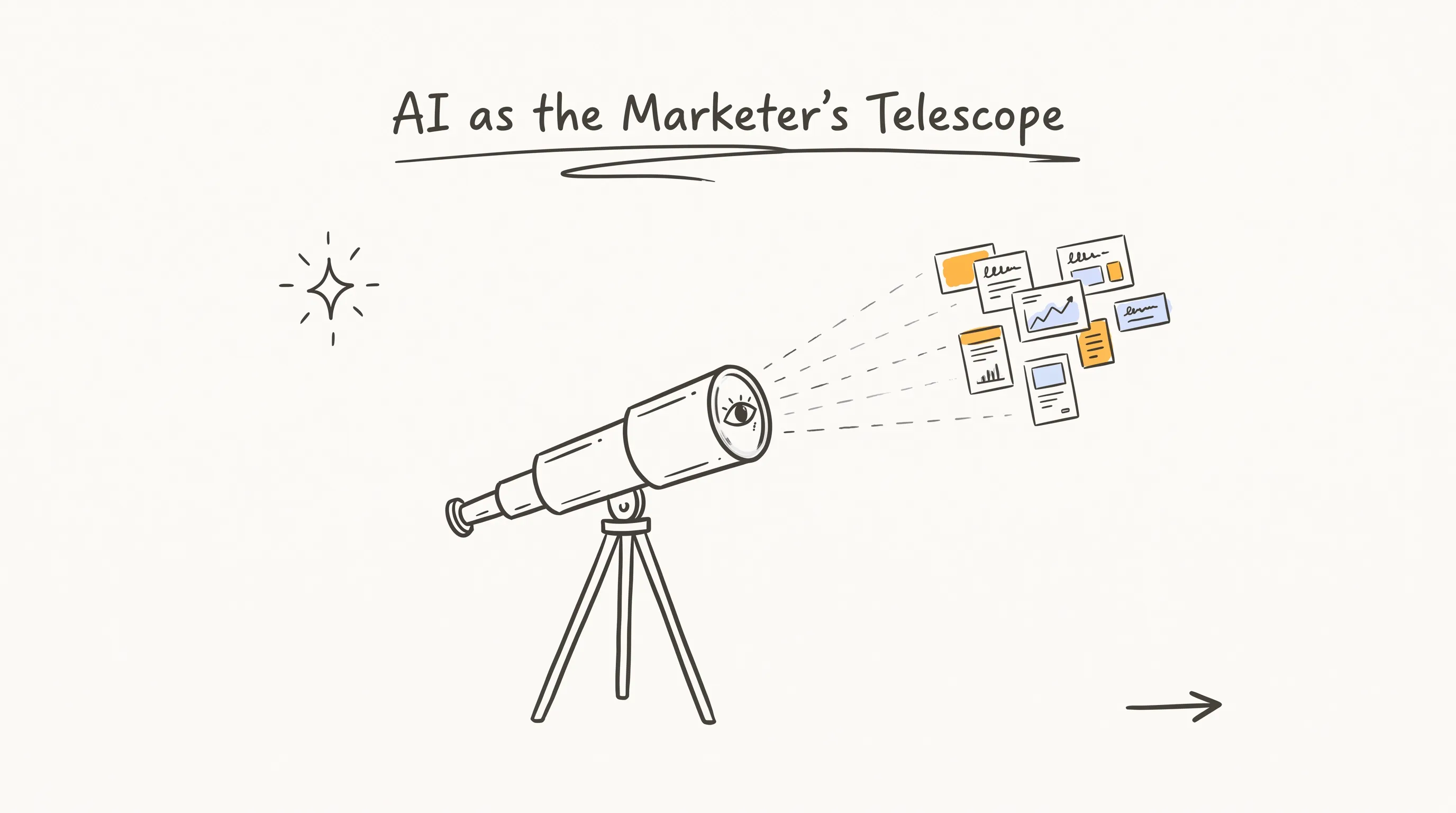
Steve Jobs once called the personal computer "a bicycle for the mind" — something that lets your brainpower pedal farther. Applied to marketing, I think AI is more like a telescope.
The stars were always in the sky. A telescope doesn't create stars; it just lets you finally see them.
"AI Replacing Marketers" Is a False Premise
People love to say that AI is coming for marketers' jobs.
I don't think that's the point.
What does AI actually swallow? Complexity. The tens of millions of execution-level decisions made every second — that's its job, and it does that job better than any human.
But intent stays in human hands. What counts as success, where the red lines are drawn, which direction to head — those guardrails must be set by people.
So this isn't machines replacing humans. It's human judgment, amplified.
Instead of turning every knob yourself, you stand at a higher vantage point: set the direction, watch the results.
But There's Always a Flip Side
How good AI can be depends on how complete the data beneath it is.
That sentence deserves a closer look.
Inside a platform that is large enough and objective enough, AI can see the full context — audience, inventory, performance, measurement, all of it. Against your goal, it can make well-rounded judgments.
But step outside that circle?
It's the blind men and the elephant.
There's a fashionable fantasy in the industry right now: layer a swarm of agents on top of ad systems, let them coordinate and orchestrate themselves, and run entire campaigns end to end.
It sounds elegant.
But think about it: if the data underneath is already incomplete and skewed, what happens to the AI layer on top?
Scale doesn't correct errors. Scale amplifies them.
AI that learns from biased data doesn't fix the bias. It puts bias on fast-forward, accelerating it straight into the results.
Why "Open" Suddenly Matters So Much
So what's the way out?
That brings us to one word: open.
In the AI era, platforms are shifting from "tools" to "infrastructure." A tool is something you pick up and use; infrastructure is the layer that decides what data is visible, which signals can connect, and what decisions AI is actually allowed to make.
Closed systems have a built-in flaw: they optimize only their own inventory and their own ledger. The AI they raise is lopsided by design.
AI doesn't eliminate bias. AI only amplifies it.
An objective platform that spans the open internet, by contrast, can judge every opportunity on its merits: whether an impression is worth its price should depend on its quality, not its pedigree.
That's why The Trade Desk is betting the future of its DSP (demand-side platform, where advertisers buy digital ads programmatically) on becoming "the operating system for modern marketing": wiring AI into the open internet, integrating signals from every source, and making optimization more transparent and better grounded.
Open systems make good outcomes possible. Closed systems cap visibility by design.
In a world where AI makes the decisions, this difference is no longer a philosophical debate. It's a structural one.
From Pushing Buttons to Directing Agents
How marketers work with machines is changing too.
Before, you fiddled with dashboards. Now, more and more people simply ask questions:
Why isn't this campaign scaling?
Which audiences are driving conversions?
What should I change to improve performance?
AI systems like The Trade Desk's Koa can already understand questions like these, run the diagnosis themselves, and come back with recommendations. The interface is no longer a dashboard — it's a conversation, one line at a time.
The significance goes beyond convenience.
It's that the marketer's role has changed: you used to manage tools; now you direct outcomes.
Fewer buttons, more decisions.
The Open Internet Is Growing
There's one more shift, buried deeper still.
For years, search ads and social ads have been locked inside their own closed platforms. AI is prying those walls open.
Conversational interfaces, generative search, AI-driven discovery — a whole new kind of ad placement is growing out of them.
But the game has changed. Keyword targeting was built for search queries a couple of words long. Now users chat with AI in long paragraphs, with intent and preferences hidden inside the prompt. In that setting, buying keywords won't capture them. You need audience targeting — the old craft that programmatic advertising (ads bought automatically by algorithms rather than by hand) has been honing for years.
More and more of the consumer journey will move into these conversations. Ad inventory isn't shrinking — it's expanding.
At that point, search and social ads will no longer be trapped behind their own walls. Like CTV (connected TV, ads inside streaming services), they'll flow into the open internet.
We've come full circle, back to the question at the start:
above all of this, who — or what — can truly see all of it?
Whoever Sees Farther Wins
At the end of that dinner, my friend asked again: so what should marketers actually do?
I said the next generation of marketing won't be won by whoever has the most dashboards or the most buttons.
It will be won by visibility. Seeing your audience, seeing your results, seeing the opportunities that were simply invisible before.
The winner isn't the one with the most tools. It's the one who sees farthest.
The personal computer was a bicycle for the mind. AI is becoming a telescope for marketing.
Here's to becoming the one who sees farther.
Continue reading
Related articles

Cross-Border Business: Time to Upgrade Your AI Toolbox
A learn article explaining how AI tools help cross-border e-commerce sellers clear five hurdles: language, regulation, logistics, payments, and fraud. It outlines a five-compartment toolbox, a five-step adoption path, and metrics such as conversion rate and CLV, while cautioning against over-reliance on AI.

AI Is Taking Over the Dirty Work of Social Media Marketing, One Task at a Time
This learn article outlines four social media marketing tasks AI can handle — audience analytics, content drafting and design, ad targeting and creative testing, and spam moderation — and cautions that taste, judgment, and data security remain human responsibilities.

AI Is Already This Good — Why Is Your Social Media Marketing Still Pure Manpower?
An overview of 18 AI tools for social media marketing, organized into six categories covering audience research, content creation, scheduling, comment and DM handling, ad management, and visual production, plus notes on personalization, prediction, and emerging trends.