
The Real Story of AI This Year: It Started "Taking Over"
An analysis of how AI agents are shifting from tools to coworkers, covering platform agent launches, in-conversation ads and payments, the "mediocrity tax" on generic content, and four suggested actions for marketing teams.
A while back, I had tea with an old friend who has run an e-commerce business for over a decade.
His company isn't big — a few hundred million yuan a year in sales. Somewhere into the conversation, he said something I still remember today:
"I used to hire people by asking if they could make a good slide deck. Now I hire by asking if they can manage several 'AI employees.'"
I paused for a second.
AI employees?
He said, just go read the news from those few days in April this year and you'll get it. The big companies in Silicon Valley and in China, as if they had coordinated in advance, all made their moves within days of each other — and every one of them was doing the same thing: turning AI from "a tool you use" into "a coworker that works for you."
When I got home, I went through all of it, and the more I read, the clearer it became: this matters more than any single product launch.
So today, let me walk you through what I saw.
What Is an Agent? In One Sentence: It's an "Employee," Not "Software"
First, a word worth defining.
What is an Agent?
Software only moves when you move it. Open a document app, and it won't write a proposal on its own.
An Agent is different. You give it a goal, and it breaks the work into steps by itself, runs across systems by itself, asks you for the resources it needs, and comes back to report when the job is done.
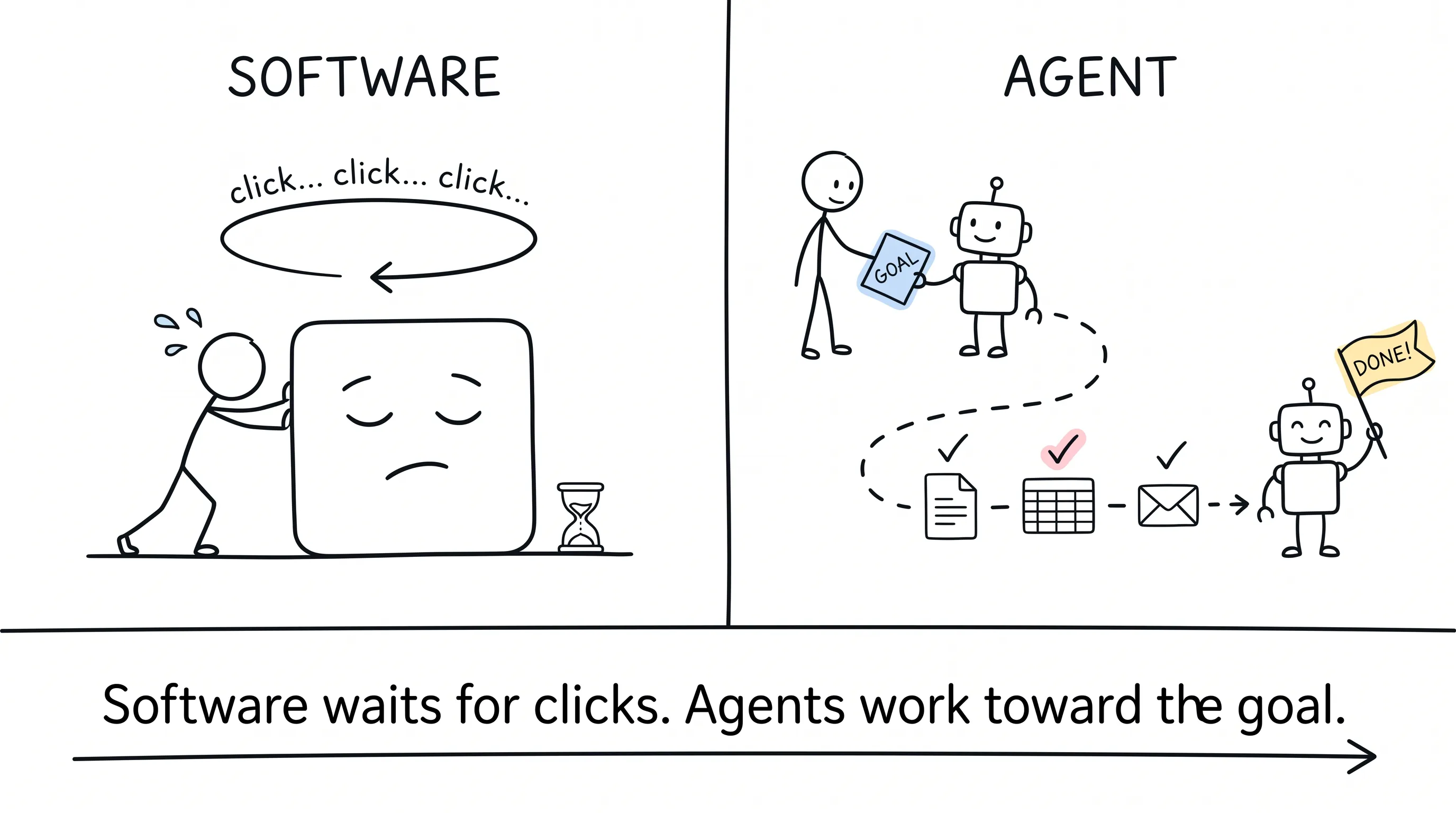
This April, Adobe did something big: it renamed Experience Cloud — a platform it had built for years — to CX Enterprise, and rebuilt the whole platform around Agents. It even gave these AIs a brilliant name: Coworkers. As in, colleagues.
A colleague is not a tool. A colleague keeps working toward a business goal on their own, coordinating tasks across systems.
That same month, OpenAI rolled out workspace agents inside ChatGPT: they go read the context in Slack and Gmail themselves, walk through the workflow themselves, and come ask you only when a decision needs a human.
Microsoft pushed Agent Mode into Word, Excel, and PowerPoint. It edits content, updates data, preserves formatting — and demonstrates every step to you in real time.
Google wasn't sitting still either. Its enterprise strategy is now all-in on Gemini Enterprise, and the new Intelligence system in Workspace can string together data across Docs, Sheets, and Gmail — proactively building spreadsheets for you, untangling messy data, drafting first versions.
Think about it: companies that are normally bitter rivals moved in remarkable lockstep this time.
There is exactly one direction all the platforms are betting on: tools no longer wait for someone to click. They run on their own.
What Should Worry You Even More: They've Started Paying on Your Behalf
If "working for you" is still just an efficiency story, what comes next strikes at the business itself.
Microsoft launched AI Max in its ad system, extending search matching into AI conversations on Copilot and Bing, and built Offer Highlights, which puts a product's core selling points right in front of the user mid-chat. The subtext is unmistakable: the battle in advertising is shifting from "who ranks first" to "who gets picked by the AI."
OpenAI is testing pay-per-click ads inside ChatGPT, and building a conversion-tracking pixel — to find out whether that ad in the conversation actually became a signup, an order. This step is crucial. Only with attribution do budgets dare to move.
Payments are even more direct. With Alipay's AI Pay, once a user grants authorization, an AI agent can complete a payment in a single sentence, backed by layered security design and real-time risk control. Yelp's AI assistant goes from "find me a restaurant" to "table booked" within one conversation.
Have you noticed? The old internet playbook was "grab attention first, then convert slowly." Now attention and conversion are compressed into the same conversation.
The purchase decision may happen inside the AI's answer.
So what does that mean for marketing?
In April this year, a group of search practitioners put a name to it, and I think it's dead on: "the mediocrity tax." Generic, everyone-says-the-same content is being filtered out by AI outright — you don't even get a chance to show up.
The flip side: comparison, review, and evaluation content — high-intent content — is worth more than ever. Because when AI answers informational questions on the spot, it saves the user that click. But when the user actually means to spend money, the AI needs to cite "answers it can trust." Whoever gets cited is standing inside the deal.
Mediocrity now comes with a tax.
The Model Race Has Changed Direction: Who Gets Smart More Cheaply
Of course the loudest news was about models. Let me pick a few.
OpenAI released GPT-5.5, explicitly on a "super app" route: chat, coding, browser, folded into one interface.
China's three players moved almost simultaneously.
DeepSeek released a preview of V4 — a big step forward in reasoning and autonomous execution, split into pro and flash variants. Alibaba served up Qwen 3.6-Max-Preview, with standout scores on coding and Agent tasks — and this version is now closed, paid only. Tencent's Hy3 is the most interesting of all: 295 billion parameters on a mixture-of-experts (MoE) architecture, activating only a small slice for each task; from infrastructure upgrade to model release, under three months.
Three signals worth remembering:
- Chinese models are shifting from open source to paid. The free lunch is receding, and AI's cost structure needs to be recalculated.
- Efficiency is the new battlefield. 295 billion parameters with only a fraction activated — in plain words: being smart cheaply is worth more than being smart.
- Iteration cycles keep shrinking. Three months a round — your suppliers, your competitors, everyone lives at this tempo.
The Other Side of the Coin — Reading It Gave Me a Chill
Writing up this batch of news, there was one item I kept struggling to tell.
Employees at a Chinese company reported being asked to write down their workflows, one step at a time, and hand them to AI to "learn." And what was it learning? Learning to replace them.
Subtler still: some people have started writing small scripts to deliberately "poison" their own operation logs, so the automation learns nothing real.
Efficiency and people just collided head-on.
Honestly, I'm excited and uneasy at once. Excited because AI really is pulling people out of repetitive work. Uneasy because the moment you're pulled out, nobody guarantees where you'll land.
I don't plan to hand you an answer to this one. But it deserves every team leader's attention tonight.
What This Means for You: Four Things
That's a lot of talk. So how do you move?
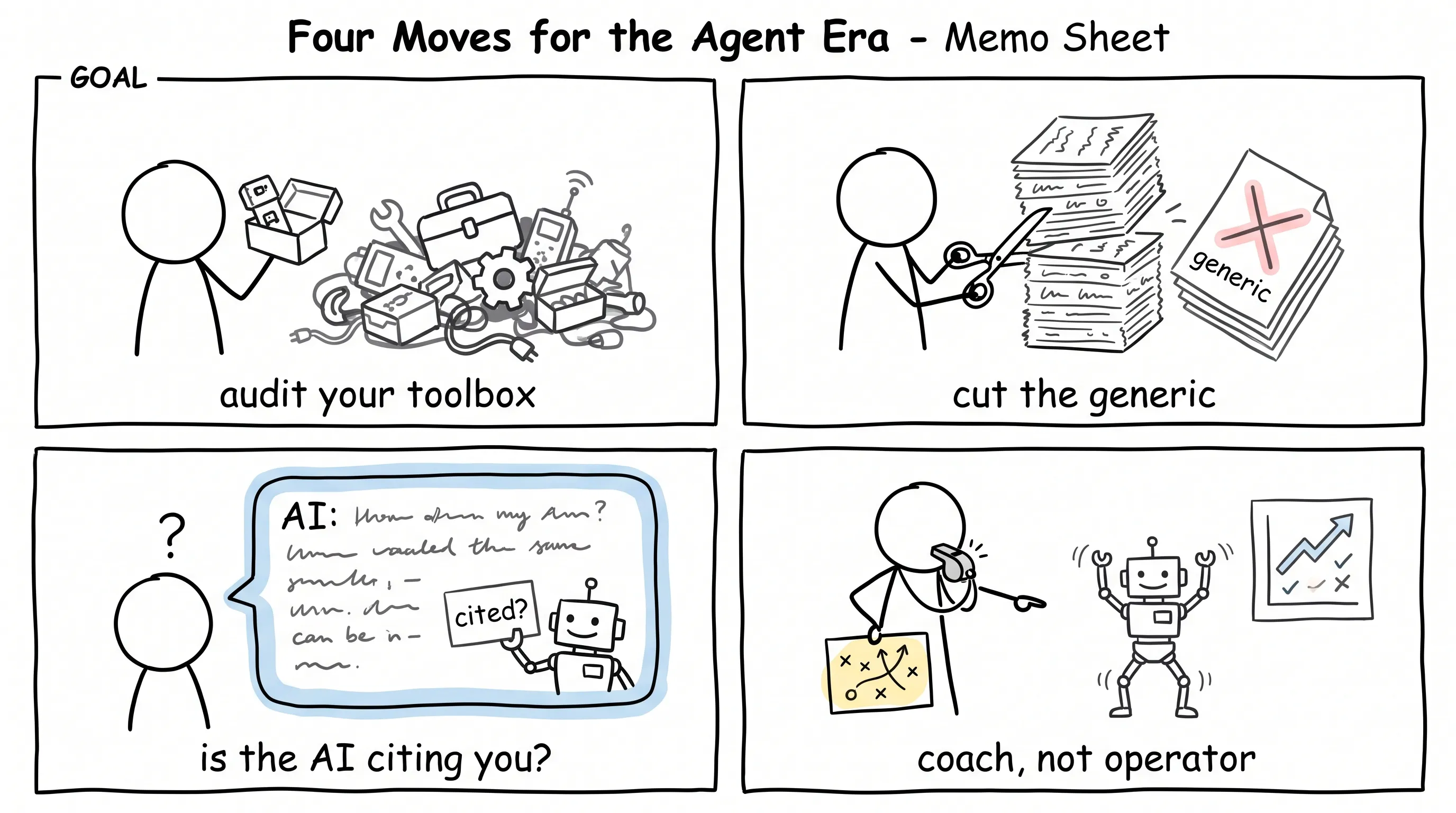
First, audit your toolbox. Consolidated platforms will keep multiplying — research, content, automation, and analytics in one environment. Stop hoarding ten little tools; pick the two or three that can "grow together."
Second, redo your content math. Look at what you published over the past six months, cut the topics where "anyone could have written it," and put the saved effort into original data, unique viewpoints, and consistent brand signals across channels.
Third, redefine "results." Clicks will keep shrinking; conversions will happen more and more in places you can't see. Track whether the AI cites you, picks you, recommends you — that matters more than watching your ranking.
Fourth, transform your team from "operators" into "coaches." Once agents take over execution, human value lies in designing the process, enforcing the rules, and guarding quality. Whoever gets this management model working first takes the dividend first.
Back to That Cup of Tea
At the end of that tea, I asked him: are you scared?
He said: "Scared of what? We've swapped tools how many times now. When we went from Excel to BI systems, nobody got cut because of it — I learned it first, that's all."
Right. The tools keep changing. What never changes: whoever learns first sets the rules for those who learn later.
AI taking over execution is exactly the best moment for humans to take over judgment.
Maybe two years from now, the résumés we read won't say "proficient in such-and-such software" — they'll say "managed three AI coworkers, and one of them even got promoted."
And I wish for you: be the one who sets the process for AI, not the one who writes AI's onboarding manual.
Continue reading
Related articles

Cross-Border Business: Time to Upgrade Your AI Toolbox
A learn article explaining how AI tools help cross-border e-commerce sellers clear five hurdles: language, regulation, logistics, payments, and fraud. It outlines a five-compartment toolbox, a five-step adoption path, and metrics such as conversion rate and CLV, while cautioning against over-reliance on AI.

AI Is Taking Over the Dirty Work of Social Media Marketing, One Task at a Time
This learn article outlines four social media marketing tasks AI can handle — audience analytics, content drafting and design, ad targeting and creative testing, and spam moderation — and cautions that taste, judgment, and data security remain human responsibilities.

AI Is Already This Good — Why Is Your Social Media Marketing Still Pure Manpower?
An overview of 18 AI tools for social media marketing, organized into six categories covering audience research, content creation, scheduling, comment and DM handling, ad management, and visual production, plus notes on personalization, prediction, and emerging trends.