
The Product Is Only the Entry Ticket — the Customer Journey Is the Business: I Cracked Open Microsoft Dynamics 365 Customer Insights
A learn article that takes apart Microsoft Dynamics 365 Customer Insights, explaining its Data and Journeys components, Copilot-powered personalization, autonomous AI agents, real-time orchestration, and trust and privacy considerations across the customer journey.
A few days ago, I had dinner with a friend who runs a chain of gyms.
The dishes had just been served when he started complaining. His class content was second to none, every trainer was a professional, and the facilities had been renovated just last year — yet members kept walking away, and the renewal rate looked uglier every year.
He put down his chopsticks and asked me: tell me, where exactly am I losing?
I said: you're probably not losing on the product. You're losing on "the journey."
What is "the journey"?
It's every step a customer takes between hearing about you for the first time and telling everyone about you every day.
My friend poured all his energy into a single point: the product. But when customers wanted to learn about him, could they find a person? When they showed up for the first time after paying, did anyone greet them? When one of them got sick and skipped a visit, did anyone ask?
None of these moments happen inside your "product." But every one of them quietly decides whether a customer stays or goes.
The customer journey itself is the product.
As it happens, I recently sat down and studied Microsoft's Dynamics 365 Customer Insights properly, and the longer I looked, the more I felt this thing does exactly the job I described above: managing the customer's whole journey, from start to finish.
Some things are worth taking apart for you, piece by piece.
What Is a Customer Journey? Start with Dating
When many people hear "customer journey," they assume it's one of those empty textbook phrases. But think about it — it's almost exactly like falling in love.
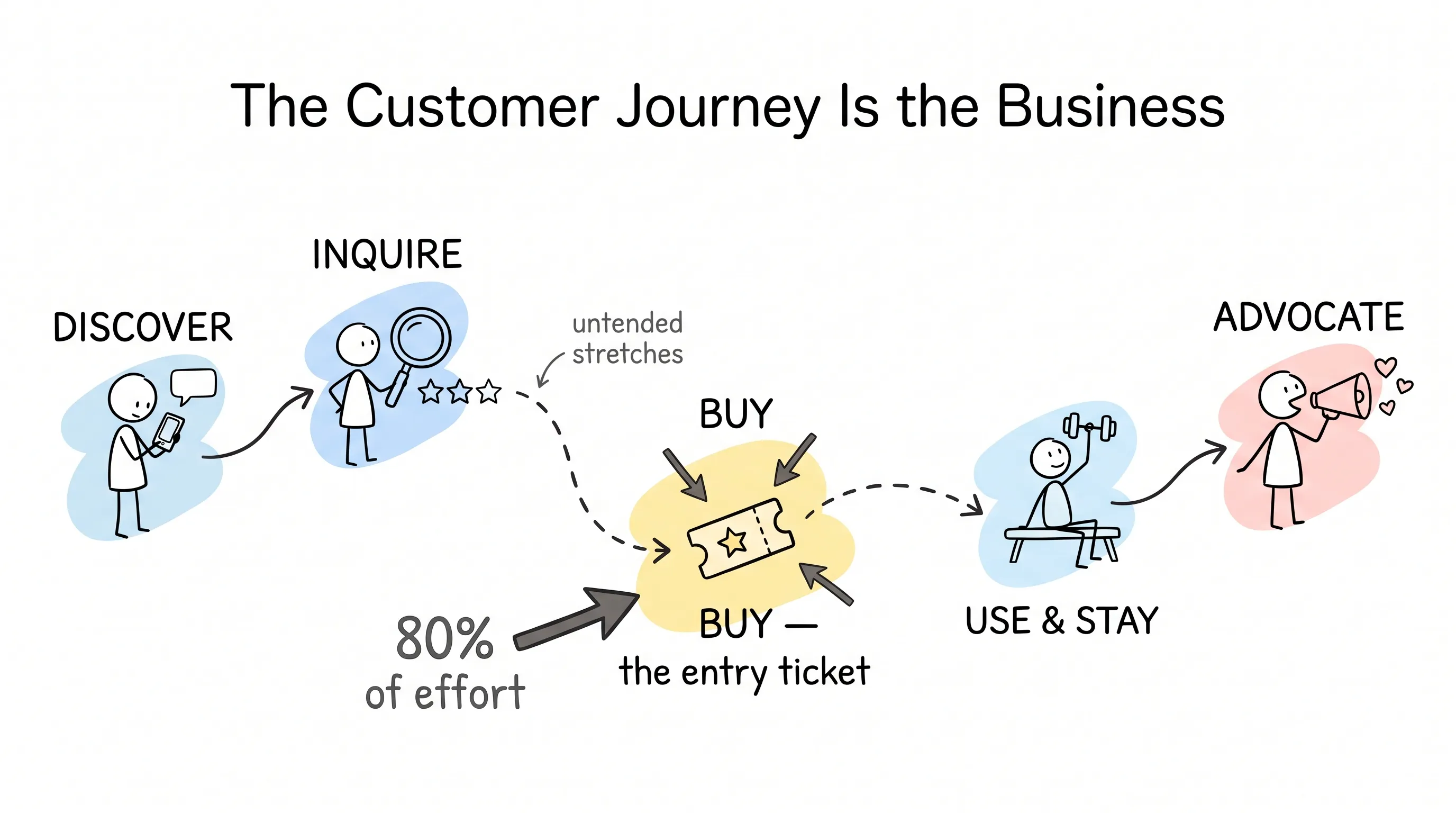
Stage one: hearing about someone. A friend mentions a person, it leaves an impression, but you're not invested yet. At this stage, the customer has just realized they have a need, and stumbled across you while scrolling.
Stage two: making inquiries. Now you're interested, so you start asking around: is this person trustworthy? How do they compare with others? Customers do the same — reading reviews, comparing plans, checking out your competitors.
Stage three: getting together. The moment of confession? That's the customer placing an order. This step needs a push — a clear call to action beats a hundred lines of polished copy.
Stage four: building a life together. This is precisely the hardest part. The wedding is only the beginning; a marriage is built one ordinary day at a time. After the customer pays, every subsequent use, every service interaction, keeps answering the same question: was choosing you, back then, the right call?
Stage five: speaking up for you. When the relationship thrives, they praise you to everyone they meet, and introduce new friends to you. Behind every loyal customer stands a crowd of potential ones.
Put the five stages side by side and you'll see a painful truth: most companies spend 80% of their energy on the single instant of stage three.
No one catches them on the way in. No one tends to them afterward.
Business is usually lost in those two untended stretches.
One Part Handles Memory, One Part Handles Action
So what exactly is Dynamics 365 Customer Insights?
It started life as Dynamics 365 Marketing; Microsoft later upgraded it, and today it comes as two pieces joined together.
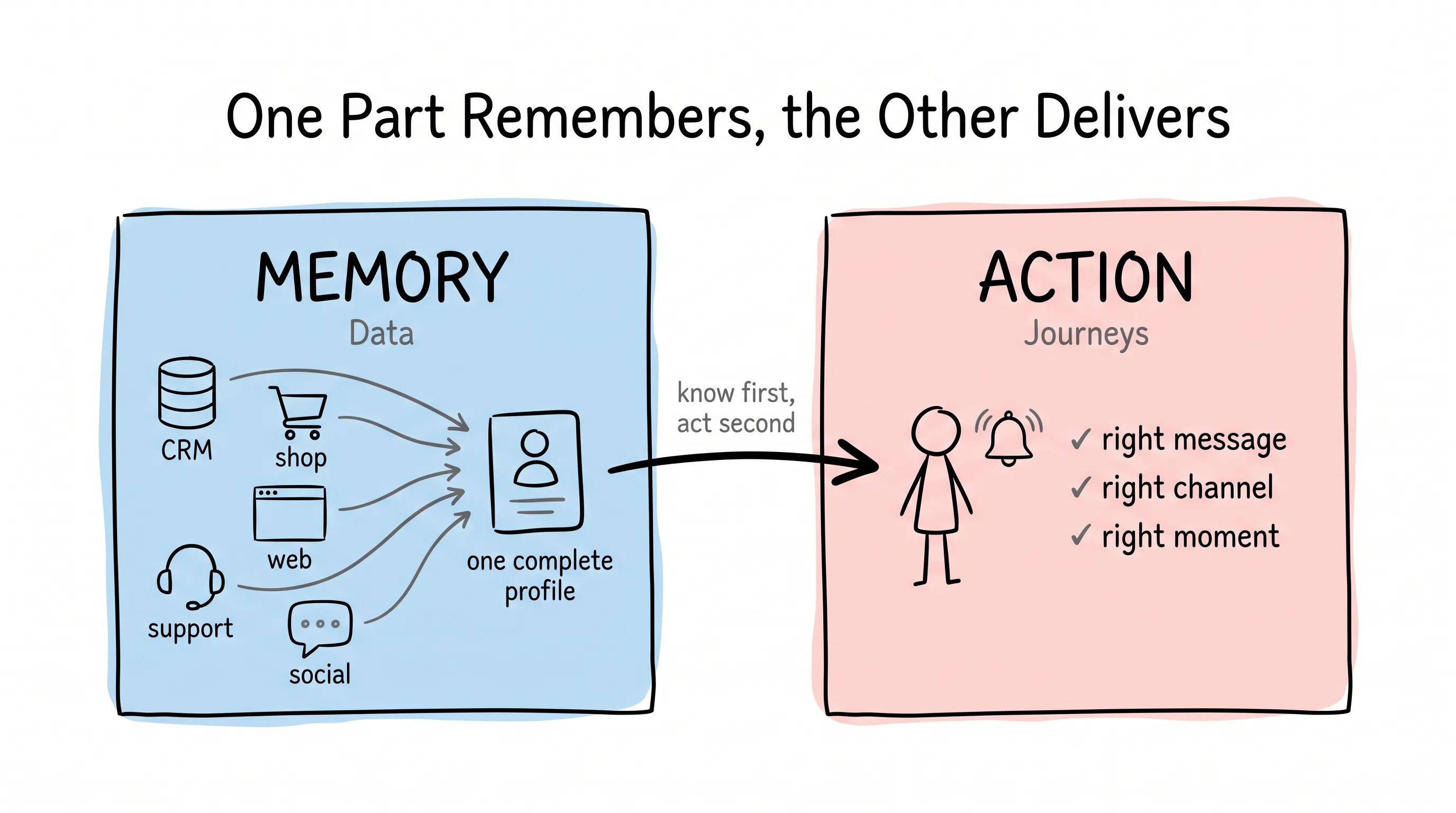
One piece is called Customer Insights – Data, and it handles memory. It gathers customer information scattered across your CRM, e-commerce backend, website, customer service records, and social media, and merges it into one complete profile. In other words, your company finally "knows" every customer, instead of every department clutching one fragment of them.
Think about how common this scenario is: last week a customer complained to support about slow shipping; this week your marketing email goes out right on schedule, warmly pitching a new product. How does he feel? He'll conclude that your company's left hand doesn't know what its right hand is doing.
The other piece is called Customer Insights – Journeys, and it handles action. Once you hold complete memory, the next job is doing the right thing at the right moment, on the right channel. What the customer clicked, what they bought, how many days they've been away — all of it triggers the next move.
One part remembers. The other delivers.
Know the person first, then act. Get the order backwards, and it's all for nothing.
Personalization Left "Dear User" Behind Long Ago
Now for the part I find most interesting.
What is personalization? To many business owners, it means: swapping "Dear user" for the customer's name at the top of an email already counts as quite "advanced."
Good grief. That was the standard ten years ago.
Personalization today means this: the system knows what content this customer prefers, which channel they habitually use, roughly when they'll buy again — and then delivers the right thing at the right time. Those "signed up and forgotten" customers at my friend's gym are, in the system's eyes, the very people who deserve extra attention.
Microsoft has built a rather interesting feature on top of this, called Query Assist, powered by Copilot. Marketers used to need database skills to carve a segment out of millions of customers, writing query conditions by hand. Now you type a plain sentence into the box — "the people most likely to attend our new product launch" — and it picks that segment out for you.
If you can talk to the system, you can run marketing. The barrier to entry has been slashed.
But there's a hurdle here you can't get around.
One consumer survey produced eye-catching numbers: more than 70% of consumers expect personalization, and would even spend 50% more with brands that do it well. Yet in the same survey, fewer than 40% believed personalization's benefits outweigh their privacy concerns.
On one side: "You should understand me." On the other: "Don't spy on me."
Both wishes exist at the same time, and both are legitimate.
What to do? My answer comes down to three rules. First, be open: write in plain language what you collect and what it's used for — don't hide it. Second, lean on information customers hand you voluntarily, like preferences they fill in or surveys they take, and cut back on sneaky, behind-the-scenes tracking. Third, hand over the switch: let customers decide whether they want to be personalized, and let them turn it off anytime.
Customers don't resent you for understanding them. They resent you for understanding them behind their backs.
What Are Agents? A Tireless Helper with Eyes
In the update that rolled out in the second half of 2025, Microsoft packed autonomous AI agents into Customer Insights. This is the part I think deserves a section of its own.
What is an agent?
Start with what it isn't. It's not the traditional kind of automation. Traditional automation is like a vending machine: coin in, product out, rules hard-coded. Button three dispenses cola, always cola, unchanged for ten years.
An agent is a different animal. It's more like a tireless helper with eyes: it reviews lead information on its own, judges on its own whether a person shows purchase intent, decides on its own what to do next, then acts. Around the clock, no vacations, no tantrums.
It's especially good at a few things.
Researching leads. It watches prospect activity every day, picks out the promising ones, and hands them to sales at the best possible moment. No more searching for a needle in a haystack.
Reaching out first. No waiting for the customer to speak up. When the system spots usage that suggests a customer is due for an upgrade, or that they've recently hit trouble, the helper goes over and says hello one step ahead.
Early warnings. Customers rarely churn suddenly; almost always, they slowly cool off. Agents specifically watch for these "cooling signals," sounding the alarm as soon as risk emerges and opening a window of time to win them back.
Writing content. With Copilot doing the drafting, it writes different versions for different audiences, then keeps tuning them based on the data coming back.
How well does it work? One industry study found that 83% of customer experience executives believe agents with memory are the real key to personalization. Companies actually using them report efficiency gains of up to 25%.
Twenty-five percent — before even counting the direct contribution to growth. That's essentially a batch of junior employees who appeared out of thin air and don't draw a salary.
And the cost of trial and error has come down too. Starting at the end of 2025, the Premium plan includes 1,000 Copilot credits per user every month. Adopting AI used to mean committing a budget first. Now you can experiment on a small scale, and pour it on once results show.
Customers Won't Stand Still and Wait
There's one more shift — not flashy, but I think it carries the most weight.
Most marketing in the past was "wholesale": campaigns scheduled in advance, blasted out on time, then everyone waits for replies. Like printing a newspaper, issue after issue.
But how do customers behave now? They scroll past you at midnight and want an answer five minutes later.
Take the most common example. A customer fills the shopping cart, then walks away at the last second without paying.
The wholesale approach: the next day, or the day after, send this customer an email — "You have items awaiting checkout." By the time it arrives, they've long since bought from someone else.
The real-time approach: the cart is barely abandoned when, within minutes, a reminder arrives, carrying recommendations for the very items they lingered over.
Same budget: one lands too late to matter, the other arrives exactly when it counts.
That's the point of real-time orchestration (the system catching each customer's action and responding on the spot) in Customer Insights – Journeys: every customer action — browsing, clicking, ordering, returning, submitting a ticket, even mentioning you on social media — becomes a signal the system catches and answers on the spot. Which path to take, what to say, when to say it — all decided by what's happening at this very moment.
One detail matters enormously: consistency across channels. If the email shows 20% off, your website had better show 20% off too — no such thing as each department quoting its own price. The customer switched channels; they shouldn't be rewarded with the feeling of being cheated.
By one statistic, companies running real-time orchestration see marketing conversion lift between 35% and 50%. Not everyone can replicate that exact number, but the direction is clear: whoever catches the customer's moment first wins the customer.
Of course, there's a precondition for any of this to run: the data from all your touchpoints must first flow to one place in real time. Full circle, right? That's why Customer Insights – Data came first in this piece. Memory is the foundation action stands on.
The Last Gate Is Called Trust
By now you might be thinking: AI has the whole journey managed — great, time to floor it.
Not so fast. There's something more important than every feature covered above.
Consider a few more numbers, from a round of research into the customer experience industry: only 37% of organizations can explain to customers "why the AI decided this," yet 80% of executives believe transparency is non-negotiable going forward. 53% of consumers worry most about personal data being misused; 76% say that if they can't trust how you keep their data, they won't buy from you.
Savor the shape of these numbers: capability on the supply side is sprinting, while trust on the demand side is still spinning in place.
However smart the AI, if customers don't trust you, everything resets to zero. They don't know why you recommended this — they just feel manipulated.
So I want to call this last stretch a gate. Three things you must have in place first.
One: be able to explain. When a customer asks "why did you recommend this to me," you need an answer. Even one sentence beats silence.
Two: provide a human exit. No matter how strong the machines, when customers hit a complicated problem, they must be able to find a living person anytime. This rule looks clumsy, but it's the single biggest source of reassurance.
Three: take less data. If one field solves it, don't collect ten; if it was promised for shipping only, don't use it for anything else. Audit regularly — don't wait until something goes wrong to patch it up.
Research firm KPMG's studies point to a counterintuitive conclusion: the number-one factor driving customer loyalty today is not price, and not perks — it's integrity, paired with empathy.
Trust is not a compliance cost. It's your cheapest growth lever.
Back to That Friend with the Gyms
Time to bring this full circle.
By the end of that dinner, my advice to him was very concrete: don't rush to add new classes. First, keep close watch on the first 30 days after a member signs up. Someone to guide them on the first visit, someone to ask if they haven't come for a week, someone to reach out before the membership expires. Just three things.
Last month he messaged me: the renewal rate had stopped falling and started climbing.
He didn't change trainers, didn't renovate, didn't cut prices. He simply re-laid the road his customers walk.
You see, the product was never more than the entry ticket. What really decides the business is every step the customer takes with you. This used to depend on people watching — and people can't watch everything. Now a tool like Microsoft Dynamics 365 Customer Insights has turned "watching every step" into something that can scale.
It's a good tool. But in the end, it's the same old line: tools can manage the process; they can't manage whether, in your heart, you treat customers as people.
Treat customers as people, and use the right tool. Get both in place, and business won't be bad.
Here's to customers who walk in the door — and choose to keep walking with you.
Continue reading
Related articles

Cross-Border Business: Time to Upgrade Your AI Toolbox
A learn article explaining how AI tools help cross-border e-commerce sellers clear five hurdles: language, regulation, logistics, payments, and fraud. It outlines a five-compartment toolbox, a five-step adoption path, and metrics such as conversion rate and CLV, while cautioning against over-reliance on AI.

AI Is Taking Over the Dirty Work of Social Media Marketing, One Task at a Time
This learn article outlines four social media marketing tasks AI can handle — audience analytics, content drafting and design, ad targeting and creative testing, and spam moderation — and cautions that taste, judgment, and data security remain human responsibilities.

AI Is Already This Good — Why Is Your Social Media Marketing Still Pure Manpower?
An overview of 18 AI tools for social media marketing, organized into six categories covering audience research, content creation, scheduling, comment and DM handling, ad management, and visual production, plus notes on personalization, prediction, and emerging trends.