
The Next Hard Battle for AI Advertising Isn't in the Algorithm — It's in Culture
An analysis of AI advertising argues that cultural fit matters more than technical quality when ads cross markets. Drawing on Yiwu merchants as a case study and a 2024 survey, it reports regional satisfaction gaps and recommends cultural data inputs, local review, and market-specific strategies.
A while back, I came across a detail that stuck with me.
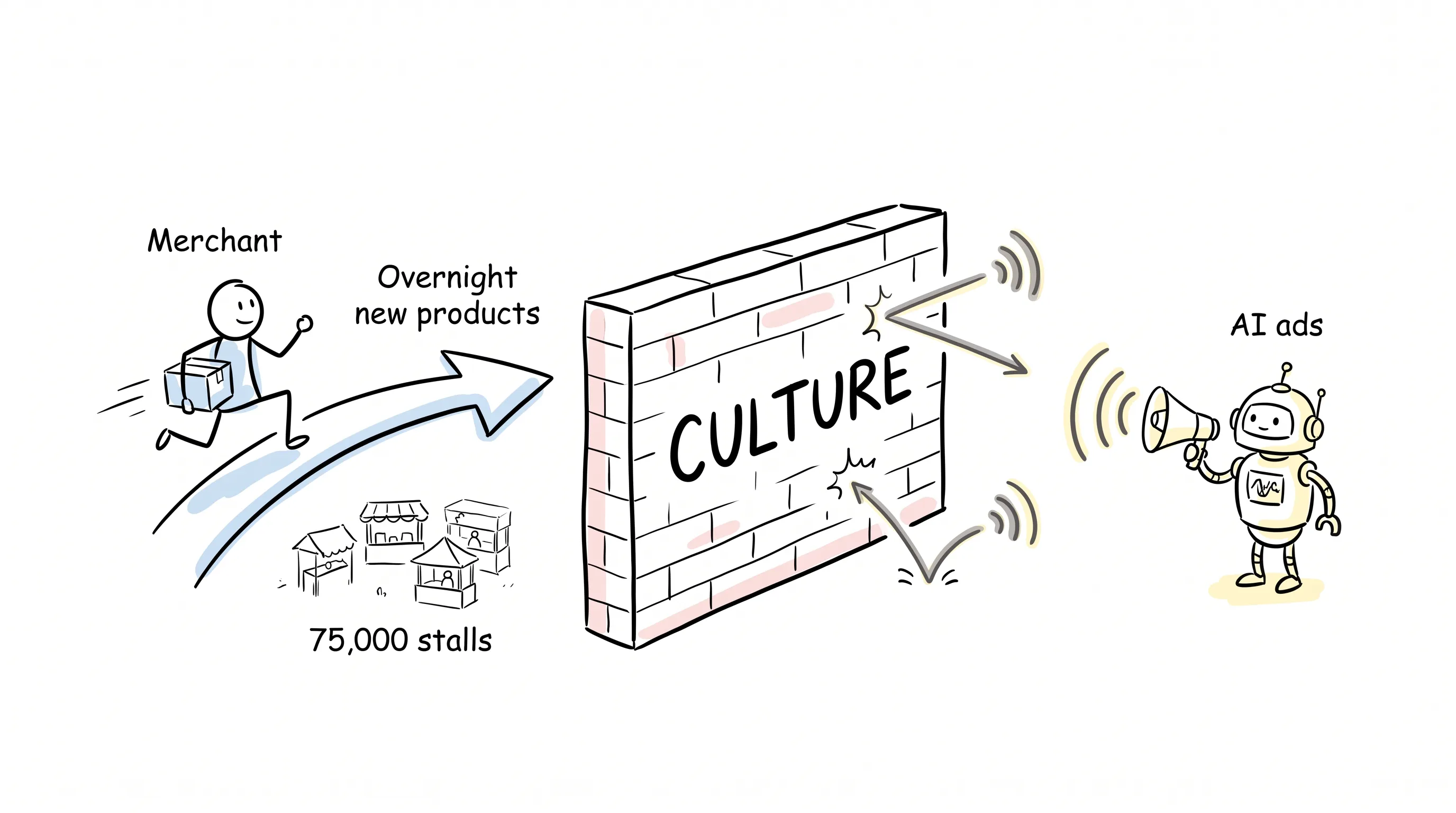
Just how fast can Yiwu merchants turn global orders around? A customer states their requirement today, and overnight, a new product is out.
Overnight. A new product.
That's not rhetoric. It's the hand speed a market builds over forty-plus years.
This market got its start in 1982. Today it runs 6.4 million square meters of floor space, 75,000 stalls, 26 major categories, and 2.1 million distinct products. In 2023, Yiwu's total imports and exports reached 566.05 billion yuan, with exports topping 500 billion yuan for the first time — figures disclosed by the Zhejiang provincial tax bureau. Stretch the timeline further: in 2011, Yiwu's foreign trade was 25.5 billion yuan; twelve years on, it had grown 21.2-fold — a Tencent report ran those numbers.
The "Supermarket of the World" lives up to its name.
But what I want to talk about today isn't how formidable Yiwu is. It's the wall Yiwu merchants keep hitting as they go overseas.
That wall is called culture.
The AI Arsenal of Yiwu Merchants
To sell to the whole world, you first have to be seen by the whole world. Today, that "being seen" mostly happens in social media e-commerce ads.
So what can AI do here?
At the 2023 China Internet Media Forum, a Weibo executive summed up AI's role in social media advertising as three things. I think it's a spot-on summary, so let me borrow it.
First, recognizing people.
AI uses big data to analyze your past behavior, works out who you are and what you like, then pushes you the ads most likely to move you. That's how click-through rates and conversion rates climb.
Second — the most interesting one: cross-cultural recommendation.
Think about it: would a Muslim user and a Buddhist want to see the same things? AI can learn to recognize what users prefer across countries and cultural backgrounds: for Muslim users, fewer products that might offend their faith; for Buddhists, prayer beads and amulets; in the mostly Christian West, cross jewelry and crystals. Paired with images, video, and other multimodal information, the experience stays coherent across platforms.
Third, multilingual creative.
AI can generate and optimize ad copy automatically based on a user's location and language habits. Going further, a livestream can reach audiences in different languages at once, translated in real time into their mother tongues. Understanding comes before wanting to buy.
In Yiwu, this playbook has already landed.
Since 2022, Yiwu has also pushed out a fully managed model for cross-border e-commerce: the platform handles sales, operations, advertising, customer service, and logistics, while merchants only supply goods and develop new products. With the division of labor at this level, advertising goes to the platform, AI goes to the tools, and merchants free their hands to make good products.
On Yiwu's Chinagoods AI innovation service platform, merchants can generate product detail pages with one click, make videos with one click, and run livestreams with digital avatars. The platform's AI translation feature automatically translates product videos into multiple languages, helping merchants charge straight into international markets. After version 2.0 launched, multilingual translation and understanding, text creation, image recognition, and smart generation of posters and videos all went live. AI can even generate hair accessory designs separately for consumers of different ethnic groups.
Good grief. Even hair accessories can now be customized by ethnic group.
Sounds like everything is wonderful, right?
A Splash of Cold Water, from 500 Questionnaires
Not so fast. Let's look at some data.
In 2024, an online survey targeting Yiwu collected 500 questionnaires: 250 from Yiwu merchants, 250 from international buyers. The questionnaire asked about their impressions of AI advertising: Do you notice it? How is the quality? Is personalized recommendation useful? How accurate are the recommendations?
The results come in two layers.
The first layer is good news.
AI advertising awareness scored 4.2 (on a 5-point scale). Most consumers can recognize an AI-generated ad at a glance while shopping online. AI content is already everywhere.
The usefulness of personalized recommendations scored 4.0. Consumers largely accept it: what AI recommends is indeed relevant and timely, and the experience is improved.
By the way, the whole scale had a reliability coefficient of 0.85 (Cronbach's alpha, a standard measure of survey consistency). Nobody made these numbers up.
The second layer is not so pretty.
Perceived quality: 3.8. Accuracy of AI recommendations: 3.9. Both below 4.
In the open-ended feedback, some respondents complained: AI-generated ads are the same few things over and over — next to human marketers, they lack creativity.
Seeing this, you might think: 3.8 isn't that low — above the passing line, pretty good.
But the real cold water is in the next comparison.
The Same Ads: Westerners Score 4.0, East Asians 3.5
Break the 500 questionnaires down by cultural background, and something interesting shows up.
Western consumers' satisfaction with AI advertising: 4.0.
East Asian consumers: 3.5.
That gap passes a statistical test: t=5.1, p<0.01. Not noise — a real, significant difference.
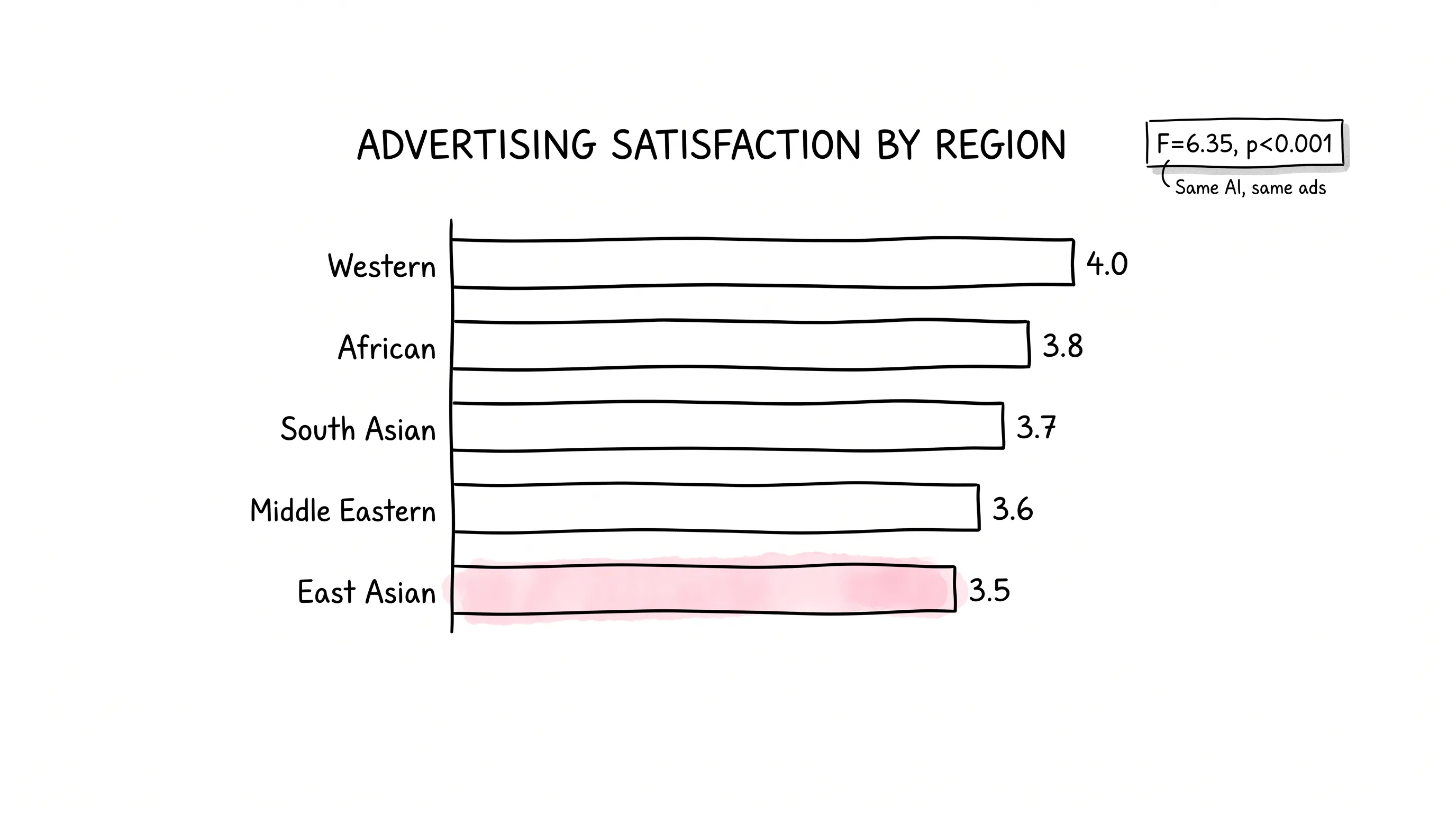
It doesn't stop there. Bring in consumers from South Asia, the Middle East, and Africa, and compare all five groups: Western 4.0, African 3.8, South Asian 3.7, Middle Eastern 3.6, East Asian 3.5. One-way ANOVA (analysis of variance): F=6.35, p<0.001 — significant differences between groups.
The same AI, the same kind of ads, satisfaction rising and falling in a neat line.
Why?
Simply put, Western consumers' preferences and AI's strengths are the same hand of cards: direct, efficient, focused on personal benefit and technical innovation. That's exactly what AI is best at — fast, precise, straight to the point. In Western markets, AI takes to the water like a duck.
East Asian consumers? They value context, relationships, tradition, and a sense of propriety. Ads need cultural depth; they need to "get me," not to have an algorithm calculate me. AI-generated content often feels too "transactional" to them — short on warmth, short on cultural thoughtfulness.
The same ad lives a different life in two different markets.
Doing the Math: How Much Is Cultural Fit Worth?
The difference is found — so which factor moves satisfaction the most?
The survey ran a regression analysis, and the conclusion fits in one formula:
Satisfaction = 2.5 + 0.8 × Cultural Fit + 0.3 × Perceived Quality
Look at the coefficients. Cultural fit: 0.8. Perceived quality: 0.3. The former is more than twice the latter. And the model explains 65% of the variance in satisfaction — considerable explanatory power.
In plain language: getting the ad "right" is merely passing. Getting it to "taste right" is winning.
A technically flawless ad that is culturally mediocre still won't sell.
So What to Do? Four Steps
The data is on the table, and the path isn't complicated.
Step one: feed culture to the algorithm. AI's cultural tone-deafness often comes from never having "eaten." Keep feeding the model the language habits, social media behavior, and consumer feedback of different markets, and the ads will start to follow local custom.
Step two: have locals vet everything. AI drafts; humans referee. Find marketers or cultural consultants who know the local culture, and run every ad past them before it goes live. Machines handle efficiency; people handle nuance.
Step three: one strategy per market. Don't expect one set of materials to conquer the globe. Western markets emphasize personal benefit and efficiency; East Asian markets want more community, family, and emotional resonance. Layer the creative, layer the strategy.
Step four: install a dashboard. Once ads go out, track performance in real time and adjust on feedback. Yiwu merchants are already fast to react — this part won't be hard for them.
Of course, this survey has its limits: the sample is mostly Yiwu merchants, so the conclusions may not transfer directly to every market. But the direction, I believe, is reliable.
Finally, Back to Overnight New Products
Yiwu merchants can turn out new products overnight — that's supply-chain muscle, the strength a "Supermarket of the World" has trained for forty years.
But overnight can't train an understanding of a culture.
Culture has no shortcut. It has to be fed slowly with data, taught bit by bit by locals, and calibrated through the feedback of campaign after campaign.
An algorithm can generate ten thousand ads overnight, yet still not know how an ad should introduce itself in an Eastern household.
That's nothing to be ashamed of — it's the honest baseline of the whole industry.
Here's to every Yiwu merchant who turns out new products overnight and takes orders from around the world — may they make their ads taste "right" a day sooner. Speed is the algorithm's job. Getting it to taste right is yours.
Continue reading
Related articles

Cross-Border Business: Time to Upgrade Your AI Toolbox
A learn article explaining how AI tools help cross-border e-commerce sellers clear five hurdles: language, regulation, logistics, payments, and fraud. It outlines a five-compartment toolbox, a five-step adoption path, and metrics such as conversion rate and CLV, while cautioning against over-reliance on AI.

AI Is Taking Over the Dirty Work of Social Media Marketing, One Task at a Time
This learn article outlines four social media marketing tasks AI can handle — audience analytics, content drafting and design, ad targeting and creative testing, and spam moderation — and cautions that taste, judgment, and data security remain human responsibilities.

AI Is Already This Good — Why Is Your Social Media Marketing Still Pure Manpower?
An overview of 18 AI tools for social media marketing, organized into six categories covering audience research, content creation, scheduling, comment and DM handling, ad management, and visual production, plus notes on personalization, prediction, and emerging trends.