
The More AI Recommends, the More Real Creators Are Worth
The article argues that AI recommendations raise rather than reduce the value of human creators, covering shopper trust in AI answers, platform crackdowns on undisclosed AI content, TikTok Shop's shift toward big-ticket items, and brand cases built on authentic creator content.
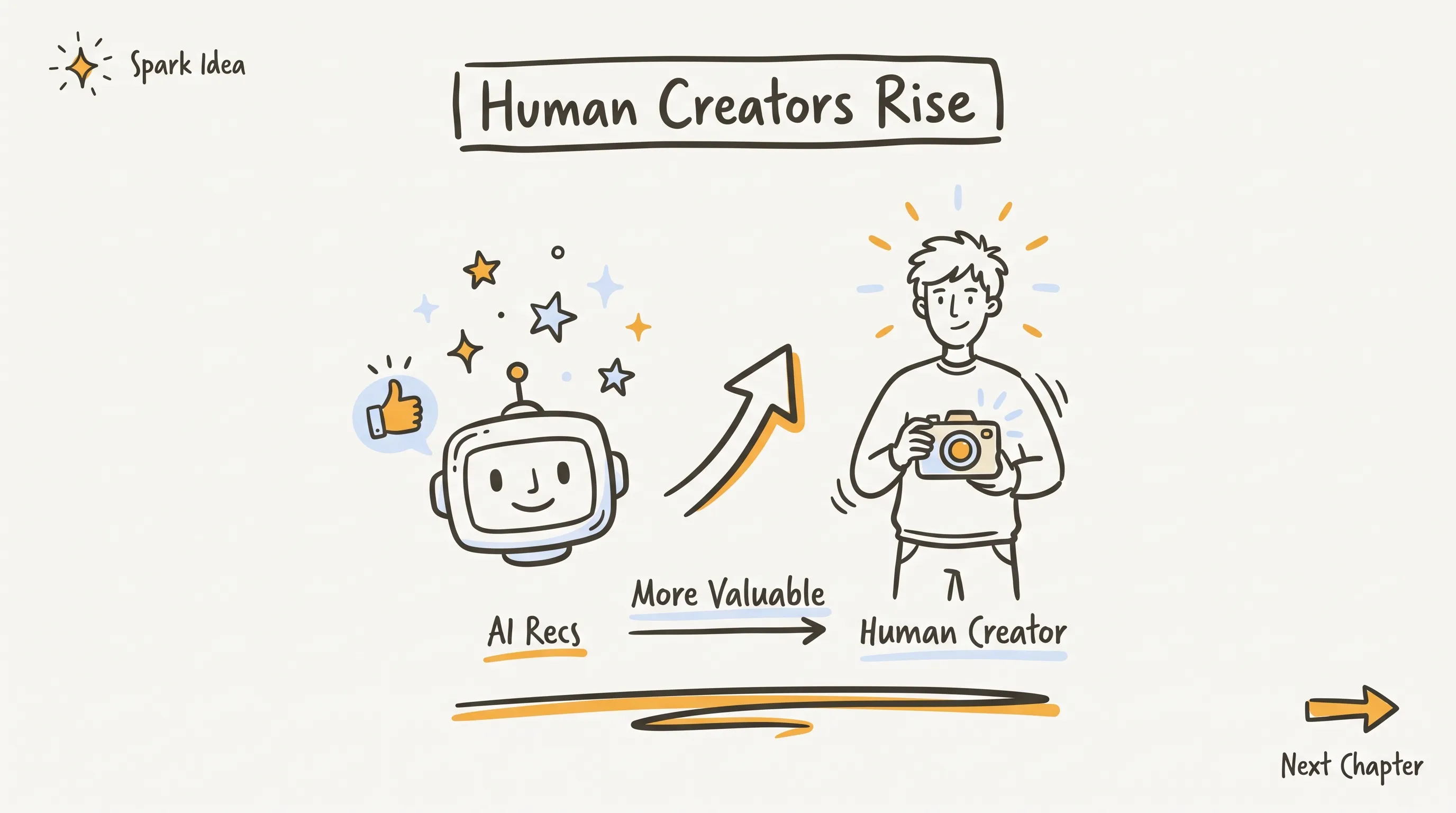
A few days ago, an old friend who runs an e-commerce business invited me out for tea. A few minutes in, his brow started to furrow.
He said, "I haven't been sleeping well lately. People shop by asking AI first, then order right after the AI answers. If this keeps up, who's still going to read creator content? Should we be cutting our influencer budget?"
I told him: don't cut it just yet. A set of data I came across recently points to exactly the opposite conclusion.
Over the past three months, 43% of consumers have bought something an AI chatbot recommended to them.
Sounds like creators should panic, doesn't it?
Don't panic. In its holiday shopping research, the marketing agency PartnerCentric found: the more shoppers trust AI recommendations, the more they trust human creators. Among people with high trust in AI, 61% also trust creators. Among those with low trust in AI, that figure is only 11%.
A gap of nearly six times.
What's going on here?
AI Is Working for Creators
Think about yourself.
Suppose AI recommends a massager — reasoning solid, tone assured, convincingly put together. Would you dare order it directly?
Most people wouldn't. They do the same thing: search again. Have real people actually used this thing? Has anyone dragged it?
What they find, most likely, is creator content: reviews, unboxings, honest impressions after thirty days of use.
RTB House's research points the same way: in shoppers' eyes, Google AI Overviews and ChatGPT now command more trust than TikTok, Instagram, or Facebook. AI has become the new "consideration engine."
And yet 83% of consumers say their attitude toward AI recommendations is: trust, but verify. 76% still worry about how AI is using their data.
Put plainly: AI is responsible for putting the product in front of you; creators are responsible for making you believe the product is actually worth it.
The more confident AI's answers get, the more people need a human to help them verify those answers.
So what should you do? Check the 10 products you sell best: if someone searched for a "second opinion" on an AI recommendation, would they find your creator content? And does what they find read like real usage experience — or ad copy?
If the answer is no, that's your first creator brief of Q4.
The Platforms Are Getting Serious
The second signal deserves even more thought.
This past September, three things happened almost simultaneously.
-
A New York Times investigation found hundreds of AI-generated "health personas" on social media, pushing supplements day after day — and ordinary people cannot tell real from fake.
-
Anthropic began embedding invisible watermarks into AI-generated text, citing the EU AI Act. Nearly 200 companies including Meta, Microsoft, and OpenAI signed the same code of conduct.
-
LinkedIn rolled out a report button for content that "looks like AI spam." Why? Because LinkedIn's own detection data shows that close to one-third of short posts and more than 40% of long posts on the platform are entirely AI-generated.
Unbelievable. One in three posts is written by a machine.
Three different policies, three different players — but all three are doing the same thing: turning "telling real from fake" from a slogan into a piece of infrastructure.
Before, platforms would say: we value authenticity. Now, they hand you a report button, an invisible watermark, a detection system.
Know what it looks like? Food safety. At first it depended on merchants' consciences; later came quality-inspection stamps; later still, traceability QR codes. Once verification became a technical feature, the room for fraud shrank to a minimum.
For brands, this means the door labeled "quietly use AI" is closing. AI-assisted content that slipped through last month is now one algorithm update away from being detected.
So don't wait. Dig out the creator content and UGC you ran last quarter, and flag everything that used AI writing, AI voiceover, or AI video tools without disclosure. Get ahead of the platforms' detection tools: set your own disclosure standard first.
What you say proactively is called transparency. What the platform catches is called an incident.
TikTok Shop Is Growing Into a Department Store
The third signal: TikTok Shop is "growing up."
What does growing up mean? It no longer sells only $9.99 impulse buys.
Spreetail, a multi-brand seller, published a set of numbers: on TikTok Shop, big-ticket items such as above-ground pools and hot tubs grew 125% year over year — five times the growth rate of the same category on other e-commerce platforms. Outdoor furniture and lawn & garden are also growing at triple digits.
A hot tub. On a short-video platform.
Mellow Sleep, a bedding brand whose comforters start at $85 a piece, is also selling briskly on the platform. Envision Horizons research shows 51% of consumers have bought something over $100 on TikTok Shop.
Why are people suddenly willing to buy big-ticket items on a short-video platform?
Half the credit goes to logistics. Spreetail partnered with TikTok to cut delivery time from 5 days to 2.
That shift from 5 days to 2 looks like nothing but a changed number. What it actually removes is a psychological threshold. Buy something cheap, and a two-day delay is fine; buy $800 furniture and get told to wait a week — who wouldn't feel uneasy?
Once delivery speed caught up with the speed of discovery, TikTok Shop went from being a "$9.99 shop" to a channel that can properly handle considered purchases.
But the playbook has changed.
$9.99 socks and $800 furniture do not run on the same kind of content. The former runs on impulse — you scroll, you buy. The latter needs someone who actually hauled it home, assembled it, and used it for half a month.
So if your average order value sits above $75, don't mass-seed. Find 5 to 8 creators, run a small pilot, watch both average order value and sales, and add budget only once it works.
Moving the cheap-goods playbook onto high-priced goods is just burning money.
A Shop Owner Who Films Her Own Mess
Numbers done — now let me tell you about two cases I genuinely love.
The first is a clothing store in New York called Colorful Natalie.
Its owner, Natalie Acopian, never set out to be an influencer. She just wanted to open a boutique. The shop sits on Bleecker Street in New York, painted pink top to bottom — it later became a photo spot for tourists, and its Instagram and TikTok accounts together have nearly 250,000 followers.
What's special about her content?
Nothing special. A queue winding around the corner — she films it. Critics grumbling in front of the pink facade — she films them too. Same phone, good days and bad days alike.
Last holiday season, business got so hot that the basement storeroom couldn't cope — stockouts, changed opening hours. She didn't hide any of it; she posted a TikTok and reported straight to her followers.
By any normal standard, this kind of content should cost her points, right?
Exactly the opposite. These "live reports of things going wrong" became her most trusted content. Because what they show is a real business running under real pressure — not a brand performing composure.
People today grow more and more sensitive to polished, AI-assisted, heavily scripted brand content. At a moment like this, a founder talking to the camera about real chaos is far more believable than a masterpiece the marketing team spent three months producing.
And the key: this cannot be faked. Real stockout anxiety cannot be acted.
Go back through your own account: of your last 10 posts, is there a single one that shows "imperfection"? If there isn't one, you're holding the most trusted content type there is — and you've never once used it.
A Group of Grandmas Out-Argued a Crowd of Fitness Influencers
The second case is Prima, a grass-fed protein bar brand.
What's the standard playbook in the protein bar category? Find a ripped twenty-something fitness influencer to recite protein content at the camera.
Prima skipped all of it.
They hired a group of Italian grandmas — nonnas (Italian for "grandma"). They had the grandmas take the ingredient list, read it out item by item, then ask one question: would this thing be in my kitchen?
Other brands throw influencer dinners; Prima threw a dinner that was all nonnas. The result: the content spread across generations — not just young people loved it.
Why is this move so strong?
Think about it. A grandma talking about "real food" carries built-in authority. The trust a fitness influencer needs dozens of videos to earn, a grandma commands the moment she opens her mouth. And precisely because she doesn't care one bit what young people think of her, young people trust her.
Prima's formula: grass-fed protein, raw honey, tallow. No seed oils, no refined sugar. Written out as a list of selling points, it's long. One line from a grandma — "would this be in my kitchen?" — makes it clear in three seconds.
What's more, this is a moat. Anyone can hire fitness influencers; a band of grandmas who dare to pick faults to your face as the brand's voice — a thing nobody else can copy.
So next time you choose creators, don't default to the youngest, most fashionable one. Ask one question: who delivers my core selling point in a way people will believe?
Finally, Back to My Friend
You might still be wondering: will AI recommendations keep getting more accurate?
They will. Just like search engines back in the day — at first everyone could game them, but in the end the ranking always calibrated itself toward the sources people genuinely trust. AI discovery will most likely walk the same road.
So don't play short-term clever tricks. Build up long-term real trust.
In the end, he didn't cut that budget.
I said: look — every time AI makes a decision for someone, that person gets one more urge to find a human to verify it.
The more AI spreads, the more humans are worth. Every step technology moves forward, the human touch gets pricier.
Here's my wish for you: in this era when AI speaks for everyone, may you still be believed.
Continue reading
Related articles

Cross-Border Business: Time to Upgrade Your AI Toolbox
A learn article explaining how AI tools help cross-border e-commerce sellers clear five hurdles: language, regulation, logistics, payments, and fraud. It outlines a five-compartment toolbox, a five-step adoption path, and metrics such as conversion rate and CLV, while cautioning against over-reliance on AI.

AI Is Taking Over the Dirty Work of Social Media Marketing, One Task at a Time
This learn article outlines four social media marketing tasks AI can handle — audience analytics, content drafting and design, ad targeting and creative testing, and spam moderation — and cautions that taste, judgment, and data security remain human responsibilities.

AI Is Already This Good — Why Is Your Social Media Marketing Still Pure Manpower?
An overview of 18 AI tools for social media marketing, organized into six categories covering audience research, content creation, scheduling, comment and DM handling, ad management, and visual production, plus notes on personalization, prediction, and emerging trends.