
The Manual Grind of Running Ads Is Being Taken Over by AI, One Task at a Time
A learn article reviewing nine AI ad-management platforms, grouped by approach: attribution and server-side tracking, rule-based automation, dynamic creative generation, and fully automated campaign management, with guidance on matching each tool to budget and team situation.
A few days ago, a friend who does media buying for a living showed me his computer screen. Three windows open side by side: Meta's ads manager, Google's, TikTok's.
He said the first thing he does every morning at the office is sweep all three dashboards, one by one. Pause the ones that ran off the rails, add budget to the ones doing well. Creative fading? Swap it out.
I asked him: how many years have you been doing this?
Four.
I said, of those four years, more than half was spent working as a remote control for the machines.
He wasn't convinced, but he didn't argue back. Because he couldn't say what exactly was wrong.
Break media buying apart and it comes down to four jobs: adjust bids, split budgets, target audiences, test creative. These four things used to be human-only work, because machines didn't understand your business. Not anymore. A whole crop of platforms now specializes in exactly this: whatever your hands would do, they execute — and they never tire the way you do.
I went through the nine that have names worth knowing, one by one. And I found they aren't remotely the same thing. Some manage data, some manage execution, and some take away the steering wheel entirely.
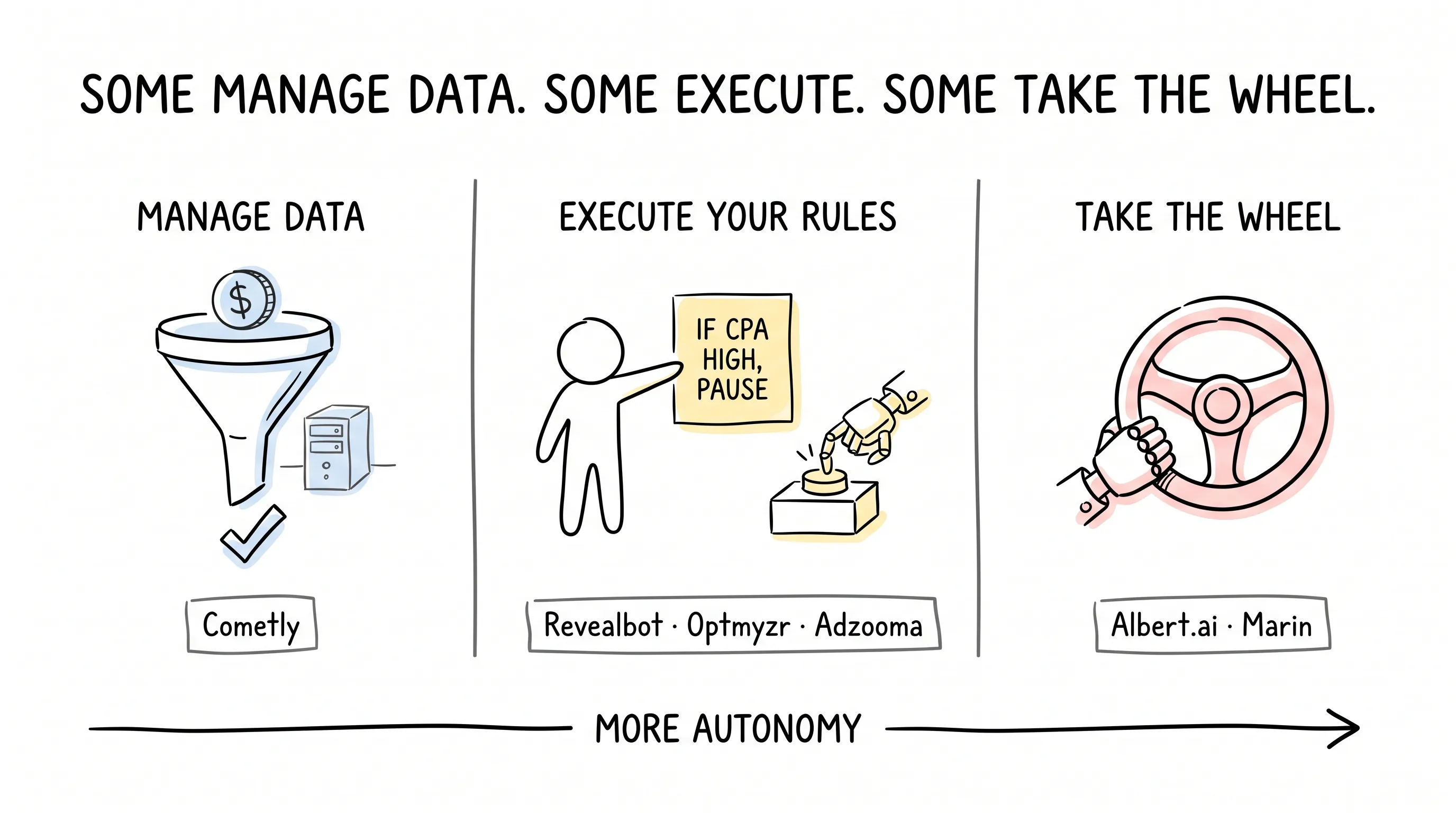
So where to begin? With the least glamorous, most fatal thing of all: data.
If Attribution Is Off, Everything After It Is Waste
Cold water first.
Plenty of tools open their pitch with AI, machine learning, intelligent optimization — all very dazzling. But think it through: however smart the machine is, what it optimizes is the data you feed it. If the data is wrong, the more decisively it executes, the faster you drift off course.
So the first stop is Cometly. Its work isn't flashy in the least, but it's the most critical: getting conversion data right.
How do you get it right? What is server-side tracking? Traditional tracking leans on browser-based tags, and the moment privacy restrictions tighten on users' phones, a whole stretch of the journey goes missing. Cometly moves tracking onto the server, holding every touchpoint in its grip from first click to final sale. What the browser can't see, it can.
Accurate capture is only step one. The clever part is the next move: it ships with Conversion Sync, which feeds calibrated conversion data back to platforms like Meta and Google, so the platforms' own algorithms learn from real data. Your data gets accurate, the platform's delivery follows, and the two sides get smarter together.
With data that's accurate, its AI Ads Manager has finally earned the right to speak: which campaign to scale, where to move budget — every suggestion is concrete. When questions come up day to day, just ask its AI chat in plain language. No building reports yourself.
Pricing is custom-quoted against ad spend; you'll have to ask.
You Decide, the Machine Executes
The second breed of tool runs on a completely different idea: it doesn't think for you, it only acts for you.
Who is it for? People who know exactly what to adjust and are only short on hands and hours.
Revealbot is the standard-bearer of this route. What's an automation rule? It's your judgment written out as conditions: CPA crosses a certain number, pause the ad; a certain ad set is performing well, add budget on a schedule; a certain campaign wins, copy it automatically and scale it up. You set the conditions, it keeps watch and executes 24 hours a day, and you never write a line of code.
Simple, but brutally effective.
It handles bulk work too. Creating, editing, pausing hundreds of ads — done in one pass. Meta, Google, TikTok, Snapchat, four platforms, one dashboard to run them all. A/B testing is automated as well: whichever ad set wins, it scales spend automatically by the criteria you set.
Starts at $99 a month, tiered by your monthly ad spend.
The same philosophy, but digging deeper: Optmyzr. Its territory is Google Ads and Microsoft Ads, and the people who built it are PPC veterans themselves, so every tool grew out of a real business pain point: adding negative keywords, adjusting bids, improving Quality Score — all turned into one-click actions. But one-click does not mean black box. What changed at every step, you see with total clarity. Anyone who manages other people's accounts knows this one is the lifeline. Power users can go further, using its rule engine and script library to assemble their own workflow, and Shopping campaigns get their own dedicated optimization tools.
The entry price is also the steepest: starting at $249 a month. Full-time PPC people will find it worth it; others, maybe not.
If you don't want to spend money at all, look at Adzooma. It has a free tier that small businesses can keep using indefinitely. The core is its Opportunity Engine: every day it scans your account, lists the points that could be optimized, and one click puts them into action. Then glance at the Performance Score — whether the account is healthy, one number makes it plain. Small teams without a dedicated media buyer can simply follow its recommendations and stay out of serious trouble. Want to move up? The Pro tier starts at $99 a month with white-label reports — polished enough for an agency to put in front of clients.
When You Can't Keep Up With Creative, Let the Machines Make It
The third kind of pain, e-commerce sellers understand best.
Thousands of SKUs, each one needing images and copy, and then variations for different audiences, different markets. Work yourself into the ground and you'll still only manage a few hundred creatives.
The answer to this one is Smartly.io. Its dynamic templates hook into your product catalog and the creative grows itself: swap in a new batch of images, a new set of copy, localize the language, spin out another version for a different audience — hundreds to thousands of variants, generated automatically. Once creative is covered, it also does predictive budget allocation: machine learning forecasts how each campaign will perform and moves the money to where things are about to take off. By the time your manual analysis produces a conclusion, it has already rebalanced three times over.
Meta, TikTok, Pinterest, Snapchat — all managed inside one platform.
This is an enterprise-grade beast, priced at enterprise level too, tied to ad spend and feature needs. If your budget isn't big, don't bother looking.
Go Deep on One Platform, or Spread Thin Across Many Clients
Next is a fork in the road, and it depends on your situation.
Is your main battlefield Meta itself? Then look at Madgicx. It does Meta only, and that focus is what made it deep. Its autonomous budget optimizer keeps watch over all your ad sets, automatically handing more money to the ones performing well, without waiting for you to spot the problem first. Its AI also studies your best customers, auto-generating lookalike audiences, interest clusters, behavior-based segments. The ceiling of doing audience research by hand is its starting point.
Starts at $44 a month, tiered by Meta spend. For those who only run Meta and want peace of mind, that starting point isn't expensive.
Are you an agency holding dozens of client accounts? That's a different problem entirely: one person can't watch dozens of accounts, and even if you could, you couldn't go deep. Acquisio was built for exactly this problem. The cleverest part of its machine-learning bidding is that it learns from the aggregated data of all your clients. A pitfall Client A steps into, Client B never has to. That's far smarter than every account fumbling about on its own. Reporting is fully white-labeled: from the dashboard to client reports, everything carries your brand, and clients have no idea who's actually doing the work behind the scenes. Clients can also get read-only access — they can see their own data, never anyone else's.
Custom pricing based on client count and spend. Agencies with a dozen or fewer clients, hold off — manual work can still carry you; past that line, this is not where you save money.
Handing Over the Whole Steering Wheel
The last route is the most radical: humans are barely in the loop.
Albert.ai is the fully automated play. It doesn't only optimize your existing campaigns — it builds new campaigns itself, tests creative variants itself, hunts down new audiences itself, moves budget across channels itself, never once waiting for approval. You just set the goals; the rest it runs on its own.
Sounds great, but there's a precondition: the budget has to be big enough. It needs to run large volumes of tests to evolve itself; with a small budget the tests never complete, and it never gets smart. So this is a tool for big-budget brands, and the price is negotiated too.
Marin Software's "hands-off" has a different flavor. Large enterprises are managing budgets of several million dollars, dozens of campaigns, several platforms, and what they fear most is disorder: accounts that don't reconcile, metrics that don't agree, overspending discovered only after it happened. Marin pulls the performance data of all channels into one place — one dashboard, one truth. Automated bidding adjusts in real time against your targets. Budget pacing and forecasting keep watch on the rhythm of spending: never overspending, but also never leaving money sitting in the account that ought to be spent. Security and compliance are enterprise-grade too.
Pricing is negotiated on monthly spend.
Finally, Let's Do the Math
Nine platforms covered. Find your row.
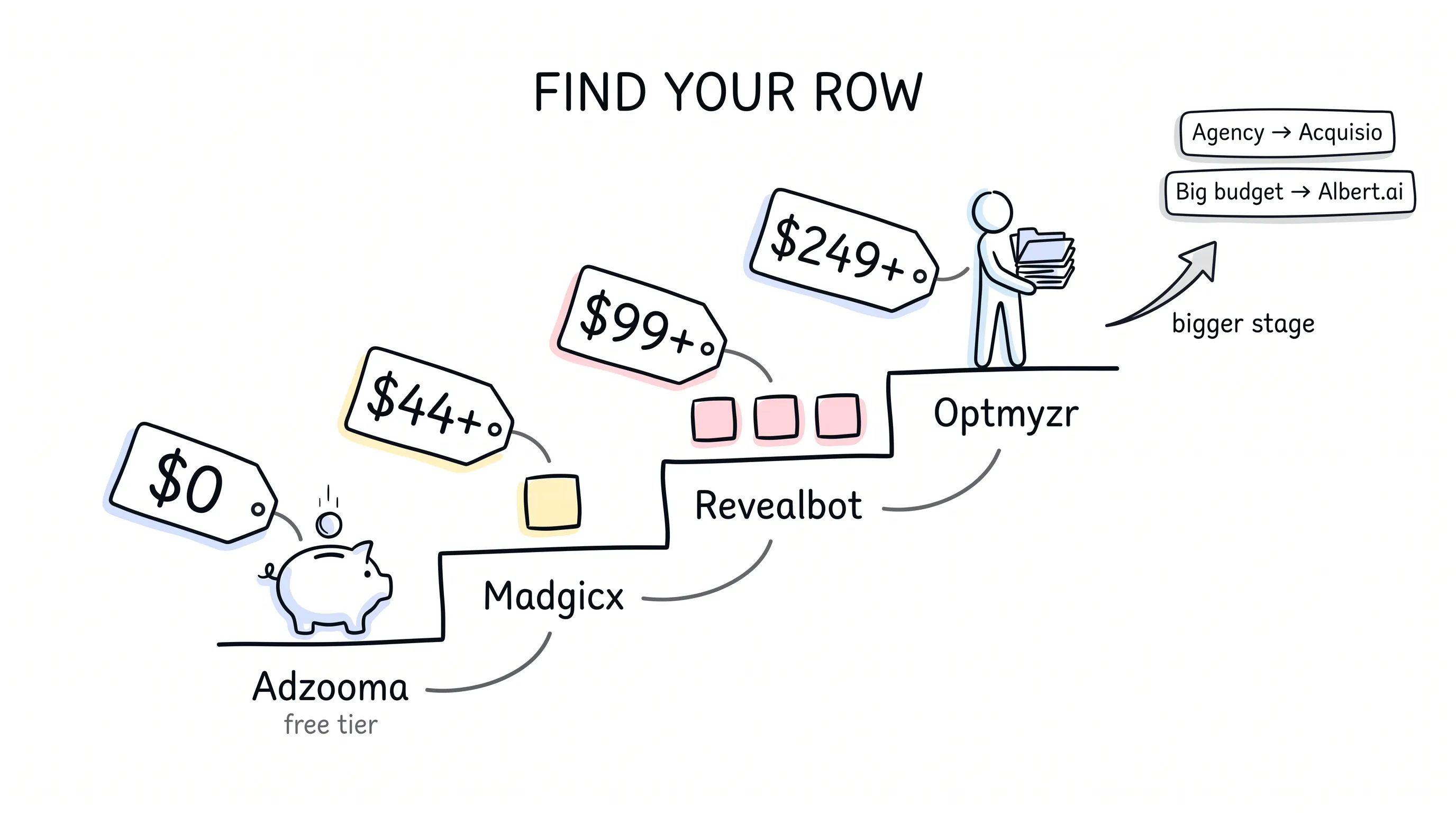
Not a cent of budget: start with Adzooma's free tier to get your reps in, follow the recommendations, spend nothing.
Monthly budget of a few hundred to a few thousand dollars, mainly running Meta: Madgicx, from $44.
Running multiple platforms and knowing what you want: Revealbot, from $99.
Full-time PPC with a fistful of Google and Microsoft accounts: Optmyzr, from $249.
An agency with more than a dozen clients: Acquisio.
Big e-commerce catalogs with creative as the bottleneck: Smartly.io.
Budget big enough to let go of the wheel: Albert.ai.
Large enterprise needing unified reporting and budget discipline: Marin Software.
But more urgent than choosing a tool is another question: is your data accurate?
When attribution is a mess, any automation is building on the wrong foundation. Fix the data lesson first — the Cometly checkpoint is one you can't skip.
Data is the foundation. If the foundation is shaky, the higher automation builds, the faster it collapses.
Remember that friend from the beginning? The one who swept three dashboards one by one.
He didn't rip everything out in one go. First he fixed his attribution, then let rules-based automation take over the morning sweep. What does he do with the time saved? Strategy, and the big picture.
In his words: I used to be my ads' nanny. Now I'm their coach.
What the machine takes over is your hands, not your brain. Your brain is freed up now — remember to use it.
Here's to the day you stop being a remote control for the machines.
Continue reading
Related articles

Cross-Border Business: Time to Upgrade Your AI Toolbox
A learn article explaining how AI tools help cross-border e-commerce sellers clear five hurdles: language, regulation, logistics, payments, and fraud. It outlines a five-compartment toolbox, a five-step adoption path, and metrics such as conversion rate and CLV, while cautioning against over-reliance on AI.

AI Is Taking Over the Dirty Work of Social Media Marketing, One Task at a Time
This learn article outlines four social media marketing tasks AI can handle — audience analytics, content drafting and design, ad targeting and creative testing, and spam moderation — and cautions that taste, judgment, and data security remain human responsibilities.

AI Is Already This Good — Why Is Your Social Media Marketing Still Pure Manpower?
An overview of 18 AI tools for social media marketing, organized into six categories covering audience research, content creation, scheduling, comment and DM handling, ad management, and visual production, plus notes on personalization, prediction, and emerging trends.