
The Make-or-Break Advantage in Cross-Border E-Commerce Is Hiding in AI
A learn article arguing that AI is the deciding factor in cross-border e-commerce, covering multilingual customer service, logistics optimization, compliance, fraud detection, and demand forecasting. It includes a three-step approach for small sellers adopting AI tools.
A few days ago, an old friend of mine who runs a cross-border e-commerce business invited me to dinner.
Before we were even halfway through the meal, he sighed. Three years ago he started selling his factory's goods to Europe and the US, and for the first two years the money was good. And now? Shipping keeps getting more expensive, advertising keeps getting more cutthroat, he's hired three customer service reps, and buyers still chase him with questions every single day.
So he asked me: is this cross-border business getting too hard to do?
I said: yes, it's hard. But the hard part — that's probably not what you think it is.
Where's the Difficulty?
What does "cross-border is hard" actually mean? When most people hear it, their first reaction is: the products must not be selling.
Truth is, products aren't the problem. Three other things are.
First, language and culture. You think translating your product page into the local language solves everything? Not even close. Germans and their exactness about wording, the Japanese and their obsession with detail, Middle Eastern consumers and their sensitivity around holidays — no translation app can handle any of that. One clumsy translation can, at best, leave a buyer lost; at worst, it wipes out their trust entirely.
Second, logistics. Cross-border shipping means high costs and long lead times, with customs holding shipments up at the smallest pretext. Returns and exchanges are a nightmare in their own right — the return shipping on one item can cost more than the item itself.
Third, compliance. Every country has its own customs law, tax law, and privacy law. Europe has GDPR (the General Data Protection Regulation); in the US, sales tax is calculated state by state. Miss a single step and you're looking at fines at best, or goods impounded at the port at worst.
Think about it: of these three mountains, which one can you climb by simply throwing more people at it?
None of them. Which is why, over the past two years, the companies that have actually smoothed out their cross-border business have all changed their tools.
What Can AI Actually Do?
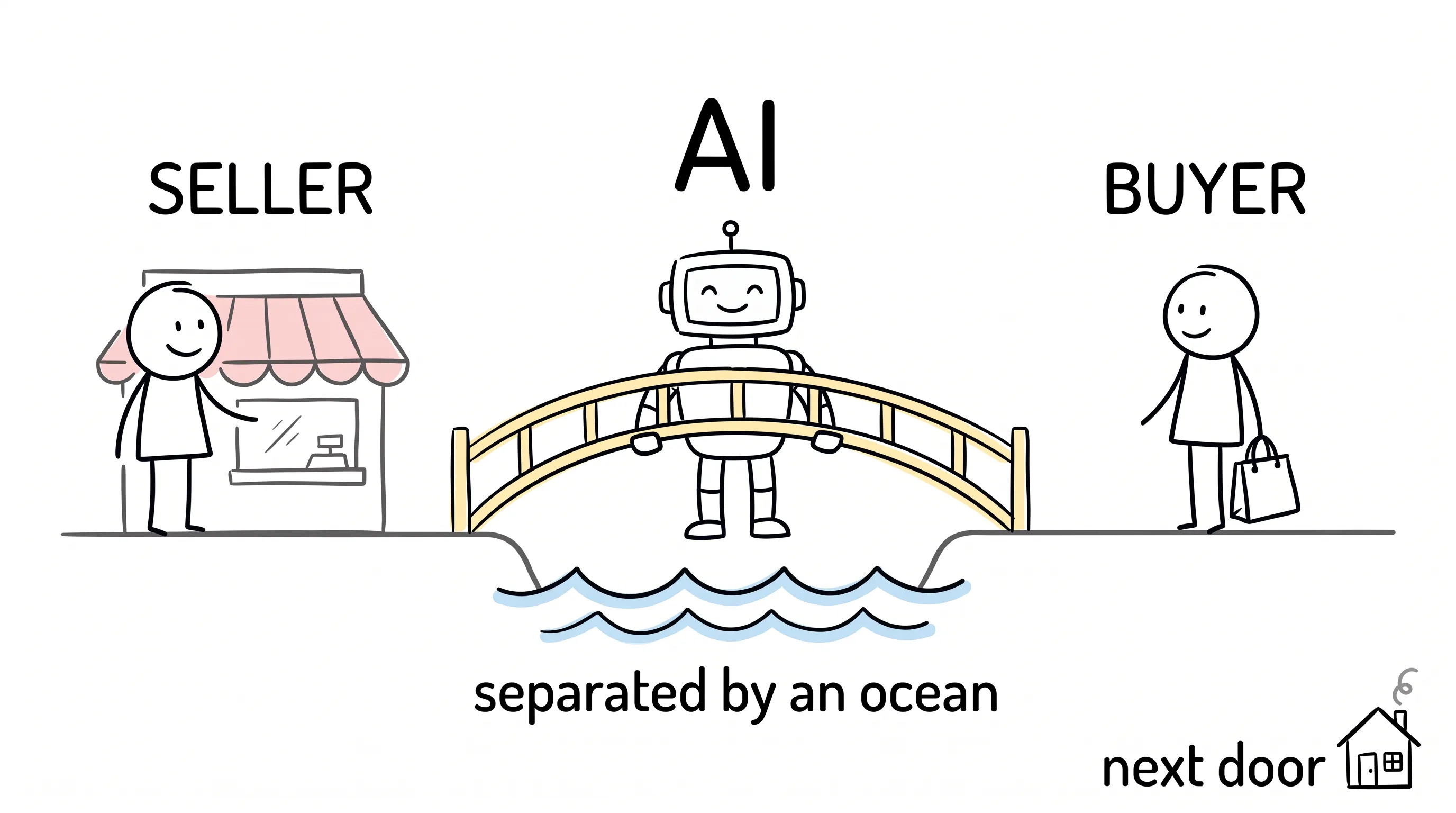
Put simply, what AI does in cross-border business is turn a trade "separated by an ocean" into one "next door."
Start with the most obvious: language
Here's an example. A buyer places an order in your store at midnight and immediately has a question. Before? Your customer service team was asleep. Now? A multilingual AI customer service agent replies instantly — in fluent, idiomatic local language, not stilted machine translation.
This goes well beyond plain translation. Good AI customer service understands the local culture, the local jokes, even local shopping habits.
How well does it work? Here are a few numbers:
- Conversion rates up 15% to 30%;
- Cart abandonment down 17%;
- Customer satisfaction above 85%.
Remarkable. The cart abandonment figure especially. There's a widely circulated statistic in this industry: because of hidden fees that pop up at checkout, roughly 60% of shopping carts get abandoned outright. When AI spells out both the language and the price upfront, a big chunk of that problem gets cut off at the root.
Next, logistics
Cross-border logistics is both the biggest cost center and the lifeline of the customer experience.
AI does four things here: it calculates optimal routes so every truck burns less fuel; it predicts when equipment will fail so maintenance happens before anything breaks down and disrupts operations; it manages warehouses to cut human error; and it forecasts sales so you neither run out of stock nor tie up a warehouse full of goods that won't sell.
The math is startling. One estimate shows logistics companies using AI can cut operating costs by as much as half. Another study projects that by 2035, productivity across the logistics industry could jump 40%.
What does cutting costs in half mean? It means that on the very same order, your profit goes from paper-thin to actually worth earning.
Then, compliance and fraud
Cross-border business has two more landmines: rules, and scammers.
The rule landmine, AI defuses. Customs declarations and tax calculations get generated automatically in real time — no missed steps, no fines.
The scammer landmine, AI disarms. AI risk control learns from massive volumes of transaction data and intercepts suspicious transactions on the spot. After one company deployed AI fraud detection, fraud losses fell 25%, and the odds of wrongly blocking a legitimate customer dropped 50%.
Cutting false positives in half is worth more than the interception itself. If you block ten fake buyers but turn away eight real ones, that's not risk control — that's self-sabotage.
And personalization
AI can remember what every buyer likes, when they order, how much they can spend — then recommend what they actually want.
Some data shows AI customer service can lift sales by 67%.
But one warning: don't overdo it. A buyer searches for a suitcase, and the moment after, their screen is nothing but suitcase ads — they'll just feel surveilled. Personalization is handing the buyer a cup of tea, not tailing them down the street. Restraint matters.
Dare to Stock Up in Advance? Ask the Forecast
Cross-border business has one final, ultimate question: how much inventory?
Stock too much, and your cash and warehouse space are tied up. Stock too little, and you run out — handing free traffic straight to your competitors. This used to be a question the boss answered on gut feel. Now the forecast does it.
AI pulls historical sales, market trends, promotion cadences, even weather data together, and forecasts how much each market will sell each quarter. Get the forecast right, and cash flow comes alive: money stops sleeping in the warehouse and goes out to open new markets and launch new products.
Dig one level deeper, and the data tells you where demand is rising. In mature markets where growth is slowing, put the effort into repeat purchases and cost reduction; in fast-growing emerging markets, get the mobile experience solid, fast. Ten years ago, intelligence at this level took a team only the giants could afford.
Some People Are Already Counting the Money
Don't dismiss this as a concept. People are already counting their money.
A beauty brand entering the EU market used to wait several weeks for product listings to clear approval; after turning on AI, it took days.
RED (Xiaohongshu) launched its "Global E-Commerce Pioneer Program," using AI translation to sharply lower the cross-border barrier — and its international e-commerce user base saw a clear wave of growth.
At Alibaba.com's CoCreate conference, a group of small and mid-sized merchants came forward to share: supplier due diligence, risk analysis, market intelligence — things only big companies could once afford — AI now equips every small seller with them.
The overall report card is just as solid. One survey found that cross-border businesses using AI saw lead generation improve by as much as 50%, conversion rates 47% higher, revenue generally up 13% to 15%, and return on sales up 10% to 20%. Nearly two-thirds of the operators recouped their AI investment within a year.
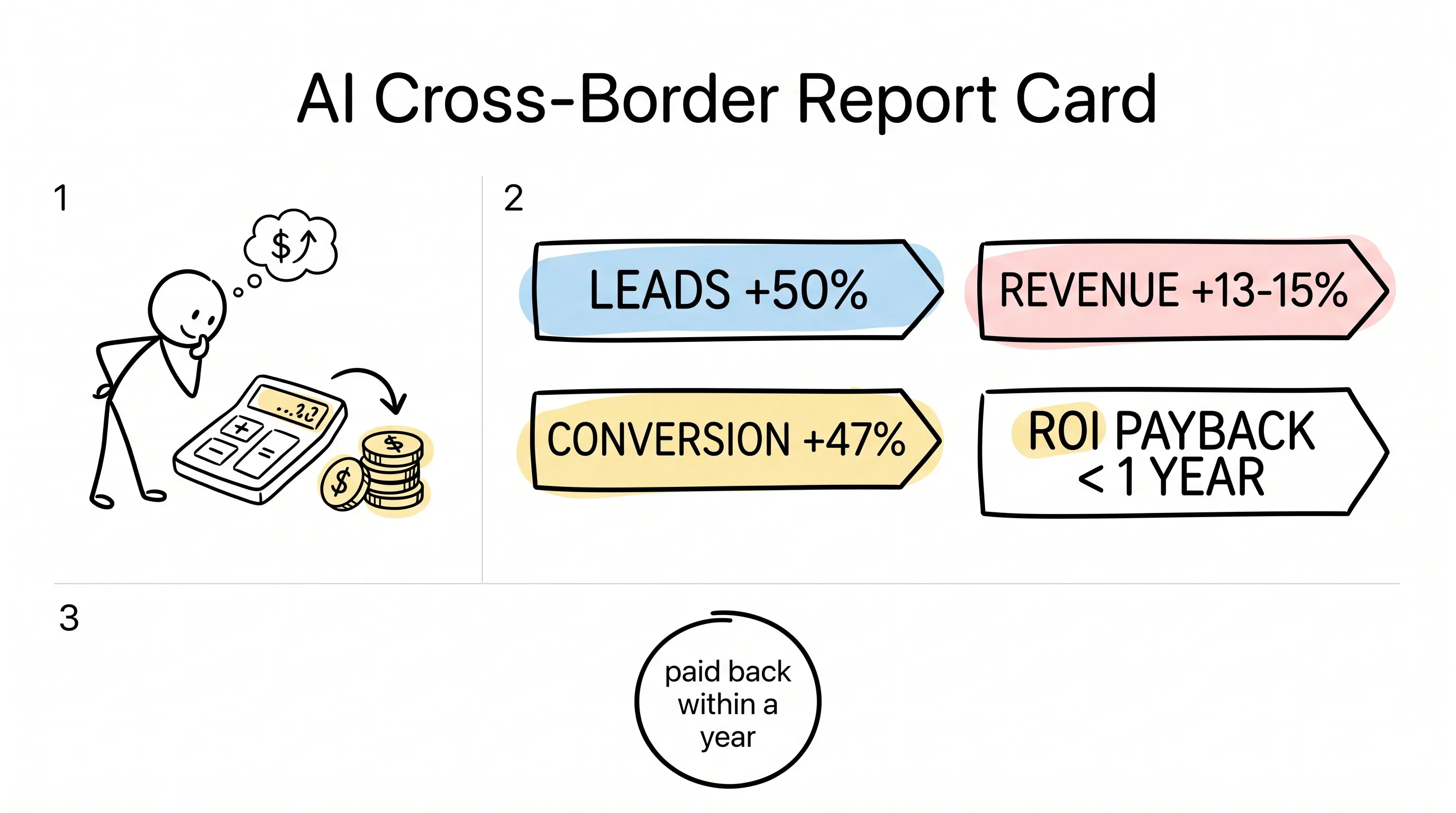
Paid back in a year. That's math every cross-border boss should run.
Want In? Where Do You Start?
Don't tear everything down and start over. Three steps are enough.
Step one: pick the place that hurts most. If customer service is exhausting your team, start with AI customer service. If inventory keeps piling up, start with demand forecasting.
Step two: clean up your data. AI's forecasting is only as good as the data you feed it. Garbage in, garbage out.
Step three: pilot small, and let real data do the talking. Whichever scenario proves out, replicate it in the next. And for major decisions, a human still holds the final step.
The barrier to entry today is far lower than you'd think. Many tools charge by scale or by results — even small sellers can afford them. Start small, then scale up step by step.
One Last Thing
Back to my friend. Toward the end of the dinner, I asked him again: three years ago, what did you win on?
He said: luck and hard work.
I said: that era is over. Today, doing business across the world comes down to who turns AI into a utility first — as ordinary and indispensable as running water and electricity.
Your old rival stopped competing with you on price a long time ago. At three in the morning, they're still taking orders in global markets — and the one taking those orders is an AI that never sleeps.
Here's to you being the next one to take off running.
Continue reading
Related articles

Cross-Border Business: Time to Upgrade Your AI Toolbox
A learn article explaining how AI tools help cross-border e-commerce sellers clear five hurdles: language, regulation, logistics, payments, and fraud. It outlines a five-compartment toolbox, a five-step adoption path, and metrics such as conversion rate and CLV, while cautioning against over-reliance on AI.

AI Is Taking Over the Dirty Work of Social Media Marketing, One Task at a Time
This learn article outlines four social media marketing tasks AI can handle — audience analytics, content drafting and design, ad targeting and creative testing, and spam moderation — and cautions that taste, judgment, and data security remain human responsibilities.

AI Is Already This Good — Why Is Your Social Media Marketing Still Pure Manpower?
An overview of 18 AI tools for social media marketing, organized into six categories covering audience research, content creation, scheduling, comment and DM handling, ad management, and visual production, plus notes on personalization, prediction, and emerging trends.