
The Least Valuable Use of AI in Content Marketing? Writing
Why writing is the least valuable use of AI in content marketing: real cases from Microsoft, Netflix, The Washington Post, and Starbucks show AI winning at social listening, personalization, and distribution, while humans keep the angle, judgment, and storytelling. Machines make it fast; humans make it right.
A few days ago, I had dinner with a friend who works in content.
He looked exhausted. When I asked, it turned out his team had been under heavy pressure lately: each person was spending 33 hours a week just writing content. Social posts, long-form articles, video scripts, emails — all of it. What does 33 hours mean? Roughly 80 percent of the entire workweek.
I said, isn't this exactly the kind of work AI could lend a hand with?
He said: AI? You mean ChatGPT writing drafts? Everything it produces has that machine smell — completely unusable.
I laughed. For many marketers today, that's the entire mental picture of AI: an intern who can type.
But if you actually look at what marketers have been doing with AI over the past two years, you'll find that writing is only AI's most famous use in content marketing — nowhere near its most important. Segmenting audiences, running predictions, watching data, tuning ad spend — AI has a hand in nearly every step of content marketing.
In this piece, I'll lay it all out in plain language.
First, Clear Up a Misconception: AI Is Not "Helping You Write Copy"
So what does it mean for AI to do content marketing?
Put plainly: take AI's handful of core abilities and apply them to every link of the content marketing chain.
So what are those abilities?
Dig to the very bottom and you find two: machine learning and deep learning. The names sound intimidating, but one sentence explains each. Machine learning means letting machines find patterns in data on their own, instead of a person writing rules one by one. Deep learning pushes the pattern-finding deeper — deep enough to handle messy things like text, images, and sound.
On that foundation grow three more abilities: understanding human language (natural language processing), seeing images (computer vision), and making out sound (speech recognition).
SaaS vendors package these three abilities and install them into tools you can buy. So you end up with four handy instruments: generative AI, which produces copy and images; predictive analytics, which guesses who will buy and who will leave; sentiment analysis and social listening, which hear what the whole web is saying about you; and chatbots, which answer your customers' questions for you.
Now, one key distinction.
Many people lump AI together with "marketing automation." They are two different things. Automation speeds up, unchanged, what you already do by hand — scheduled posting, say. AI adds judgment to "what to do, who to do it for, and when."
Automation saves your hands. AI saves your brain.
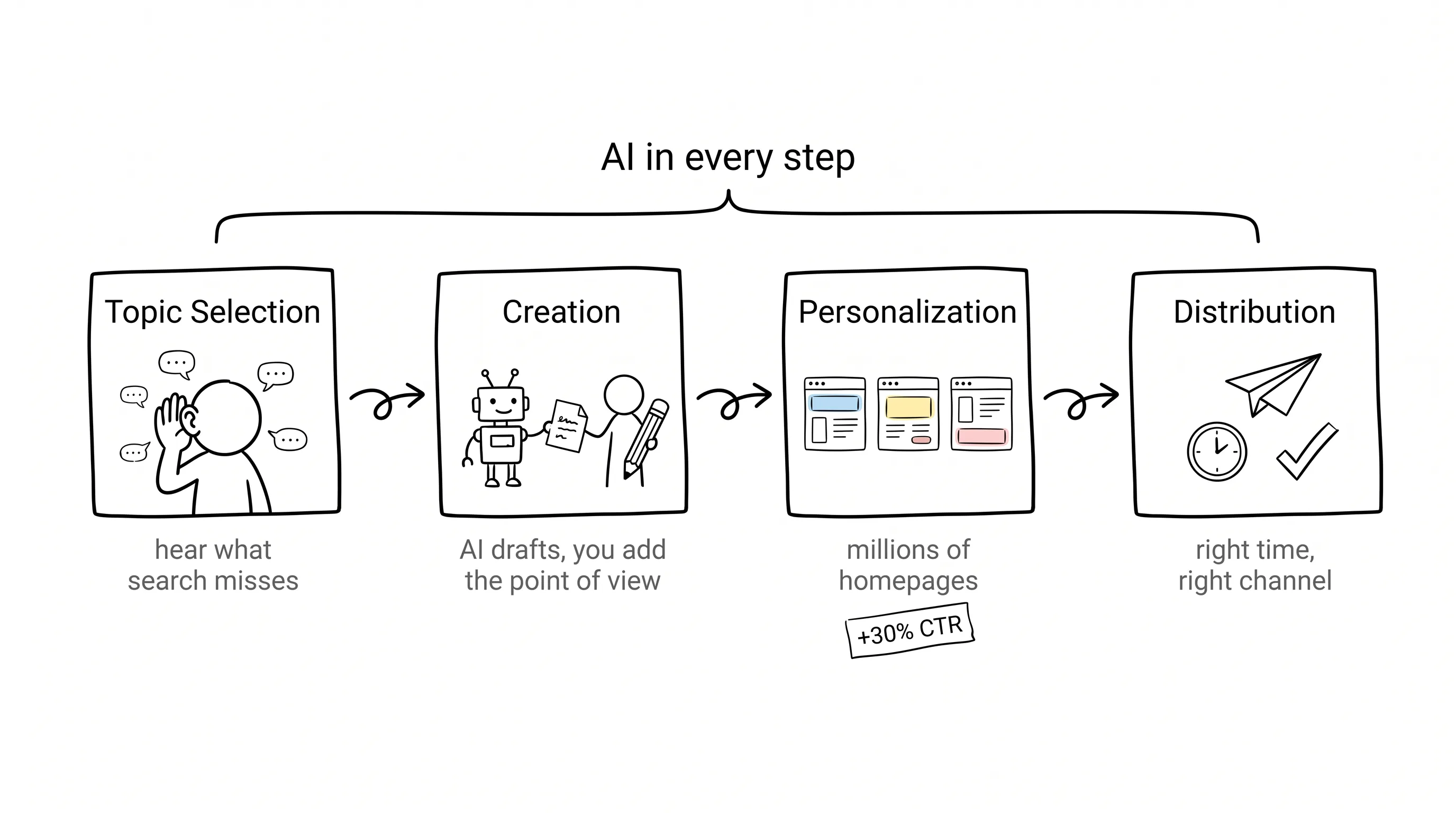
With that distinction made, let's look at where AI actually fits. I break content marketing into four steps: topic selection, creation, personalization, and distribution. One step at a time.
Step One, Topic Selection: Don't Just Listen to the Search Box
In an earlier survey, the Content Marketing Institute found that 47% of enterprise marketers can't produce content that stands out from the crowd.
Why? Because everyone's topic-hunting routine is too alike. Open an SEO tool, check keywords, build a topic library. The more diligent ones go browse a few forums as well.
Should you do SEO? Yes. But if you only stare at the search box, you hear only the half of users' voices that passes through it. The huge pile they never search — complaints in their feeds, grumbles in communities, rants in review sections — you miss all of it.
That's where the topic-selection gold mine lies buried.
AI's strength is pulling in the billions of real conversations scattered across social media, forums, blogs, and review sites, clustering them into themes, trends, and sentiment, and serving them straight to you. The industry term is social listening. Sprinklr surveyed in 2024: one out of every two marketers planned to buy a social listening tool within half a year.
How does this work in practice? Microsoft is a good example.
Just after the pandemic, remote work was the topic the whole web was discussing. Microsoft used social listening to capture those conversations and spotted one detail: in users' own words, "hybrid work" had come to mean the same thing as "flexible work." What people wanted wasn't a set number of office days — it was the freedom to arrange their own time. That finding directly set the tone for Microsoft's thought leadership content afterward.
If you understand users half a step before they understand themselves, your content wins before the race starts.
Step Two, Creation: AI Writes the Draft, You Write the Point of View
Now creation. My friend's 33 hours are spent on this very step. And that is the average for B2B content marketers: 80 percent of the week's working hours, burned on output.
What to do?
Sprinklr also surveyed in 2024: 75% of social media marketers planned to use generative AI to improve the customer experience on social media. By today's yardstick, that number can only be higher.
The approach is simple too: AI produces the first draft, humans make the final one.
Many people are disappointed in AI writing because they use it backwards: they expect it to produce a finished piece in one go, then are let down to find it is all correct nonsense. The right approach is to treat it as a first-draft machine. The angle is yours, the data is yours, the examples are yours. AI lays down the 60-point foundation; you add the 30 points on top.
Marketing tools today — the ones managing social media, customer data, content publishing — mostly already have generative AI built in. Sprinklr AI+, for example, can generate the first version of whatever you publish, from Facebook to LinkedIn, from email to blog. And general-purpose tools like ChatGPT, Claude, Gemini, and Perplexity are right at hand.
One number in passing: according to the tool directory Seekme.ai, as early as 2025 there were already more than 12,000 AI tools on the market. Whichever stage you want a helper for, you can almost always find one.
So my judgment is: the cost of "writing" is being hammered to the floor, and the price of "thinking" keeps climbing. First drafts are no longer worth money; what's worth money is the angle, the data, and the judgment that only you have.
Step Three, Personalization: Ten Million People, Ten Million Homepages
Have you ever noticed that your Netflix homepage doesn't look like other people's?
It's not just the homepage. Even each show's poster can be different. The machine has read your history and picked for you the poster you're most likely to click. The same shop, serving different signature dishes.
The result of running it this way: click-through rate up about 30%, and the users kept from churning in a year worth roughly US$1 billion.
Unbelievable. One poster, a billion dollars.
That is personalization at scale: the audience is millions of people, yet what each one sees feels made just for them. Applied to content marketing, AI can slice the audience into segments by channel, behavior, geography, lifecycle, and interests, then give each segment different content. Sprinklr's SmartAudienceEngine does exactly this: it merges data from websites, apps, email, e-commerce, and CRM, maps out four audience segments — active, at risk of churn, dormant, and prospective — and then sends each its own content.
One-to-one marketing used to be done by adding headcount.
Not anymore.
Step Four, Distribution: The Most Tedious Work Is What AI Does Best
The final step: distribution. Also the most underestimated.
Finishing the draft is only the beginning. Which channel to publish on, what time, whether compliance approval has finished — that pile of chores is far more vexing than the writing itself. Big companies have it worst: before a piece goes out it must pass legal, pass brand, pass compliance; if any link gets stuck, at best you're delayed, at worst it's a public fiasco.
At this step AI can take over the three most labor-hungry jobs.
Compliance. Take Sprinklr's Smart Approvals: before content is even published, AI has flagged the offensive wording, the questionable images, the off-key tone. The old way was to publish, then scramble to delete posts in the middle of the night. The new way is to stop it before it goes out.
Timing. Social algorithms change every day, and no amount of guessing will find the best posting hour. Smart Scheduling goes through your own historical data and computes for each account a suggestion of "post at this time and the odds of engagement are highest." Every account, every platform — the answer differs.
Ads. Facebook's Automated App Ads, for instance, assembles creatives, tests them, and adjusts them itself, concentrating the budget on whichever one performs best.
Draft, pair, publish — one clean loop, no more dragging spreadsheets back and forth. Content shows up on time where it should, seen by exactly who it should be.
Let Me Tell You a Few Real Stories
Enough theory. Let me tell you a few things that really happened.
First, The Washington Post. The 2016 US election: hundreds of races starting at once, and the paper simply couldn't send reporters to cover each. They built their own system called Heliograf, letting machines write election briefs in real time, covering nearly 500 races. In its first year it published about 850 stories, and election coverage brought more than 500,000 clicks — work the newsroom could never have staffed anyway. What did the reporters do? They went off to write the deep-dive stories only humans can write. That logic cuts even sharper today: Ahrefs statistics from 2025 showed that more than 70% of new webpages at the time already had AI involved, and as long as quality was up to par, rankings were no worse than human-written ones.
Second, Corning. This glassmaker's marketing team ran ads on LinkedIn, adjusting bids by hand. Later they switched to AI bidding: the algorithm trained on Corning's own campaign data, predicting how much each ad should bid. In a two-week pilot, website visits rose 124% and the cost of acquiring each customer fell 55%. The team was freed from the frantic dashboard-watching and went back to real work.
Third, Trivago. The 2023 rebrand: one ad had to go live simultaneously in more than ten language markets; in the past that meant keeping several production teams on hand. They used AI: the leading man in the film stayed unchanged, the voiceover became a local version for each market, with the tone fitted to the local culture. By 2025, with their new ad starring Klopp, they still shot a single English version and used AI translation to roll it out across 20 markets.
Fourth, Starbucks. In 2022 it launched a recommendation engine called Deep Brew, built into its app and loyalty program. Machine learning blends customer preferences, weather, and store location into its recommendations: hot days push more iced drinks, rainy days push something warm; even the drive-thru menu changes along with it. Reportedly, after this system went live, return on investment rose 30% and customer engagement rose 15%.
Fifth, Booking.com. Sixty days, more than 9,500 TikTok comments — no human could read them all. AI tagged each one by sentiment and intent and delivered insights to the marketing and customer-service teams in real time. Saving 17 hours of manual review is the small part; the big part is never missing a single window to ride a trend.
Five stories, five uses, one thing in common: AI does the repetitive, the massive, and the can't-wait; humans do the judging, the creating, and the deciding.
One Layer Deeper: Content Strategy Becomes "Alive"
Everything so far has been stage by stage. Look deeper and AI is changing how the whole content strategy is played.
What did tuning a campaign use to depend on? The quarterly report. Data moved at a snail's pace. Now AI watches real-time sentiment, competitor moves, and trend signals; you can turn things around in hours instead of waiting weeks.
Publishing used to be fire-and-forget: few people went back to see how a piece performed. Now every campaign, however small, feeds its data back into the system; AI finds the patterns and tells you how to change the next one. The closed loop between creation and results is, for the first time, truly turning.
One step further, AI can anticipate: it infers from behavior patterns what users will need next, and has the content ready before they ask. Value offered proactively is the kind that builds trust.
Oh, and the compliance big companies ache over most: approval chains run automatically, risks are flagged automatically, messaging across dozens of markets aligns automatically. There's no story in this one, but it's an absolute lifesaver.
So, Will AI Replace Content Marketers?
At the end of that dinner, my friend couldn't help asking this question after all.
My answer is clear: no. But the people who use AI will.
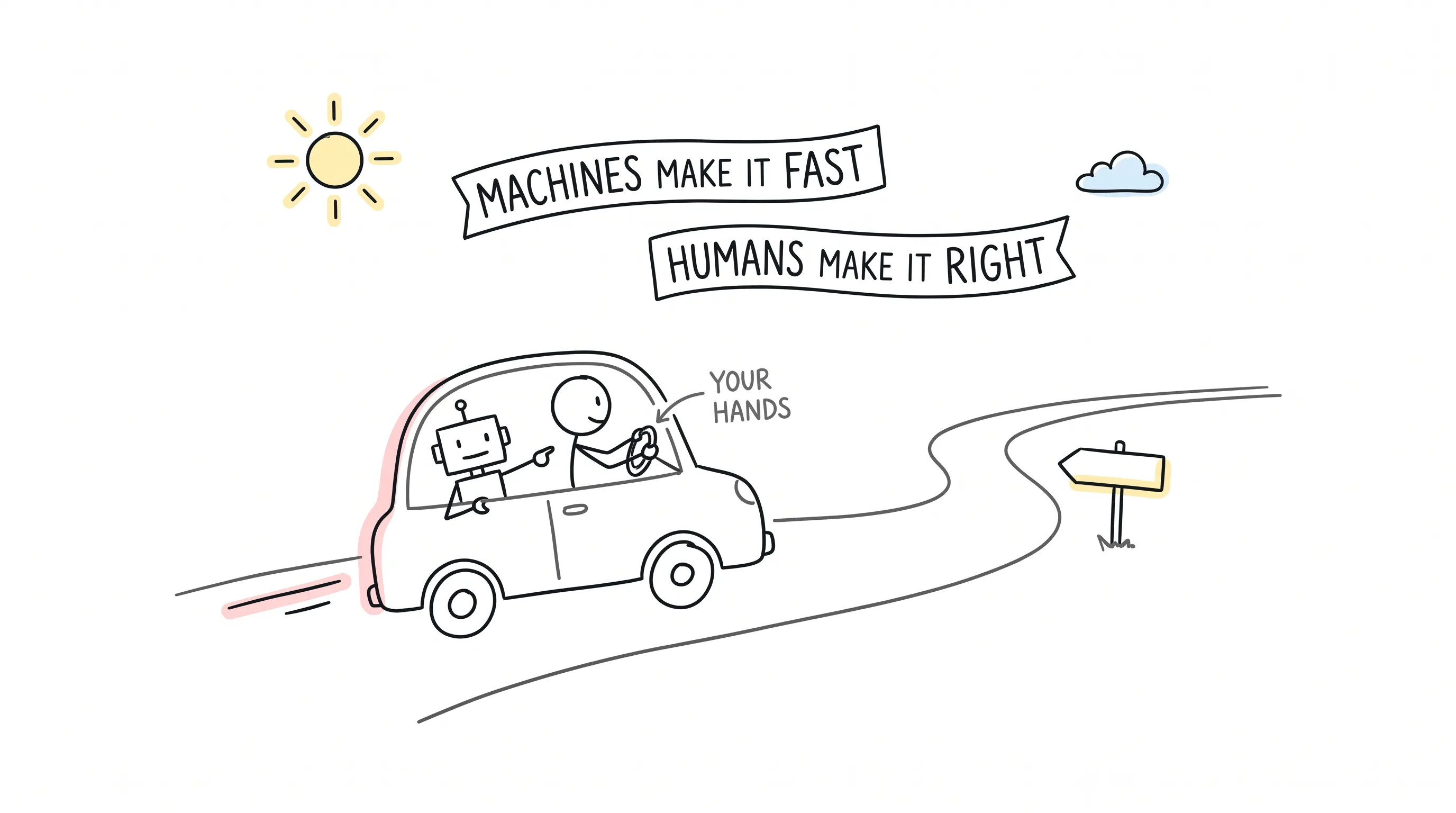
To be more precise: AI takes over the "hands" part — first drafts, segmentation, scheduling, watching data. Humans hold the "brain" part — the angle, the judgment, the brand, and the stories only a living person can tell. The most comfortable division of labor is to treat AI as your co-pilot: the steering wheel stays in your hands, and it helps you see farther and drive faster.
A week later he messaged me: they had handed topic selection, first drafts, and scheduling all to AI, and the time saved each week was enough to write two more genuinely deep pieces. He finished with one line: why didn't we start this sooner?
Machines make it fast; humans make it right. That is probably the best version of content marketing in the AI era.
Here's to you and your AI finding your rhythm together.
Continue reading
Related articles

Cross-Border Business: Time to Upgrade Your AI Toolbox
A learn article explaining how AI tools help cross-border e-commerce sellers clear five hurdles: language, regulation, logistics, payments, and fraud. It outlines a five-compartment toolbox, a five-step adoption path, and metrics such as conversion rate and CLV, while cautioning against over-reliance on AI.

AI Is Taking Over the Dirty Work of Social Media Marketing, One Task at a Time
This learn article outlines four social media marketing tasks AI can handle — audience analytics, content drafting and design, ad targeting and creative testing, and spam moderation — and cautions that taste, judgment, and data security remain human responsibilities.

AI Is Already This Good — Why Is Your Social Media Marketing Still Pure Manpower?
An overview of 18 AI tools for social media marketing, organized into six categories covering audience research, content creation, scheduling, comment and DM handling, ad management, and visual production, plus notes on personalization, prediction, and emerging trends.