
The Influencer Marketing Gold Rush—and the People Selling the Shovels
A learn article explaining what influencer marketing platforms do, why the rise of micro-influencers drives demand for them, which industries and regions are adopting them, and how AI supports creator matching and performance tracking.
A while back, I had dinner with an old friend who runs a consumer brand.
When the talk turned to marketing budgets, he pulled out his phone to show me: this quarter, more than half of their spend never touched splash-screen ads or in-feed placements—it all went to a lineup of content creators.
I said, that's a bold bet.
He said it wasn't bold—it was arithmetic. The same budget spent on straight display advertising just makes a noise; spent on the right people, it moves real product and builds up goodwill along the way.
On the way home that night, one question kept turning over in my mind: brands everywhere are lining up to wire money to influencers—so behind this whole business, who's the one guaranteed to profit?
Later I came across an industry report that untangled the question for me.
What Exactly Is an Influencer Marketing Platform?
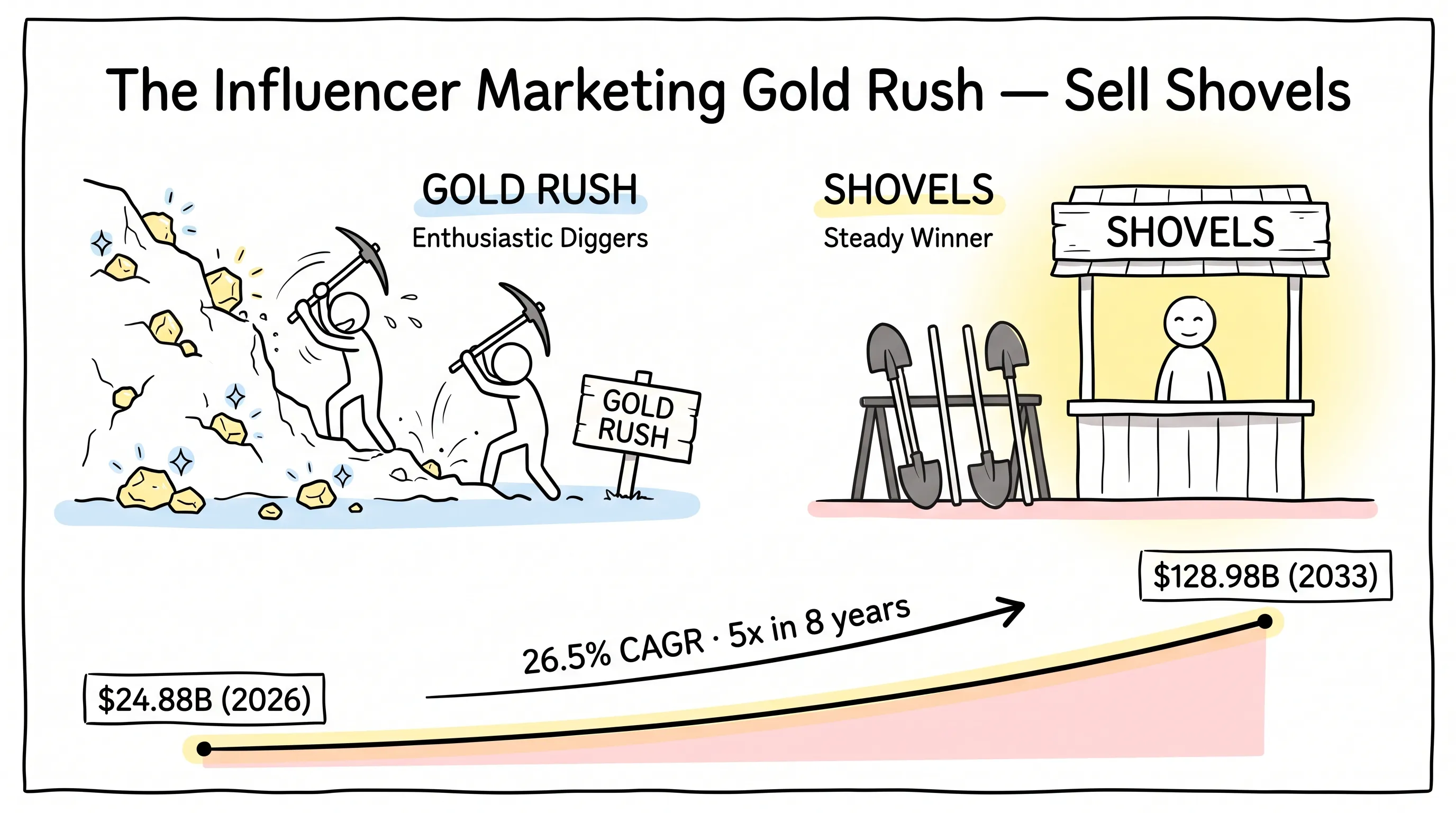
Let me lead with my conclusion: in a gold rush, the steadiest business is usually not digging for gold, but selling shovels.
Influencer marketing platforms are that shovel.
So what is one, exactly? Simply put: software that helps brands find influencers, manage collaborations, and measure the returns.
Say you want a lineup of creators to push a new product—where do you find them? Among thousands of candidates, whose numbers are real? Whose audience actually overlaps with your target customers? And once a deal is struck, contracts, payments, content scheduling, performance tracking—every one of them is a job of work.
With ten influencers, a spreadsheet will just about cope. What about a thousand?
That's where the platforms come in. Influencer databases, audience profiles, collaboration management, contract management, payment processing, engagement tracking, performance analytics—these features are now table stakes across the industry.
A recent market forecast covering 2026 through 2033 caught my eye; I've fished out the most important numbers for you:
The global influencer marketing platform market is estimated at roughly $24.88 billion this year; by 2033, it's projected to reach $128.98 billion.
What does that mean? Run the numbers at a 26.5% compound annual growth rate, and you get more than a 5x expansion over eight years.
Punch it into a calculator and you'll see: this isn't a curve growing at a leisurely pace—it's riding a rocket.
Why Are Small Creators with a Few Thousand Followers Outperforming Celebrities?
Why has this business suddenly gotten so big? The report offers several reasons: social media keeps digging deeper into daily life, online shopping keeps getting smoother, influencer marketing costs less than traditional advertising, and ordinary people love to share and show off.
All true. But to my mind, the most interesting shift is a quieter one: the rise of the micro-influencer.
Who counts as a micro-influencer? The kind with a few thousand to a few tens of thousands of followers. Not long ago, brands only had eyes for celebrities and mega-influencers.
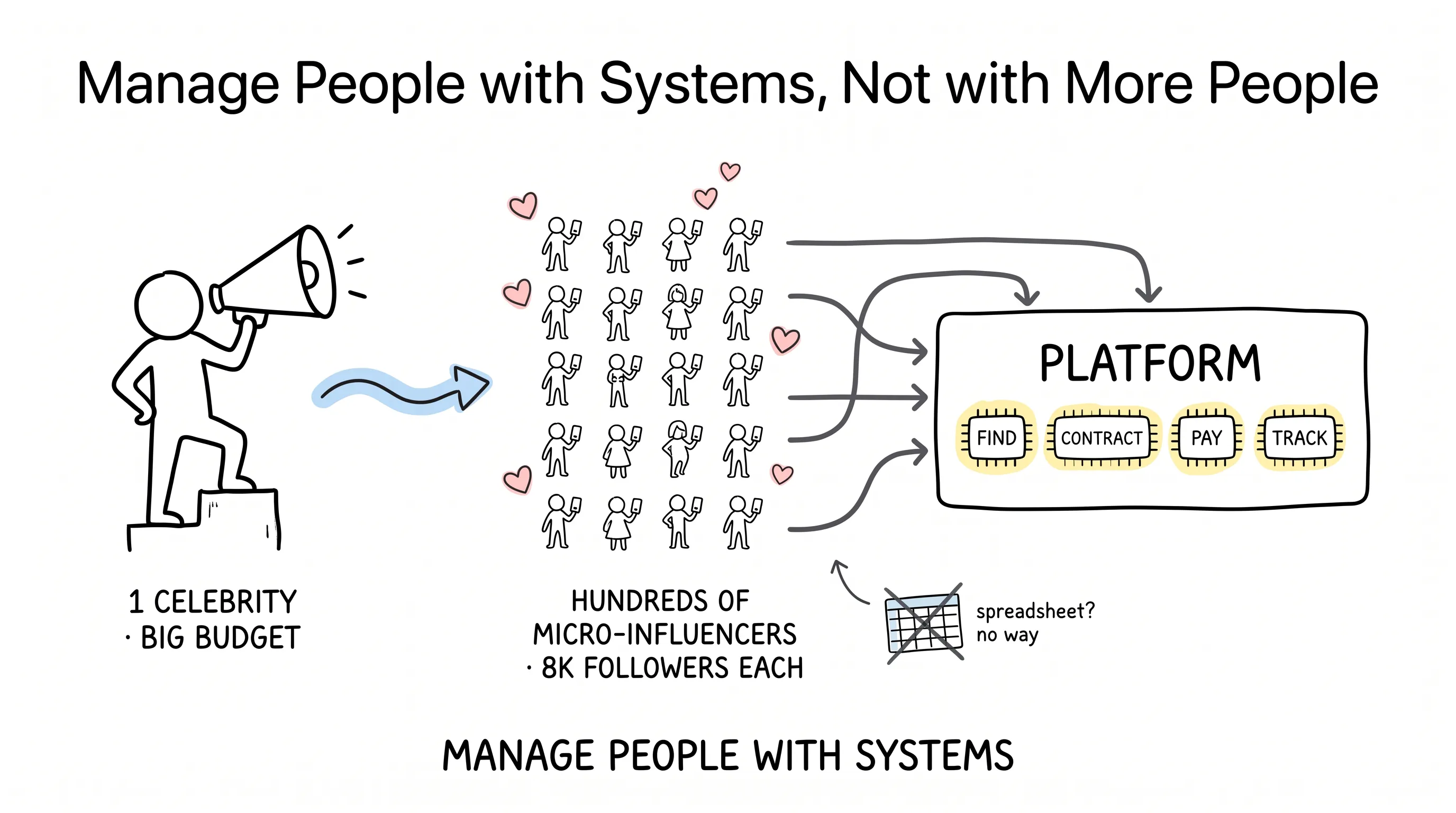
But think about it: a creator with just eight thousand followers recommends a face mask—do you believe her?
Odds are you do. Why? She comes across like the neighbor next door, not a paid ad slot. A small following makes her seem more real, not less.
The data backs up that instinct: micro-influencers often post higher engagement and conversion rates than celebrities do.
So brands figured it out: instead of betting big money on one celebrity, spread the spend across a roster of micro-influencers, each reaching a small, precisely matched audience—and together it's cheaper and more effective.
But new headaches followed.
A brand can easily find itself managing hundreds or even thousands of micro-influencers at once, scattered across different platforms, regions, and product categories. Spreadsheets are hopeless at that scale, and manual management even more so.
The answer?
Manage people with systems, not with more people.
That's the demand engine behind influencer marketing platforms: the more micro-influencers you deploy, the more indispensable the platform becomes.
Who's Buying the Shovels?
Having looked at the demand side, let's see who's actually paying.
The first answer may surprise you: large enterprises.
One number from the report: in 2026, large enterprises are expected to account for 59.6% of this market.
Why are big companies buying hardest? Because their influencer operations have grown to the edge of chaos. Different product lines, different countries, different platforms—thousands of influencer relationships to maintain, budgets to split, results to account for.
Without a system, that's a disaster.
So the big players have been building their own. In May 2025, JioStar launched its own influencer marketing platform, JioStarverse, helping brands and agencies manage creator collaborations in a data-driven way. Earlier that year, in February, Sprout Social had repackaged and upgraded its influencer marketing offering and brought it to market.
When even the giants step in to make shovels, how hot do you think this business is?
The second answer: the fashion and lifestyle sector is the most aggressive buyer of all.
In 2026, the sector is expected to account for 36.1%—the biggest buyer of any industry.
Why fashion? Consider what this business runs on: visuals. Outfits, color swatches, makeup tutorials, unboxing videos—it's all visual content, a natural fit for platforms like Instagram and TikTok.
Fashion is also an emotion business. When a consumer buys a dress, it's often not need but desire that someone planted. A single "outfit of the day" post from a creator can set off a wave of impulse buying.
Add to that fashion's breakneck pace—practically a new trend every week—and brands need a steady stream of fresh content. Influencers are their faucet: turn it on and it flows.
Where Is the Shovel Business Hottest?
Regionally, North America remains the leader, projected at 43.7% in 2026. Social media took root there early, platform vendors cluster densely, and big brands carved out dedicated influencer marketing budgets long ago. In 2024, IZEA's Flex platform even picked up a martech award—companies like that grew straight out of that soil.
But the genuinely interesting story is Europe.
The report judges Europe to be one of the most fertile markets in the forecast period. A small example: in January 2026, Hypefy, a European influencer marketing startup, raised a €1.75 million seed round for exactly this—using AI to automate the whole workflow of creator collaborations, from selecting creators to setting budgets to producing reports. And its ambitions don't stop at Europe; it's eyeing the US market too.
Savor that trajectory: train up in Europe, then charge into America. Europe has become the training ground for the new generation of shovel sellers.
The UK and Germany offer especially big opportunities. Advertising budgets are migrating from traditional media to social media, while regulators demand high transparency—leaving brands little choice but to use platforms to manage compliance.
Big money is voting with its feet, too. In May 2025, Publicis Groupe spent roughly $150 million to acquire the influencer marketing platform Captiv8, which holds data on more than 15 million creators worldwide.
A century-old advertising giant paying $150 million for a shovel—that's more convincing than any forecast figure.
The same year, Linqia rolled out an intelligent creator scoring system, and Launchmetrics added the ability to identify key industry voices within its own products. Everyone is pushing in the same direction: not just finding influencers, but finding the "right" ones—and being able to account for the results.
And what makes the accounting possible? AI. Platforms use algorithms to analyze audience interests, past engagement, and content preferences, recommend the best-matched creators for each brand, then keep self-correcting with every campaign's data.
But Shovels Have Pitfalls Too
Everything has a flip side.
This business has at least two pitfalls, and the report doesn't try to hide them.
First, quality influencers are scarce. However smart the platform, you can't make bricks without straw. There are only so many top-tier creators, and plenty of mid-tier and below inflate their numbers.
Second, transparency. Followers can be faked, engagement can be faked, and sales attribution can be padded. When brands spend money and can't reconcile the books, trust starts to crack. Layer on ever-tightening data-privacy rules, and the cost of getting that data only goes up.
So the next round among shovel sellers won't be about feature count, but about four things: how accurate the data is, how clearly the books reconcile, how solid the compliance is, and how deep the local network runs.
Put simply: moving from a matchmaking business to a trust business.
A Closing Word
When that dinner wound down, I asked my friend: managing this many creators yourselves—doesn't it wear you out?
He laughed: it does. That's why we bought a system.
You see, the people digging for gold have no time to make shovels—they're busy digging.
Gold diggers come and go; shovel sellers get rich quietly.
Maybe in a few years, when brands talk growth, their first question will be: which system should run my influencer operation? Buying ad slots takes a back seat.
Here's wishing you your own pot of gold—whether you stand on the digging side or the shovel-selling side.
Continue reading
Related articles

Cross-Border Business: Time to Upgrade Your AI Toolbox
A learn article explaining how AI tools help cross-border e-commerce sellers clear five hurdles: language, regulation, logistics, payments, and fraud. It outlines a five-compartment toolbox, a five-step adoption path, and metrics such as conversion rate and CLV, while cautioning against over-reliance on AI.

AI Is Taking Over the Dirty Work of Social Media Marketing, One Task at a Time
This learn article outlines four social media marketing tasks AI can handle — audience analytics, content drafting and design, ad targeting and creative testing, and spam moderation — and cautions that taste, judgment, and data security remain human responsibilities.

AI Is Already This Good — Why Is Your Social Media Marketing Still Pure Manpower?
An overview of 18 AI tools for social media marketing, organized into six categories covering audience research, content creation, scheduling, comment and DM handling, ad management, and visual production, plus notes on personalization, prediction, and emerging trends.