
The Google Ads, Meta, and TikTok APIs: Three Days to Integrate, Three Years to Keep Them Alive
An explainer on why integrating Google Ads, Meta, and TikTok Ads APIs takes days but keeping them maintained takes ongoing effort, covering differences in authentication, data hierarchies, reporting, and rate limits, and weighing unified advertising API vendors against in-house integration.
Last month I went to Shenzhen to meet a SaaS founder. His product helps advertisers see their data: where the money went, how the campaigns performed, all in one view.
He flipped through his team's roadmap, then said something that stuck with me: our product isn't big, but we've hooked up more ad platforms than a lot of big companies have.
Google Ads, done. Meta Ads, done. And lately customers keep asking for TikTok Ads.
Is it hard? I asked.
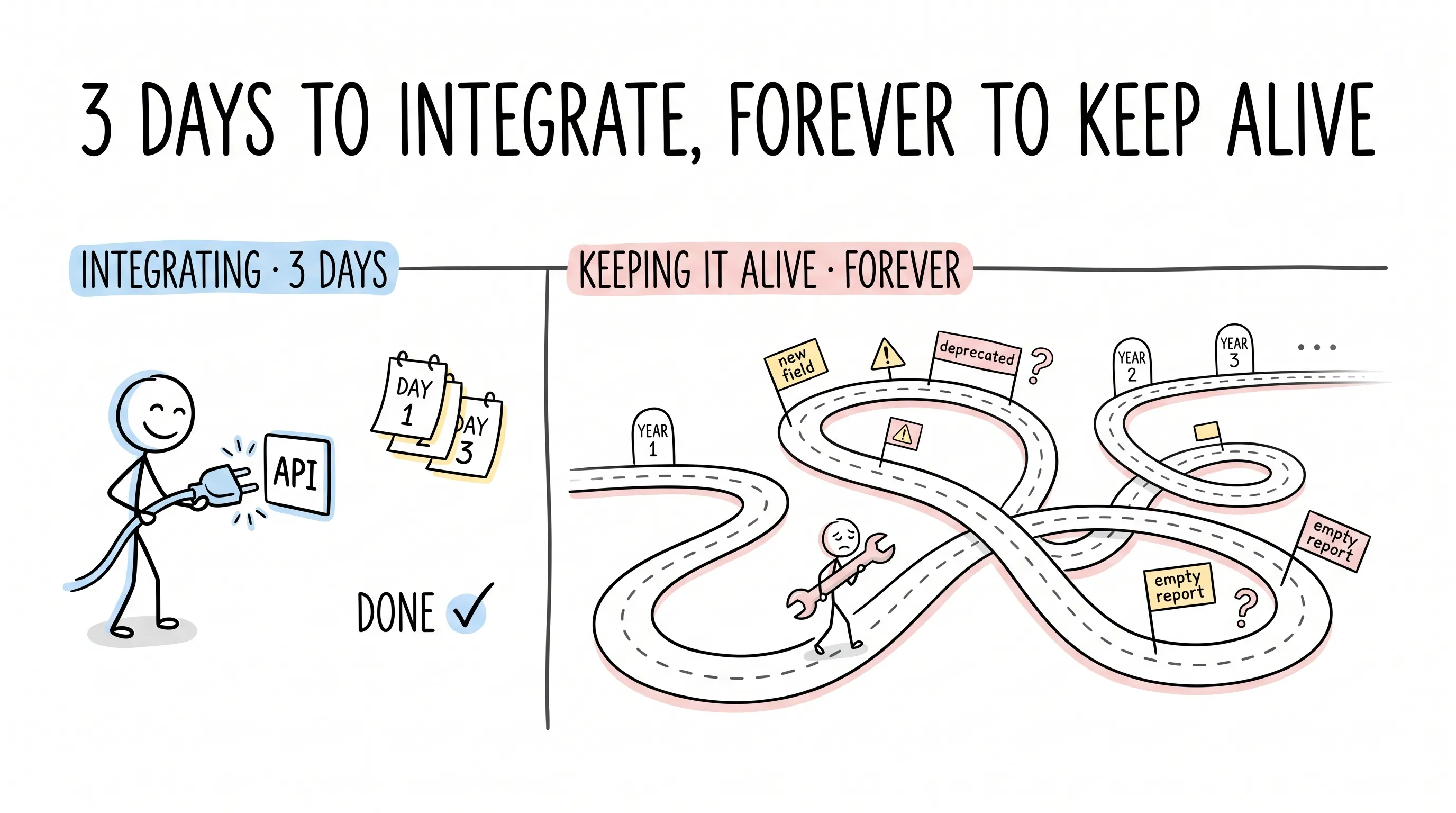
Integrating, he said, isn't hard. Keeping it alive is.
I've been turning that line over in my head ever since I got back. Today, let me tell it to you.
First, the "Integrating" Part
What does it mean to integrate an API?
Your software reads the ad platform's data directly. You apply for a developer account, walk through OAuth authorization, chew through the documentation, wire up the endpoints. The platform hands you a console where you can watch your call counts and your errors.
Run through it once — for an experienced team, three days. Honestly, not hard.
But hold on — not so fast.
The Hard Part Comes Later
You think you're integrating an API. You're actually adopting an entire worldview.
Google Ads, Meta Ads, and TikTok Ads are three entirely different worlds.
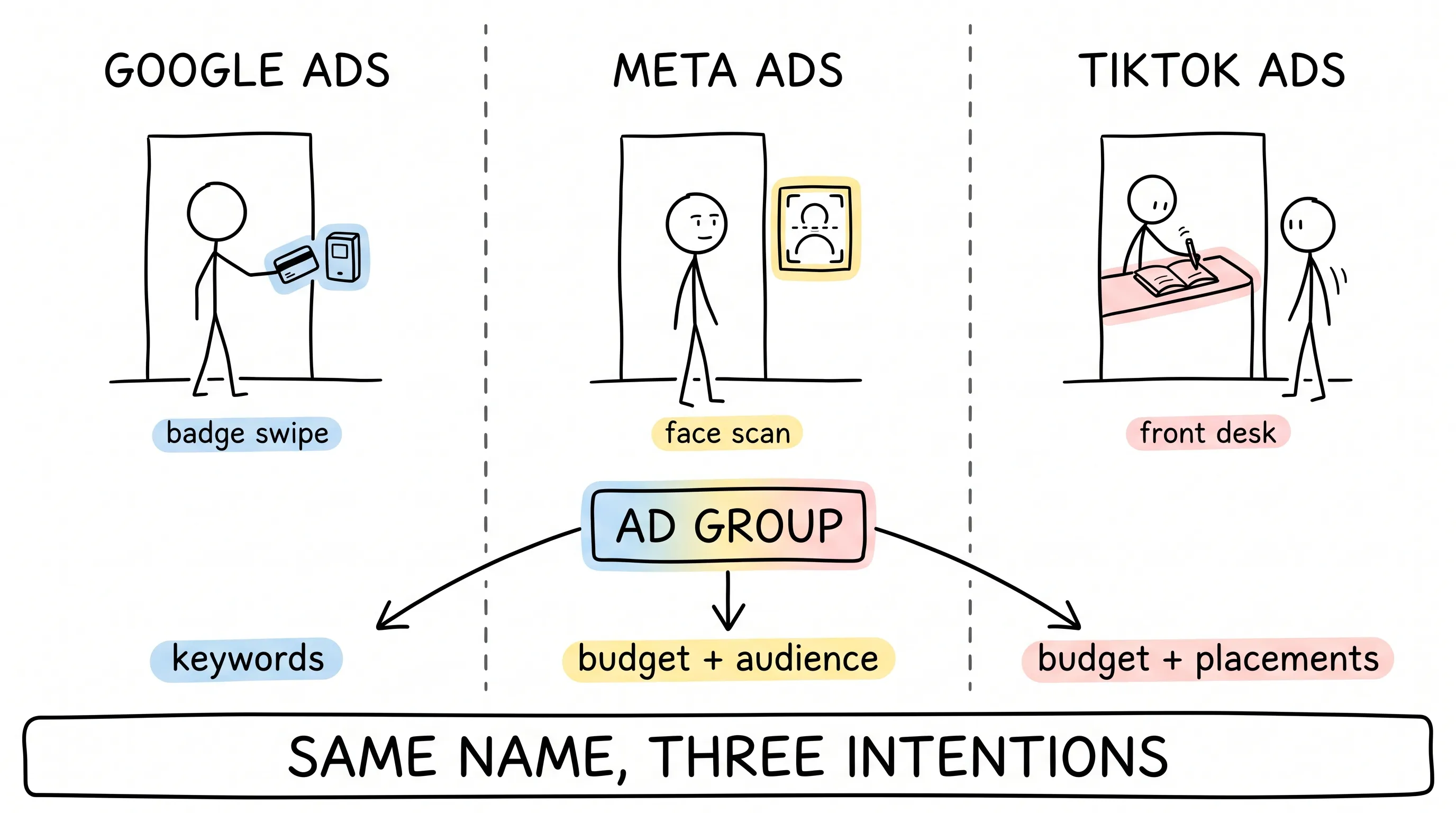
Start with getting in the door. Every platform does authentication differently. It's like running errands in three different office towers: one takes a badge swipe, one wants a face scan, one makes you register at the front desk and wait for someone to come down and walk you in. Your code has to learn the security desk of each building separately.
Then there's the language. Once you're inside, you have to find your data. Ad data comes in layers: ad account, campaign, ad group, ad. All three split it the same way, at least by name — right?
Here's where it gets interesting. All three use the same-sounding name for that middle layer. But Google's ad group manages keywords; Meta's ad set manages budget and audience; and by the time you get to TikTok, the ad group is back to budget and placements.
Same name, three different intentions.
Reports are even messier. The field names don't line up, the metrics don't measure the same things, and the export logic you wrote for one platform has to be rewritten from scratch for the next.
And then there's temperament. Every platform has its own rate-limiting rules. Push your concurrency too high and they'll cut you off. So you write a separate "keep it happy" routine for each one.
That's why he said the hard part isn't integrating — it's keeping the thing alive.
Now, Let's Do the Math
Suppose you integrate just one platform. One platform is a one-engineer job — manageable.
Now integrate three. Three authentication schemes, three hierarchies, three reporting formats, three rate-limit regimes. Multiply.
And that's just the existing work. Ad platform APIs are living things: every few weeks a new field shows up, and old versions get deprecated without much ceremony. Do the math: say each platform only disrupts you twice a year — three platforms, six disruptions, and that's a good year. Their release cycles aren't synced either, so your team spends the entire year following the platforms around, fixing pipes.
Integration is a one-time cost. Maintenance is forever.
Worse, none of this work is visible while it's being done. When an API is behaving, nobody remembers it exists. The day Meta changes a field and a client's report suddenly comes back empty — that's when you feel it.
So What Do You Do?
You might be thinking: fine, I'll hire a couple more engineers, one per platform.
You can. But have you considered that for most SaaS teams, the core business isn't integrating APIs at all? You build marketing dashboards, reporting tools, maybe AI campaign management — the interfaces are just pipes. Pipes shouldn't be your main line of work.
Which is how a new category came to exist: the Unified Advertising API.
What is a Unified Advertising API?
Simply put, someone has built a layer of interpreters on top of the APIs of platforms like Google Ads, Meta Ads, and TikTok Ads. You only ever speak one standard language to the interpreter: authenticate once, one data model, the same interface for reading and writing. The dialects underneath — it translates them for you.
Unified.to is one of the vendors doing exactly this. Go through its interface and you no longer maintain a separate data structure for each platform: authorize once, read and write data in real time, and you don't have to stockpile your customers' ad data in your own database either.
Isn't that just a universal power adapter?
Exactly. When a business trip takes you to Europe, you don't rewire every appliance you own — you pack one adapter.
But I Have to Warn You
Everything has a flip side.
A unified API erases the dialects. It cannot erase the business.
What does that mean? Google Ads and TikTok Ads were built with different campaign logic and different attribution (how each platform decides which ad deserves credit for a sale) to begin with. No amount of unified interfacing can think through those business differences for you. Whoever needs to understand the platforms still has to understand the platforms.
And every layer of abstraction adds a layer of dependency. If the interpreter gets sick, you lose your voice too. When you're evaluating vendors, two things to nail down: how stable is it, and when a platform ships a breaking change, how fast does it catch up?
What a unified API saves you is the cost of keeping integrations alive. What it can't save you is the work of understanding the business.
Back to My Friend in Shenzhen
As we said goodbye, he asked me: do you think I should go with a unified API?
Here's a test, I told him. If your moat is knowing how to run ads, outsource the plumbing and save your energy for differentiation. If your moat is the integration work itself, then the pain of these three APIs is your barrier to entry — don't give it away easily.
He paused for a second. "That advice is worth paying for," he said.
Honestly, there's no such thing as advice worth money. It's just the arithmetic, done clearly.
The next time I see him, I hope we're not talking about APIs. I hope he's telling me how many customers his product saved money for this time — and how much.
That's what SaaS is supposed to look like.
Continue reading
Related articles

Cross-Border Business: Time to Upgrade Your AI Toolbox
A learn article explaining how AI tools help cross-border e-commerce sellers clear five hurdles: language, regulation, logistics, payments, and fraud. It outlines a five-compartment toolbox, a five-step adoption path, and metrics such as conversion rate and CLV, while cautioning against over-reliance on AI.

AI Is Taking Over the Dirty Work of Social Media Marketing, One Task at a Time
This learn article outlines four social media marketing tasks AI can handle — audience analytics, content drafting and design, ad targeting and creative testing, and spam moderation — and cautions that taste, judgment, and data security remain human responsibilities.

AI Is Already This Good — Why Is Your Social Media Marketing Still Pure Manpower?
An overview of 18 AI tools for social media marketing, organized into six categories covering audience research, content creation, scheduling, comment and DM handling, ad management, and visual production, plus notes on personalization, prediction, and emerging trends.