
The Game-Decider for Restaurant Chains May Hide in the Question You Ask AI
A learn article comparing expanding vs. shrinking restaurant chains using SOCi's Local Visibility Index, covering search, reviews, social, and AI recommendation gaps.
Two news stories crossed my feed recently. I put them side by side, and it sent a slight chill down my spine.
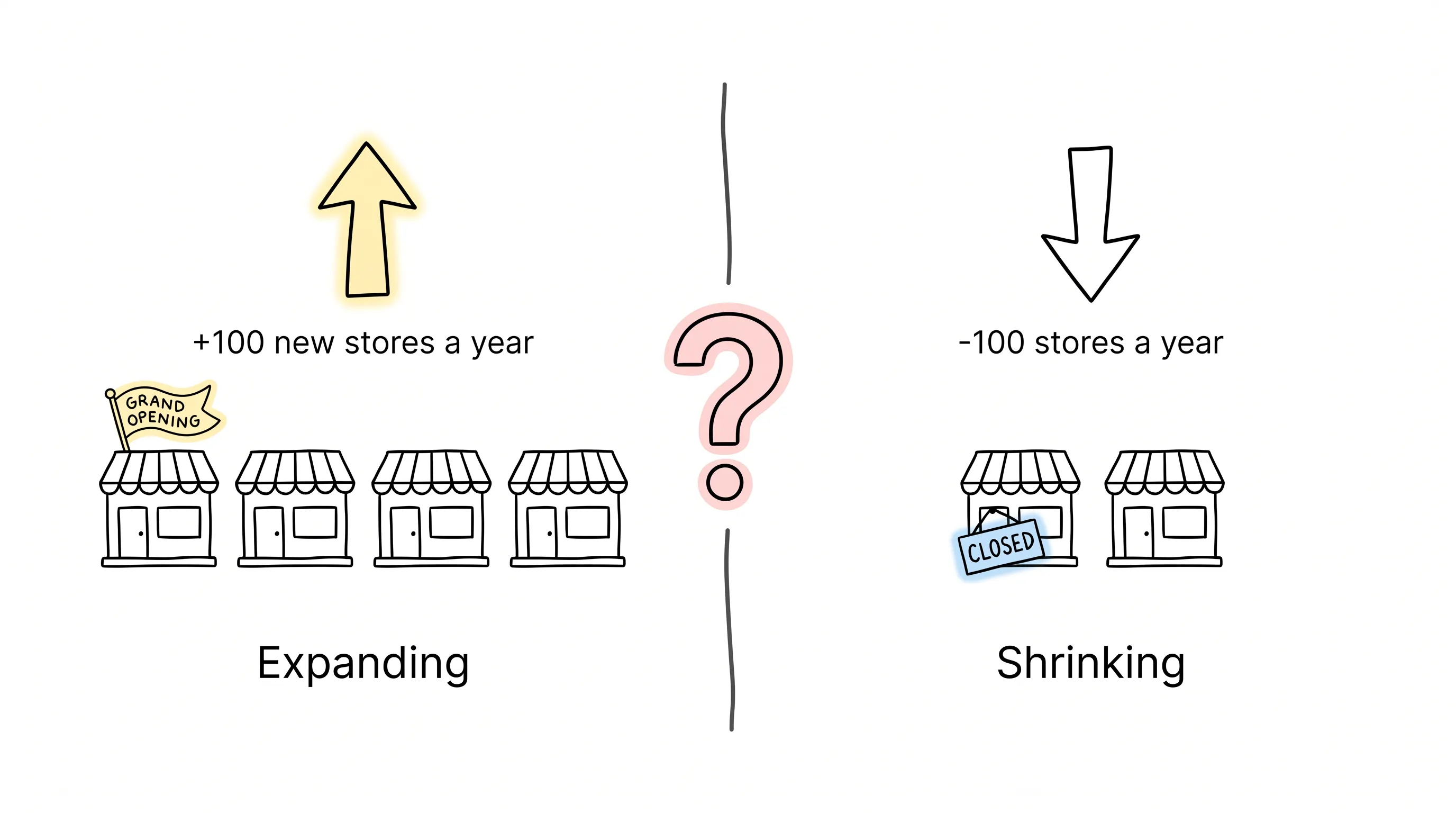
Story one: Culver's, Texas Roadhouse, and Nothing Bundt Cakes are all opening stores like crazy, adding over a hundred new locations a year.
Story two: Wendy's, Papa John's, Pizza Hut, and Red Lobster are all pulling back, closing over a hundred a year.
One side opening, one side closing. Why?
Your first instinct is probably the same as mine: the economy is bad, people are tired of the menus, or private equity is stirring things up behind the scenes. All of those explanations are right, but they share one flaw: they're slow. By the time you spot the clues in an earnings report, the stores have already closed and the news has already been written.
Is there an earlier signal?
There actually is.
SOCi is a company that does local marketing. Using its own Local Visibility Index (LVI), it ran a comparison: 8 expanding restaurant chains against 8 shrinking ones. The gap between these two groups online turned out to be scary-big.
First, let's be clear about what local visibility means.
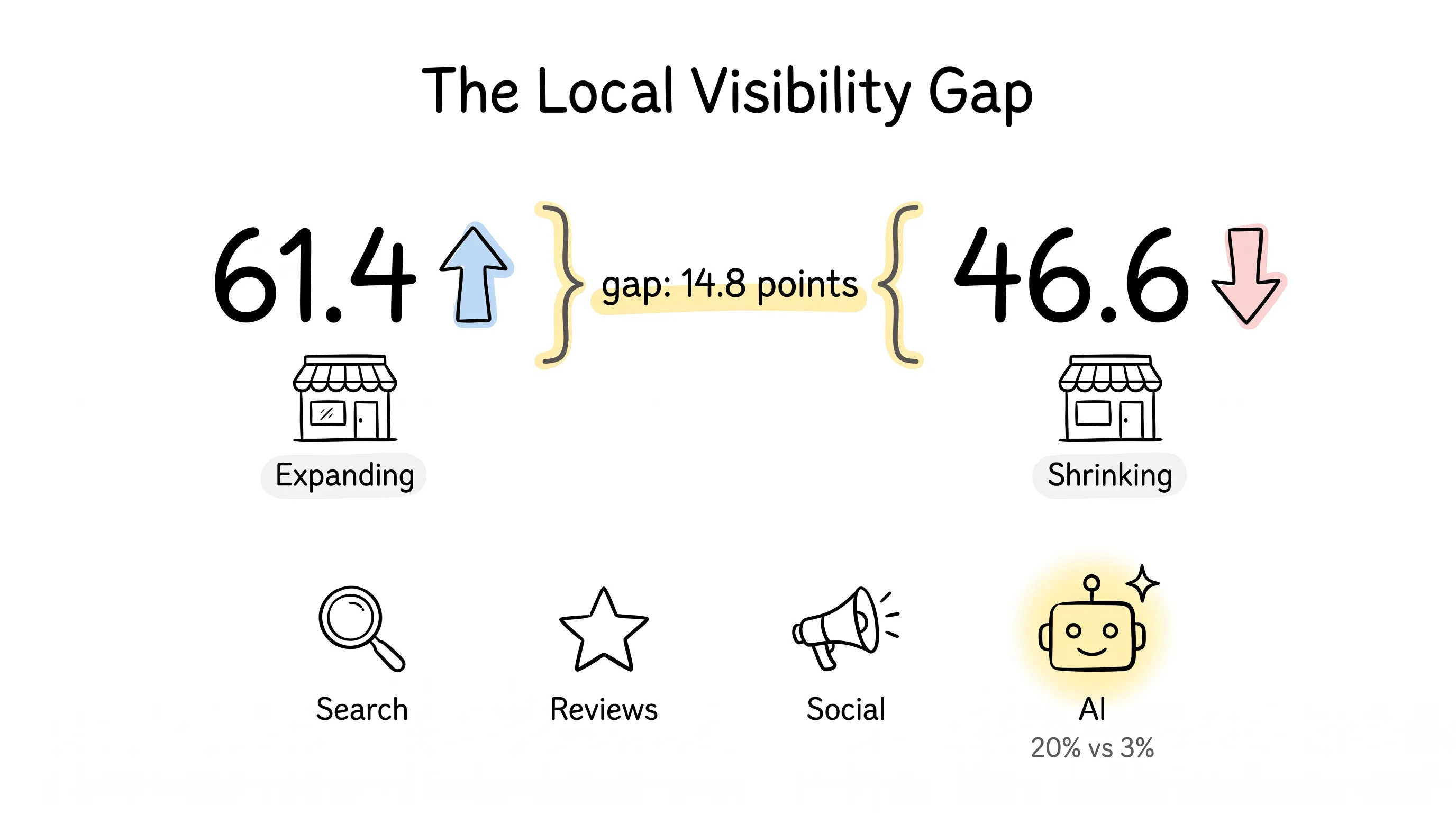
Put simply, it's how easy a brand is to find online. It breaks down into four things: can people find you in search, do your reviews look good, is your social media alive, and does AI recommend you. LVI blends these four into a single score from 0 to 100.
The headline numbers first: expanding brands average 61.4, shrinking brands average 46.6 — a gap of 14.8 points.
Those 14.8 points were pulled open by all four channels together. Every single channel lags.
The Scariest Gap Is in AI
Of the four channels, where is the gap biggest?
Search, you'd guess? Social? Neither. It's AI recommendations.
SOCi tested a batch of user queries: expanding brands get recommended by ChatGPT about 20% of the time; shrinking brands, about 3%. A 6-to-7x difference. On Gemini and Perplexity, the exact same pattern. Even the star ratings AI gives brands are noticeably higher for expanding ones.
What does 20% versus 3% actually mean?
Think about how customers find a restaurant today. They don't flip through the Yellow Pages anymore, and they use traditional search less and less. They just ask AI directly: which steakhouse nearby is worth going to? Whoever AI names makes the shortlist. If AI doesn't mention you, you never even make it to the table.
And AI is frighteningly picky.
There's a number in SOCi's overall 2026 LVI research: Google's traditional-search 3-Pack (the little box with the top three local results) — 35.9% of brand locations manage to squeeze in. But the share that ChatGPT, Gemini, and Perplexity will proactively recommend? Only 1% to 11%.
In the past, squeezing into the top three meant you'd won. Now AI's bar is even higher than the top three: your data has to be accurate, your reputation has to be good, and your content has to offer something distinctive. Missing any one of those, and it won't recommend you.
An AI recommendation is a ticket that's harder to get than Google's front page.
Old Fundamentals, New Exam
So how do you get recommended by AI?
Here's the interesting part: when you break it down, AI is testing nothing but the old fundamentals.
On the search test, 35.3% of expanding brands make it into the Google 3-Pack, while shrinking brands only reach 14.4%. For the top organic result on Yelp, expanding brands win it at nearly twice their rivals' rate — 55% versus 29.3%.
On the reputation test, the gap is even more plain to see. Expanding brands average 4.39 on Google and 3.65 on Yelp; shrinking brands, 3.82 and 2.49. On Yelp, that's a full star apart.
None of this is new. What really made me stop and think for a while was responding to reviews.
Expanding brands respond to 72.4% of their Google reviews; shrinking brands, only 43.6%. And expanding brands reply two to three times faster.
Star ratings are built through years of showing up every single day — you can't rush them. Responding to reviews? You can do it today. It costs no budget, needs no scheduling — just reply and it's done. Yet it's precisely this small thing you can do today that splits the two groups into 72.4% and 43.6%.
What does this show? It shows expanding brands treat reputation as an operation: someone manages it every day, with deadlines, with standards. Shrinking brands treat reputation as a report: glance at it at the end of the month, sigh, turn the page.
Stars are compounded over years. Replies are done today.
A 26x Gap That Comes Down to One Word: Local
There's one more gap with the most extreme multiplier: social media engagement rate.
Expanding brands' local social media engagement rate is 3.45%; shrinking brands, 0.13%.
Twenty-six times. Expanding brands also have roughly five times as many followers.
Is the 26x gap just the result of posting more?
No. In SOCi's broader LVI research, the conclusion points to another word: localization. Expanding brands create locally fitting content for every store — local jokes, local events, local neighbors. Shrinking brands? Headquarters writes one post, and the pages of a thousand stores across the country repost it together. The industry calls this waterfall posting. It saves effort — that part is real. So is the part where customers don't buy it.
Think about it: blasting every city the same "The weather is nice today, come eat a burger," versus a local store manager filming "The street outside our store has a night market tonight" — which one feels human?
If You Run Multiple Locations
That's the data. Now for what you can use today. If you run marketing for a multi-location brand, these four things are worth starting right now:
-
Treat data accuracy as infrastructure you keep tending, not a one-time deep clean. Google, Yelp, Facebook, plus your own store pages — addresses, opening hours, phone numbers, all of it has to match. This is the foundation of every channel, and the first thing AI checks before recommending you.
-
Turn responding to reviews into a process. Who replies, how quickly replies get done, how to reply to negative reviews — write it into the rules. This is one of the few levers that shows results within weeks.
-
Push social content down to the local level. The 26x gap isn't posted into existence; it's built one piece of local content at a time.
-
Go test your AI visibility — deliberately. Open ChatGPT, Gemini, and Perplexity and ask about your own brand the way a customer would. Doing well at search doesn't mean AI will recommend you. This is the biggest blind spot in this research.
Back to Those Two News Stories
Now, look back at the two news stories at the start, and you may feel the same thing I did: the stores that closed probably didn't lose to one particular day — they lost to every day.
Lost on page two of the search results, lost on that negative review nobody replied to, lost in the instant AI read out a competitor's name.
Earnings reports can't see these signals, and the news doesn't write them, but the online data is shouting them every single day.
Let me say this clearly up front: I won't scare you with lines like "one bad review drags down a restaurant." This research is about correlation, not causation. But if you run a local business, it's worth treating as a head start.
And my wish for you: whether you open one store or a thousand, every time someone asks, may AI remember you — and may customers find you.
Continue reading
Related articles

Cross-Border Business: Time to Upgrade Your AI Toolbox
A learn article explaining how AI tools help cross-border e-commerce sellers clear five hurdles: language, regulation, logistics, payments, and fraud. It outlines a five-compartment toolbox, a five-step adoption path, and metrics such as conversion rate and CLV, while cautioning against over-reliance on AI.

AI Is Taking Over the Dirty Work of Social Media Marketing, One Task at a Time
This learn article outlines four social media marketing tasks AI can handle — audience analytics, content drafting and design, ad targeting and creative testing, and spam moderation — and cautions that taste, judgment, and data security remain human responsibilities.

AI Is Already This Good — Why Is Your Social Media Marketing Still Pure Manpower?
An overview of 18 AI tools for social media marketing, organized into six categories covering audience research, content creation, scheduling, comment and DM handling, ad management, and visual production, plus notes on personalization, prediction, and emerging trends.