
The Fundamentals of Influencer Marketing Have Changed in the AI Search Era
Explores how AI search changes influencer marketing: creator content becomes the evidence cited in AI answers, shifting campaigns from rented traffic to lasting assets. Includes a five-step playbook and ways to measure influence when click-based attribution breaks down.
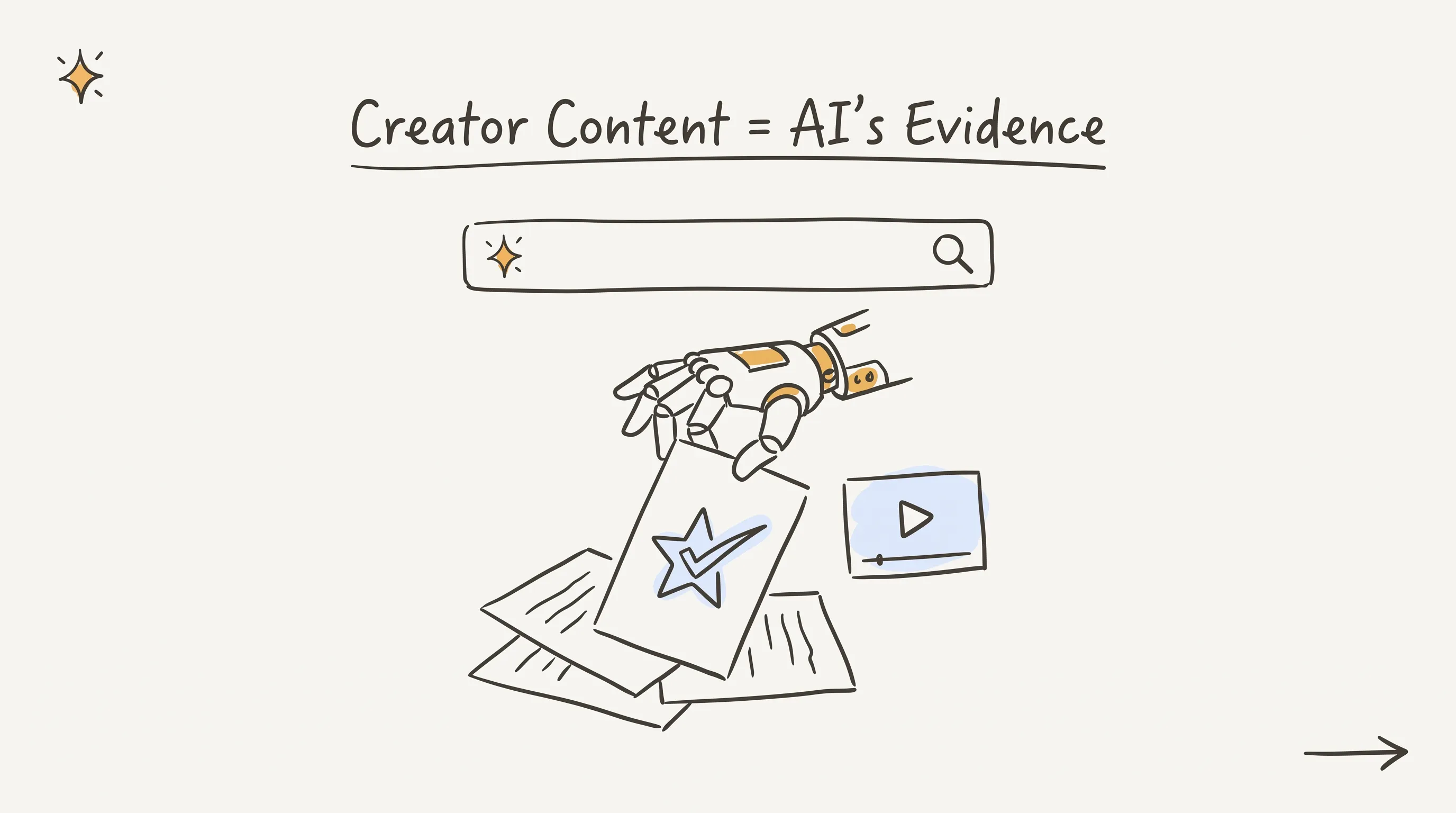
A while back, I wanted to replace my running shoes.
Old habit: I opened the search box and typed in "marathon running shoes for heavier runners." Then I froze. At the top of the page there was no longer a row of blue links — instead, a machine-written summary. And embedded below the summary was a blogger's hands-on review video.
I watched for five minutes. Without clicking into a single shopping site, I already had my answer.
The moment I closed the page, something hit me: the first place where consumers make decisions has changed.
And it has changed more thoroughly than most people realize.
Search Didn't Move — It Grew a New Organ
For the past two years, marketing circles have been debating whether AI search will replace Google. The default script had users migrating from Google to ChatGPT.
Unfortunately, that script is wrong.
The biggest change isn't happening elsewhere — it's happening inside Google itself. A 2026 Similarweb study found that more than 40% of searches in the US now trigger an AI Overview (Google's AI-written answer at the top of the results page). Google itself announced that by May 2026, AI Mode had surpassed 1 billion monthly active users worldwide, with related search volume roughly doubling every quarter.
What does that mean? AI search is not a new channel — it's a new organ Google has grown.
Standalone AI assistants are growing too. In Similarweb's data, traditional search draws about 3.3 billion monthly unique visitors, while AI chatbots combined account for a little over 600 million — a five-fold gap. Before rushing to say "no big deal, the pie is still small," look at the math first: Ahrefs, the SEO tool maker, published its own case study in June 2025. Over the previous 30 days, AI search drove only 0.5% of its visits — but 12.1% of its signups. Conversion efficiency per visit was 23 times that of traditional organic search.
The volume is small, but these people aren't browsing. They arrive with a question and leave with a comparison.
So the question was never "bet on Google or bet on ChatGPT." The question is figuring out what consumers are asking at every decision point.
Machines Are Gathering Evidence for Consumers
This is where influencer marketing comes in.
What counts as evidence? To generate an answer, a machine first has to assemble material from across the web — and much of that material is creator content. BrightEdge tracked data from May 2024 through September 2025: in Google's AI Overviews, YouTube was cited in 29.5% of cases — the highest of any major platform, roughly 200 times as much as Vimeo, the video platform that ranks next. Semrush analyzed 89,000 LinkedIn links cited by AI and found that 11% of AI answers cite LinkedIn on average; in ChatGPT search, that figure is 14.3%.
Even more striking: in Semrush's statistics, 99% of the YouTube content being cited comes from creator videos, not official documentation or help pages.
Ninety-nine percent. Let that sink in.
Why do machines favor this kind of content? Think about it: what is a running-shoe buyer's real question? "Are carbon-plate shoes worth it for a runner targeting 3:30 in the full marathon?" That's a judgment call, not a factual lookup. A spec sheet can't answer it. It takes someone who has actually run 100 kilometers in them and can talk about wear, about how they feel underfoot, about how they behave in hot weather, about who should buy them — and who absolutely shouldn't.
None of that is in the product manual. It only exists in influencer videos.
The same person, the same pair of shoes: saying "I love these shoes" is a mention. Saying "Vaporfly 5 vs. Adios Pro 4 — a 100-kilometer real-world test, how they handle rain, and which one to pick on a budget of around 2,000 yuan (about $280)" is evidence.
Machines don't trust ads. Machines trust evidence.
The same holds in B2B. When a global beauty brand's team picks an influencer management platform, it isn't looking for a feature checklist either — it wants someone who has explained the inner workings thoroughly. Semrush also found that most of the LinkedIn content cited by AI comes from creators' personal posts, not corporate accounts. In the eyes of AI search, an expert's personal authority is becoming a company-level marketing asset.
From Renting Traffic to Building Assets
Influencer marketing used to be like renting an apartment. The moment the campaign period ended, traffic stopped and value dropped to zero. The post-campaign report showed only impressions, engagement, and clicks.
Now there's a second timeline.
Publish a review video, and it gets indexed by YouTube, picked up by Google video search, cited by AI Overviews, summarized by some assistant. Months later, long after the campaign has wrapped, that video is still answering questions on your behalf.
The campaign is over, but the asset is still on the clock.
A 2025 study by Google and Ipsos found that Google or YouTube appears in 82% of consumer journeys when discovering new brands, products, and retailers. Google Lens handles roughly 20 billion visual searches a month, about 20% of them shopping-related. YouTube announced that in 2025 its shopping transaction volume grew five-fold year over year, and more than 500,000 creators worldwide have joined its shopping program.
Search, content, and commerce are being stitched into one complete path.
You used to rent traffic. Now you build assets.
Of course, not every piece of content accumulates. Trend-chasing posts rot — they expire like food. What endures is content built around questions that people keep asking: real-world tests, comparisons, demos that make clear who should buy, and who shouldn't.
The New Playbook: Five Moves
So how do you actually play? Five moves.
Step one: find the questions before you find the influencers. Don't open with "which influencer should we sponsor?" Start by asking: what do consumers want to know before they buy? "Vaporfly or Adios Pro — which one?" "Are carbon-plate shoes worth it?" "Which enterprise influencer platform is best?" Search each of these real questions across Google, AI Overviews, YouTube, and ChatGPT, and note who's answering — and who keeps showing up.
Step two: choose authority, not just followers. An influencer with 3 million followers may not exist at all in the search world; a creator with 150,000 subscribers may own the review language of an entire category, showing up in the answers to dozens of comparison questions. Follower count pays for today; searchability pays for tomorrow.
Step three: brief for evidence, not for mentions. Have creators run tests, explain their methodology, and call out flaws. Yes, flaws. What consumers want to see is the trade-offs — ten "this is really great" posts aren't worth as much as one review that admits real shortcomings.
Step four: divide the work by platform. A March 2026 BrightEdge analysis sketched the division of labor: for evaluation and comparison questions ("best," "vs," "how to choose"), Google's AI Overviews cite YouTube 2.5 times as often as ChatGPT does; meanwhile, 60% of ChatGPT's YouTube citations go to "how-to" instructional content. Consumer brands should lean on YouTube real-world test videos; B2B should lean on LinkedIn expert posts.
Step five: measure increment, not just clicks. This one hurts the most, so it deserves its own section.
The Influence Is Real; the Attribution Is Broken
In March 2025, Pew Research Center analyzed nearly 69,000 searches from 900 US users. When an AI Overview appeared, the rate at which users clicked traditional results was 8%; without one, 15%. And the click-through rate for links inside the summary? Just 1%.
At first glance, traffic has collapsed.
A separate 2026 Similarweb study filled in the other half of the story: users who received an AI recommendation were 2.5 times more likely to visit the recommended brand within seven days than those who didn't. And these AI-influenced visitors browsed about twice as many pages as ordinary visitors and stayed about twice as long.
The most critical number: 55.9% of AI-influenced traffic arrives via search — not via a click from the AI itself. The machine's recommendation created the demand; the user took a detour and searched their way back. The analytics system credits "organic search," while the AI that did the real work stays invisible.
Seer Interactive's statistics supply the third piece of the puzzle: in 2025, keywords covered by AI Overviews saw organic click-through rates fall 61% and paid click-through rates fall 68%. Yet brands cited in AI Overviews earned organic click-through rates 2 to 5 times higher than brands that weren't.
The influence is real. The attribution is broken.
So what do you do? If one layer of measurement isn't enough, measure several. Look together at: your share of mentions in AI answers, changes in branded search volume, off-site mentions, promo code redemptions, and final conversions. Where budget allows, use holdout markets and staggered campaigns to test true increment. And remember: what promo codes and UTM links can measure is only the floor of AI's influence.
The good news: the lights are coming on, one by one. In September 2026, Google launched AI Performance Insights in Merchant Center. For the first time, eligible retailers can see, in shopping conversations within AI Mode and AI Overviews, what share of voice their brand holds against competitors. Someone is turning on the lights.
The Biggest Opportunity Hides in the Most Dangerous Place
One more danger deserves its own mention. BrightEdge has warned that a single YouTube video that doesn't belong to your brand can influence AI's answers across thousands of questions.
What does that mean? If the answers to a category's "is it worth it" and "how to choose" questions are already monopolized by a few independent creators, then whatever those people say is what the machine learns.
The fastest path here isn't building a channel from scratch — it's collaboration. Step one is an audit: for the category's most valuable questions, whose videos show up in the citations? Is the narrative helping you, or hurting you?
By the way, this is actually a golden age for creators. Whoever sits closest to the buying decision is the one who's worth the most. Celebrity influencers can bring volume, but a creator who can define a category's language and keep answering purchase questions may be worth far more than their follower count suggests.
One Last Thing
Back to those running shoes.
To this day, I don't know who made the video that influenced me first — but that pair of shoes did end up in my cart. A campaign that earned no click. A sale no dashboard can attribute.
Rand Fishkin, co-author of Zero Click Marketing and founder of SparkToro, put it this way: AI's influence is already happening — what marketers need now are new ways to measure it.
Instead of waiting for every light to come on, start with one small thing: today, list the ten questions your buyers actually ask before purchasing, search them, and see who is answering on your behalf right now.
May your brand become that answer — sooner than you think.
Continue reading
Related articles

Cross-Border Business: Time to Upgrade Your AI Toolbox
A learn article explaining how AI tools help cross-border e-commerce sellers clear five hurdles: language, regulation, logistics, payments, and fraud. It outlines a five-compartment toolbox, a five-step adoption path, and metrics such as conversion rate and CLV, while cautioning against over-reliance on AI.

AI Is Taking Over the Dirty Work of Social Media Marketing, One Task at a Time
This learn article outlines four social media marketing tasks AI can handle — audience analytics, content drafting and design, ad targeting and creative testing, and spam moderation — and cautions that taste, judgment, and data security remain human responsibilities.

AI Is Already This Good — Why Is Your Social Media Marketing Still Pure Manpower?
An overview of 18 AI tools for social media marketing, organized into six categories covering audience research, content creation, scheduling, comment and DM handling, ad management, and visual production, plus notes on personalization, prediction, and emerging trends.