
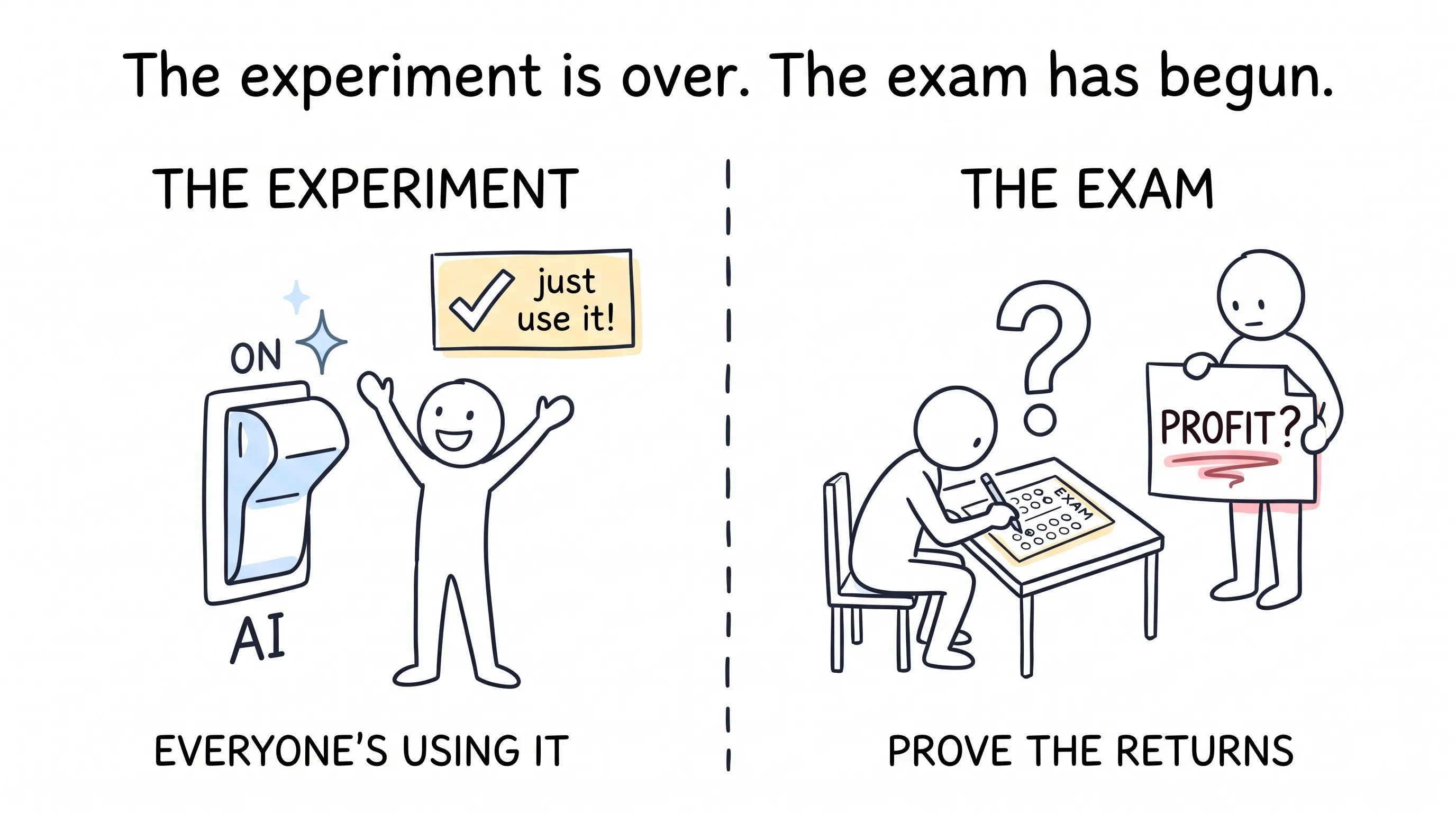
The Experiment Is Over. The Exam Has Begun: 1400 Marketers' AI Report Card
A commentary on Jasper's State of AI in Marketing report, which surveyed 1,400 marketers about AI adoption, ROI measurement, governance bottlenecks, and new AI-focused roles.
Late one night a few days ago, an old friend of mine in marketing suddenly messaged me on WeChat.
He opened with a single line: at our company's leadership meetings, the boss no longer opens by asking "Have you put AI to work yet?" He now asks, "How much money has AI made us?"
I stared at that message for a long time.
And I knew: an era had just turned its page.
As it happens, Jasper published its annual report this year, The State of AI in Marketing. They surveyed 1400 marketers — from CMOs to frontline content operators, across every industry and every size of company. I read it like an industry health checkup, page by page.
Let me pick out a few sets of numbers and tell you the story they tell.
The Big Picture: No One Debates "Whether to Use It" Anymore
First, the big picture.
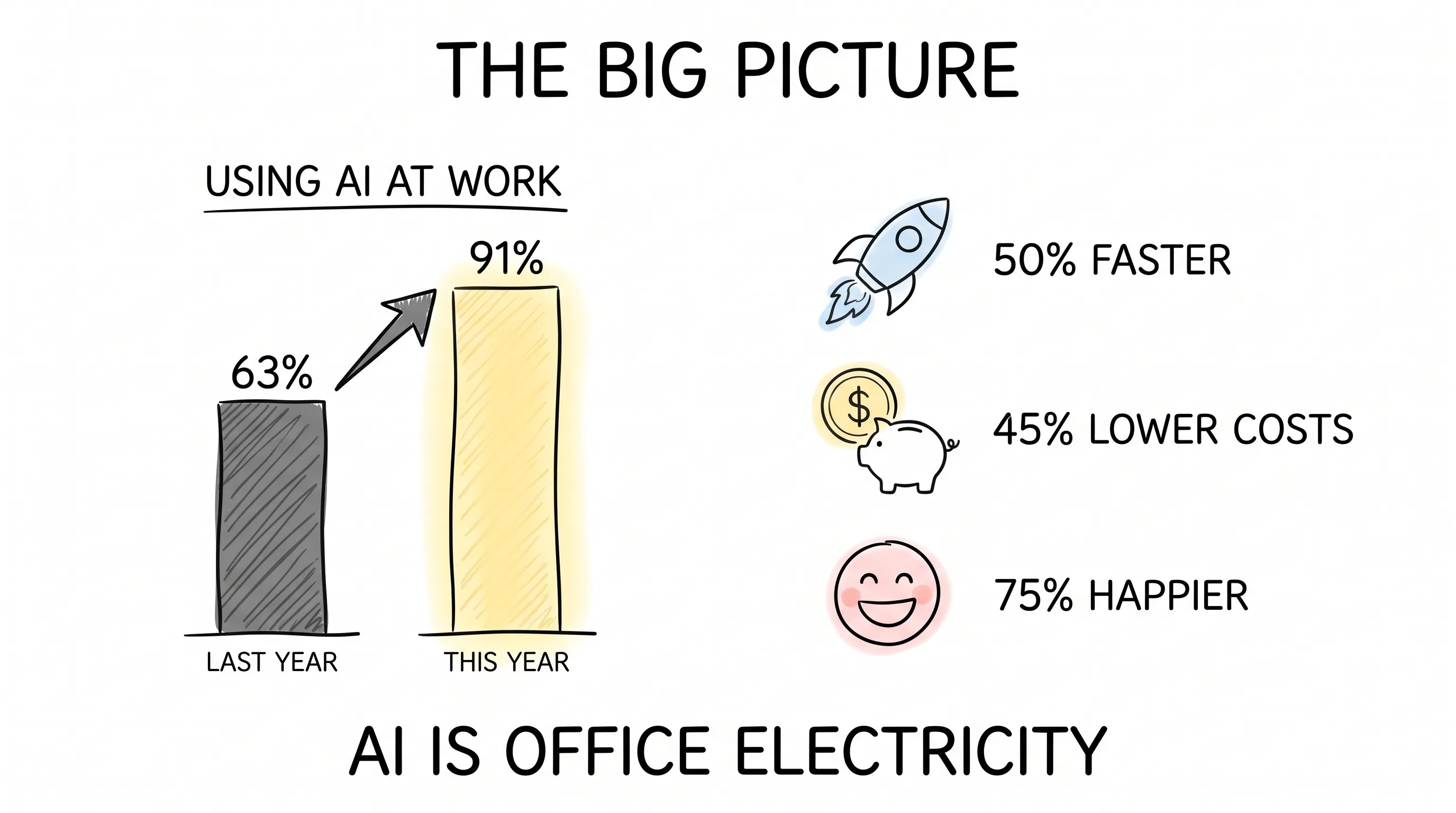
This year, 91% of marketers are actively using AI in their work. Last year, that number was 63%.
What does "actively using" mean? It means AI has grown into the daily workflow itself. Writing copy — AI. Making images — AI. Crunching data — AI too. It's like the electricity and the Wi-Fi in the office: nobody calls a meeting to discuss "should we turn the power on."
And simply "using it" isn't the whole story. 50% say they get work done noticeably faster; 45% say operating costs have genuinely come down; and 75% of those using AI say their job satisfaction has risen.
75%. My God. A tool that makes the people using it happier — you don't see that often.
At this point you might say: isn't that winning?
Not so fast.
Right Behind the Good News, a Piece of Bad News
Let me ask you a question: can you prove AI's ROI?
Last year, 49% of marketers said yes. This year, that's down to 41%.
More people are using it, the results are real — yet the share who can prove "it's worth it" has shrunk.
Why?
Because the exam has changed.
Last year, when you said "AI has saved us a ton of time," the boss nodded, finding it fresh and new. This year, you say the same thing, and the boss looks at you and asks: and then what?
What did the saved time turn into? More content shipped? Which number on the financial statements got better because of AI?
On the course called "saving time" alone, there is no passing grade this year. What the boss wants to see is business results.
In the experiment phase, you're judged on whether anyone is using it. In the operations phase, you're judged on whether anyone is profiting from it.
It's like running a restaurant. During the soft opening, friends come by to show support, and "everyone showed up" is enough. Once you're officially open, the landlord and your suppliers don't care how many people walked in — they only look at table turnover and daily revenue.
So what kind of team can actually hand in the answer sheet?
The report has a number: among teams that changed their measurement methods first, 60% saw returns of 2 to 3 times or more.
Notice — what they changed wasn't anything exotic: it was "the way they do the math." In the same exam, some are still writing last year's essay prompt, while others swapped in a new answer sheet long ago.
The Choke Point Has Moved: From Money to Brakes
Here's another shift, and it's a fascinating one.
What did people worry about last year? Not enough budget. A shortage of AI talent. Leadership unwilling to sign off.
This year? All three have slid down the list. The top three things choking AI's scale-up all sit inside the company's own processes:
First, brand, legal, and compliance review. Second, inconsistent output quality. Third, data and privacy risk.
I call this "the bottleneck moving inward." Here's an analogy: two years ago, your question was "should I even buy this car?" This year the car is home, and the accelerator is easy to press — what's really keeping you up at night is the annual inspection, the insurance, and the rules of the road.
Capacity is there; it's quality control that sets the hard questions now. AI can write a hundred articles a minute, but before every single one goes out the door, someone has to confirm: Is the brand tone right? Any legal risk? Did any user data get fed in?
The bottleneck to scale was never the machine — it's the road people build for the machine.
Companies Are Growing New Organs
The third set of numbers is about people.
65% of marketing teams have already created dedicated AI roles — AI operations, AI workflow, AI strategy. And one in three marketers has taken on a whole new pile of duties inside their existing role: AI strategy, AI policy, AI governance.
Does that ring a bell? Twenty years ago, internet companies grew a job called "new media operations"; a decade or so ago, they grew "growth hackers." Every time a new technology turns into infrastructure, the organization grows a new bone to match.
This time is no different. AI is no longer just a skill attached to some role — it has itself become a role.
What the Front-Runners Look Like
Of the 1400, the report summed up 6 traits of the teams running fastest. Let me read them out, and you tell me: isn't every single one just plain, unglamorous grunt work?
Treat content as a system, not as one-off pieces. Writing one piece at a time will never amount to much; building the assembly line is how you get in the door. Governance lives inside the process. Traffic lights are built into the road, so the moment a car gets on the road, it knows where to stop. Calling the traffic cop after the accident is too late. Keep ownership clear. When something AI-generated goes wrong, everyone knows exactly who to turn to. Be confident in your returns. Dare to do the math — and dare to show it. Think in three years, not just the next three months. Use marketing-specific tools and processes — don't make do with generic ones.
Impressive.
Did you notice? Not one of these 6 says a word about "how strong the model is" or "how clever the prompts are." All of it is work on the organization, work on the system.
What AI tests has never been just technology. It's management.
Back to My Friend
Late that night, I replied: congratulations — your company has made it into the main event.
A technology truly becomes infrastructure the moment people stop debating it. That's how electricity went. That's how the internet went. AI will go the same way.
The experiment is over.
The exam is only just beginning.
Here's to you — may you move from the 91% who "use AI" into the 60% who "make money with it."
Continue reading
Related articles

Cross-Border Business: Time to Upgrade Your AI Toolbox
A learn article explaining how AI tools help cross-border e-commerce sellers clear five hurdles: language, regulation, logistics, payments, and fraud. It outlines a five-compartment toolbox, a five-step adoption path, and metrics such as conversion rate and CLV, while cautioning against over-reliance on AI.

AI Is Taking Over the Dirty Work of Social Media Marketing, One Task at a Time
This learn article outlines four social media marketing tasks AI can handle — audience analytics, content drafting and design, ad targeting and creative testing, and spam moderation — and cautions that taste, judgment, and data security remain human responsibilities.

AI Is Already This Good — Why Is Your Social Media Marketing Still Pure Manpower?
An overview of 18 AI tools for social media marketing, organized into six categories covering audience research, content creation, scheduling, comment and DM handling, ad management, and visual production, plus notes on personalization, prediction, and emerging trends.