
The EU Has TikTok and Meta in Its Sights — This Time, It's the "Addictive" Design
Commentary on EU Commission President von der Leyen's speech naming TikTok, Meta, and X over addictive design features like infinite scrolling, autoplay, and push notifications. Covers the planned Digital Fairness Act, possible minimum-age rules for teens, AI use limits, and regulatory moves beyond the EU.
The other day I was scrolling my news feed when a story out of Europe stopped me cold.
This past May, European Commission President Ursula von der Leyen gave a speech in Copenhagen and named three companies: TikTok, Meta, and X. The goal, she said, was to protect children from social media's "addictive design." And she went further: she did not rule out setting a minimum age for teenagers to use social media.
The EU, it seems, means business this time.
First, the line that made me sit up
Von der Leyen said something on that stage that I think everyone who builds products should copy down and tape above their desk:
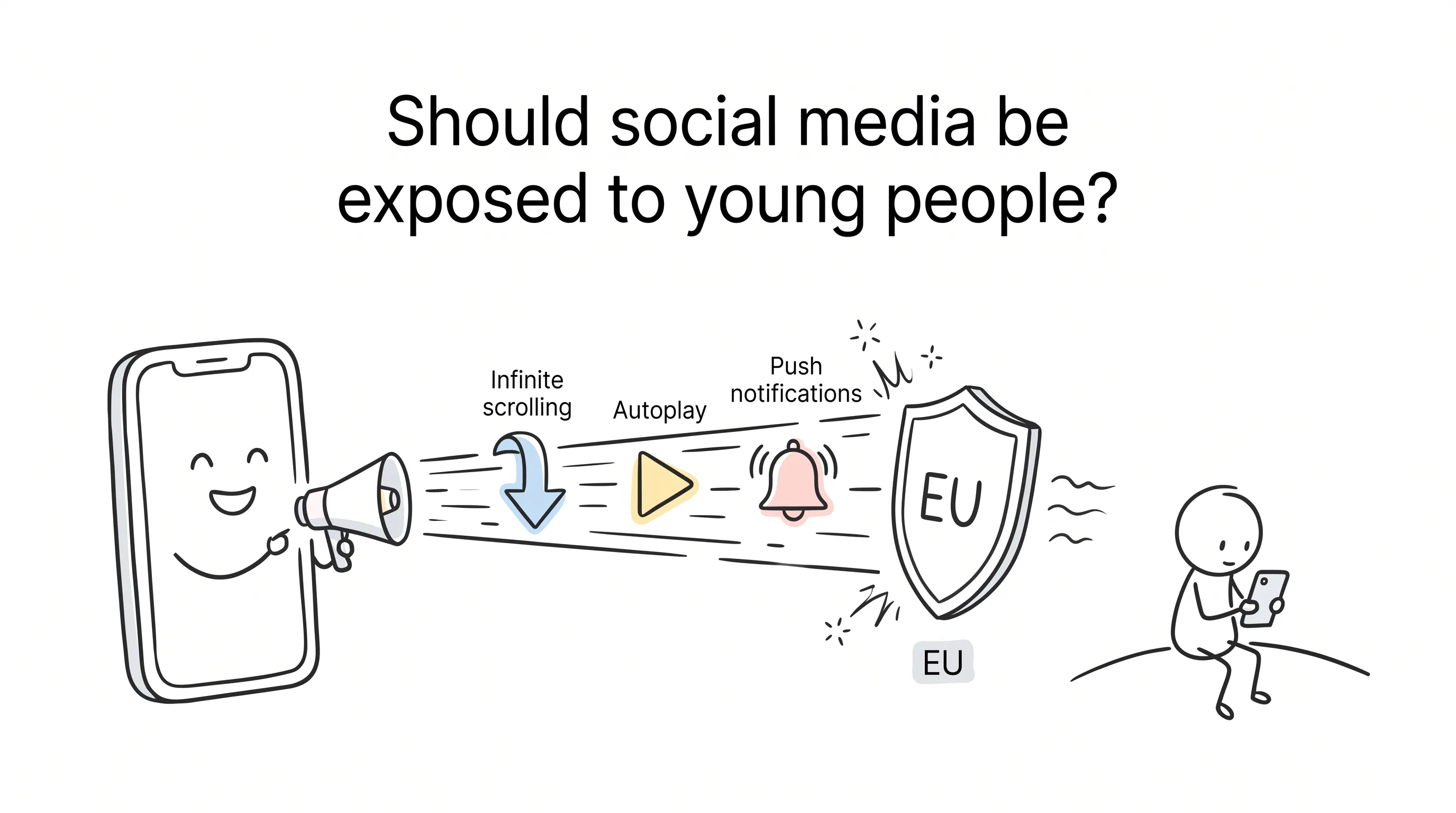
"The question is not whether young people should be exposed to social media. The question is whether social media should be exposed to young people."
Sit with that for a second.
Swap the subject of that sentence and the whole nature of it changes. The first half is a conversation about how parents manage their kids. The second half asks whether platforms are actively reaching out. That's no longer a parenting question — it's a question of product ethics, and underneath that, a question of business model.
After that line, she ran through a list: sleep deprivation, depression, anxiety, self-harm, addictive behavior, cyberbullying, grooming, exploitation, suicide.
Then she added: the risks are rising fast.
That list was not a sighing aside from an expert panel. Behind it stands a set of regulations about to land.
So what is "addictive design"?
Addictive design means the features that make it impossible to stop.
Infinite scrolling. You meant to scroll for two minutes. A swipe up, another swipe, and an hour is gone.
Autoplay. One episode ends and the next starts by itself. You tell yourself "just one more." It has never been just one.
Push notifications. You're doing something else entirely, your phone buzzes: "Someone you follow just posted." When to ping you for maximum effect? It knows better than your own mother.
When von der Leyen called out TikTok, these were the three things she named: infinite scrolling, autoplay, and push notifications. Action against these designs is already moving.
On Meta, she was even more direct: the EU has concluded that Instagram and Facebook are not enforcing their own 13-year minimum age.
There you go. Even the line the platforms promised themselves isn't being kept.
The root of the problem is the business model
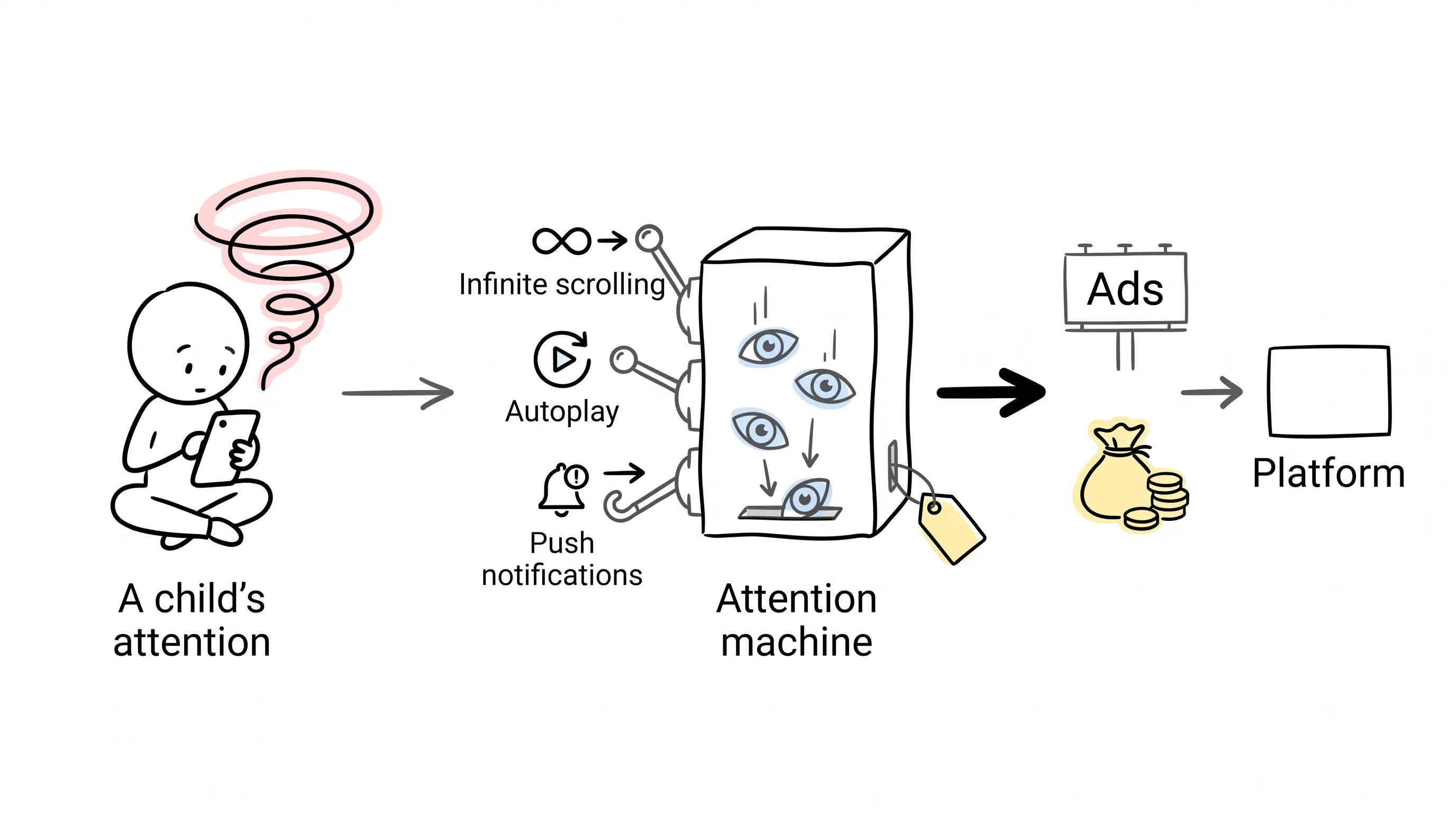
Why regulate this? She put it plainly: these risks come from a business model that treats children's attention as a commodity.
What does "attention as a commodity" mean? You scroll for free, and the platform makes money off your eyeballs. The longer you stay on screen, the more you swipe, the more ads get shown, the more the platform earns. A child's attention, inside this machine, has a price tag.
That is why, at the same time, she proposed strict limits on how AI is used inside social media. AI can now generate content, guess what you want to watch, and hold people tighter and tighter. The smarter the tool, the better it gets at keeping people hooked.
What will the rules look like?
The concrete vehicle is called the Digital Fairness Act — DFA for short — with a formal proposal expected by the end of the year.
It would ban three kinds of things: manipulative design, addictive features, and misleading influencer marketing. It would also set hard red lines for AI use inside social media.
And there's a harder step. Von der Leyen revealed that an expert group is studying what to do, and if its conclusions support it, a legislative proposal on age restrictions could come very soon.
In other words, the EU really is pushing toward legislation on whether teenagers should be allowed on social media at all.
These new rules would also reinforce the existing Digital Services Act (DSA). The DSA is the EU's baseline law for the big platforms, requiring them to take more responsibility for illegal and harmful content. Under the DSA, the EU was already investigating TikTok and X, along with Meta's Instagram and Facebook.
In the X case, one of the areas under examination is the risks that deploying Grok in the European market could bring — such as generating and spreading manipulated pornographic images.
At the same time, the EU's top court ruled in another case, siding with Italy's telecom regulator, that Meta must pay publishers for using snippets of their articles. TikTok, meanwhile, is mounting a last-ditch fight to overturn its designation as a "gatekeeper" — a label that means it must meet stricter standards.
You see what the EU is doing here: legislation, enforcement, and the courts, all moving at once.
Not just the EU
And the EU isn't the only one getting tougher.
Norway and France are debating legislation. Turkey is pushing forward. The UK is moving too. Everyone is looking to the same reference point: Australia. Australia went first, passing a law that bans anyone under 16 from social media.
One regulator moves, and country after country follows. We've seen this play before — on AI, on data privacy. This time, it's children's attention.
Finally, my own take
My own judgment: this is something everyone who makes content or builds products needs to take seriously.
Because these designs don't spare adults either. The finger still scrolling at midnight is the same finger a child scrolls with. The difference is that when an adult gets hooked, nobody fights your corner. When a kid gets hooked, someone is finally stepping up to fight for them.
Attention is the most expensive thing of our era — and the last thing that should ever be put up for sale is a child's attention.
Von der Leyen's position, summed up in one line, is that flip of the subject: stop arguing about whether young people should leave social media, and answer first — what gives social media the right to put its hands on young people.
How this plays out from here — especially how that year-end proposal gets written — I'll be watching closely.
And here's wishing your kids a good night's sleep tonight.
Continue reading
Related articles

Cross-Border Business: Time to Upgrade Your AI Toolbox
A learn article explaining how AI tools help cross-border e-commerce sellers clear five hurdles: language, regulation, logistics, payments, and fraud. It outlines a five-compartment toolbox, a five-step adoption path, and metrics such as conversion rate and CLV, while cautioning against over-reliance on AI.

AI Is Taking Over the Dirty Work of Social Media Marketing, One Task at a Time
This learn article outlines four social media marketing tasks AI can handle — audience analytics, content drafting and design, ad targeting and creative testing, and spam moderation — and cautions that taste, judgment, and data security remain human responsibilities.

AI Is Already This Good — Why Is Your Social Media Marketing Still Pure Manpower?
An overview of 18 AI tools for social media marketing, organized into six categories covering audience research, content creation, scheduling, comment and DM handling, ad management, and visual production, plus notes on personalization, prediction, and emerging trends.