
The Entry-Level Jobs AI Took — and How We Take Them Back
An essay on how AI automation is eroding entry-level marketing jobs and why martech teams should rebuild apprenticeship structures that let newcomers learn judgment through real work.
A few days ago, I had tea with a friend who works in marketing operations.
He runs a martech team of a dozen or so people. When the conversation turned to hiring, he said something I haven't been able to shake since: "These days I only hire people who are already seasoned. Entry-level positions? I'm not opening a single one."
I asked why.
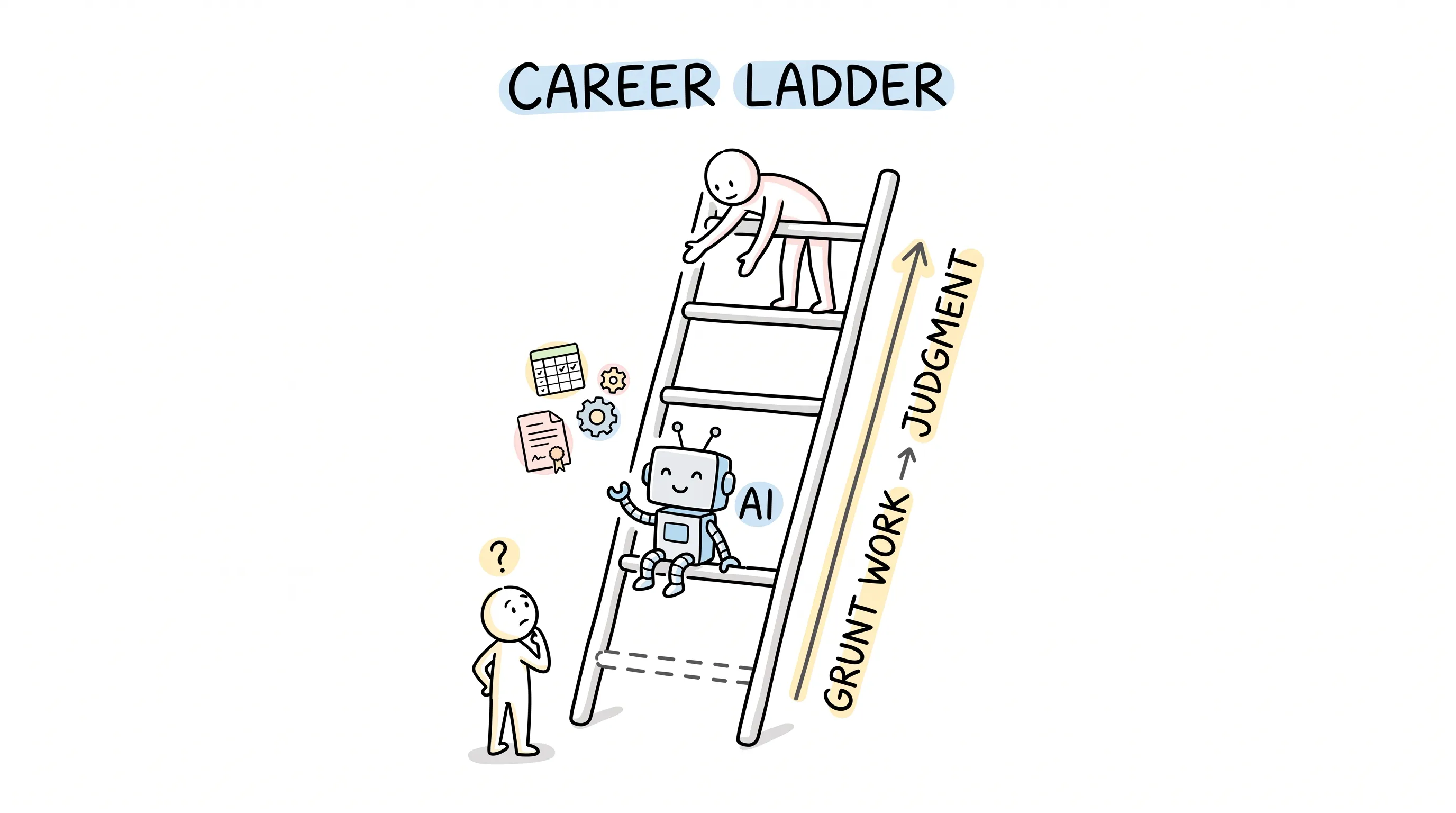
It used to be, he said, that a junior analyst would come in, you'd coach them along, and in three years they'd carry real weight. Now AI has finished off the entire layer of work newcomers used to cut their teeth on. Nobody does the grunt work anymore — and nobody gets the chance to grow out of it.
"It's not that I don't want to mentor juniors. It's that I can't afford the time to watch them make mistakes."
That line hit a nerve. That's what I want to talk about today.
What Is Apprenticeship?
First, let's get the concept straight.
Apprenticeship means treating newcomers not as "plug-and-play" parts, but as steel that still needs tempering: give them real tasks, give them a mentor, give them room to fail, and let them learn by doing until judgment is ground into them, bit by bit.
Think of an old carpenter and his apprentice. The apprentice's craft only exists after thirty ruined boards at the master's side.
Which raises the question: in the age of AI, who still has the patience to be that master?
A Counterintuitive Fact
Many people assume the marketing technology industry is riding the AI wave. It plays with automation tools all day — the stronger AI gets, the more valuable the industry becomes.
That's half right.
Over the past fifteen years, martech and marketing operations (MOps) genuinely did feast on the tool explosion. The martech landscape grew from around a hundred tools to tens of thousands, and jobs rose with the tide. You'd learn one platform, earn one certification, and a door would open.
But it has stopped.
In this year's latest edition of the martech landscape — the one Scott Brinker and Frans Riemersma put out — net growth fell to about 0.79%, essentially flat. The industry has a name for it: "peak martech." The expansion of tools has topped out.
When tools peak, the jobs that grew alongside them peak too.
Making matters worse is another set of numbers. This August, a Stanford team released data showing that jobs exposed to AI are being disrupted 19% more than other roles.
19% doesn't sound so brutal?
Consider this: 19% is the average. Behind that average, it's entry-level roles getting hammered hardest. Why? Because entry-level work is precisely the layer AI is best at: cleaning data, drafting first versions, configuring workflows, running reports.
Mass layoffs make headlines. But what actually kills entry-level jobs is usually slow growth. When growth slows, companies stop opening entry slots, the veterans absorb a bit more, and the newcomers never get in. No headline, no trending topic — the door just quietly closes.
Sure, ten years ago a computer science degree was a golden ticket. Would anyone dare say that today?
And martech, don't imagine you're the exception. This industry works with AI every day; its exposure to AI is higher than almost any other role's. If we don't do something, we're next on the disruption list.
What AI Took Is the Most Expensive Thing
Time to dig to the root of the problem.
What exactly has AI taken away from junior marketers?
On the surface, the grunt work: data cleaning, report configuration, content first drafts.
At the root, the chance to make mistakes.
Where do you think our generation of marketers got their judgment? From countless botched campaigns. The first time I set up an automation flow, my hand slipped and a hundred thousand users got the same email twice — I went green in the face. The second time, I knew to roll out to a small test group first. By the third time, I could spot the failure points with my eyes closed.
Judgment is what settles out of that pile of mistakes.
You cannot skip the fundamentals and grow judgment directly, any more than you can run before you crawl.
Now AI has taken over that entire layer. On a newcomer's very first day, AI has the draft written, the workflow configured, the report run. It looks like an efficiency miracle. In reality, young people have lost the chance to screw up.
No profession grows experts who have never botched anything.
I'm not the only one worried. Gartner analyst Meaghan Kelly has made a point to this effect: traditional, incremental talent development no longer works in an AI environment. You can't expect newcomers to accumulate skills from daily grunt work; you have to deliberately build support structures that let them handle complex, judgment-heavy work early in their careers.
Notice: she said you have to build the structure. It won't come with time, and it can't be intuited. It has to be built.
How to build it? Which brings us to the martech community's home turf.
Why the Martech Crowd, of All People, Should Do This
Of all the job families in the world, the martech community may be the best qualified to run apprenticeships.
Why?
Because we've been doing it for fifteen years already.
Martech was never a stable trade — it constantly reinvents itself. Over fifteen years, so many roles were born only to morph: first the platform specialist, mastering one tool and climbing on vendor certifications; later the full-stack orchestrator, one person coordinating several platforms. Every wave of tools reshaped the roles.
For an industry that practices "embracing change" every day, building a growth path for its own young people ought to be instinct.
There are roughly three paths.
First: from tool specialist to workflow orchestrator. A newcomer starts on one platform, earns a certification, learns to configure multi-platform agents, and eventually orchestrates an entire workflow.
Second: from content executor to generalist in brand context. AI can write a first draft, but it can't write "what this brand is really trying to say." A newcomer enters through content, then moves toward becoming a "context engineer" — teaching AI to understand your brand is a brand-new craft.
Third: from junior specialist to marketing engineer. Marketers who can write some code, understand some architecture, and build systems themselves have always been in short supply.
The three paths point in different directions, but underneath is the same idea: let AI do AI's work, and let people grow human skills.
Don't Build Walls, Open Doors
But first, a bucket of cold water.
The new titles are seductive. Marketing engineer, GTM (go-to-market) engineer — they all sound glamorous. But watch out for one thing: don't let these new roles become a closed club of senior experts.
The temptation is all too real. Hard-won craft is clutched tightly; nobody wants to let go. If the veterans hoard the new tools while the newcomers are left with the grunt work, apprenticeship dies right there.
Think about it: anyone can now "chat" an application into existence in natural language, and vibe coding has become the everyday language of experimentation. What does that mean? It means the barrier to entering martech has never been lower in history.
A low barrier threatens the incumbents. For the industry, it's a tremendous blessing. Anyone who can chat can build a workflow — every young person who can use AI is a potential gateway into the field.
So the right posture is to open the door wider, not to wall yourself into a private garden.
How to Build It, Concretely
Enough theory; let's talk about the actual work. Building apprenticeship takes a few additions to the toolbox.
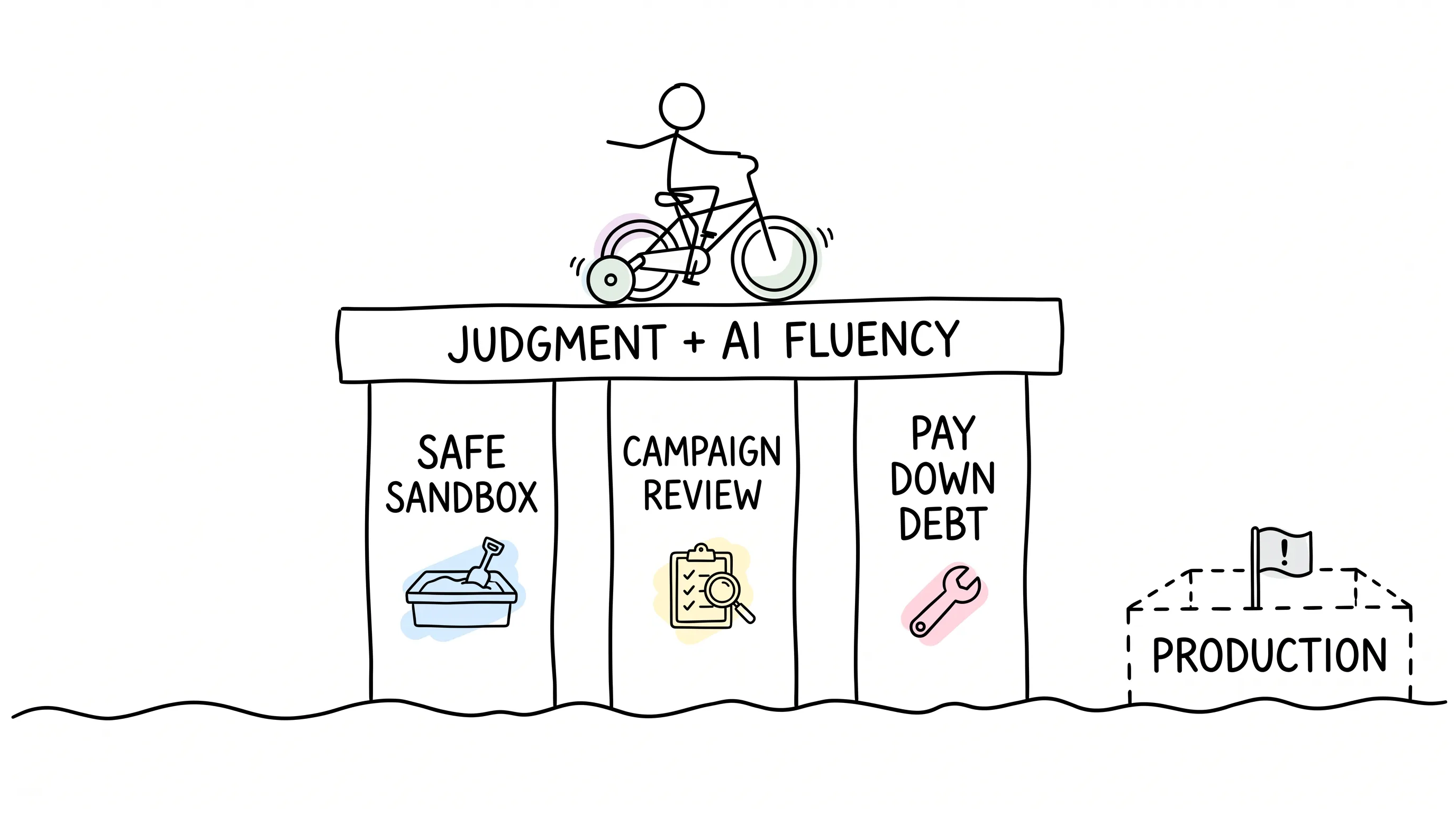
First, a safe sandbox.
Today's marketing systems routinely reach millions of real people — who would dare let a newcomer experiment with AI in production? So you need a genuine test environment, populated with realistic data, ideally a snapshot lifted straight from production. The more the training ground resembles a real battlefield, the more real the skills you build there.
Second, a review mechanism.
Software development has code review. Could marketing have "campaign review"? Let apprentices test and audit AI output, find the missing step or the lost context, then propose fixes. That exercise is training and risk control at the same time.
Third, pay down debt along the way.
Hunting down data quality issues, surfacing edge cases, drafting fix plans — which team hasn't been saying "we'll fix it when things calm down" for years, and never found the time? Now you can: give the work to the apprentices. They get practice; you pay down the debt.
Put the three together, and you've bolted training wheels onto the AI era for newcomers: fundamentals stay intact while AI fluency develops — both wheels turning.
One Last Thing
Whenever AI comes up, someone says: AI clears away the basic work so people can do more valuable things.
I keep wanting to ask: more valuable — for whom?
If a young person has never built a workflow with their own hands, what will they use to check the errors in an automation? They've never even seen what an error looks like.
The price of judgment is set by the fundamentals. Whoever skips that tuition pays it back somewhere more expensive: either in incidents, or in the team.
I know — everyone understands the argument; the hard part is acting. Organizations change slowly, and in the short term, plenty of basic work really will be swallowed by automation. I won't pretend that's rosy.
But martech people are bridge-builders to the bone. Fifteen years ago when we started, marketing teams thought we were the weird tech nerds, and tech teams thought we were the weird marketing people — a roomful of misfit toys — and we went ahead and built the bridge between the two sides anyway.
Bridge-building? That's our specialty.
Apprenticeship won't save every entry-level job — admit that. But it can preserve the chances that genuinely grow expertise, and it can buy us time to build the next rung of the ladder. Nobody can rebuild the entire career ladder. But the bridge under our feet? Martech people can build that.
Start with the next newcomer.
May you always have a mentor willing to let you make mistakes. And may you, one day, become that mentor.
Continue reading
Related articles

Cross-Border Business: Time to Upgrade Your AI Toolbox
A learn article explaining how AI tools help cross-border e-commerce sellers clear five hurdles: language, regulation, logistics, payments, and fraud. It outlines a five-compartment toolbox, a five-step adoption path, and metrics such as conversion rate and CLV, while cautioning against over-reliance on AI.

AI Is Taking Over the Dirty Work of Social Media Marketing, One Task at a Time
This learn article outlines four social media marketing tasks AI can handle — audience analytics, content drafting and design, ad targeting and creative testing, and spam moderation — and cautions that taste, judgment, and data security remain human responsibilities.

AI Is Already This Good — Why Is Your Social Media Marketing Still Pure Manpower?
An overview of 18 AI tools for social media marketing, organized into six categories covering audience research, content creation, scheduling, comment and DM handling, ad management, and visual production, plus notes on personalization, prediction, and emerging trends.