
The Entrance to Marketing Is Moving
This learn article argues that the customer entrance is shifting from search boxes to AI chats, citing Google's AI Overviews growth and ChatGPT's share of AI referral traffic, and advises comparison pages, original research, and public brand presence to earn AI citations.
A few nights ago, a friend of mine who runs a cross-border e-commerce business sent me a WeChat message.
He asked just one thing: with the budget I have, should I keep spending on search ads, or go "wait on" the AIs? Apparently a lot of people now, before they buy anything, ask ChatGPT first, then Claude — they just don't search anymore.
I stared at the screen for a long while.
The thing is, that week in early July this year, a whole pile of tech companies had already answered his question with their actions. The news was just scattered everywhere, and each item on its own looked unremarkable. Put the pieces together, though, and you see a remarkably clear trend:
The customer's entrance is moving out of the search box and into the chat box.
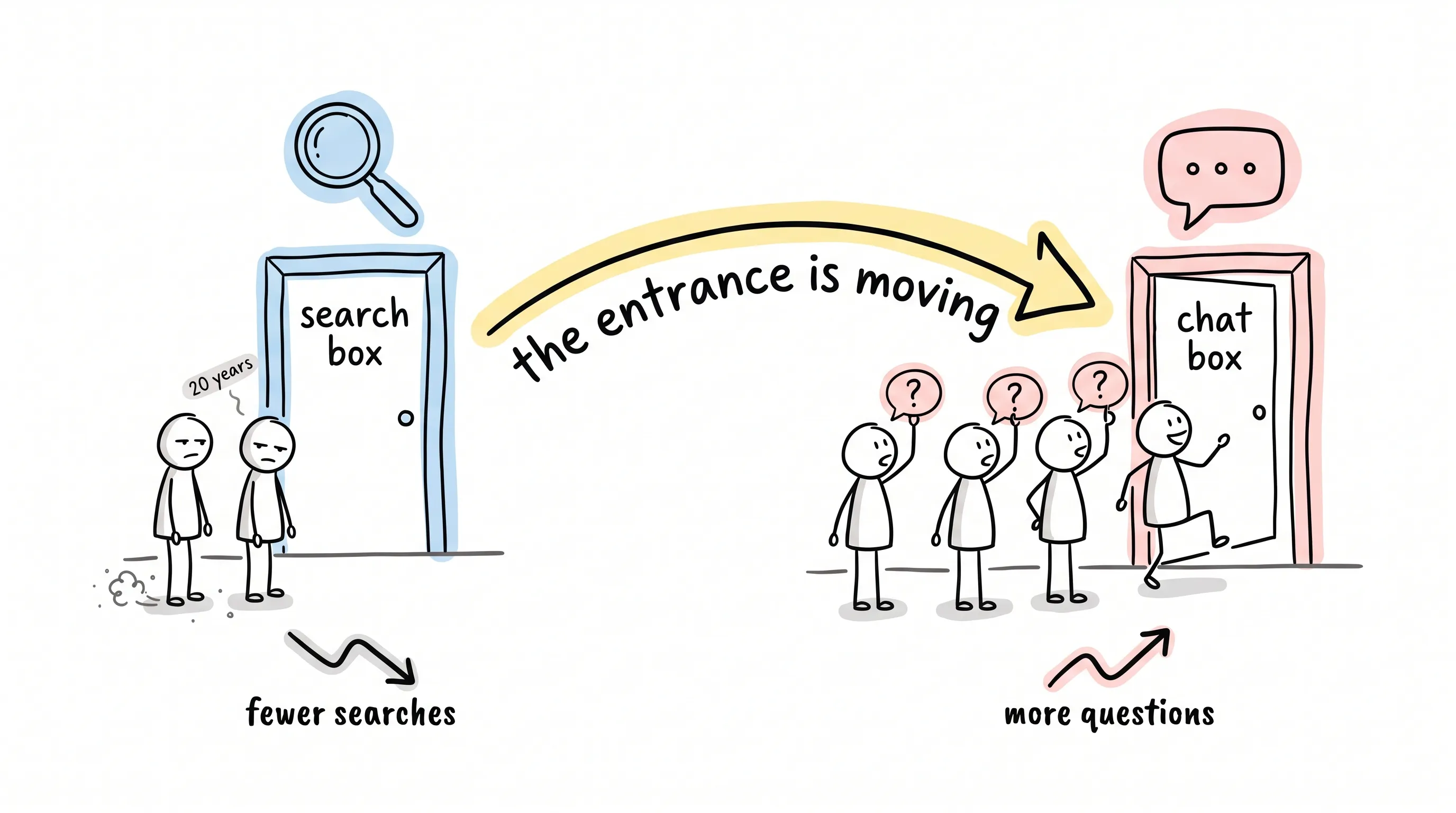
What do I mean by "entrance"? It's the spot you end up staking out when you do marketing. For the past twenty years, that entrance was the search engine. A user typed a few words into the box, you ranked near the top, and the business was yours.
Now, more and more users aren't typing words anymore. They're asking questions.
And once the entrance moves, the business logic of the entire street has to be rewritten. Let me walk you through three things, and you'll feel just how fast this move is happening.
1. Google Itself Is Making Room for AI
A few months ago, Google quietly rolled out a set of generative AI controls in Search Console, its backend for site owners. When it first appeared, it was open only to websites in the UK.
What's interesting is what came after. By early July, some sites in the US and a few other regions started seeing the feature too.
What are generative AI controls? Plainly put, they let site owners manage one thing: how AI treats your website's content when it generates answers.
Think about it — why would Google build a dedicated backend switch for this? Because the share of search results with AI involved has grown too big to ignore.
How big? Semrush, a marketing data company, ran a study: it tracked more than 600,000 keywords across 10 industries for a full six months. The finding: on search results pages with commercial intent, the frequency of AI summaries — Google calls them AI Overviews — rose by an average of 71%.
71%. In six months. And on commercial-intent searches — the ones closest to the money. Even on results pages that carry ads, AI summaries are showing up more and more often.
God. The places closest to the money are being rearranged by AI.
2. Where Did the People Go
The entrance has moved — so where did the foot traffic end up?
One team analyzed 6.77 million referred visits coming from AI and found something that made me pause: ChatGPT alone accounted for 92% of all AI referral traffic.
92%. Of every ten visitors the AIs send you, more than nine come from ChatGPT. Claude's share is small, but quietly climbing. Of course, this traffic swings wildly — whether users actually click through still depends on whether your landing page can hold them.
So back to my friend's question: should he still run search ads?
Yes. For now, keep spending. But —
At the same time, you need to start preparing for a world without clicks.
3. How AI Decides Whom to "Crown"
When marketing people meet these days, the question they ask most is the same one: how do I show up more often in AI's answers?
That's the crux. Back in the search-engine era, you studied keywords and piled up backlinks, and your ranking would climb. In the AI era, the selection logic has changed.
Siege Media, a content marketing company, analyzed 116 B2B websites to answer one question: what kind of content pulls the most traffic from AI?
The answer was a little surprising: comparison pages.
What's a comparison page? It's a page like "Product A vs. Product B." You honestly put yourself side by side with your competitors — comparing features, prices, who fits which scenario. Pages that look like ads for your rivals turn out to be the ones AI loves to cite.
Why? Think about it. When a user asks AI "which of these two should I choose," AI needs a ready-made comparison table on hand to answer well. Whoever provides that table, AI cites.
And then there's an experiment that stings more. An SEO team ran tests for four straight months and found this: self-promotional content does have a chance of being cited by AI. But AI may then turn around and recommend a competitor to your reader. And for products that already have name recognition, this kind of content barely works at all.
Put plainly: what AI cites was never advertising. It's evidence.
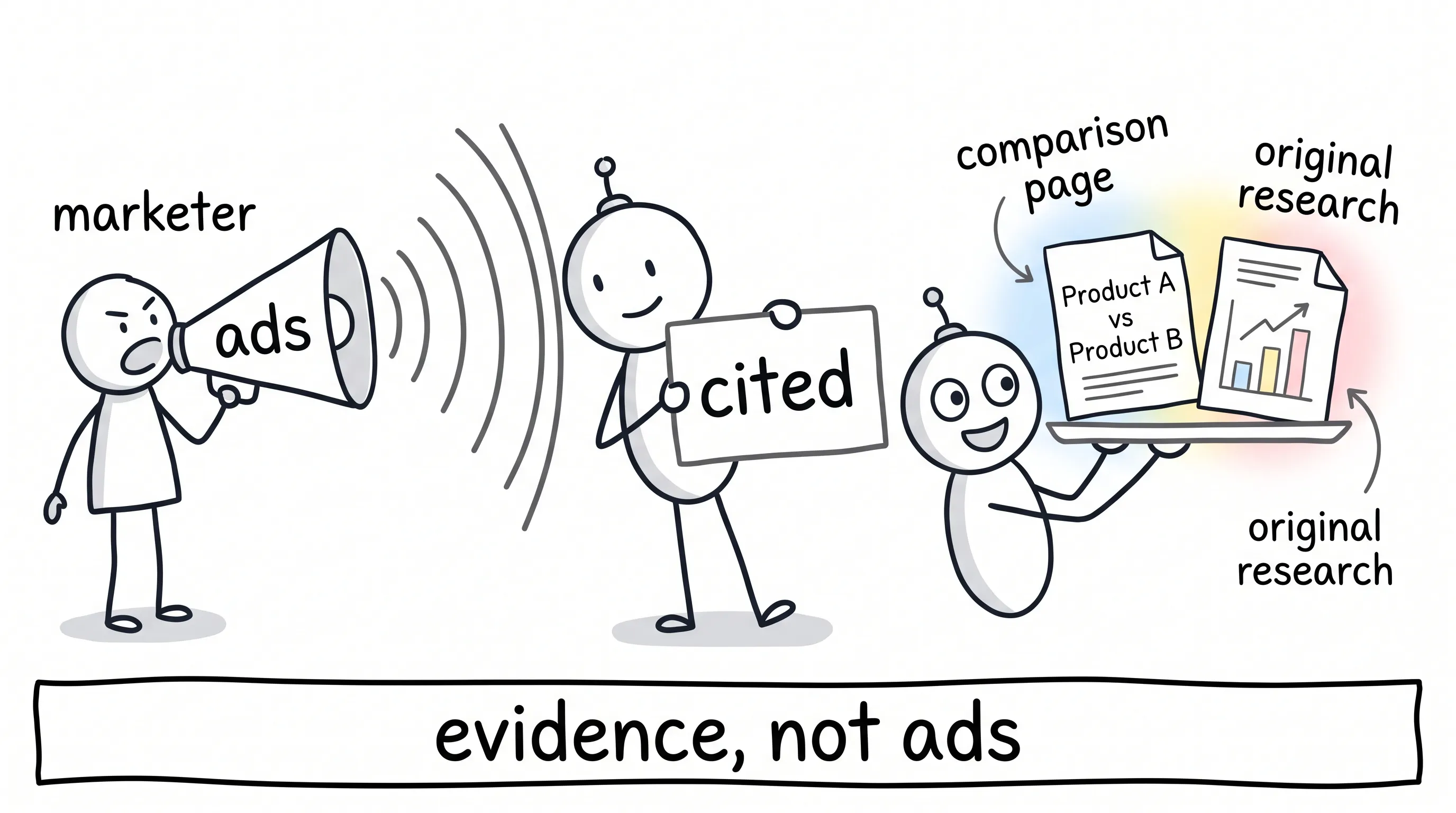
So what's the strongest evidence you can put on the table? Original research.
Researchers have found that very few websites are willing to do their own primary research — but when one does, it gets cited by AI at a far higher density than ordinary pages. The prerequisite: the research has to directly answer users' comparison questions, not sit behind closed doors as a self-congratulating whitepaper.
There's another path, even less visible. Some people dug into the underlying data left behind by ChatGPT's answers to travel questions and found that roughly one-third of the queries, ChatGPT never went online for — it answered straight from memory in its training data.
What does that mean? It means that for a substantial share of questions, AI relies on the public corpus — the common sense that has settled over years across the web's news, reviews, discussions, and reference pages. Whether your brand has a presence in that public corpus decides whether AI remembers you exist.
In the world of AI, your brand's public share of voice is your original capital.
Even LinkedIn itself has given official advice: the first sentence of a post should be clean, because the link preview card lives or dies by it; don't pile on hashtags; keep the length to 200–300 words. You see — even what counts as good writing on social platforms is being redefined by AI.
4. What the Players Were Busy With This Summer
Having seen how to get seen, take one more look at what everyone has been doing these past few months, and you'll feel it even more.
OpenAI released GPT-5.6 to everyone, in three tiers: the flagship model Sol, for maximum brainpower; the balanced model Terra, for everyday work; the value model Luna, for saving money. Doesn't that look like an airline's first class, business class, and economy? One company, catching customers at every spending level. ChatGPT, the coding tool Codex, the open API — all rolled out across the board.
Anthropic built a little dashboard called reflect, still in testing, first available to users who have memory enabled. What does it do? It helps you see clearly how you've been using Claude. See that? AI is now helping people review how they use AI. Oh, and their Claude Cowork can now be directed from your phone. An AI employee, right there in your pocket.
Meta let its own image generation model, Muse Image, out into the world — the first image model to come out of its superintelligence lab. It's already inside Meta AI, powering creation experiences in Instagram and WhatsApp, with Facebook and Messenger next, and advertisers getting access through the Advantage+ creative tools. Before long, the ad images you scroll past may all be painted by it.
Cloudflare and OpenAI launched a research pilot together, working on one thing: how to use insights from participating websites around the world to help AI search engines index the open web faster and more accurately. Think of it as building a highway for AI crawlers.
Google, meanwhile, rolled out AI ad labels worldwide: in Search, YouTube, and Discover, whether an ad creative was made by AI — or touched up by AI — will be clearly labeled.
Put all of this side by side: models are being tiered, dashboards are shipping, highways are being built, billboards are getting labels.
What does that tell us? That AI marketing has moved from the novelty phase into the infrastructure phase.
5. Back to That Question
Back to my friend's question. I answered him with three lines, and I'll pass them to you.
The first, about the math. AI content hasn't stopped working. What's broken is your yardstick. Clicks represent results less and less; you need to watch new metrics — AI citations, brand mentions, quality of conversion. Don't go hunting for a new continent with an old map and conclude the continent has sunk.
The second, about content. Build comparison pages. Do original research. AI wants evidence. Answer your industry's comparison questions honestly and thoroughly; produce first-party data that's rock solid, and AI will cite you on its own. The self-congratulation? Save it.
The third, about brand. Plant it in the public corpus. One-third of questions, AI answers from memory, and that memory comes from years of accumulation across the web. PR, reviews, industry discussions — this unlinked presence is turning into your rankings.
Near the end of our chat, he asked one more: so looking long term, what's the best bet?
I thought for a moment and answered: brand. Industry veterans believe what comes next is a shift from people searching for things to AI agents doing things on people's behalf; websites will need to be rebuilt for machines, and the ones that survive the shakeout will be those with the strongest brands. Some websites have even started publishing a kind of directory file written specifically for AI agents, telling them: here's my site — here's what I can do for you.
See how it all loops back around. The entrance is moving, but there has only ever been one thing that makes people remember you.
In moving season, the thing to fear isn't moving slowly.
It's that the house has changed, and you're still waiting for customers at the old address.
Here's to moving into the new place soon.
Continue reading
Related articles

Cross-Border Business: Time to Upgrade Your AI Toolbox
A learn article explaining how AI tools help cross-border e-commerce sellers clear five hurdles: language, regulation, logistics, payments, and fraud. It outlines a five-compartment toolbox, a five-step adoption path, and metrics such as conversion rate and CLV, while cautioning against over-reliance on AI.

AI Is Taking Over the Dirty Work of Social Media Marketing, One Task at a Time
This learn article outlines four social media marketing tasks AI can handle — audience analytics, content drafting and design, ad targeting and creative testing, and spam moderation — and cautions that taste, judgment, and data security remain human responsibilities.

AI Is Already This Good — Why Is Your Social Media Marketing Still Pure Manpower?
An overview of 18 AI tools for social media marketing, organized into six categories covering audience research, content creation, scheduling, comment and DM handling, ad management, and visual production, plus notes on personalization, prediction, and emerging trends.