
The Endgame of Marketing: Making the Customer Feel You Know Them
An overview of marketing automation and personalization, profiling fifteen vendors from a CB Insights matrix across customer recognition, messaging, on-site experience, and checkout, with Act-On Software's acquisition as a closing lesson.
A few days ago, a text message very nearly "moved" me.
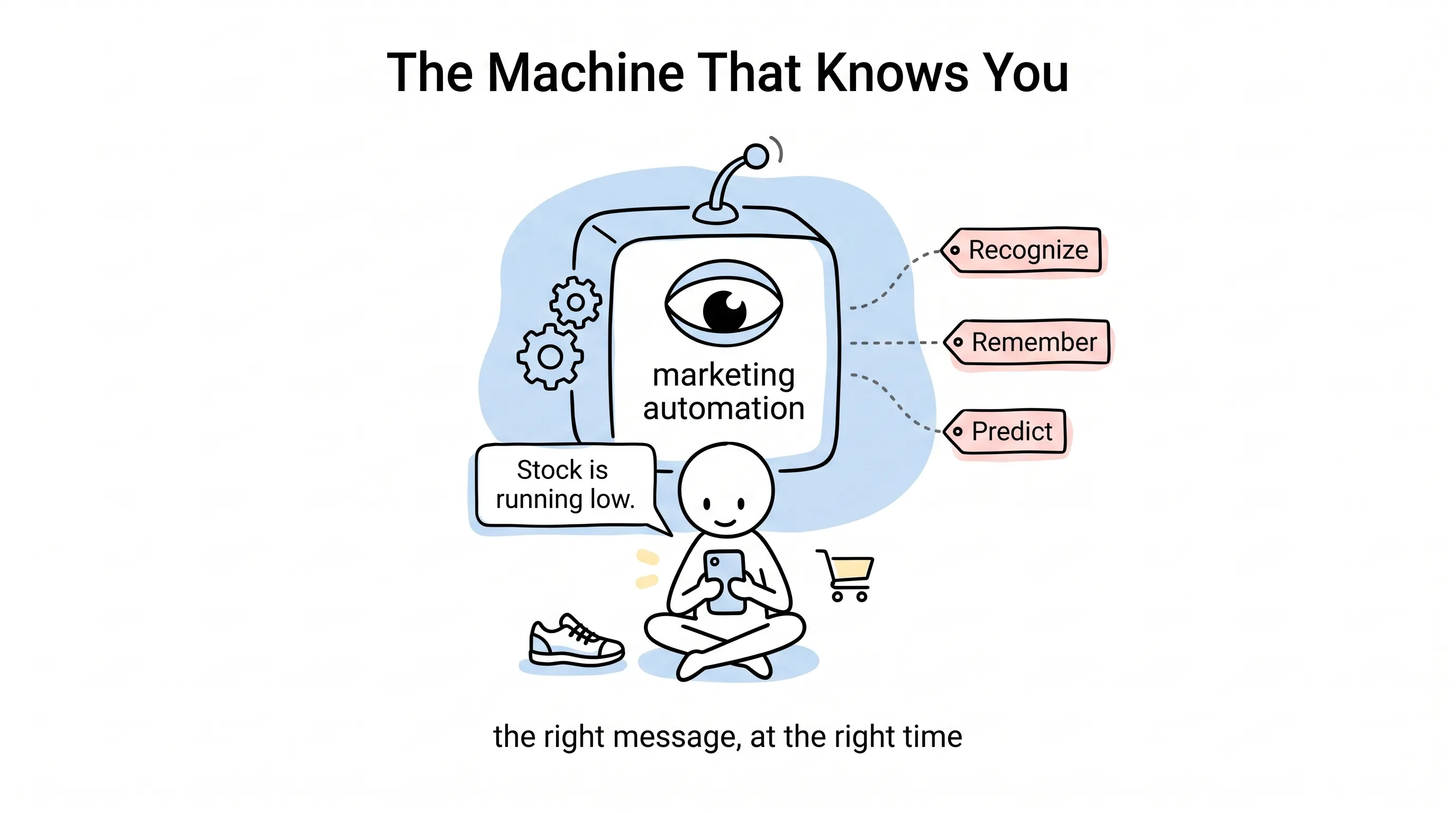
Here's what happened. I spotted a pair of shoes in an e-commerce app and dropped them into my cart, figuring I'd compare prices before buying. Before I could even close the app, a text message beat me to it: "That pair you've been eyeing? Stock is running low."
And guess what—I placed the order that very night.
Once I cooled down, though, a chill crept up my spine. How did it know I'd looked at those shoes? How did it know I was hesitating? And how did it know that one little line was all it would take to pull me back?
Behind that text stands a whole corner of the market you've probably never noticed: marketing automation and personalization.
So what is marketing automation and personalization?
In plain terms, it means letting machines do the "people-reading" for you. Recognize who you are, remember what you did, guess what you'll want next—then say the right thing, at the right time, on the right channel.
Think about it: in the offline world, this knack has a name—being good with people. Picture the owner of a time-honored silk shop. The moment you walk in, he remembers the fabric you bought last year and the colors you favor, and with a warm sweep of his sleeves: "Ah, there you are at last. The new arrivals—just right for you."
On any given street, you'd be lucky to find one shopkeeper like that.
The trouble is, an online business gets a million visitors a day. Where on earth would you find a million shopkeepers?
You can't afford it. So the machines have to step in.
All automation, at its core, is human understanding of humans, written into the system ahead of time.
So who's crowded into this space?
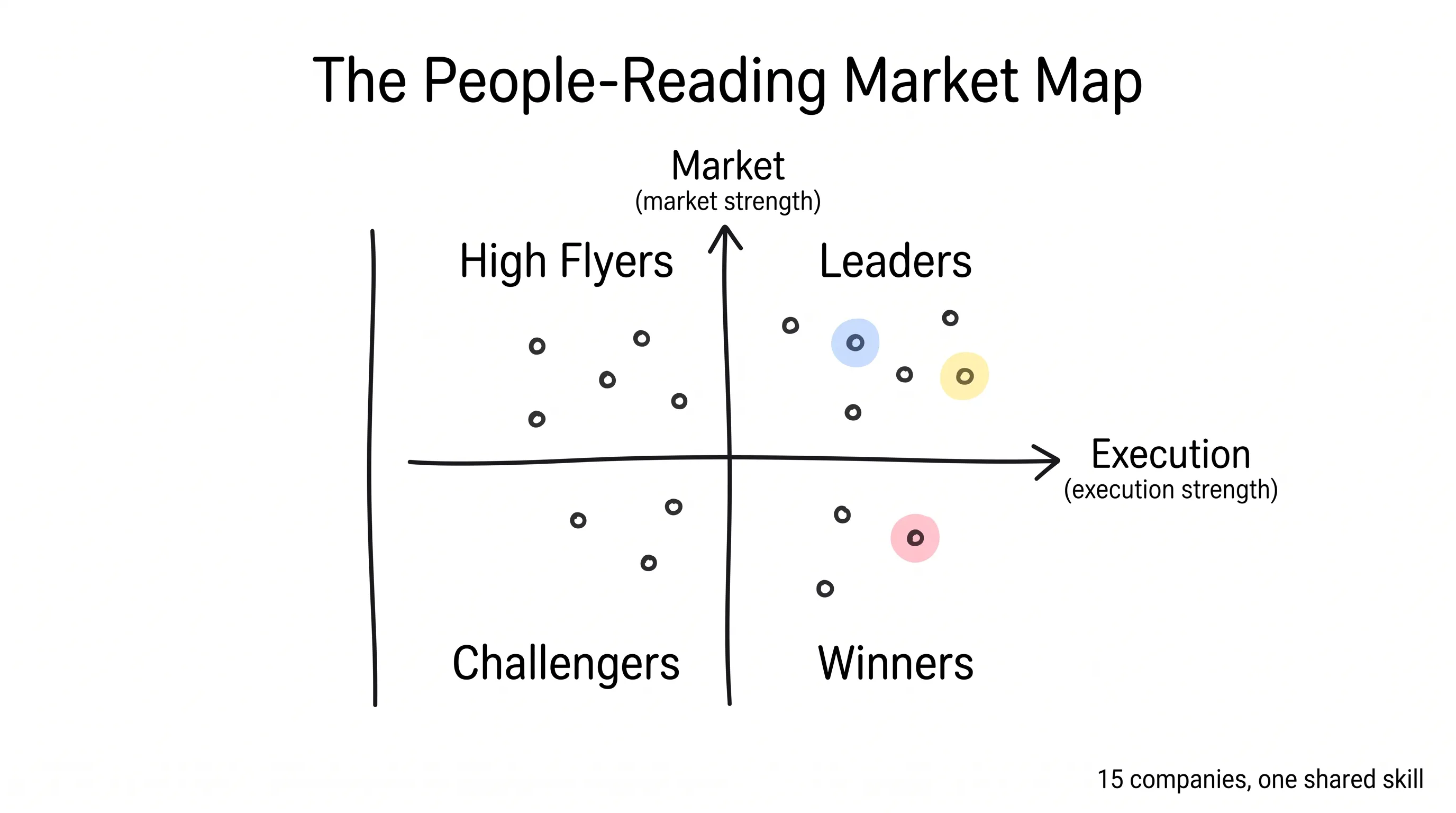
A while back, I was flipping through a chart. CB Insights, an enterprise technology intelligence firm, had laid this whole space out as a matrix: the horizontal axis is execution strength—whether your product is actually any good; the vertical axis is market strength—whether you've planted your feet firmly in the market. Slice it along those two axes, and the seating order appears: Leaders, High Flyers, Winners, Challengers.
By the way, this map has a few neighboring spaces standing beside it: online sentiment analysis, consumer trend detection, customer identity resolution. The logic behind them is all the same—see people more clearly.
I counted: fifteen companies in all. Let's go through them one by one. Don't worry, it won't be dry—each one carries a lesson of its own.
The first group handles "recognize plus reach." Their job is making sure your texts, emails, and app push notifications land on the right person's phone at exactly the right moment.
Braze, founded in New York in 2011, was originally called Appboy. Cross-channel customer engagement is its signature strength: texts, emails, and push notifications, strung together into one complete journey. Its client roster includes a particularly interesting name: Whataburger, the American burger chain. Go grab a burger in the dead of night, and they'll still know the secret handshake. Respect! Among its partners you'll also find Shopify and Snowflake, plus another player on this very list, Movable Ink. In this space, competition and cooperation are all tangled up together.
Klaviyo, 2012, Boston: it focuses on email and SMS, building a consumer-facing CRM. Attentive is even younger—2016, New Jersey—and went all in on SMS, betting that the text message sits closest to you. ActiveCampaign, 2003, Chicago, has been doing customer experience automation for over two decades, with a sharp eye on e-commerce. MoEngage, 2014, San Francisco—finance, media, dining, travel, retail—it's in every one of them.
The second group owns "what to say." Once you've recognized the person, what you actually say is a craft of its own.
What Persado does feels the most mystical to me: it uses machine learning, natural language processing, and transformer models (the architecture behind today's AI language tools) to infuse marketing copy with emotion. For the very same promotion, it can tell you with data which words put people at ease and which words manufacture urgency. Movable Ink, meanwhile—2010, New York—specializes in turning the data in hand into one-to-one content, different for every single person.
The third group guards the "on-site" experience. Once someone has walked into your e-commerce site, how do you help them find what they want?
Bloomreach, 2009, Mountain View, twists customer data and product data into a single strand to deliver real-time personalization. Lily AI pulls off something even cleverer—2015, also in Mountain View—by injecting "the language customers actually use" into on-site search and product recommendations. Search "what to wear to a dinner party," and the system knows you're probably after a dress—not a wall of dead, mechanical search results.
The fourth group keeps its eyes on the "cash register."
Rokt, 2012, New York, specializes in the few seconds at checkout: how to optimize the payment step, then ride the momentum to recommend what to buy next. Thanx, 2011, San Francisco, builds membership and loyalty programs for restaurants, helping you put a hard number on what a repeat customer is worth. Bluecore, 2013, New York, once known as TriggerMail, serves retail brands, using real-time data and predictive models to guess which rung of the purchase funnel you're standing on.
And then there's one special case, a B2B player: ZoomInfo. It does the "people-reading" in the other direction—not merchants reading consumers, but sales teams reading customers. Who's researching your product right now? Hand over the purchase-intent data, and sales is the first to know.
And the giants? The giants are here, of course. Oracle, founded in 1977 as Software Development Laboratories, grew from databases into cloud infrastructure, and then into enterprise applications. When it comes to personalization, it can lay every single brick by itself.
Fifteen. That's the full count.
That was the lively part of the story. But what I really want you to remember is one small line of print tucked into the corner of the list.
Act-On Software, founded in Portland in 2008, spent seventeen straight years building marketing automation. In January 2025, it was acquired by Banzai for $53.2 million.
Seventeen years, $53.2 million. That averages out to less than $3.2 million a year.
At any table where someone is eating the meat, someone else is picking up the bill.
On the direction itself, I have no doubts: the better you know your customers, the more money there is to make. But the right direction doesn't mean everyone wins. Where execution strength can't hold you up, no amount of market-strength storytelling will save your seat—the rankings will politely usher you off it.
So if one day it's your turn to enter this arena, don't be in a rush to ask where the next big wave is. Ask yourself three questions first: Can you recognize your customers? Can you remember them? Can you call their next move?
Back to that text message from the beginning. It got me to place an order that same night. And now you know: standing behind it were the machines of an entire space.
Finally, here's to your business, growing better and better.
And here's to you, too—may you always be recognized, at the right time, by the right people.
Continue reading
Related articles

Cross-Border Business: Time to Upgrade Your AI Toolbox
A learn article explaining how AI tools help cross-border e-commerce sellers clear five hurdles: language, regulation, logistics, payments, and fraud. It outlines a five-compartment toolbox, a five-step adoption path, and metrics such as conversion rate and CLV, while cautioning against over-reliance on AI.

AI Is Taking Over the Dirty Work of Social Media Marketing, One Task at a Time
This learn article outlines four social media marketing tasks AI can handle — audience analytics, content drafting and design, ad targeting and creative testing, and spam moderation — and cautions that taste, judgment, and data security remain human responsibilities.

AI Is Already This Good — Why Is Your Social Media Marketing Still Pure Manpower?
An overview of 18 AI tools for social media marketing, organized into six categories covering audience research, content creation, scheduling, comment and DM handling, ad management, and visual production, plus notes on personalization, prediction, and emerging trends.