
The End of Search Is No Longer a Row of Blue Links
An explainer on how AI-generated answers are replacing traditional search clicks, introducing GEO and AEO as complements to SEO. It outlines practices for making website content easier for AI engines to understand and cite.
The other day I needed to look something up, and out of habit I opened a search box.
Wait — no. What I opened wasn't a search box. It was AI.
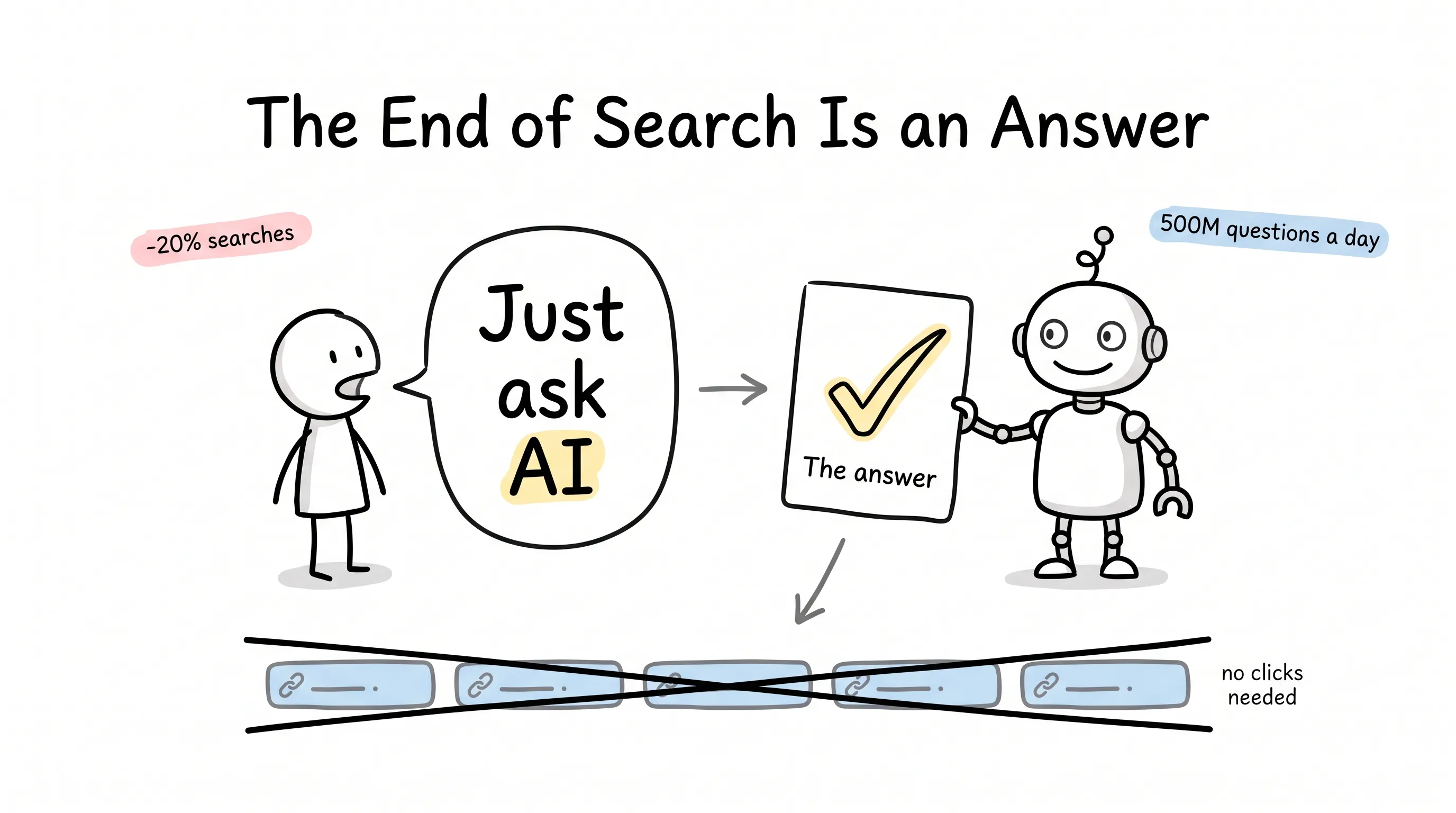
That's when it hit me: it's been a long time since I last bothered to click any link below the second line of search results. The first result is usually an AI summary, with the answer sitting right there on the page. Or I just go straight to ChatGPT.
I assumed this was just me. Then I came across a few numbers compiled by The Deciding Factor (a US digital marketing agency, hereafter TDF), and a chill ran down my spine:
Per-person search volume on Google desktop is down nearly 20% year over year.
Every day, 500 million search-style queries pour into ChatGPT. It answers, it summarizes, and while it's at it, it recommends service providers for you.
Even if you stick with Google, it's the same story. The first thing on the results page is now an AI Overview, with the answer laid out right there. Whether it's accurate is another question — either way, users aren't clicking links anymore.
Rank High, Get Clicks? That Formula Is Broken
For the past decade or so, the logic of running an online business was dead simple: do your SEO well, rank high, and traffic follows.
Ranking = clicks = business.
Now the formula breaks at the middle link. Users have stopped clicking. You can rank #1 and still be nothing more than a gray citation line at the foot of an AI answer.
So was all that SEO for nothing? Is the website beyond saving?
Don't panic yet.
AI Copies Homework Too
Think about it: AI generates a staggering number of answers every day — whose homework is it copying?
It needs sources too.
That's why, in TDF's view, "making your website AI-ready" comes down to four things: solid technology, clear semantics, trustworthy content, and a presence beyond your own site. The first three are about the website itself; the last one is about your footprint across the internet as a whole.
In plain language, it looks roughly like this:
- Cut the marketing jargon and just give the answer. AI prefers content that talks like a human.
- Organize information with lists, tables, and clear headings. Write like a manual, not an essay.
- Add structured data (schema) so machines can understand what your page is actually about.
- Take comparison content seriously: spell out where you beat your competitors. AI especially loves citing this kind of thing.
- Do your FAQ properly. Answer the way users actually ask.
- Mind your reputation. Reply to reviews and social media posts, one by one. These all become trust signals in AI's eyes.
- Step outside your own site — publish in industry media, journals, and buying guides. AI's sources go well beyond your website.
It all looks like small stuff. But every single item answers the same question: why should AI cite you, and not somebody else?
What Is GEO? What Is AEO?
At this point, two new terms take the stage.
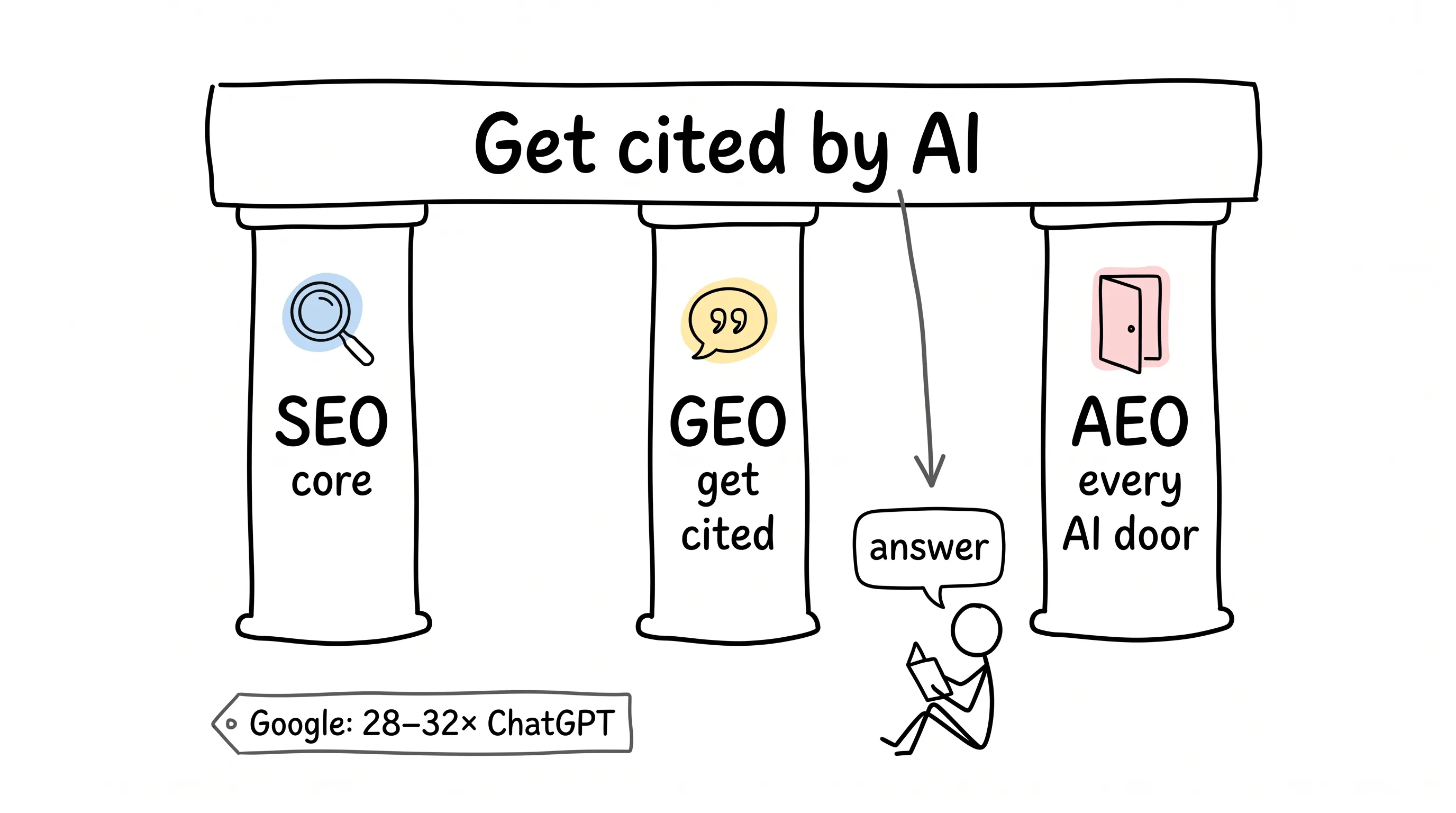
What is GEO (Generative Engine Optimization)? It means making your content understood and cited by AI search and chatbots, so that it shows up in the answers they generate. You used to optimize keywords, chasing rankings; now you optimize content, aiming to get cited.
Here's an analogy. SEO is opening your shop on the busiest street in town and making the sign big, so everyone passing by sees you. GEO is when a customer casually asks "which shop is worth a visit?" — and the savvy guide standing next to them is willing to mention your name.
And what is AEO (AI Engine Optimization)? Its scope is even bigger. Voice assistants, generative AI, agents... anywhere a user asks AI a question counts. ChatGPT, Gemini, Perplexity, Google's AI Overview, even Siri. The goal: no matter which door the customer walks in through, they can find you.
Keep or Drop SEO? Run the Numbers First
TDF ran the numbers: Google's search volume is still 28 to 32 times that of ChatGPT.
Thirty. Times.
However fast AI search grows, the main battlefield is still traditional search. So don't think about throwing SEO away. The right posture is a three-legged approach: SEO holds the core, while GEO and AEO capture the incremental growth.
The head of TDF also shared an observation: everyone used Google, and over time Google became the verb "search" itself; in the past few years, they've watched AI tools reshape consumer behavior from the ground up. Your content has to be built in a form AI can digest and retell.
Which Industries Should Move Fastest
TDF named a few: healthcare, where users routinely ask AI about symptoms and treatment options; finance and insurance, where trust is everything; education and training, where explanatory content is what AI gets asked about most; e-commerce and retail, where product recommendations are being taken over by AI; and professional services like law and consulting, where perceived authority directly decides whether clients believe you.
The logic is the same in every case: whoever gets cited by AI wins half the battle in the user's mind first.
The playbook differs between B2B and B2C. B2C is about speed: make your product details, user reviews, and FAQ solid, so AI can recommend you in a second. B2B is about depth: build up your white papers, case studies, and industry analysis, so AI sees you as authoritative enough to write your views into its answers. Simply put: one competes on convenience, the other on expertise.
A Final Word
TDF is a marketing agency serving small and medium-sized businesses. I genuinely agree with their guiding belief: data and technology are tools, and tools exist to serve real people. People before machines — that's what makes content stand firm.
Lately I've deliberately paid attention to my own habits: when I need to look something up, I ask AI first; if AI can't explain it clearly, then I go search. My guess is, you do the same.
Before, the end of search was a row of blue links. Now, the end of search is an answer.
The only difference: who gives that answer.
May you become the answer itself, one day soon.
Continue reading
Related articles

Cross-Border Business: Time to Upgrade Your AI Toolbox
A learn article explaining how AI tools help cross-border e-commerce sellers clear five hurdles: language, regulation, logistics, payments, and fraud. It outlines a five-compartment toolbox, a five-step adoption path, and metrics such as conversion rate and CLV, while cautioning against over-reliance on AI.

AI Is Taking Over the Dirty Work of Social Media Marketing, One Task at a Time
This learn article outlines four social media marketing tasks AI can handle — audience analytics, content drafting and design, ad targeting and creative testing, and spam moderation — and cautions that taste, judgment, and data security remain human responsibilities.

AI Is Already This Good — Why Is Your Social Media Marketing Still Pure Manpower?
An overview of 18 AI tools for social media marketing, organized into six categories covering audience research, content creation, scheduling, comment and DM handling, ad management, and visual production, plus notes on personalization, prediction, and emerging trends.