
The Day the Regulator Shows Up: Can Your Marketing Data Survive an Audit?
A learn article on preparing marketing data for regulatory audits: data inventory, consent management, data minimization, AI documentation, vendor oversight, user rights requests, and shifting to consent-based first-party data.
Let's start with a thought experiment.
You run marketing. Your latest campaign just hit it out of the park — conversion rates at an all-time high, and the team is gearing up for a debrief and a celebration. Suddenly, a regulatory inquiry lands: How was user data collected? Were users' opt-out requests honored? Do those third-party tools you use actually meet the required security standards?
So you start digging through your MarTech stack. The deeper you dig, the colder your stomach gets.
The answers aren't clean.
Why do so many teams end up here? Not because they're careless, and not because they're reckless. It's because compliance was never built into the system in the first place. It gets slapped onto the wall, layer by layer, after something goes wrong.
But in 2026, that playbook no longer works.
Regulators are done with just issuing guidelines — they've started handing out fines. The California Privacy Protection Agency began enforcement in 2025, and it's ramping up in 2026. Over in the EU, GDPR has put the right to erasure (Article 17) squarely on its 2026 enforcement priorities.
So the question stopped being "whether to comply" a long time ago. The real question is: when the regulators actually come to look, will your work stand up to scrutiny?
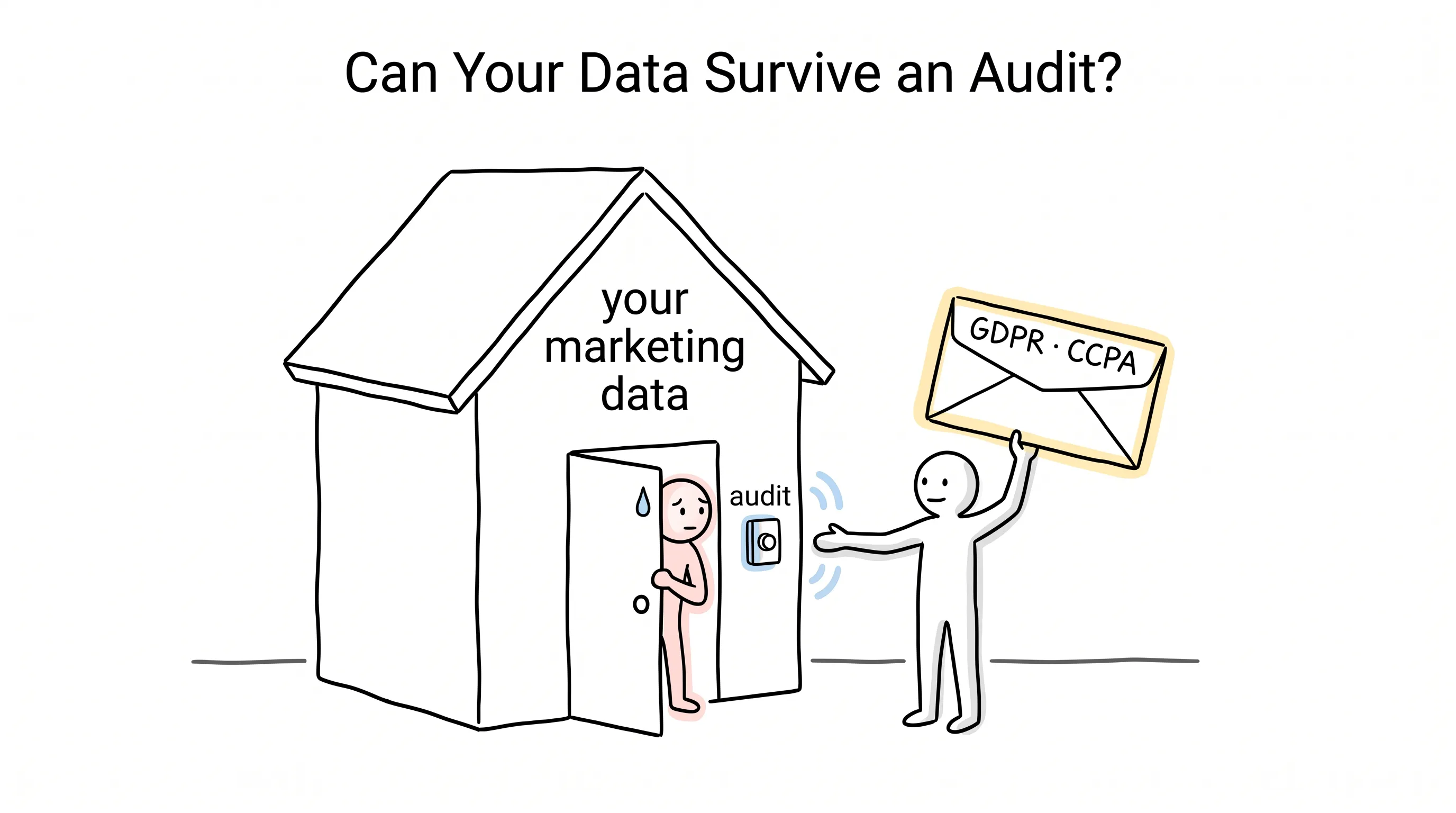
What does "standing up to scrutiny" mean? It means you didn't just do it — you can prove you did it
What regulators examine today is whether your processes actually run — not whether your documents exist.
Take Tractor Supply in the US. A single broken opt-out form earned the company a $1.35 million fine.
Note what it was caught on. Not secretly tracking users. Users clicked "opt out," the system didn't opt them out — and the company told them they had.
One form. $1.35 million. Possibly the most expensive frontend bug in the world.
So what does "provable" mean, concretely? Four things:
- You know what data you hold and why you collected it;
- The consent you obtained is genuine consent — and you deliver on it;
- Your vendors are held to the same standard you are;
- When users exercise their rights, you can catch it.
The eight self-audit items below are built around these four things. Go through them one by one — wherever you can't get past, that's where your gaps are.
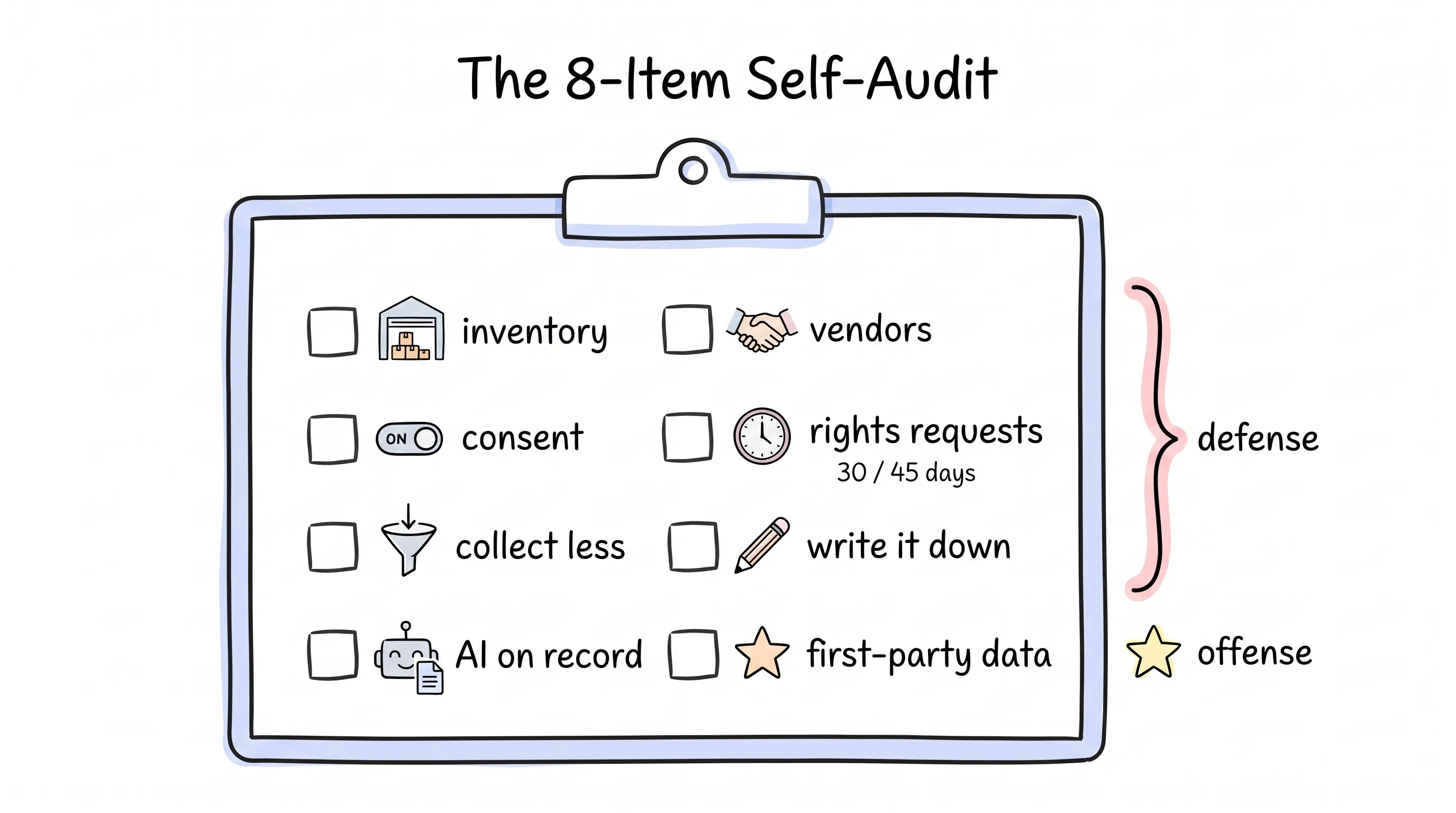
Where to start? Start with the warehouse.
Item 1: Take inventory first. If you don't know what's in the warehouse, forget about guarding it
A data inventory is the foundation of every compliance action. For every data point you collect — what it is, why you collect it, where it's stored, who can touch it, how long you keep it — you need a written record.
"How long you keep it" especially. Every category of data needs a clear retention period and a deletion schedule. Why the urgency? Because the GDPR right to erasure is a 2026 enforcement priority. A user says "delete me," you comb through your systems and can't find it all — that's no longer an attitude problem. It's a violation.
Here's a painful yardstick: if your data inventory is an Excel file a colleague built two years ago and nobody has touched since, it's not an inventory. It's an artifact.
The inventory needs an owner, regular reviews, and real, hands-on deletion of the "collect it now, think later" data.
Item 2: Get consent under control. This is where self-perception and reality diverge the most
Plenty of teams have consent pop-ups that look perfectly compliant — until you test them: the user clicks "reject," the trackers keep running; the user changes a preference, and the system takes ages to update.
Why is this the most accident-prone area? Start with a new rule.
The CCPA amendments that took effect January 1, 2026 contain a hard requirement: when a user's browser sends a GPC signal (Global Privacy Control — a one-click "stop tracking me" set at the browser level), you not only have to honor it automatically, you also have to show the user a visible confirmation that it was received and processed.
Pay attention to the word "visible." Processing it quietly in the backend and saying nothing doesn't count. This is the first time compliance has required you to show your work to the user.
One more landmine to avoid: making "Accept All" a big green button while shrinking "Reject" into tiny gray text. Regulators have a name for this kind of cleverness — dark patterns — and they're cracking down on them hard. And users today aren't so easy to fool; anyone playing games gets spotted immediately.
Users judge who you are by what your consent page looks like. The consent experience is already part of the brand experience.
Self-check actions: the reject button is as easy to find as the accept button; every consent is stored with a timestamp; when users change preferences, it takes effect in real time across the whole chain; run the opt-out flow end to end and confirm with your own eyes that tracking actually stopped.
Item 3: Collect less. Data isn't better in bulk
This is the most counterintuitive one — and possibly the most valuable.
For every data field, ask one question: which specific decision does it support? No answer? Delete.
"But what if we need it someday?" Data collected that way is like expired inventory in a warehouse: it takes up space, needs tending, and when the fire starts, it's the first thing to burn you.
Collect less but collect right, and storage gets cheaper, models stay clean, questions from regulators become easy to answer, and if a leak really happens, your exposure is smaller too. GDPR wrote data minimization into law, but for people doing business, this is just a simple arithmetic problem.
In one sentence: Collect what you'll use. Delete what you won't.
Item 4: Put your AI on the record
In your stack, how many algorithms are making decisions about individual customers? Lead scoring, audience segmentation, predictive targeting — they all count.
In 2026, they face new documentation requirements. The EU AI Act became fully applicable and enforceable in August 2026. New California rules require that significant decisions handled with automated decision-making technology complete a formal risk assessment, in writing, before deployment.
What counts as a significant decision? Anything touching employment, housing, finance, education, healthcare — all of it.
Self-check actions: keep a roster of the algorithms involved in decisions; the risk assessment is documented before deployment, not patched on afterward; you've tested the model for bias across specific demographic groups; training data, testing methods, and accuracy evaluations are all traceable; users can request human review.
Item 5: Keep your vendors in line
You hired a renovation crew, the house catches fire — the fire marshal comes for you, not the crew.
Data works the same way. Regulators recognize only one responsible party: the data controller, which is you. If a vendor screws up your customer data, the fine has your name on it.
So for every vendor that can touch customer data, you need to know where things stand: Is a data processing agreement (DPA) signed? Does the agreement meet current GDPR and CCPA standards? Has a security questionnaire been done in the past 12 months? The encryption, access controls, and incident response they claim — have you verified them? Your data in their hands — could it be resold or re-shared? When the contract expired, was access revoked?
Don't groan about the hassle. Vendors come down to three moves: ask tough questions, verify what you hear, keep the answers on file.
Item 6: Catch every user rights request
Users have the right to view, correct, and delete their data — and to take it with them. This isn't a gesture. It's an obligation with a clock on it.
GDPR gives 30 days. CCPA gives 45.
What does dropping one look like? A request that sat 90 days before anyone answered, and the deletion still missed two systems. Even if your intentions were good, in a regulator's eyes, this is failure.
Self-check actions: the request intake is clearly visible; there's a written cross-system lookup process; deletion reaches third-party vendors, and you can confirm it was complete; every request and response is logged. And ask yourself one more thing: in the past six months, has this process been rehearsed end to end?
Item 7: Write down the work you've done
The companies that face regulatory inquiries with the most composure all share one trait: they can show their work.
What you should have: Records of Processing Activities (RoPA) as required by GDPR Article 30, with the legal basis written for every entry; written risk assessments before high-risk processing starts; a 72-hour data breach notification process; if revenue exceeds $50 million, confirm the timeline for the cybersecurity audit certification.
Documentation isn't paperwork. On the day you're investigated, the only thing that can speak for you is what you wrote down.
Item 8: Switch granaries — start stockpiling your own data
The first seven items are all defense. The last one is offense.
In a compliant marketing system, third-party cookies are basically out of the game. Teams still counting on cross-site tracking are building on foundations that enforcement is tearing down.
Where to turn? Toward first-party data — data users have consented to and handed to you.
This isn't a loss — it's a bargain. Cisco ran a survey: 95% of enterprises say the return on their privacy investment outweighs the cost, and the two most common reasons are better data quality and lower regulatory risk.
First-party data collected with consent is an asset you own. Browser updates can't block it, regulatory revisions can't obsolete it, and it grows more valuable with time. The playbook isn't mysterious either: give users a clear value exchange; use progressive profiling, don't demand everything up front; let users see the benefit as soon as the data arrives; and try zero-party data — for example, a small preference quiz that lets users tell you their interests themselves.
You've run the checklist. Now what?
Three steps.
First, go through all eight items and mark every line you can't confidently check off. That's your compliance roadmap.
Second, prioritize by risk. Consent management and vendor agreements carry the biggest exposure; documentation and rights response follow close behind.
Third, give every item a named owner. Note: one person, not a committee. Who updates the checklist, who chases the questionnaires, who tests the opt-out flow — it all has to land on a person.
Set the rhythm like this: the highest-risk items get a look once a quarter; the full self-audit, once a year. Compliance isn't a renovation you hand over with the keys. It's property management — someone has to be on duty every day.
Oh, and one more thing. If you find that your own stack can't even run one clean self-audit — can't find everything, can't reconcile, can't explain — the problem may not be the process. It may be the architecture. If the system wasn't designed from day one to make data explainable, no amount of process diligence can patch that.
Back to that inquiry letter
Nobody knows when that letter will come. But when it does, you already know what it will ask.
The cost of teaching yourself compliance early is always lower than the price of the regulator's remedial lesson.
And here's an even better wish for you: may you never get that call.
Continue reading
Related articles

Cross-Border Business: Time to Upgrade Your AI Toolbox
A learn article explaining how AI tools help cross-border e-commerce sellers clear five hurdles: language, regulation, logistics, payments, and fraud. It outlines a five-compartment toolbox, a five-step adoption path, and metrics such as conversion rate and CLV, while cautioning against over-reliance on AI.

AI Is Taking Over the Dirty Work of Social Media Marketing, One Task at a Time
This learn article outlines four social media marketing tasks AI can handle — audience analytics, content drafting and design, ad targeting and creative testing, and spam moderation — and cautions that taste, judgment, and data security remain human responsibilities.

AI Is Already This Good — Why Is Your Social Media Marketing Still Pure Manpower?
An overview of 18 AI tools for social media marketing, organized into six categories covering audience research, content creation, scheduling, comment and DM handling, ad management, and visual production, plus notes on personalization, prediction, and emerging trends.