
The Customer Service Rep You Turn to at Midnight Might Not Be Human at All
An explainer on how AI is reshaping customer experience, covering personalized recommendations, 24/7 support bots, sentiment analysis, and prediction, along with common pitfalls like tone-deaf automation, data privacy, and bias.
Ever had this happen? It's midnight, something's gone wrong with your online order, and, figuring it's worth a shot, you open the customer service chat.
Three seconds later, a reply comes back.
Every question answered, the tone gentle — and a coupon slipped in for good measure.
You probably didn't think much of it. But here's a thought: what company has human agents who answer in seconds at midnight?
Odds are, the one helping you was an AI.
And odds are, you never even noticed.
Here's what makes this interesting: over the past few years, AI has quietly slipped into just about every job that involves dealing with customers. Support, sales advice, recommendations, pricing, follow-ups — its shadow is everywhere.
One e-commerce giant switched on an AI recommendation engine, and in its first year, customer engagement rose 30% and sales revenue grew 25%.
What do 30% and 25% mean here? Plenty of companies grind all year long without their profit margin ever touching 25%.
So today, let's talk about it: how exactly is AI reshaping customer experience? What is it getting right — and where does it tend to fall over?
So What Is Customer Experience?
What is customer experience, exactly?
Put simply, it's everything a customer feels along the whole road — from first hearing about you, to buying from you, to using what they bought, to coming back for a return or exchange.
That road is long, and every touchpoint is an exam. The product page is an exam. The support reply is an exam. Shipping speed is an exam. The returns experience is an exam too.
Humans used to sit all of those exams. And human exam-takers have human problems: they get tired, they get irritated, they get emotional, and they go home at the end of the day.
AI doesn't go home.
Gartner once made a widely quoted prediction: by 2023, AI would create $2.9 trillion in business value while recouping 6.2 billion hours of work time.
Six point two billion hours.
How much is that? If one person works 2,000 hours a year, 6.2 billion hours is the equivalent of more than three million people working around the clock for a full year.
That's why I've always felt that what AI brings to customer experience isn't patchwork repair.
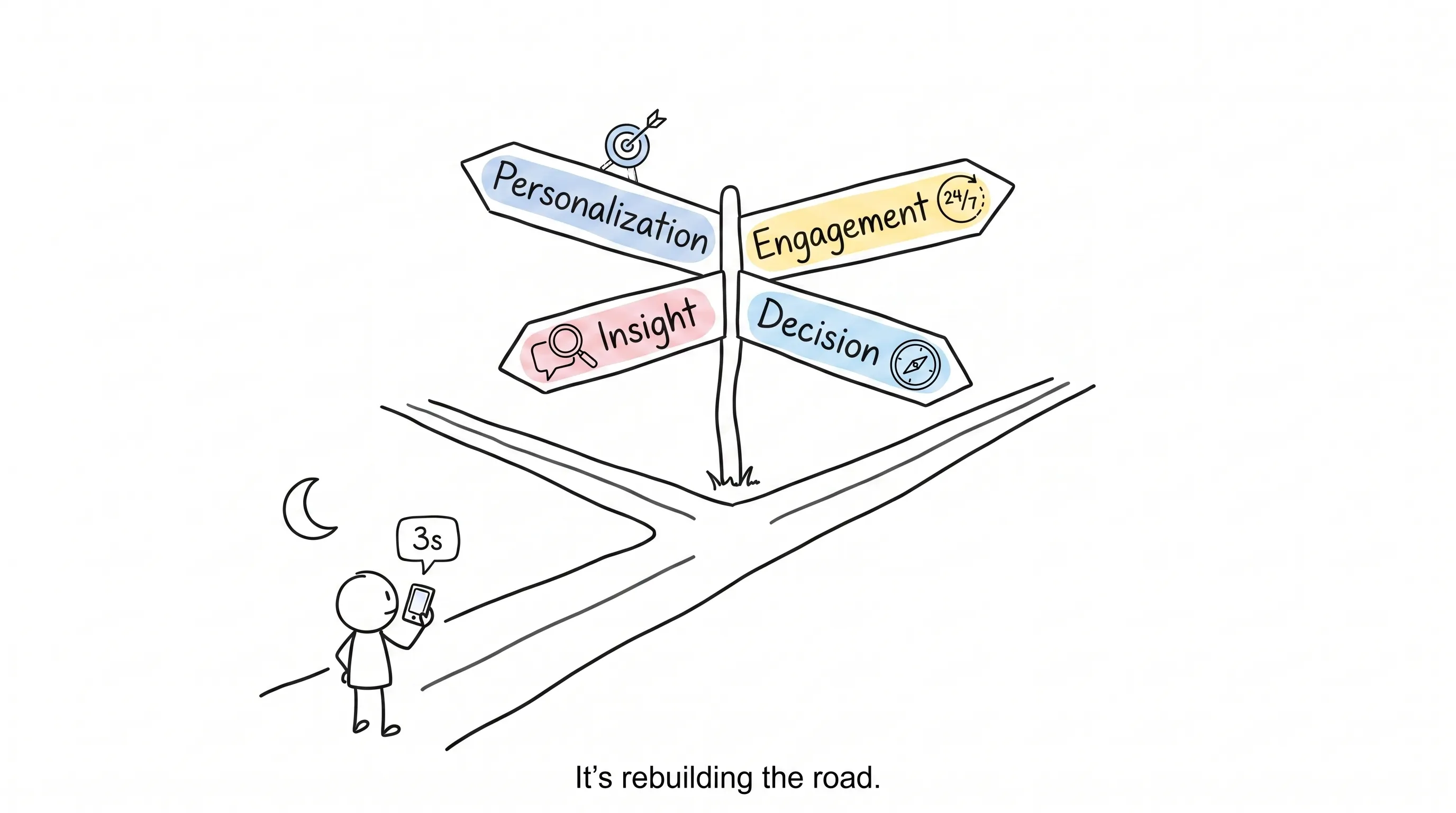
It's rebuilding the road.
And that road, once rebuilt, runs in four directions: personalization, engagement, insight, and decision-making. Let me take them one at a time.
The First Thing: From "One-Size-Fits-All" to "One-Size-Fits-One"
The first place AI went to work in customer experience was recommendations.
Open a shopping app and look at the row of products on the home screen. Doesn't it always seem a little too well suited to your taste?
You might think it's coincidence.
It's not coincidence. It's the algorithm.
Amazon's recommendation engine and the recommendation systems inside Shopify stores are all doing the same job: taking your browsing history, purchase history, and time on each page — even the items you put in your cart and then deleted — and running the numbers over and over, trying to guess what you'll want to buy next.
When the guess lands, browsing feels great. You're spared the needle-in-a-haystack hunt, and satisfaction and order rates climb together.
But the one that truly made me think "this is impressive" was L'Oréal.
The beauty giant has an in-house tech incubator devoted to a single question: how do you use technology to make beauty understand each individual better? A few of the things they've built — have a listen.
There's an app called Makeup Genius. Turn on the camera and try on makeup in augmented reality — twenty shades in one minute, without ever reaching for the makeup remover.
There's a smart hairbrush. As you brush, it quietly collects data on your hair and scalp, then tells you when you're done: time to switch to this conditioner.
And there's a chatbot on Messenger that chats casually with you about your skincare needs — and somewhere in the back-and-forth, it recommends the right products.
Think about it: what did buying lipstick used to depend on? The counter clerk's eye, plus your own luck.
What does it depend on now? Data.
The one-size-fits-all business is turning into one-size-fits-one. That's the first answer AI has handed in.
The Second Thing: Instant Replies, Always On
The second thing happens in customer support.
Many support bots today — ManyChat and Drift among them — stay online 24/7: answering simple questions outright, replying to common ones in seconds, even steering the conversation based on customer data. When something genuinely complex comes up, they hand it over to a human.
No one has taken this playbook further than the pizza seller Domino's.
In 2024, Domino's formed an AI alliance with Microsoft and built a voice ordering assistant. Say into the phone, "One Hawaiian pizza, light on the onions," and it understands, places the order, and confirms — all in one unbroken flow.
How did that turn out?
Average ordering time dropped 30%. Online orders rose 25%.
Don't underestimate that 30%. At the dinner rush, the speed of taking orders is the speed of getting food out — and that means your pizza lands in your hands a few minutes earlier.
There's another case, at a hospital, that moved me even more.
Stanford Healthcare deployed an AI chatbot to answer patients' basic questions: what time the clinic opens, where to look up test results, how to book an appointment.
After launch, call volume at the call center dropped 20%.
What does that 20% mean?
It means the human agents who used to be tied up with "what time does the clinic open" were freed up — free to take the calls that are genuinely complex, genuinely anxious, and in need of a human to soothe them.
Now that is what technology should look like.
AI takes away the simple questions and leaves the complicated human heart to people.
The Third Thing: Getting There Before the Customer Speaks
The third thing is subtler, but worth even more.
How did merchants used to understand their customers? Surveys, follow-up calls, interviews. Ask ten questions, and you'd be lucky to get one answer.
And now? AI takes in the traces customers leave all over the internet. This craft is called sentiment analysis.
Say you type a quick comment in a review section: "Nice product, but shipping was slow." AI fishes that one sentence out of millions of comments, groups it with tens of thousands of other "shipping is slow" remarks, and turns it into a nudge to the merchant: logistics is holding things back — time to fix it.
The same data can then go one step further: prediction.
Predict which customers are about to churn, and slip them a win-back coupon right away. Predict what will sell next month, and stock up early. Predict which transaction looks suspicious, and block it before the fraudster gets paid. Predict which price point both sells and protects your margin, adjusting in real time as it goes.
And on the side, it runs a little "observant shopkeeper" business: you just bought a camera, so it figures you might be short a memory card; you've been looking at strollers for three days, so it lays the hospital-bag checklist in front of you. Average order value inches up, bit by bit.
Put bluntly, it comes down to one sentence:
Count, one by one, the votes customers cast with their feet — then get the thing done before they ever have to ask.
But There's Always a Flip Side
By this point, you might be thinking AI is a miracle cure for customer experience.
Not so fast.
You and I have almost certainly been tormented by "dumb AI": you type out a long paragraph, and the reply is "Sorry, I didn't understand your question"; you're frantic with urgency, but the other side keeps that calm, unhurried robot tone; you want a human, you press through eight rounds of buttons, and you're still going in circles in the voice menu.
Where does the problem lie? I'd file it under four.
First, a lot of AI can't understand how people actually talk. Complex phrasing, roundabout phrasing, emotionally loaded phrasing — it can't catch any of it. All it knows is keywords.
Second, a lot of AI has no heart. It can't hear that you're already angry; it just keeps serving up "I'm happy to be of service" at the same unhurried pace.
Third, data. The better AI knows you, the more of your data it has stockpiled. Where is it stored? Who gets to see it? What else has it been used for? Europe passed a law for exactly this — the now-famous GDPR (the EU's General Data Protection Regulation). If a company treats data protection lightly, one breach can wipe out years of accumulated trust overnight.
Fourth, bias. Algorithms are raised on historical data. Whatever favoritism is buried in that history, they learn it faithfully — and sometimes amplify it. On two identical applications, an algorithm may score different people differently based on features that have nothing to do with the decision.
So my judgment is clear:
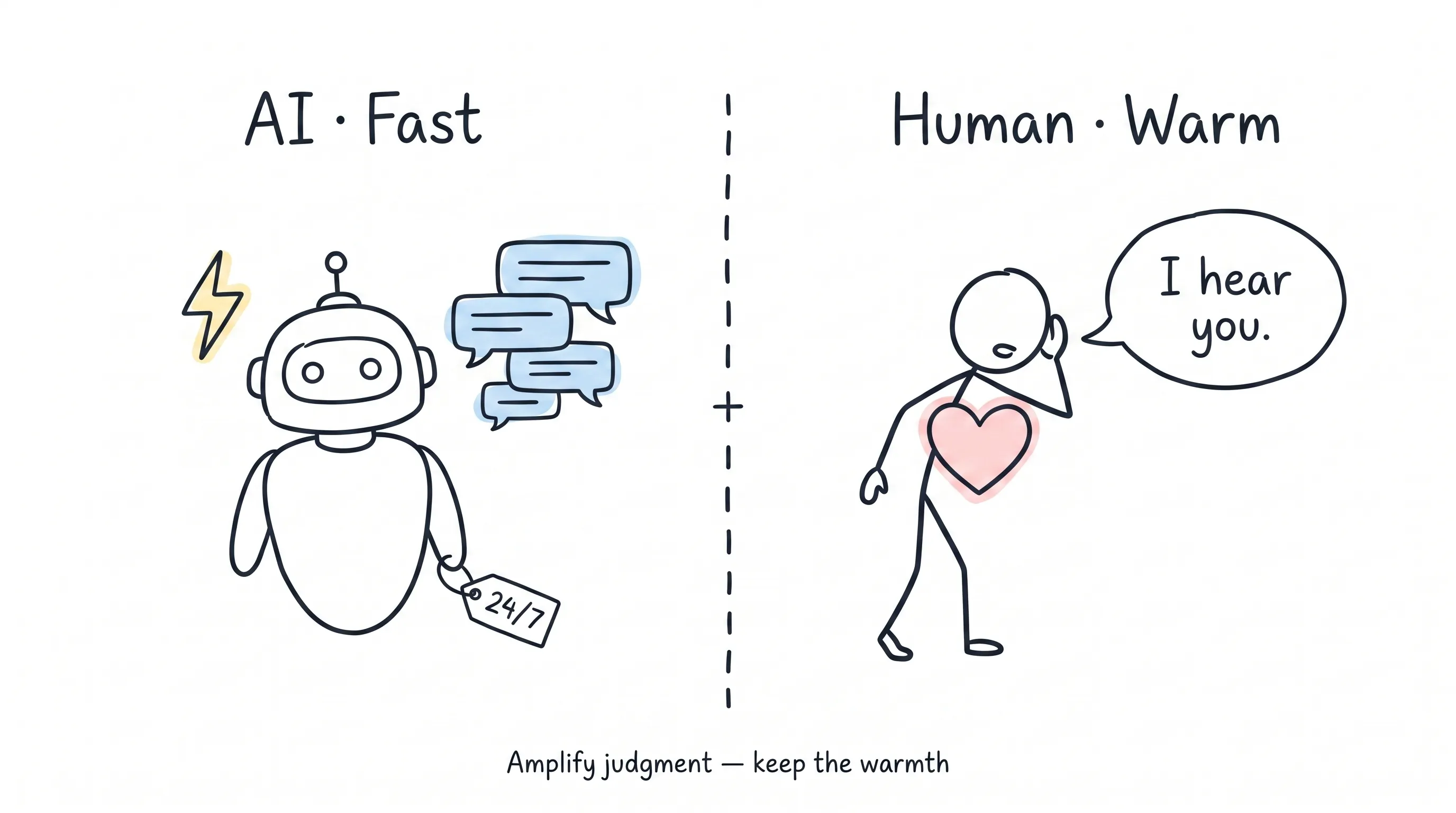
AI should amplify human judgment, not replace human warmth.
The companies that truly use AI well keep their moves plain: test it over and over before launch so it never embarrasses itself in public; tell customers openly, "you're chatting with an AI," instead of passing it off as human; watch customer feedback closely and fix problems the moment they appear; and most important of all, always leave a door open to a human — when AI hits its limit, a person can step in immediately.
Machines handle efficiency; humans handle the human heart. Just don't get that division backwards.
One Step Further Ahead
Where does all this go next?
Two scenarios — feel them out.
Scenario one. The AI support agent of the future understands your "tone." If your voice is shaking, it knows you're anxious; if your words are evasive, it knows you still have reservations. It might even resolve the problem before you've noticed it: the moment your flight is delayed, the rebooking plan and the apology are already on their way, both at once.
Scenario two. You buy a cabinet that comes unassembled. Hold your phone's camera up to the parts, and the virtual assistant on the screen labels them for you: this screw goes here.
These sound like science fiction, but the road signs are already clear: more attuned to emotion, more proactive.
Oh — and one more term you'll be hearing more and more: explainable AI.
What is explainable AI?
It's AI that doesn't just give you an answer; it can explain why it judged the way it did. Why it recommended this product, why it made that decision — laid out point by point, plain to see.
The truth is, customers don't resent being served by AI. What they fear is being handled by a black box they can't read, with no one to turn to when something goes wrong.
Back to That Midnight
Remember the scene at the start? Midnight, something wrong with your order, and, figuring it's worth a shot, you open the customer service chat.
Three seconds later, a reply comes back.
Twenty years ago, that was good luck. Today, it's table stakes.
But what I really want to say is the second half: now that technology has made the instant reply cheap, the person who truly listens to you looks rarer — and more precious — than ever.
So, a wish for your business:
May the AI half be fast enough to delight your customers, and the human half warm enough that they can't bear to leave.
Continue reading
Related articles

Cross-Border Business: Time to Upgrade Your AI Toolbox
A learn article explaining how AI tools help cross-border e-commerce sellers clear five hurdles: language, regulation, logistics, payments, and fraud. It outlines a five-compartment toolbox, a five-step adoption path, and metrics such as conversion rate and CLV, while cautioning against over-reliance on AI.

AI Is Taking Over the Dirty Work of Social Media Marketing, One Task at a Time
This learn article outlines four social media marketing tasks AI can handle — audience analytics, content drafting and design, ad targeting and creative testing, and spam moderation — and cautions that taste, judgment, and data security remain human responsibilities.

AI Is Already This Good — Why Is Your Social Media Marketing Still Pure Manpower?
An overview of 18 AI tools for social media marketing, organized into six categories covering audience research, content creation, scheduling, comment and DM handling, ad management, and visual production, plus notes on personalization, prediction, and emerging trends.