
The Consumer's Road Has Changed. The Advertiser's Ruler Hasn't.
An analysis of the IAB 2026 Outlook Study on how AI-driven discovery is changing consumer purchase journeys while advertiser measurement lags behind. It covers citation optimization, attribution gaps, and bot traffic in analytics.
A few days ago, I came across a survey. The more I read, the more interesting it got — and the more a chill crept in.
The survey comes from IAB (the Interactive Advertising Bureau), and it's called the 2026 Outlook Study: September Update. They asked 211 people who manage ad budgets at brands and agencies one question: what's your biggest headache this year?
The answers clustered tightly. 44% picked the same item: adapting to changes in consumer behavior. Especially the kind of change AI is driving.
You might say: adapting to change is this industry's daily routine, isn't it? We adapt every single year.
True. But this year's question is a different one.
What Is AI-Driven Discovery?
What is AI-driven discovery?
Put simply: the way consumers find things has changed.
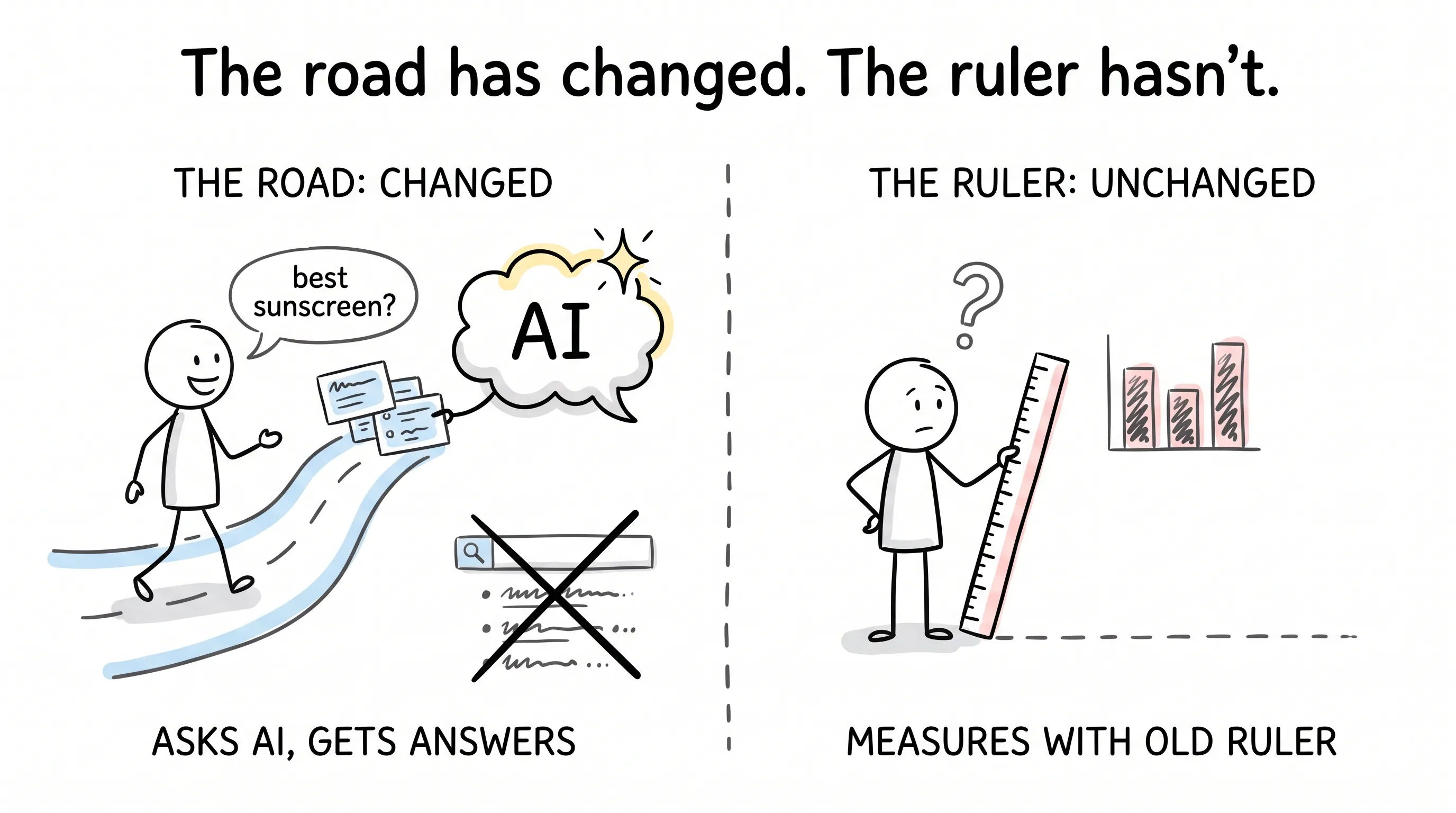
Before, when he had a need, he would open a search box, type in a few words, and dig through rows of blue links himself. Now, he asks the AI directly: recommend a sunscreen for sensitive skin. The AI hands him three answers on the spot — with the reasons summarized for him, too.
Before the consumer even walks out the door, the shopping guide's job has already been done by AI.
Just like that, the road has changed.
But the ruler in the advertiser's hand — the one that measures traffic and conversions — is still the old one.
They spend more money than ever, and the numbers make less sense than ever. That's the most awkward spot advertisers find themselves in today.
First, the Money
First, the money.
In January, IAB forecast that the US advertising market would grow 9.5% for the full year. By September, that number had been revised up to 12.3%.
The market is accelerating, budgets are growing. On paper, that's good news.
But think about it: while budgets keep going up, the steering wheel keeps getting looser. How consumers discover you, and what actually moves them to buy — AI is rewriting both, and you see it less and less clearly.
The more you spend, the blurrier it gets. That's why those 44% can't sleep at night.
What Are Advertisers Busy With?
So what is everyone busy with?
76% of marketers say this year's biggest effort is optimizing their own content so that AI answers will cite it. 72% are studying large language models, trying to make AI understand their brand better.
The interesting one is a different number: enthusiasm for using generative AI directly in media placements hasn't risen — it has fallen. In January, 78% were paying attention; by September, only 69%.
What does that tell us?
It tells us the center of gravity has moved. From "use AI to do work for me" to "make sure AI can see me."
Consumers are asking AI now. If you're not in AI's answer, you never even get onto the field.
The Most Dangerous Link: You Can't Measure It
So are these investments actually working?
That one question stops most people cold.
45% of advertisers say their worst headache is not being able to tell which purchase path — the AI-driven one or the traditional one — is actually bringing in business. 35% say it's hard to get consistent data on their brand's exposure and citations inside AI tools. And 30% say even the data on how much traffic AI sends them is missing, or unreliable.
So what to do? Wait for the platforms to get the measurement tools right?
Advertisers didn't wait. 86% are already changing how they measure, or plan to start within 12 months.
Changed into what? Honestly, it looks like patchwork:
48% go into AI tools again and again to count their brand's exposure and citations; 44% use brand search volume and direct visits as stand-ins, indirectly estimating AI's effect; 40% have bought third-party AI-discovery analytics tools; another 30% are doubling down on incrementality experiments (experiments that measure the lift a channel truly adds), and the same 30% lean on modeling to backstop it all.
And the old metrics haven't left the stage. Only 26% of advertisers have lowered the weight they give website traffic.
Do you see the picture now? AI hasn't taken the old ruler away. It has simply pushed a new one into your hands on top of it.
Both of your hands are now full — and both are measuring.
Money Is Still Flowing to New Places
The ruler hasn't caught up, but money won't wait for you.
IAB projects that commerce media — that is, ads that live on e-commerce platforms — will grow 13.6% this year, a step above January's forecast of 12.1%.
Why is it growing so fast? The report puts it bluntly: AI has shortened the distance between "seeing a product" and "buying it."
Before, from the first spark of desire to the placed order, there stood price comparison, searching, hesitation — it could take days. Now, somewhere mid-conversation, the order is done.
The shorter the road, the faster the money flows.
The Worse Trouble: Who's Walking Into the Store — People or Machines?
But there's a sharper edge to all this.
The consumer's path has changed. Changed by how much? Some of those "consumers" are no longer human at all.
27% of advertisers worry that among their own website traffic, bots and agents (autonomous AI that browse and act on a user's behalf) may already outnumber real people.
At the measurement stage, it gets messier still. 28% can't tell whether a visitor is a real person or a legitimate agent running errands for one; 33% can't tell legitimate agents apart from malicious bots and fraudulent traffic — who's who.
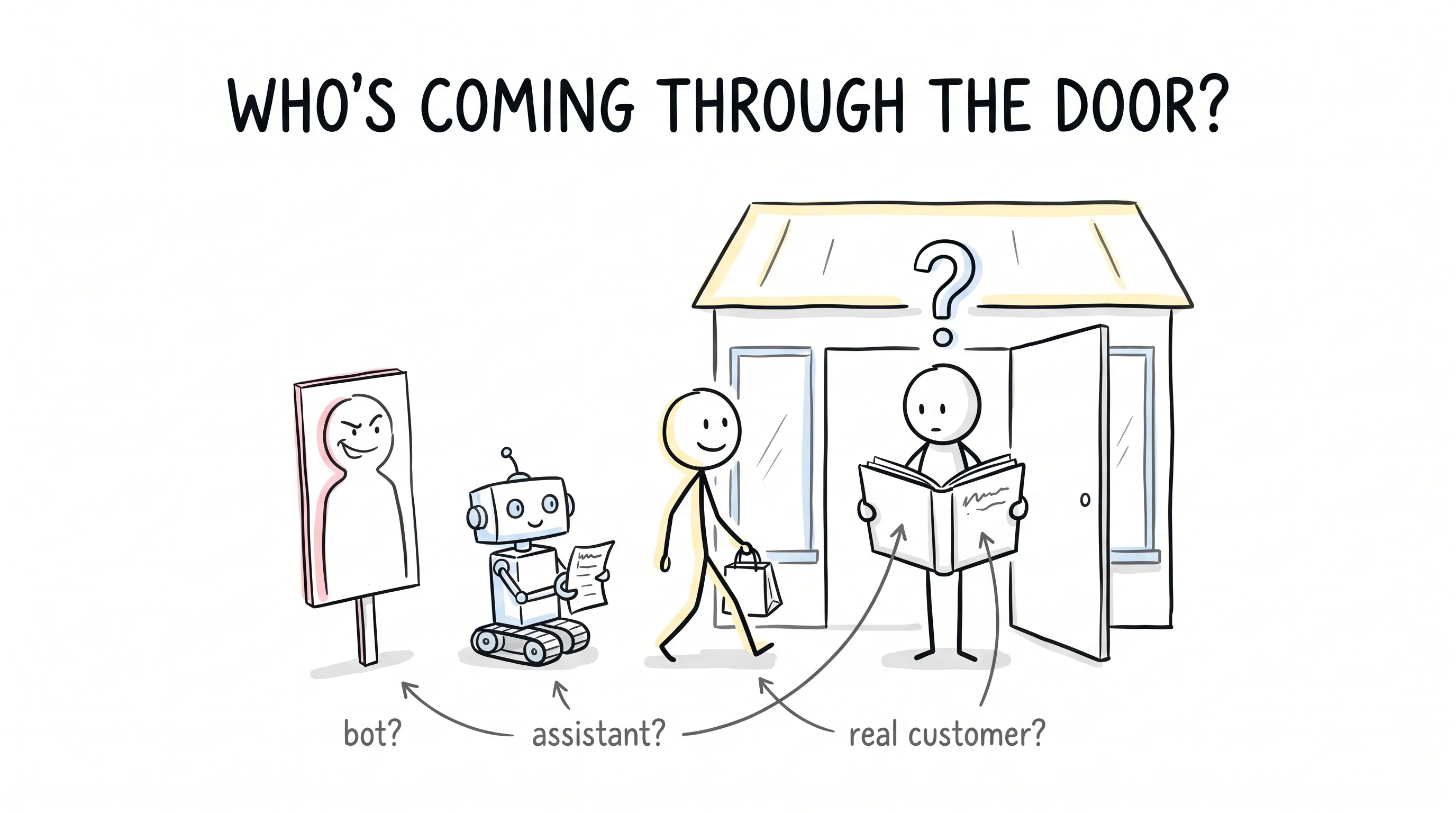
Picture this scene: your store is open, people coming and going at the door. Real customers. Assistants sent by customers to scout for them. And "cardboard cutouts" whose only job is to inflate your numbers.
And your ledger has to tell every one of them apart.
Finally
Looking back, the advertiser's situation today can be said in one sentence:
Consumers have followed AI into a new purchase journey. Advertisers have no choice but to follow them in — walking while trying to make out who's coming toward them: the customer in person, an assistant scouting the road for the customer, or a bot.
The road has changed.
The ruler is still on its way.
Whoever gets the new path measured first will grab the best seat on the day the budgets reshuffle.
Here's to getting that new ruler into your hands soon.
Continue reading
Related articles

Cross-Border Business: Time to Upgrade Your AI Toolbox
A learn article explaining how AI tools help cross-border e-commerce sellers clear five hurdles: language, regulation, logistics, payments, and fraud. It outlines a five-compartment toolbox, a five-step adoption path, and metrics such as conversion rate and CLV, while cautioning against over-reliance on AI.

AI Is Taking Over the Dirty Work of Social Media Marketing, One Task at a Time
This learn article outlines four social media marketing tasks AI can handle — audience analytics, content drafting and design, ad targeting and creative testing, and spam moderation — and cautions that taste, judgment, and data security remain human responsibilities.

AI Is Already This Good — Why Is Your Social Media Marketing Still Pure Manpower?
An overview of 18 AI tools for social media marketing, organized into six categories covering audience research, content creation, scheduling, comment and DM handling, ad management, and visual production, plus notes on personalization, prediction, and emerging trends.