
The Companies That Get AI Right Are All Doing These Six Things
A retelling of a talk by WPP's Chief AI Officer that sorts marketing friction into six AI application categories — task automation, content generation, audience modeling, prediction, optimization, and human augmentation — and argues companies will converge on building digital twins of the business.
A while back, I rewatched a talk from a little over two years ago.
The speaker was WPP's Chief AI Officer.
WPP is one of the largest marketing communications groups in the world — 120,000 people, all doing one kind of work: helping the world's best brand-builders spend money, make content, and place ads.
His job, in one sentence: make those 120,000 people actually use AI.
By rights, I should be sick of talks like this. First, how important AI is; then, how sexy the technology is; finally, a call to embrace change — and everyone goes home.
But this one was different. From start to finish, he never talked about technology. He gave a framework.
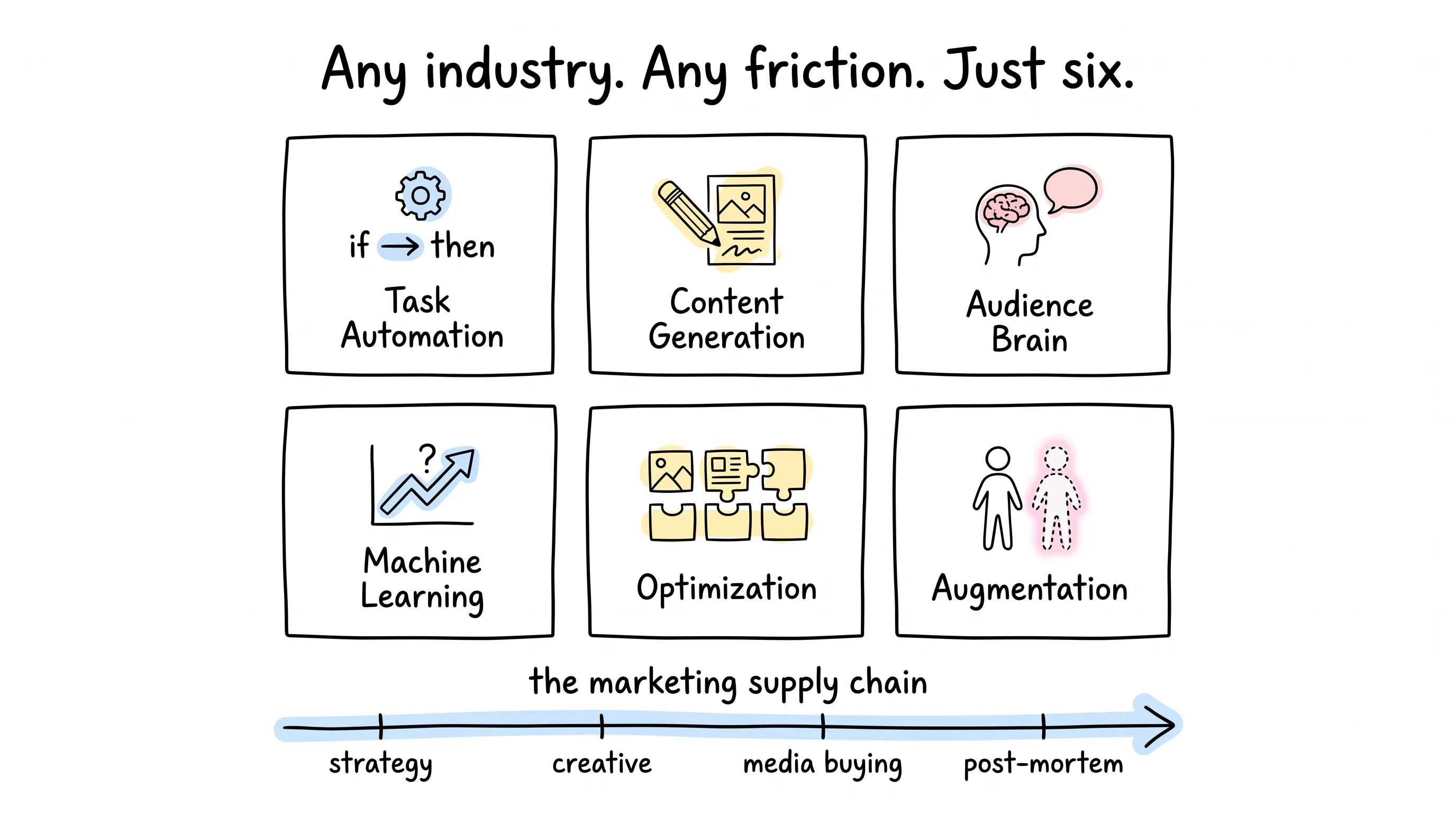
A framework so ambitious it bordered on arrogance. He said: any friction, in the supply chain of any industry, fits into six categories of AI application.
Any industry. Any friction. Just six.
My first reaction: that sounded like a big boast. But by the end, I realized he hadn't been boasting. He really took marketing — the most fiddly, most concrete trade there is — peeled it apart layer by layer, sorted everything into its slot, and every single slot landed on solid ground.
So here is that talk, retold for you.
First, a Correction
Before the framework, he corrected a concept: what exactly is AI?
The most popular definition: getting computers to do the things humans can do.
That, he said, is the most popular definition — and also the weakest one.
Why weak? Because we keep using humans as the yardstick. Humans are the smartest thing we know of, so by default, human-like equals intelligent.
But are humans really all that smart? That's a conversation we can't finish today. He offered a definition I find far more sophisticated:
Intelligence is goal-directed, adaptive behavior.
What does goal-directed, adaptive behavior mean?
You have a goal: a marketing budget — how do you spend it for the best return? You make a decision, see whether the outcome is good or bad, learn, adjust, and make the next decision better.
That loop is intelligence.
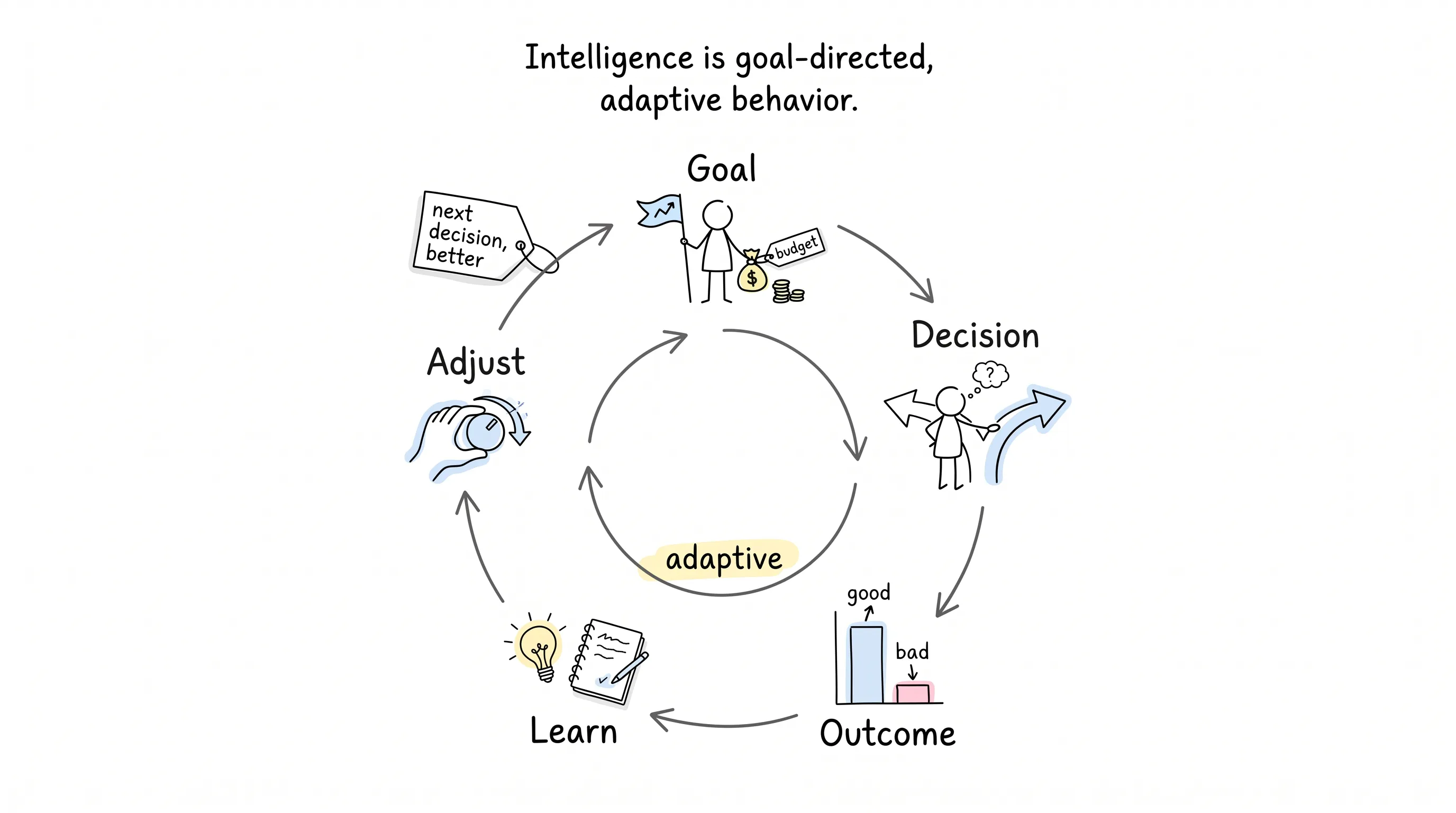
The key word is "adaptive."
But then he said something brutally honest: go looking in production environments, and you'll hardly find a truly self-adapting system. Because building a safe adaptive system is extremely hard.
Then came a short history of AI. Three acts.
Act one: the sixties and seventies. People wrote knowledge about the world into machines, rule by rule, and had the machines reason. The classic example: Socrates is a man; all men are mortal; therefore Socrates is mortal. Beautiful in theory. But the world's knowledge can't all be written down, and this road led nowhere.
Act two: the eighties and nineties. A different idea: stop writing rules, imitate the brain. The speaker's own PhD, more than twenty years ago, was exactly this — putting a bumblebee's brain into a machine.
How many brain cells does a bumblebee have? One million. The entire brain could stand on the tip of a pin. With just that many neurons, bumblebees can navigate a three-dimensional world, talk to each other, solve problems — and make first-rate honey.
Twenty years ago, a machine couldn't fit a million neurons. Today? Billions of them fit just fine.
Things with billions of neurons packed inside — today we call them large language models.
Act three: right now. Large models are powerful, and their power lies in two things: they know things about the world, and they can express what they know — in text, images, video, audio, all of it.
But they're still not very good at predicting, or at reasoning. Especially not at making complex decisions.
That one line alone is worth a fortune. Because most of the "using AI" attempts out there amount to carrying a hammer that can only talk, and wandering the world looking for nails.
So what's the right way to use it?
Read on.
Six Categories, One Story Each
Here comes the framework. He divided AI applications into six categories.
Marketing happens to be the perfect example, because everyone lives inside its supply chain: from strategy, to creative, to media buying, to the post-mortem — it's friction all the way down.
Category one: task automation.
The least glamorous of the six. If-then-else, macros, RPA (robotic process automation) — handing the repetitive work that humans do over to the simplest algorithms.
Not cool at all, right?
But his judgment: simple algorithms, placed in the right spot, deliver value to an organization so large it's frightening. Most people hear "AI" and fixate on large models — while a pile of work sitting right at their fingertips could be solved by the dumbest algorithms, and just sits there, untouched.
Don't fetishize new tools. First, give the work at hand to the dumbest algorithm.
Category two: content generation.
Today, anyone can get a large model to produce a poster or a line of copy. So he said: generic content is no longer the battlefield.
Where is the battlefield? Brand-specific, production-scale, differentiated content.
An example. You ask a general-purpose large model to make an ad for Milka — you know, the chocolate brand that's entirely purple. The model would probably luck its way into purple. But a century of accumulated tone, the details, that something you can feel but not explain — it doesn't get that.
How do you make it get it? He had a brilliant analogy.
A large language model is like a drunk graduate. He's got plenty in his head, but you never know when he'll be sober. The first way to make him smarter: shove a book into his hands — your brand guidelines, your product materials — and let him answer while flipping through it. That's RAG (retrieval-augmented generation), and you can build one in minutes.
But what if what you want is a brain that can actually produce the ad described above? Then you have to train, fine-tune, stitch several classes of technology together, and spend weeks.
What's the result? A professor.
From the drunk holding a book to the professor: the weeks in between are the moat that many companies couldn't buy even by burning money.
Category three: representation of people (modeling how real audiences think and feel). Internally, they call it the "audience brain."
Here's a question for you: when an ad goes out, which of your nerves does it hit?
You can't say. People have never been good at articulating what goes on in their own minds.
So marketing, as a trade, has been guessing from the very beginning.
But he said: for the first time in history, we can build a "brain" that simulates how people think and feel about a piece of content. These signals were never opened up before.
They're working with Coca-Cola. Massive data goes in; the system validates the audiences the marketing team thought it already knew, then surfaces the audiences it had no idea existed. And then those audiences become focus groups you can actually talk to.
There's an even finer version: regulations, different cultures, minority groups, ad compliance — all of them turned into "brains" too. Before content goes out, it runs through them once: does this break any law? Will it offend anyone?
Compliance, of all things, can grow into a brain.
But what really made me sit up straight was how these brains get used. You make them talk to each other.
Say you need to run an ad for Thanksgiving. What do you do? First, ask the "audience brain": what kind of Thanksgiving ad would you want to see? It hands you a scene description. You feed that description, word for word, to the "brand brain" as the prompt.
The brains have started talking to each other.
What does this playbook look like when assembled? They demoed the birth of an ad, live: an e-commerce detail page for a L'Oréal product. Pick an Amazon UK audience, pour in the review data, let the system understand how those people read content — one click generates a page that's almost ready to go live. Swap in a Spanish audience? It's not translation — you plug in L'Oréal's Spanish brain and re-understand that audience's nuances. Then move the page from Amazon to Instagram? As the layout reflows, the prediction brain will casually tell you how many likes and how many clicks this piece of content is likely to earn.
A brand brain, an audience brain, a prediction brain — meshed together.
Category four: machine learning. In media buying, they call it "prediction."
An ad featuring a black cat: you can predict its clicks, likes, and sales.
And then?
Machine learning's real power lies in the explanation that comes after the prediction. It tells you: swap the black cat for a ginger cat and every metric goes up — because these people love Garfield.
The speaker himself admitted it's a terrible example. But the point is crystal clear:
What companies lack has never been insight. What companies lack is decisions.
Prediction gives you a number. Explanation — that's what hands you the steering wheel.
Category five: complex decision-making. In other words, optimization — operations research, the oldest branch of AI.
The content is made — which channels do you put it in for the maximum return? That's a math problem.
How hard is that problem? He did the math on stage.
5 pieces of content, 5 channels: 120 ways to divide them up.
15 across 15 channels: a trillion.
60 across 60? More than the atoms in the universe.
And every single second, WPP is allocating thousands of pieces of content across thousands of channels.
So remember the line he handed out on stage:
Past seven, take the human out.
This category runs on operations research and discrete mathematics. Not large models, and not machine learning. Wrong tool, money burned for nothing.
Category six: augmentation of people.
This one sounds a bit unsettling.
For one of the world's top brands, they're doing this: training a separate large language model for every single person in the marketing department. Fed on what? That person's emails, calendar, and years of feedback.
Then you can ask this "digital double": put this person on this project — will they do the job well? On this team — will they thrive?
The speaker himself said: I know, this sounds a bit scary.
But the interesting part is the next sentence: the employees, surprisingly, welcomed it.
Because compared with a few cold fields in an HR database, this double feels more like "me."
More Important Than the Six: Three Doubles
At this point, the six categories are done.
But what sent a chill down my spine was another, bigger claim.
He said companies usually push AI in three directions. One: improving day-to-day efficiency — making PPTs a bit faster; the shallowest of the three. Two: using AI to solve the friction in your supply chain — everything I've told you today. Three: AI completely disrupting your own industry. Their group's CEO put it this way: AI will disrupt this industry sooner or later; rather than wait for someone else to do it to us, we might as well do it ourselves.
And looking deeper: whether you realize it or not, these directions all converge on the same move:
building a digital twin of your company.
What's a digital twin? A replica of the organization that you can run scenarios on.
Here's a question to give you the feel of it. I'm a retailer about to run a marketing campaign that lifts demand by 10%. Run the simulation: will any supplier fail to deliver? Is there enough staff at the warehouses and stores to keep the promises we made to customers?
The vast majority of companies can't answer. They don't even qualify to simulate.
So the first double is your business model. The second double is that layer of flowing resources — people, skills, cash flow, attention — and how they're allocated onto the business model. The third double is the back-office processes: hiring, exits, onboarding, expense reports. What AI does in these places isn't just making the process faster — it's a different way of doing things.
His judgment was emphatic: over the next decade, the companies that thrive will be the ones that build these three doubles — and fuse them into one.
He said this in 2024. Two-plus years later, the more I look, the more it seems he was right.
There's one more layer most people never think of: the six categories are also a safety map.
The governance questions you must ask for task automation and the ones for building digital doubles of your employees are not even in the same weight class. Through the digital double, you can even spot who's about to quit — before they know it themselves.
Same framework: to the left lies efficiency, to the right lies ethics. Whichever category of application you use, you have to be able to answer for the questions that come with it.
Finally
In the last minute of the talk, he mentioned in passing that these brains are converging into an end-to-end platform that handles marketing from start to finish, called WPP Open.
I won't expand on the platform. Platforms get replaced by the next generation; the framework doesn't.
What's really nailed into my head is that correction: intelligence isn't being human-like — it's goal-directed, adaptive behavior. And that ruler: past seven options, don't bother the humans.
Oh right, and one more thing, about sequence, for everyone out there "embracing AI": first see clearly what your friction is, then pick your tools.
Large models are not the only hammer.
Viewed from today, that 2024 talk hasn't aged a day — if anything, it looks more and more like a manual written ahead of time.
May your company find its own six slots, too.
Continue reading
Related articles

Cross-Border Business: Time to Upgrade Your AI Toolbox
A learn article explaining how AI tools help cross-border e-commerce sellers clear five hurdles: language, regulation, logistics, payments, and fraud. It outlines a five-compartment toolbox, a five-step adoption path, and metrics such as conversion rate and CLV, while cautioning against over-reliance on AI.

AI Is Taking Over the Dirty Work of Social Media Marketing, One Task at a Time
This learn article outlines four social media marketing tasks AI can handle — audience analytics, content drafting and design, ad targeting and creative testing, and spam moderation — and cautions that taste, judgment, and data security remain human responsibilities.

AI Is Already This Good — Why Is Your Social Media Marketing Still Pure Manpower?
An overview of 18 AI tools for social media marketing, organized into six categories covering audience research, content creation, scheduling, comment and DM handling, ad management, and visual production, plus notes on personalization, prediction, and emerging trends.