
The Ceiling for Marketers Just Moved
An interview-style article with HubSpot's Nicholas Holland discussing how AI became essential for marketers: feeding context and company data, fast image and video generation, customer and prospecting agents handling sales conversations, and opportunities in AEO and video content.
A few days ago, at HubSpot's annual conference, I collared an old friend of mine and talked with him for a solid half day.
His name is Nicholas Holland. He runs all of HubSpot's AI products.
I had come to hear him talk about new things. Instead, he opened with a bucket of cold water.
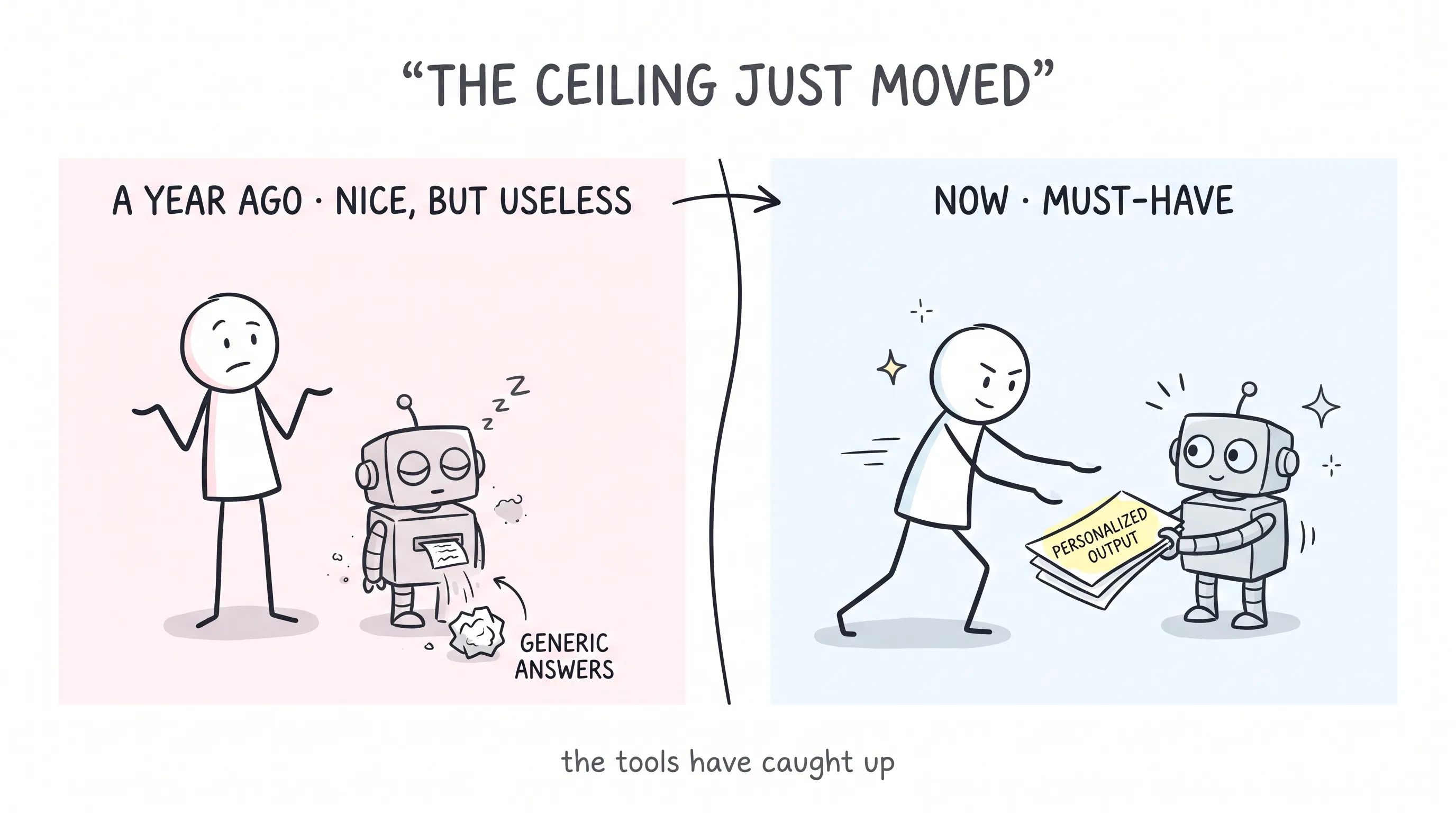
He said: a year ago, if you'd asked me about these AI marketing tools, my whole verdict came down to three words — nice, but useless.
And now?
Now it's a must-have.
What does that mean?
He meant that if you're still wondering whether AI can actually do the work, you're already behind. It crossed what most people would call "competent use" a long time ago. While you hesitate, it has run far ahead.
Now only two things can hold a marketer back: your creativity, and your ambition.
That day, the more I turned the conversation over in my head, the more I felt it deserved to be told. Where to begin?
Start with the one word he kept coming back to.
This Year's Keyword Is Context
I asked him: after a full year of building AI products, what do you think matters most?
He didn't hesitate: context. He said it was the word he had picked for 2026, and now, most of the way through the year, it has played out just about as predicted.
What is context?
He said: think about it. If I walked into your company to work tomorrow, I'd know nothing on day one. How long would it take you to train me?
You'd have to teach me what kind of company HubSpot is, teach me how we do marketing here. Six to twelve weeks, at minimum.
AI is the same.
However smart it is, it doesn't know you and it doesn't know your company, so what it gives you will always be generic answers. If you want real work out of it, treat it like a smart new hire and teach it, bit by bit.
Teach it what? Your business data, your CRM, your files, your PDFs, your brand guidelines, and all those marketing playbooks buried on your hard drive.
When they built the Breeze assistant, they slammed into this wall at the very start.
For a while, AI-written blog posts came out badly. The team dug in: the prompts were written fine. They checked again — still fine. So where was the problem?
The problem was that it didn't know this company.
No matter how beautiful the prompt, without context what comes out never quite lands. Eventually they went and built an entire product layer dedicated to context, so the AI could "read" the company's own material.
Nick (everyone calls him that) said the lesson drilled a habit into him. Now, when evaluating a requirement, he has his team answer one question:
Convince me that AI can't do this thing.
Note that the direction is reversed: first prove it can't be done.
With that question, the team has to break the AI's capabilities into building blocks and test them one by one. Test to the end, and either you find something it genuinely can't do (which is usually exactly where context is missing), or you discover that those blocks, snapped together, can do things you wouldn't have dared to imagine.
Beautifully put. That's product thinking — and marketing thinking, too.
13 Seconds
When we got to image and video models, Nick lit up like a kid. He told me a story.
On a Photoshop forum, people often post asking for help: edit this image for me.
One person posted a photo of a couple kissing, with an old movie billboard in the background. What did he want? He wanted the text on the billboard changed to his own wedding date.
A pile of people on the forum hunched over their edits to help, with tutorial threads stretching on and on.
Nick saw it, tossed the image into Google's Nano Banana image model, and typed one line: change the billboard to this date.
13 seconds.
Done. And the result was really good.
He didn't stop there. He fed the image into Google's Veo 3 video model. This time it got even better: he typed only two words — surprise me.
The model made up its own scene: the couple is kissing, the girl lowers her leg, they both stand up and smile at each other.
Another 13 seconds.
I had exactly one reaction: wow.
Think about what that means. In the past, a job like this required either knowing how to edit photos yourself or paying someone who did. Now: one line of text, a dozen-odd seconds. Even Super Bowl–caliber ads are starting to appear that are made with AI end to end.
Nick has an analogy I especially love.
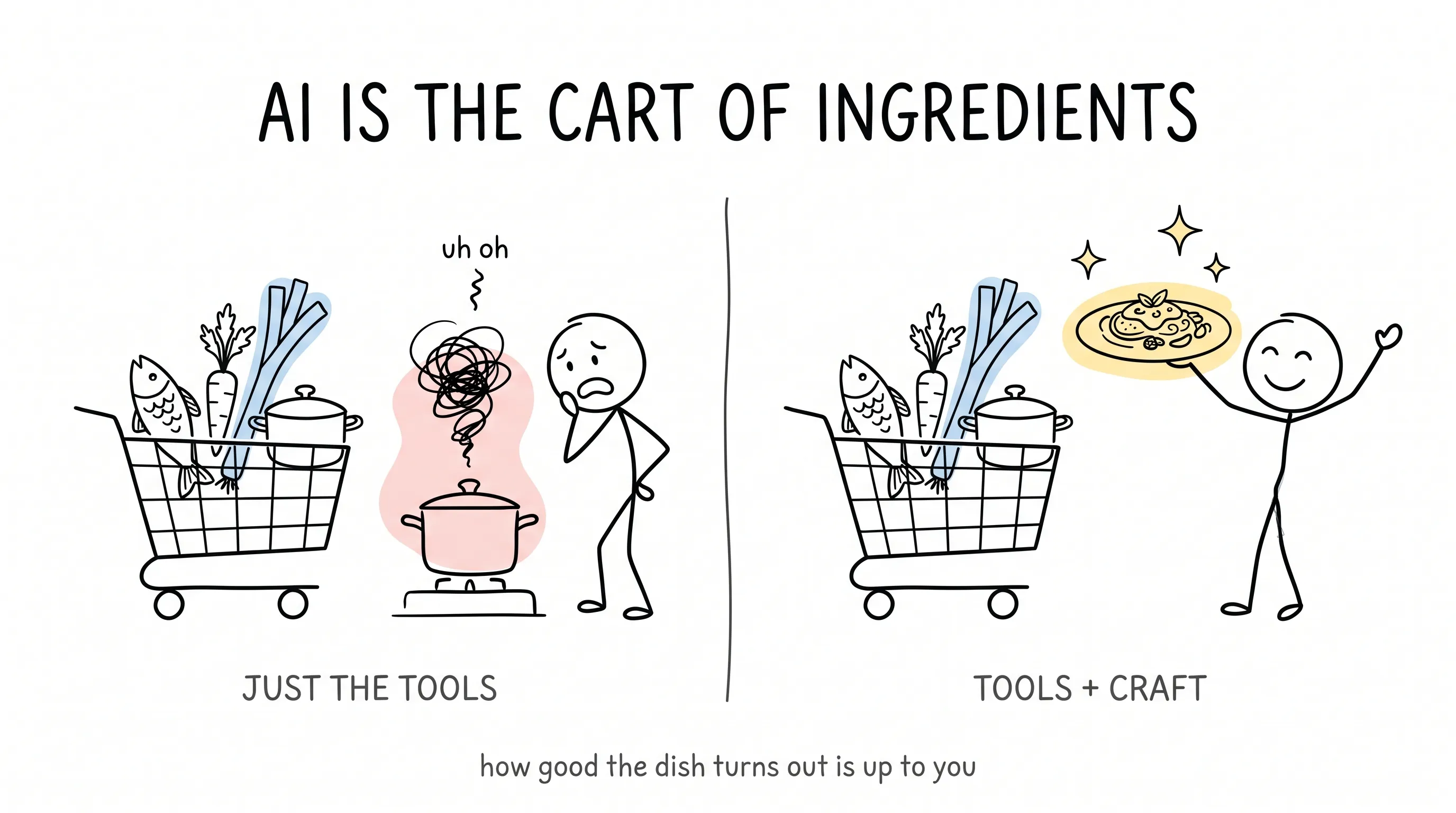
Take the same cart of ingredients to the supermarket: what Gordon Ramsay cooks and what you cook — one is heaven, the other earth.
Is the difference in the ingredients?
The difference is in the craft.
AI is that cart of ingredients. Everyone has it now. How good the dish turns out is up to you.
Muscle Is Built, Not Born
So what do you do? How do you train the craft?
Nick told me about a personal quirk of his, and I wrote it straight into my notebook.
He takes his kid to a ballgame, snaps a photo on the spot, drops it into ChatGPT or Breeze, and asks: how would you describe this picture?
Then he writes down the AI's description, goes into an image model, and, following the description alone, "reproduces" the photo.
Then he checks how far off the result is.
Why do it this way?
He says: think about public speaking. His daughter is 11; she gives a speech on stage. He gives a speech on stage. Obama gives a speech on stage. All three look like they're speaking, and the gestures all look about the same.
But the gap between them is heaven and earth.
Where does it come from? From massive amounts of invisible practice and polishing. Same with AI. The same model sits there for everyone; some people can squeeze ten points of ability out of it, and some can't even get three.
So Nick set himself a rule: practice on a schedule. Reproduce images, reproduce videos — train your AI muscles the way you'd train at a gym.
He even ran a harsher number by me.
Take the hundred best ads in the world, reverse-engineer them one by one, break down their creative logic, and practice along the way.
After a year, your creative level would very likely surpass 99% of people.
No eye-wateringly priced creative courses. A hundred ads, one AI, one year.
Marketing Starts Eating Sales
The main event of the afternoon was agents.
Nick walked me through a detour his own team took, and it was fascinating.
At the start, when HubSpot put a chat component into its product, the idea was simple: anyone who starts a chat must want to buy something. It launched — and flopped badly.
They turned around and repositioned it as a customer service tool.
A few years into customer service, something looked off again. Plenty of users were doing things with it that had nothing to do with "filing a ticket." For example, someone would ask: why can't I send emails? They checked — because you never bought that product.
Is that a customer service problem, or a sales problem?
Impossible to say.
Later they shipped a customer agent, one that could handle both customer service and pre-sales. The moment it opened up, something interesting happened.
One customer told Nick: I've noticed that the visitors asking questions aren't idle troublemakers — they're doing their homework. Asking the agent saves far more effort than clicking around our site navigation. This customer said: I don't have data to prove it, but I believe it in my bones: without this agent, these people would have long since gone off to a competitor to find their answers.
Why are people willing to chat with an agent but not with a real person?
Nick's own experiment supplied the answer.
They had tried putting an AI avatar on their website — you could talk to it, you could type. They found that the average conversation with a human service rep ran under 4 minutes; with the AI avatar, 8 minutes — double.
At first he wondered whether slow AI answers were dragging out the time.
Then it clicked: it's pressure.
A human service rep carries a quota, and only booked meetings count. You ask one question, and they warmly take it: great question! Want to book a meeting to talk about it? At that point your heart sinks a little.
With an agent there's none of that weight. Ask the dumbest question you like. Why is this so expensive? What does this acronym mean? How does this thing actually work? You would never ask a real person any of these — you'd be embarrassed.
Where there are no dumb questions, people actually speak up.
The more interesting part was still to come.
Today's customer agent doesn't just answer questions; it can identify leads and qualify them, and if the visitor is willing to talk, it books them straight onto sales' calendar.
And what if the visitor says: I don't want to meet anyone right now?
In the past, that deal was dead.
Now, the agent packages up the whole conversation and hands it off to another agent, a prospecting agent (the lead-nurturing agent). It takes the chat history, goes off to study the company, and comes back after a while to follow up.
One agent handing the work to another agent.
Nick said that at the time his judgment was that agent-to-agent handoffs would be one of the biggest themes of the coming year. Looking back now, it's proving out one case after another.
Behind this hides a bigger shift: marketing is starting to eat the sales process, little by little.
The work sales never liked doing — follow-ups, nurturing, answering questions — marketing is now taking over with agents. Tell the sales team, I'll fill up your meeting calendars, you just focus on closing — they couldn't wish for more.
My takeaway was one line: the sales role needs rethinking.
Nick added that the SDR (Sales Development Representative) role was hard to begin with. A new hire comes in and gets planted on the phone for a year; only after grinding through that do you earn a real sales seat. Like a boot camp.
If marketing can take this stage over at scale, the whole playbook has to be rewritten.
White Space, White Space Everywhere
By this point, I asked Nick: having seen so many customers, where do you think the biggest opportunity is right now?
He answered in two words: white space.
Two years ago, every crack in the marketing world was packed solid, every inch demanded a fight to the death. The performance-marketing playbook meant scraping away all year long for 0.3 of a percentage point in conversion rate — scraping until you couldn't breathe.
And now?
New channels keep sprouting up, one crop after another. AEO (Answer Engine Optimization — optimizing content so AI answer engines cite it) is upending traditional search, the creator economy is growing new plays, AI has smashed the cost of images and video to the floor; even old channels like Instagram and YouTube have become more cost-effective than ever.
They're running the experiment themselves: the same ad, one group shot the traditional way, one group made with AI. He told me with a smile: the AI group will most likely win.
There's a subtler shift I want to tell you about separately.
For the past 15 years, the marketing industry has had a huge information gap: the information the world needed far exceeded what had already been produced. So companies wrote articles and made content desperately, shoveling material into the gap. LLMs have all but filled that gap in.
But what about video?
On the things people genuinely care about, video is still far from enough.
The gap remains, and AI happens to have just crushed the cost of making video. Over the next 5 years, you will see a flood of video.
Even B2B will change. B2B companies used to keep a straight face and only make "informational" videos; entertainment was B2C's business. Nick says that wall is about to fall too. Entertainment will become just another legitimate engagement channel on social platforms. You can imagine B2B soap operas; imagine B2B horror series. Someone once made a parody ad skewering various B2B software products, turning each product's pain points into jokes, and it went insanely viral. From now on, this kind of thing will be standard practice.
Finally, he painted me a picture, and after hearing it I went silent for several seconds.
Say you're an enterprise-level company with a hundred target accounts. In the past, the most you could do was send each one a template email.
And now?
With AI, you can make, for those hundred companies, one dedicated podcast episode for each. Deep research, three hours long, polished production, the content centered entirely on that one company.
A few months. Done.
After it's done, sales takes that episode and knocks on the door: hey, we made this episode just for you — have a listen.
Would anyone turn that down?
Nick says: don't fixate on grabbing the number-one spot in an existing lane — that's the old map. The rules have changed. In the new game, the way you win is to set the rules yourself.
The Shackles of Free
Toward the end of our talk, I figured that was the whole day. Then Nick said: wait, one more thing — about my son.
His son is in the first year of high school and wants to start a little business: teaching the neighborhood's young kids to play American football.
Father and son sat in the car, with Gemini's voice mode on, talking through how to get this thing going.
How to price it? How to recruit students? Breaking it down step by step, at the very bottom they found: we need some promotional materials.
The kid tried to make them himself with the free version of Gemini, couldn't produce them, got furious, and concluded the tool was simply no good.
Nick said that in that moment he saw it clearly: it wasn't the tool that was failing — it was the free tier's ceiling, blocking the kid. Having never seen the stronger version, the boy assumed the mountain was only this tall.
He pulled out the paid version; within minutes the materials were made, and they looked great. Once they went up on Facebook, his son's little "coaching class" actually got off the ground.
He tells this story to people often. The difference in tools becomes the ceiling of a person's vision. Whatever level of capability you have been exposed to determines how big a thing you dare to imagine.
So the last point he wanted to make is wonderfully plain:
This is an era that demands you build muscle like mad.
Build to what degree? Build until the moment you turn back and see that most complex billboard, that most powerful ad, and your first reaction is: how do I reproduce it?
Not: I can't do that.
That day, we said goodbye at the venue entrance. What kept spinning in my head was his opening line.
A year ago, AI was nice, but useless.
Now, it's a must-have.
The tools have caught up. What's left is whether your imagination dares to reach up for it.
And above all, I wish you this: may your own imagination never be the ceiling.
Continue reading
Related articles

Cross-Border Business: Time to Upgrade Your AI Toolbox
A learn article explaining how AI tools help cross-border e-commerce sellers clear five hurdles: language, regulation, logistics, payments, and fraud. It outlines a five-compartment toolbox, a five-step adoption path, and metrics such as conversion rate and CLV, while cautioning against over-reliance on AI.

AI Is Taking Over the Dirty Work of Social Media Marketing, One Task at a Time
This learn article outlines four social media marketing tasks AI can handle — audience analytics, content drafting and design, ad targeting and creative testing, and spam moderation — and cautions that taste, judgment, and data security remain human responsibilities.

AI Is Already This Good — Why Is Your Social Media Marketing Still Pure Manpower?
An overview of 18 AI tools for social media marketing, organized into six categories covering audience research, content creation, scheduling, comment and DM handling, ad management, and visual production, plus notes on personalization, prediction, and emerging trends.