
The CDP Market Has Been Rebuilt From the Ground Up
An essay recounting a dinner with BlueConic's CEO on how AI rebuilt the CDP market: outcome-first deployment, agentic CDP vs agent-washing, true personalization, first-party data foundations, and end-to-end M&A.
A few days ago, I had dinner with an old friend.
She has spent more than twenty years in enterprise software — stints at LinkedIn and Hootsuite — and today she runs a customer data platform company called BlueConic. Her name is Melissa Murray Bailey.
Halfway through the meal, I asked, casually: anything worth talking about in the customer data world lately?
I expected her to walk me through products and features.
Instead, she set down her chopsticks, thought for a moment, and said: this market has been torn down and rebuilt, almost from scratch, over the past year or so.
I blinked.
CDP had been the marketing world's buzzword for years. How did it suddenly get "rebuilt"? Who tore it down? And what are they building in its place?
That dinner was a joy to sit through. Back home, while it was still hot, let me pass on what I managed to understand.
First, What Exactly Is a CDP
What is a CDP? Customer Data Platform.
Put simply: one big pool of customer information.
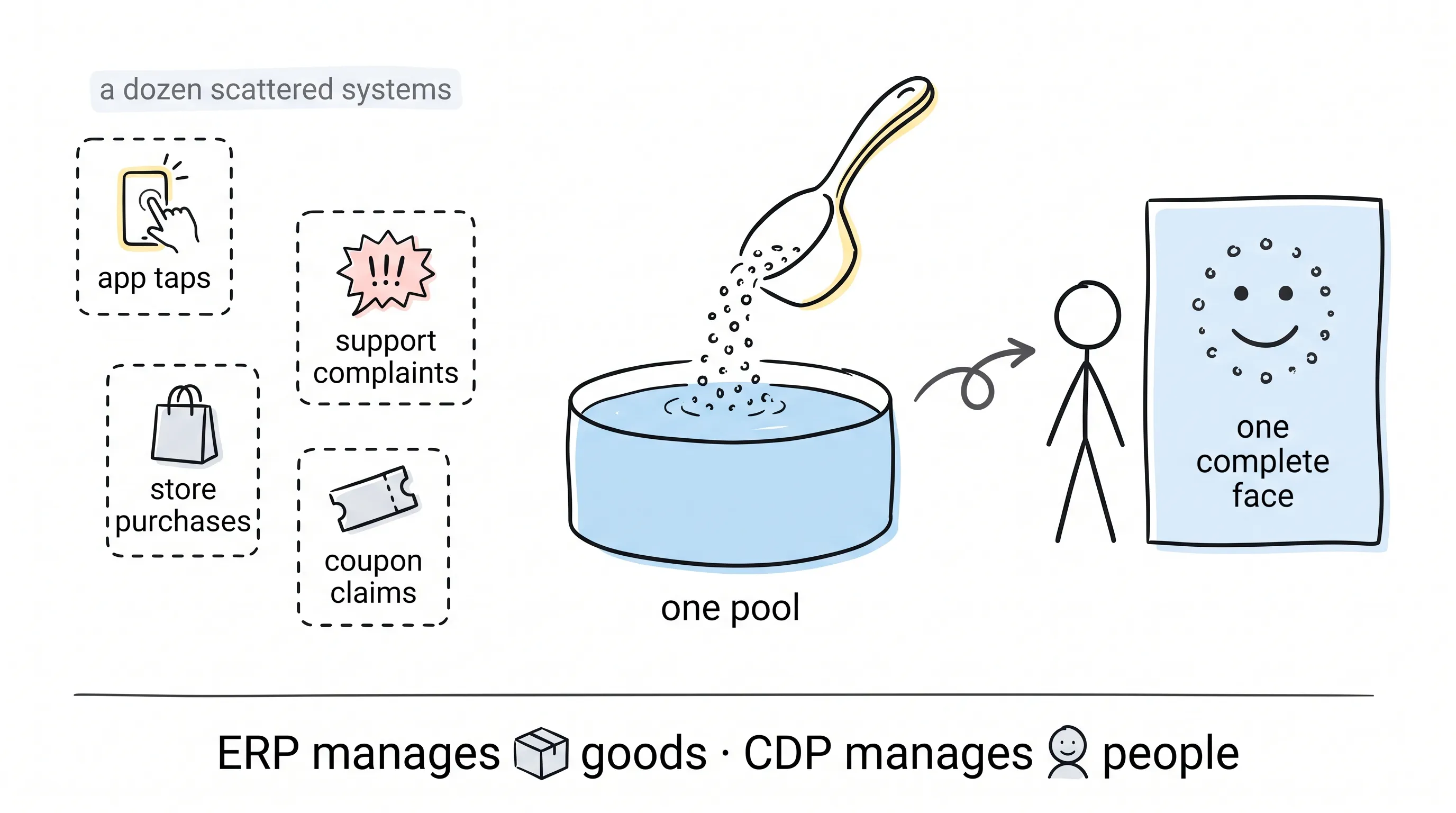
What a customer tapped in your app, what they bought in your store, what they complained about to support, which coupon they claimed. These fragments used to be scattered across a dozen systems, none of them recognizing the others.
What a CDP does is scoop those fragments into one pool and assemble, for each person, a complete face.
If that still doesn't land, here's a reference point: ERP.
ERP manages goods. CDP manages people. Goods are the foundation of a business. So are people.
That's the concept. But go look at this market's history, and you'll notice something: when many companies talk about CDPs, you catch a complicated look in their eyes.
Why?
Because of the scars.
Where the Scars Came From
What did it take to deploy a CDP in the old days?
Millions of dollars up front, projects running two or three years. Cross-department alignment, data cleansing, system integrations — every single one unavoidable. Then, on launch day, the boss asks: is the business doing better?
Nobody in the room answers.
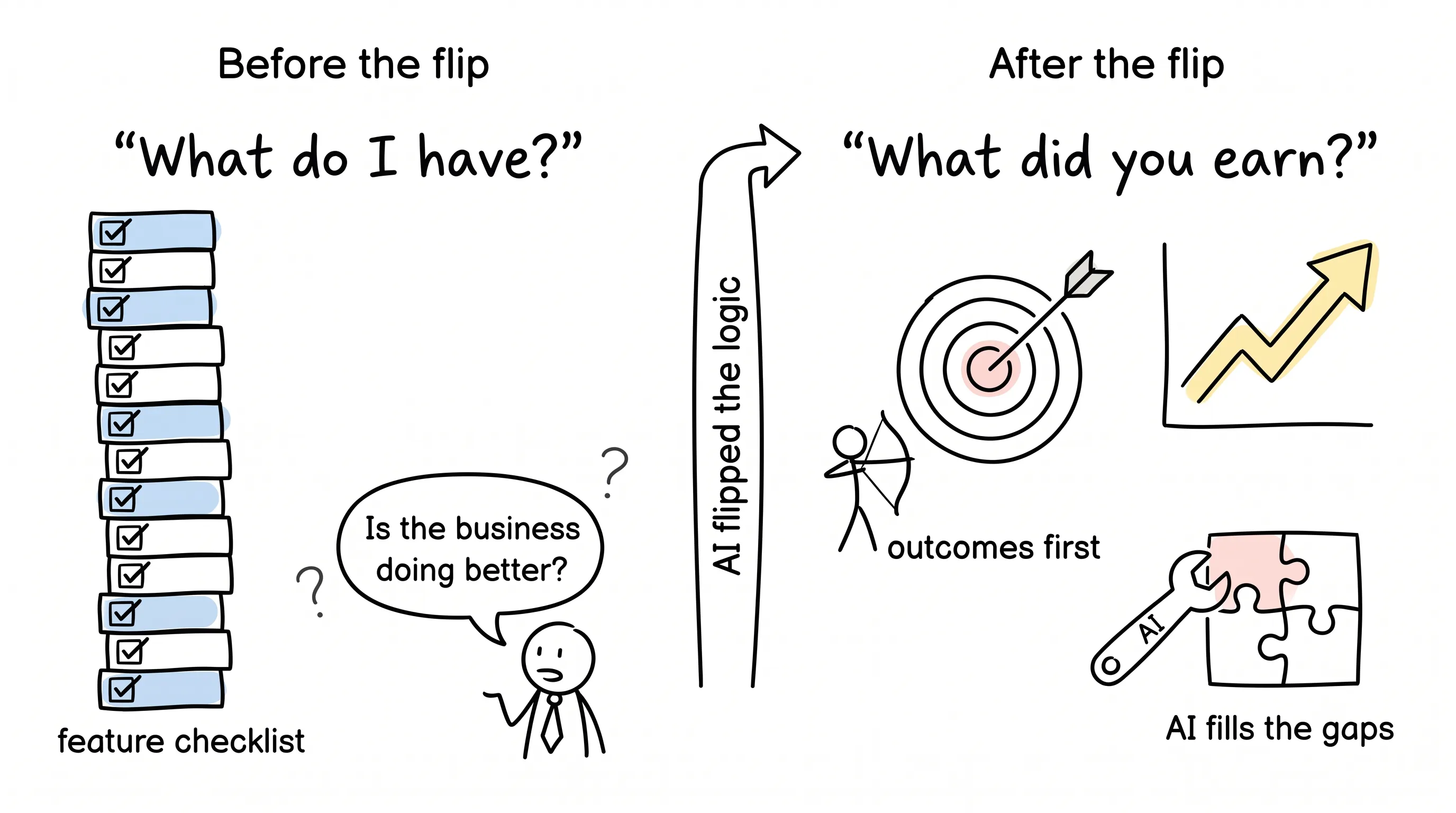
Why does this happen? Because from day one, plenty of these projects were aimed at a feature checklist: does it have this module, can it connect to that system. Checklist complete, acceptance passed.
But features are built to impress systems; business is won from people.
Not one extra order from a customer, and millions of dollars went up in smoke. Given time, many companies' CDPs grew into an expensive "data graveyard": everything piled up in there, and nobody ever built a house on top.
Pile on the data silos that never quite got connected, and you have an industry carrying a mountain of old debts.
So why rebuild now, of all times?
Because AI has entered the picture.
AI Flipped the Old Logic
Melissa said the biggest force behind this rebuild is AI. It flipped the old deployment logic entirely.
Before the flip: stack up features first, talk business later.
After the flip: lock onto outcomes first; whatever's missing, let AI fill in.
In one line: the question changed from "What do I have?" to "What did you earn?"
That sounds easy to say. But think about it: a market spoiled by feature checklists, daring to swap its acceptance test from "are the features all there?" to "is the business growing?" — that is quite a turn.
"Agentic," or Agent-Washed?
Once you talk AI, you can't dodge a hot word: Agentic CDP.
There's a lively spectacle in software right now: the boss issues an order, everyone scrambles onto AI. Vendors rewrite their product manuals overnight, tack an "Agent" onto the end of every module, change the name, swap the packaging — and presto, they call themselves agentic.
Melissa calls it agent-washing.
But having "Agent" in the name and being a real agent are two different things.
A real agent is born into the product while the foundation is being poured. It reads the data on its own, makes its own calls, adjusts things with its own hands. You just state the goal.
The washed version? More often than not, it's a chat box slapped next to an old button.
One is family. One is a sticker. Use both for three days and you'll know the difference.
Something We've Chased for Decades Is Finally Within Reach
So what is one thing AI can actually get done for marketers?
Melissa pointed at one: personalization.
Marketers have chased personalization for decades. But look at what most companies actually hold under that label — it's a broadcast station: split customers into a dozen segments, send each segment a pre-written email on schedule. A thousand faces for a thousand people, promised; ten faces, delivered.
With AI, the game changes.
Segmentation can be nearly infinite. Adjustments can happen in real time. You browse late at night and don't buy; the message you receive the next morning is no longer the same one you got last month.
Of course, all of it rests on the foundation.
Melissa stressed it again and again: the first-party data foundation has to be poured first. Foundation solid, AI has room to work. With both in place, the personalization marketers have recited for decades finally has a shot at coming true.
Creepy, or Helpful?
But once personalization gets this far, an old question is bound to surface.
Can customers stomach it?
Ever had this experience: you just finished telling a friend you're thinking about running shoes, you open a shopping app, and the whole screen is running shoes. In that instant, did you feel genuinely cared for — or a chill down your spine?
That's the classic dividing line: creepy, or helpful. Bone-chilling, or genuinely useful.
Where is the line?
Melissa's answer is plain: helpful is the ultimate test.
My own gut says the technology is identical, the feel is worlds apart. You're hesitating over an order, and it reminds you the price dropped fifty bucks this week — that's helping. You mentioned something in passing, and it shows up at your door with a quote — that's eavesdropping.
When it helps, it's personalization. When it spooks, it's surveillance.
Buy a Company, Buy the Whole Chain
Back to the business itself. These past two years, one more spectacle in this space: acquisitions everywhere.
BlueConic, the company Melissa steers, recently bought Jebbit, and then Blueshift.
Why buy?
She said: to offer the whole chain. Collecting customer data at the front end, then using that data to engage customers at the back end — that used to be several companies' jobs. Now it's twisted into one, end to end, a closed loop.
Let me offer a metaphor: you used to sell buckets — haul the customer's data home, and your job was done. Now the entire chain, from drawing the water to handing you the glass, is connected. You're thirsty; warm water arrives in your hand.
The market is putting real money on the table, which tells you one thing: selling one segment of the pipe is no longer enough. Customers want the answer from start to finish.
The Biggest Lie
Near the end of that dinner, I asked her the question I'd been saving:
In the marketing industry, what's the biggest lie the industry tells itself?
Her answer is written in my notebook. And I've hazarded one of my own:
"I know my customers well."
How many companies pound their chest and say exactly that.
But go ask Sales: is the data accurate?
Go ask Support: are the profiles complete?
Then go ask the customers themselves: do you feel understood?
Ask those three questions, and in most cases, the lie exposes itself.
On the Ride Home
On the way back, I kept thinking about that dinner.
Every time technology rebuilds a market, it is really paying down history's debts. What this wave of AI is paying off is the old bill run up by years of "heavy on features, light on results."
And once the debt is cleared, things get simpler: treat customers as living people, not as a row of data.
And I wish you this: the next time you press "send," the instant your customer sees it, the thought that crosses their mind is — this company really gets me.
Continue reading
Related articles

Cross-Border Business: Time to Upgrade Your AI Toolbox
A learn article explaining how AI tools help cross-border e-commerce sellers clear five hurdles: language, regulation, logistics, payments, and fraud. It outlines a five-compartment toolbox, a five-step adoption path, and metrics such as conversion rate and CLV, while cautioning against over-reliance on AI.

AI Is Taking Over the Dirty Work of Social Media Marketing, One Task at a Time
This learn article outlines four social media marketing tasks AI can handle — audience analytics, content drafting and design, ad targeting and creative testing, and spam moderation — and cautions that taste, judgment, and data security remain human responsibilities.

AI Is Already This Good — Why Is Your Social Media Marketing Still Pure Manpower?
An overview of 18 AI tools for social media marketing, organized into six categories covering audience research, content creation, scheduling, comment and DM handling, ad management, and visual production, plus notes on personalization, prediction, and emerging trends.