
The Buyer's Wallet Is Already Out — Your Process Is Still Stuck in Approval
Buyers use AI to shortlist software before ever talking to sales, yet evaluation is now the slowest stage and internal approvals stall deals. What G2 and Cleverbridge data reveal about self-service checkout, when buyers want sales involved, and why money at the bottom of the funnel has no owner.
A few days ago, I read two reports back to back, and the more I read, the more off-kilter everything felt.
One was G2's 2026 Buyer Behavior Report, about how buyers buy software. The other was Cleverbridge's The Cost of Selling Software, about how sellers sell it.
Put the two together, and the picture is fascinating:
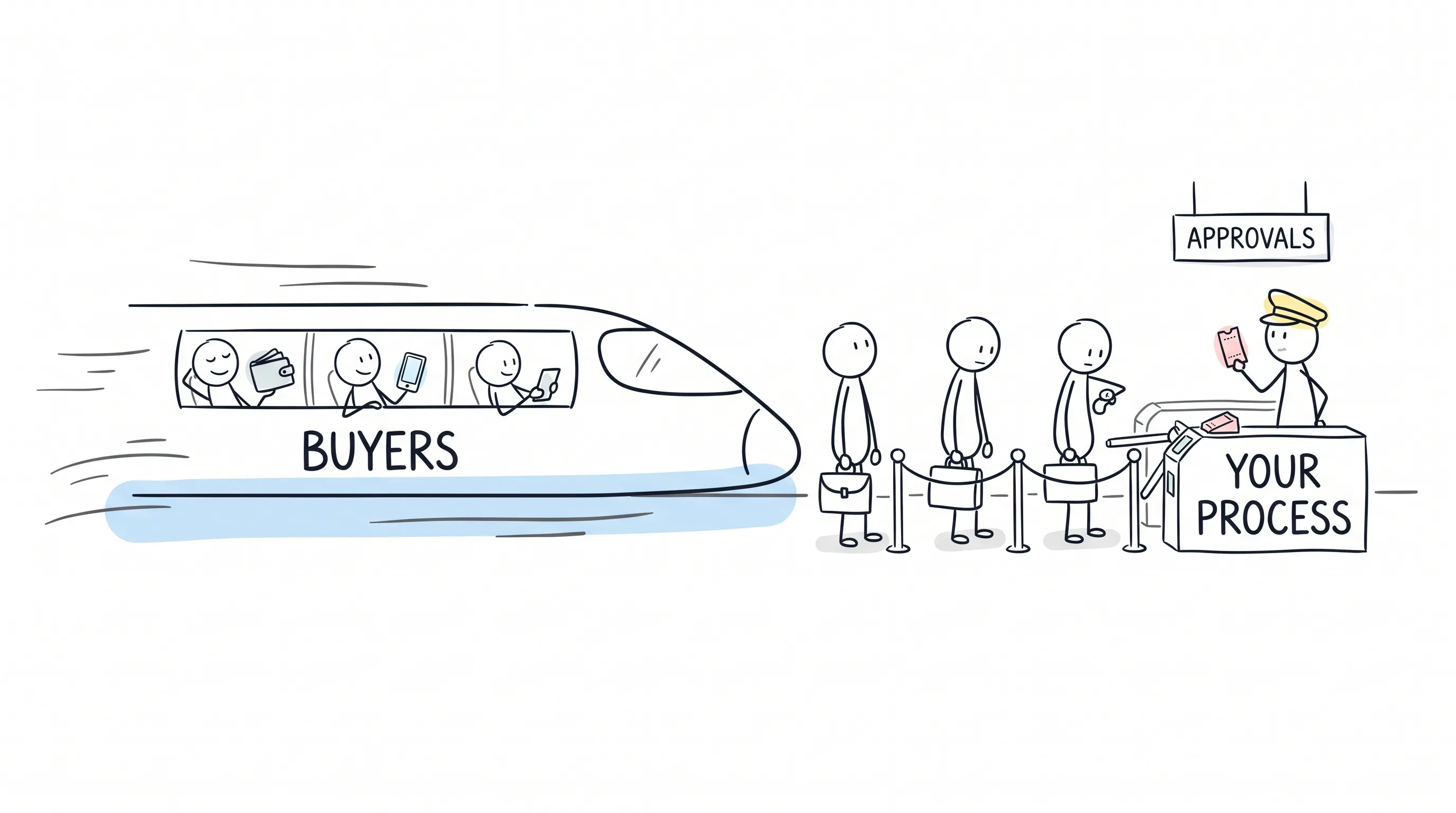
The people buying software have already boarded the high-speed train.
The process for selling it is still on the platform, checking tickets one by one.
Buyers Have Already Run the First Half on Their Own
Start with the first half.
G2's data shows that over the past two years, more than 80% of software buyers have used AI chatbots to help them pick software. Nearly half say the moment AI influenced their decision most came during shortlisting and evaluation.
What does that mean?
It means your potential buyer may have talked things over with an AI for a dozen rounds before ever meeting you. That shortlist of theirs? Chances are the AI drew it up.
The next number is even more brutal: among buyers who used AI for recommendations, 80% closed at least three of their last five purchases from the shortlist. Those who didn't use AI? 65%.
What's a shortlist? The handful of vendors the AI circled at the very start.
Make the list, and you've basically made the finals. The players outside it never even get to take the field.
So the smart sellers have started running ahead: stuffing pricing logic, ROI calculators, customer stories, and free trials into the first half of the buying journey. The direction is right.
The Bottleneck Didn't Disappear. It Moved.
Where did all that saved time go?
G2 found that 40% of buyers say evaluation is now the most time-consuming stage of the entire software-buying process. A year ago, that figure was 36%. Research comes next at 36%, and actually making the final call accounts for just 22%.
It's staggering. An AI can produce a candidate list in seconds — yet none of the time was saved. It all piled up in evaluation.
Does it end once evaluation is done? No. After picking a vendor, the three biggest sources of delay are: security review, 39%; budget approval, 32%; and implementation planning, 25%.
Finance has moved in early, too. Its presence on buying committees jumped from 31% to 46% in a single year. And 49% of buyers say their CFO has overruled a purchase the team had already approved.
Then there's this: three in four buyers expect positive ROI within six months of signing.
Picture what that means. On the buyer's side, everyone has a foot on the gas.
But floor it all you want — the car still can't get out of the garage.
People Ready to Pay Are Stuck at the Checkout
Cleverbridge's report has a number: nearly three in four buyers admit a software purchase has been significantly delayed — or abandoned outright. Two culprits: internal approvals, and back-and-forth with the seller.
36% got stuck waiting for a quote. 30% got stuck haggling over terms.
In the end, only 45% of buyers can complete a routine software purchase within three business days. A quarter wait more than a week.
You know this experience: at the supermarket, you scan and pay yourself and walk out in 30 seconds. But what if the line at the checkout never gets any shorter?
In buyers' minds, buying software became self-checkout a long time ago. 93% say that if company policy allowed it, they'd happily use self-service digital checkout for routine software. 84% flat-out prefer the self-service path.
Some will say: self-service, sure — but that's for the small stuff.
Quite the opposite.
More than half of buyers are willing to see a routine purchase of $25,000 or more through on their own. 17% would go it alone even past $100,000.
And it's not just new purchases. Two-thirds will handle renewals, upgrades, and plan changes through self-service; 54% will do the same for seat expansion; even for a brand-new purchase, 44% want to handle it themselves.
In buyers' minds, "routine" stopped meaning "small-ticket" a long time ago. It means "I can do this myself."
And on the seller's side?
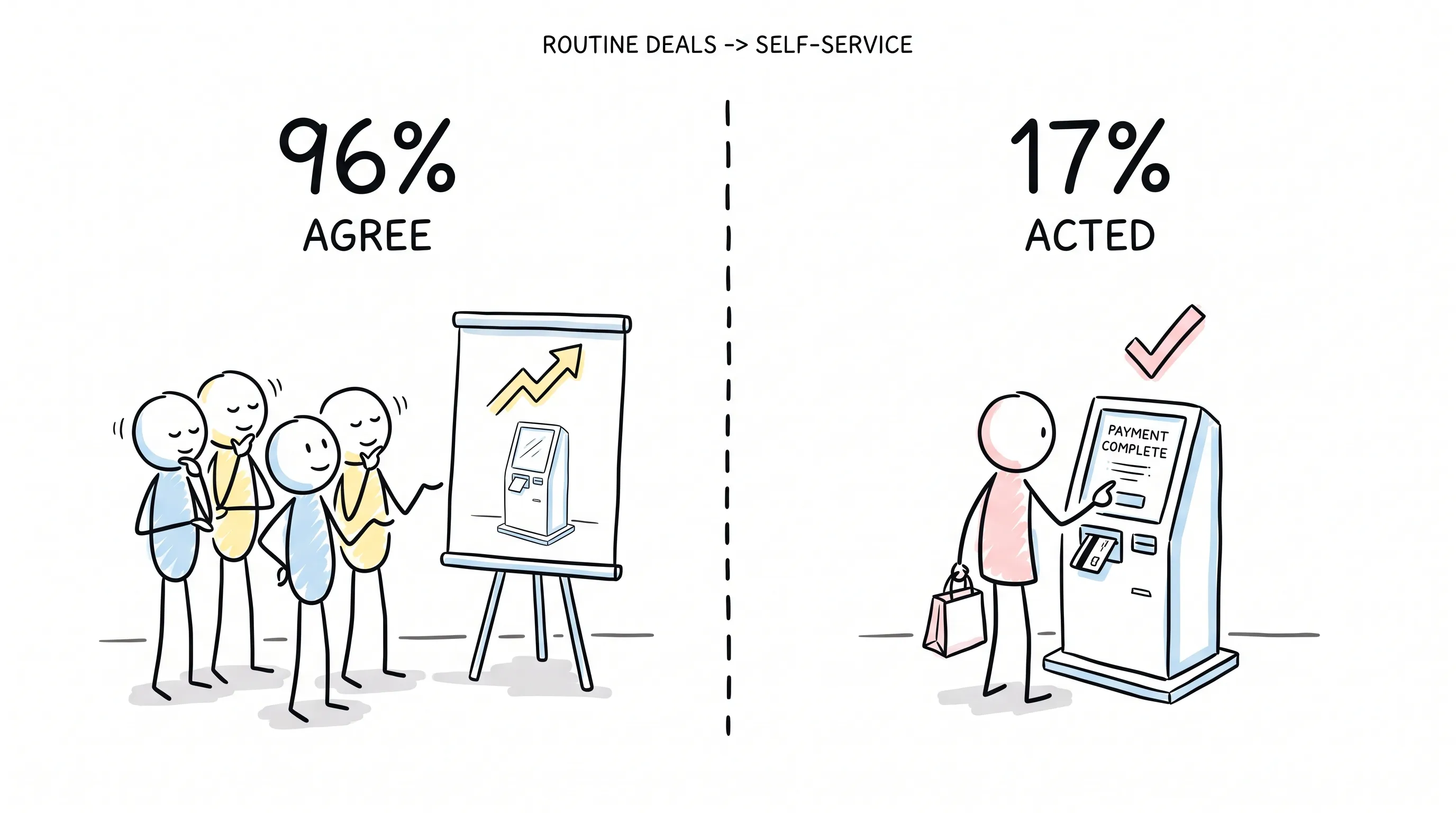
96% of sellers agree that routine deals are heading toward self-service.
Those with a self-service path actually up and running: 17%.
Everyone sees the trend. Only 17% have acted on it.
Sales Isn't Being Dropped. It's Being Called In.
So is the sales role about to disappear?
Buyers' answer is clear: call them in when needed — and only then.
More than half of buyers want a human in these situations: large multi-year contracts, security and compliance reviews, procurement exceptions and special terms, complex configurations. Nearly half want a person across the table when custom pricing and discounts are on the line.
Notice something? Buyers don't hate salespeople. Adding a seat, processing a standard renewal, running a routine upgrade — they can handle those themselves. But negotiating an unusual contract, untangling a security or compliance question, setting up a complex implementation — that's when they genuinely want someone who knows the ropes beside them.
Buyers don't reject sales. They reject meeting sales at the wrong time, over the wrong things.
There's math in this for sellers, too. To process a single routine transaction, more than half of sellers burn at least $1,000 internally; more than a third burn six hours or more. Quoting, approvals, invoicing, collections, support, coordination — a deal that barely needs negotiating still eats up that many resources.
The service didn't go away. It moved to where it's actually needed.
The Money at the Bottom of the Funnel Has No Owner
A buyer walks away because the seller takes too long to take his money. Whose fault is that?
Marketing says: demand is my job. I got the person convinced — what happens after isn't on me.
Sales says: he was ready to sign the contract. If the process won't move, that's not my problem either.
Neither side is wrong. And that's exactly what makes it so messy: the money at the bottom of the funnel has no owner.
For marketers, this poses a new exam question. When demand generation is done and the buyer has been delivered to your door — is what's beyond the door an open highway, or another turnstile? Are your purchase process and the way buyers want to buy even the same map?
Companies that only solve discovery may just end up delivering buyers to the next bottleneck, faster.
The finish line of demand generation isn't the deal. In between stands an entire checkout.
Remember the picture from the opening? Buyers are already on the high-speed train, and your process is still checking tickets.
The ticket gate won't disappear on its own.
Whoever tears down the turnstile first is the first to catch the people whose wallets are already out.
Here's wishing your buyers green lights all the way — from the moment they see you to the moment they buy from you.
Continue reading
Related articles

Cross-Border Business: Time to Upgrade Your AI Toolbox
A learn article explaining how AI tools help cross-border e-commerce sellers clear five hurdles: language, regulation, logistics, payments, and fraud. It outlines a five-compartment toolbox, a five-step adoption path, and metrics such as conversion rate and CLV, while cautioning against over-reliance on AI.

AI Is Taking Over the Dirty Work of Social Media Marketing, One Task at a Time
This learn article outlines four social media marketing tasks AI can handle — audience analytics, content drafting and design, ad targeting and creative testing, and spam moderation — and cautions that taste, judgment, and data security remain human responsibilities.

AI Is Already This Good — Why Is Your Social Media Marketing Still Pure Manpower?
An overview of 18 AI tools for social media marketing, organized into six categories covering audience research, content creation, scheduling, comment and DM handling, ad management, and visual production, plus notes on personalization, prediction, and emerging trends.