
The Business of E-Commerce Is Being Rebuilt by AI
A learn article explaining how AI is reshaping e-commerce, covering personalization, AI customer service and agents, dynamic pricing, visual search, AI-generated product descriptions, and security monitoring, along with data quality, privacy, and bias risks.
A few days ago, I wanted to buy a red sweater online.
I typed "red sweater cropped" into the search box, scrolled through dozens of pages until my eyes glazed over — and still couldn't find the one I had in my head.
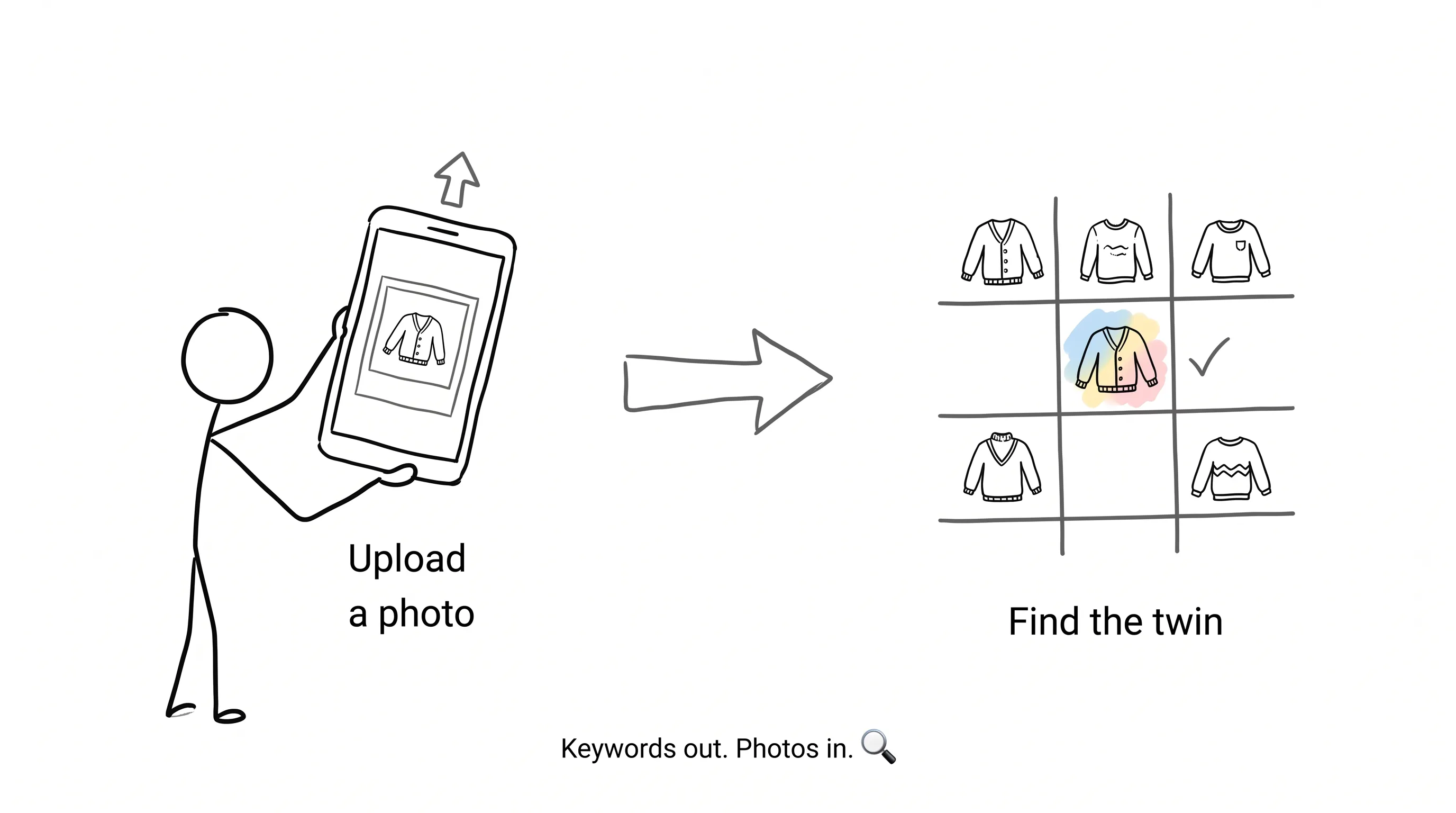
So I tried a different way. I uploaded a photo with one line attached: this exact one. Find me its twin.
A few seconds later, the results came back. Nearly the entire screen was filled with what I wanted.
I stared at the screen for a moment. My god — e-commerce really is being rebuilt by AI.
What Is E-Commerce AI, Exactly?
A lot of people hear "AI" and think it's something mystical. Break it down, though, and it's just three things.
The first is natural language processing (NLP). What does that mean? It means making computers understand what people say. You ask customer service, "Where's my package?" — it understands, and it answers you in plain human language.
The second is machine learning. Machine learning lets the computer teach itself from data, instead of a human writing rules one by one. The more orders it has seen, the better it gets at guessing what you want.
The third is deep learning. You can think of it as machine learning with many more layers — it can look at images and listen to sound. When you snap a photo today and search for the same item, that's what's running underneath.
What happens when you twist these three things together?
There's a number in Salesforce's State of Commerce report: 84% of businesses believe AI has given them a competitive advantage.
What has that number come to mean over the past year? It means AI is no longer a question of "should we give it a try." It's a utility — infrastructure, like water and power.
What Has It Actually Changed?
Let me tally three ledgers for you.
The first ledger is about personalization. I've seen this figure: 73% of consumers expect a better personalized experience. What does that mean? It means every one of them assumes you should already know what they want. If you don't, you lose.
What can AI do here? String together every store you've browsed, every product you've clicked, everything you've bought — and guess what you'll want next. Guess right, and the add-to-cart, the checkout, the whole flow runs in one motion. That's how conversion rates and average order value (AOV) climb.
The second ledger is about customer service. Another number is even more striking: in Salesforce's survey, 43% of consumers have stopped buying from a brand altogether after a single bad customer-service experience.
One bad service interaction can cost you that person — plus the circle of friends behind them.
What can AI customer service do? Work around the clock, all year, and reply in seconds. It also works proactively: your shipment runs late, it calculates it, and — before you even open your mouth to complain — it pushes the news to you first. That's called proactive service.
The third ledger is about the people doing the work. Roughly seven in ten marketers are hoping AI will take over the repetitive labor. Filling out forms, updating inventory, answering the same question that's been asked eight hundred times — who wants to do that?
Once AI takes it over, people free their hands for the work that's actually valuable: thinking about the product, thinking about the user.
My Favorite Case
Let me tell you a true story.
SharkNinja makes small appliances. A customer asked where their ice cream maker order was, and its AI assistant, Agentforce, replied with the delivery date. Then, in passing, it recommended a companion storage container.
Did the customer buy it? Most likely, yes. Because they had just bought an ice cream maker, and they needed somewhere to put the ice cream.
This is what makes AI powerful. It isn't "selling." It's helping out — and the selling happens in passing. A casual question here, a small recommendation there, one more well-timed nudge at every touchpoint. Small drops, piled up, become a serious chunk of revenue.
The best salesperson never pitches. It gets things done for you — and sells along the way.
Five Things Happening Right Now
If you only watch the spectacle, you'll miss the point. I've broken it down into five concrete things.
First, dynamic pricing. Pricing used to depend on people watching the market and going with their gut. Now the algorithm does it: a competitor drops their price — drop. Inventory piling up — discount. Demand suddenly spiking — raise. Every single transaction, fight to sell at the optimal price.
Second, visual search. That's the red sweater from my opening. Finding things used to rely on keywords; now it relies on a photo. Upload, search, done. For the first time, shopping has become as intuitive as strolling through a store.
Third, AI-written product descriptions. A merchant with thousands of SKUs used to hire a small army to write a blurb for every item. Now you feed the product data and customer reviews to AI, and within minutes, thousands of descriptions come out — accurate and search-friendly. The operations team can finally go do something else.
Fourth, one-to-one storefronts. There used to be one homepage, and every visitor saw the same one. Now everyone sees a different one: what you see in the south differs from what he sees in the north; what you see in autumn differs from what he sees in winter. 40% of consumers say AI has genuinely raised the bar on experience. That extra height is exactly the feeling of "it gets me."
The fifth — and the one I judge most critical: agents.
What is an agent? AI used to be a chatbot: you ask one question, it gives one answer. An agent is different — it can act on its own. A customer reports a problem with an order; it checks the logistics by itself, judges on its own that fulfillment went wrong, then initiates a partial refund by itself — or directly recommends a replacement. Whatever it can't handle, it hands off to a human.
The data shows that roughly 39% of merchants using AI have seen clear improvement in product discovery. A customer wants to recreate an outfit from the Cannes Film Festival? Upload a photo, and AI assembles the whole look for you.
The thing you couldn't find after three hours of wandering a mall, AI puts together in three minutes. You only truly understand this once you've tried it. The repeat purchase rate is its most honest reward.
Don't Forget the Gatekeeper at the Door
There's one more link in the chain that nobody mentions — until it breaks, and then it's all anyone talks about.
I've seen this data: over the past year, roughly 36% of e-commerce merchants experienced website downtime, and 57% of those outages happened during peak season. What does that mean? The business you spent all year building can go to zero overnight — because the servers collapsed on the day of the big sale.
Beyond downtime, there's fraud. A newly registered account suddenly places a huge order. One person logs in from three different devices. Someone uses small orders to repeatedly test a stolen card. Humans can't keep watch over all of these signals.
AI can. First it learns from historical data what "normal" looks like, then it stands guard around the clock. A server load slowly climbing — invisible to the human eye — and AI raises its hand. An anomalous order appears; it flags it in red on the spot, for a human to review.
Platforms like Salesforce's Commerce Cloud have already built these capabilities in as factory settings: automatic security patches, blocking of high-risk orders, helping merchants meet compliance requirements like PCI DSS (the payment-card industry's data-security standard). Small teams get to sleep soundly at night too.
But Every Coin Has Another Side
By this point, you might think AI is a miracle cure. Hold on.
First, AI is only as good as the data you feed it. Website, CRM, social media — every source tells its own story, messy and inconsistent. Whatever you feed in is what comes out.
Second, many established merchants run systems built a decade ago. Wiring them to AI costs money, time, and manpower.
Third, the privacy hurdle can't be dodged. GDPR and CCPA are watching. The deeper you use customer data, the higher the price when things blow up.
Fourth, bias. Whatever bias is baked into the training data, AI will amplify as-is. Recommendations that discriminate against certain groups, pricing that treats people differently — these aren't science fiction; they are real risks.
So my view is simple: AI is not a switch you flip and it works. It's a systems-engineering project — roll it out slowly, watch it closely, fix it constantly.
Finally, Back to That Red Sweater
I did end up buying that red sweater. AI found it.
Since that day, I keep coming back to one question: in thirty years of e-commerce, the essence hasn't changed at all — help people find what they want, then get it into their hands. The only thing that changes is the efficiency of the "help."
Before, you relied on shelves, on search boxes, on people.
Now, you rely on an agent that never sleeps, remembers every preference you have, and can act on your behalf.
Whoever uses AI deepest — whoever "guesses" their customers most accurately first — finishes the track switch first.
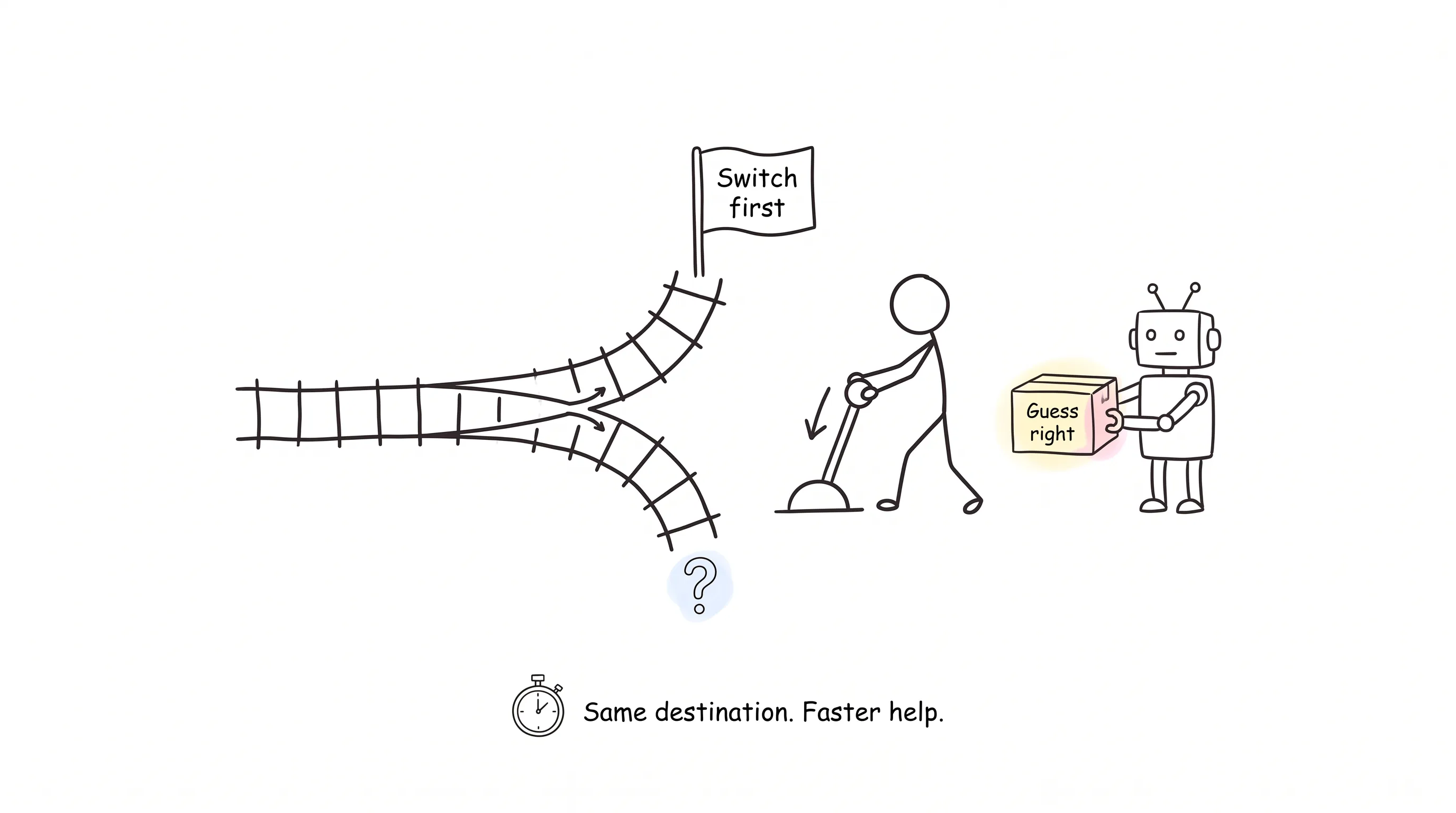
Here's to switching tracks soon.
And here's to always being guessed right.
Continue reading
Related articles

Cross-Border Business: Time to Upgrade Your AI Toolbox
A learn article explaining how AI tools help cross-border e-commerce sellers clear five hurdles: language, regulation, logistics, payments, and fraud. It outlines a five-compartment toolbox, a five-step adoption path, and metrics such as conversion rate and CLV, while cautioning against over-reliance on AI.

AI Is Taking Over the Dirty Work of Social Media Marketing, One Task at a Time
This learn article outlines four social media marketing tasks AI can handle — audience analytics, content drafting and design, ad targeting and creative testing, and spam moderation — and cautions that taste, judgment, and data security remain human responsibilities.

AI Is Already This Good — Why Is Your Social Media Marketing Still Pure Manpower?
An overview of 18 AI tools for social media marketing, organized into six categories covering audience research, content creation, scheduling, comment and DM handling, ad management, and visual production, plus notes on personalization, prediction, and emerging trends.