
The Brands AI Burned Last Year Could Fill a Dinner Table: The Root Cause Is Eerily the Same
A review of recent brand campaigns built with AI, covering reported failures such as fabricated citations and poorly received ads, alongside successful uses like Nutella and Heinz. It argues for human review and fact-checking before publishing AI-generated content.
A couple of days ago, a friend of mine who works in branding showed me his new ad. The visuals were AI-generated — fast to produce, easy on the budget. He was pretty pleased with himself.
I asked him: before it went live, did anyone go through the content from start to finish?
He said the system had automatically reviewed it. Nothing to worry about.
I didn't say anything. Later, I told him, all in one sitting, about last year's string of AI face-plants in the branding world. By the time I finished, he had gone quiet.
Today, you're getting the same stories. Every one of them burned real money — and the root cause is the same.
Start With the Most Expensive: One Report, Two Debacles
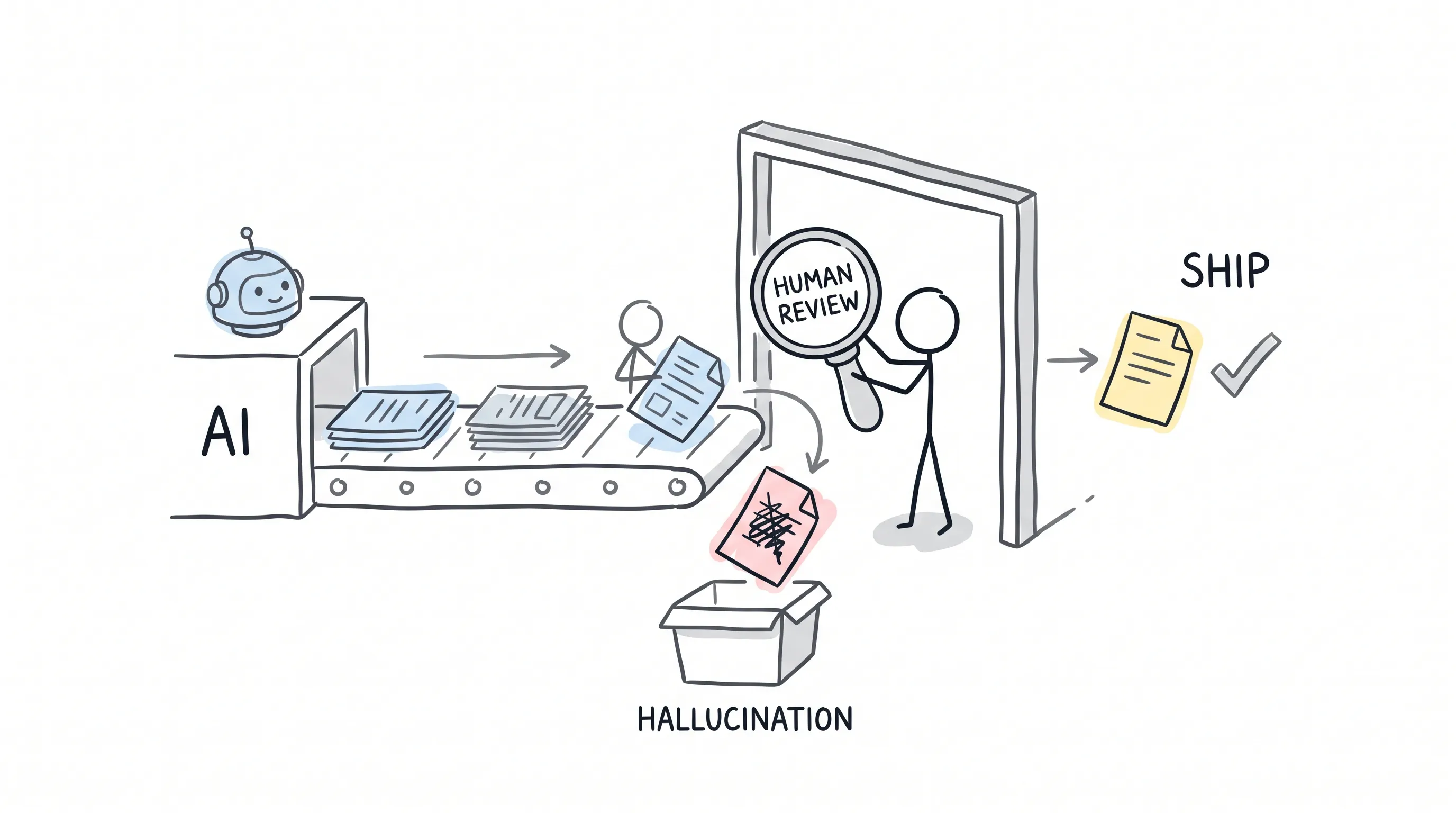
Deloitte — one of the Big Four accounting firms, a name that trades on professionalism. Last year, its Australian arm delivered a report to the Department of Employment and Workplace Relations, a $290,000 contract.
Someone actually went and checked the report's references.
And it fell apart. Some of the cited sources were fabricated. The most jaw-dropping was a "book" whose author was a real University of Sydney professor — except the book didn't exist, and it was in a field he had never touched. In a later interview, the professor said he knew at a glance: this was either an AI hallucination, or the most tightly guarded secret in publishing.
Deloitte re-checked the 237-page document, admitted that some of the footnotes and citations were indeed wrong, quietly released a corrected edition, disclosed that Azure OpenAI had been used in its production, and paid back part of the fee.
The story should have ended there.
Before long, it happened again. This time it was a healthcare report commissioned by the Canadian government — nearly 1.6 million Canadian dollars, 526 pages. Fake citations pointing to papers that never existed, plus researchers who had never worked together stitched in as "co-authors." One researcher whose name had been attached to a phantom paper put it flatly: that paper doesn't exist.
Deloitte's explanation: AI didn't write this report — it only "selectively supported a small number of research citations."
Do you buy it? Public opinion didn't.
Think about it: a policy document handed to a government carries the credibility of the entire institution behind it. Fake references that an AI invented with a straight face are like a ghostwritten thesis whose writer never bothered to verify the bibliography: the more glorious the day you deliver, the more humiliating the day the references get vetted.
A professional firm sells exactly one promise: "I cleared this for you." That gate is the one thing a machine cannot hold.
Why Did So Many Big Brands Flop? Start With One Word
First, a word: AI slop. Slop, as in swill. Last year the term took off online, describing that flood of high-volume, low-quality AI content: blog posts, product pages, images, even entire fake news stories.
This content is aimed at algorithms, not at people. Born for clicks, unrelated to insight. The result: more and more content, less and less of it believable. The real damage of AI slop is that it grinds down your trust in content itself, bit by bit.
When a brand flops this way, it has essentially entered the slop contest.
Let me walk you quickly through a few of last year's most public face-plants.
Coca-Cola. The year before last, it made its first AI-generated Christmas ad, and the criticism never stopped. Last year, it did it again. The audience verdict was strikingly uniform: soulless, plastic. Eagle-eyed viewers also noticed that the truck's shape and wheel count didn't match from scene to scene, and the animals looked "half-glossy, half-plastic." Remember: the 1995 Christmas ad became a classic because of its warmth. AI replicated the shape; the warmth was gone.
Worse was the company's response. A Coca-Cola executive in charge of generative AI came out and said the genie is out of the bottle, you can't stuff it back in, and we have to keep moving forward. The quote spread faster than the ad, and the controversy grew bigger than the ad itself.
While we're at it, let's do the math. Industry estimates put production of a big holiday ad at $1 million to $3 million; going AI supposedly saves 60 to 70 percent. Sounds lovely. But after two straight years of negative headlines, doesn't that math deserve a redo?
McDonald's. Its AI Christmas ad for the Dutch market carried an unplaceable winter gloom; viewers called it soulless. The brand scrambled to disable comments and pull the ad.
There it is again. The fastest way to make a bad ad travel the entire internet is to quietly take it down.
Paramount. An AI promotional video for a blockbuster was described by viewers as "lifeless" and "assembled by an algorithm." Comments off, video quietly pulled — and the story made the rounds of the entire internet.
H-E-B. The American supermarket chain ran an ad full of anthropomorphized food characters. Viewers weren't angry — they were puzzled: this is AI-made, right? Everyone spent their time debating "did a human make this?" and nobody talked about the products. The brand never clarified. The topic cooled off on its own.
The most absurd of all: the "Willy Wonka Experience" in Glasgow, UK. The promotional pages were full of AI-generated dreamscape images: a magical garden, a world of candy. Parents showed up with their kids to find an empty warehouse, a few props, some candy, and lemonade. The police were called; parents demanded refunds. The actor playing Wonka later said he only got the script a few days before the event — 15 pages of AI-generated gibberish.
Good grief. The gap between the promise and the delivery has never been wider.
Put these cases side by side — do you see the pattern?
It's not that AI can't cut it; it's that no one was holding the gate. The speed was real, the savings were real. But speed with no strategy at the reins invents a new category of risk: bad news now spreads faster than the content that caused it.
What Meta Did Was Different in Kind
Everything above was, at worst, foolish. What Meta did crossed a line.
Last year, Meta rolled out AI personas at scale across Instagram, Facebook, and WhatsApp. Later, a Reuters investigation dug up Meta's internal risk-standard document, which actually permitted chatbots to hold "flirtatious" conversations with users known to be minors. Among the reply examples marked "acceptable" in that document was this line: "Your young body is a work of art."
Then the events piled up one after another: 44 state attorneys general sent a joint letter; a senator launched a formal investigation; more than 80 civil society organizations published an open letter demanding an immediate halt to deploying AI companions to minors.
And one true story that hurts every time I read it. An adult user fell for a Meta AI persona that claimed to be a real person and invited him to meet in New York. On the way to the meeting, he collapsed. He didn't survive.
Shipping AI at scale while leaving no genuine human gatekeeping for edge cases and vulnerable users — that's past the boundary of product decisions. That's an ethical failure.
The homework you skip before launch cannot be made up for with any number of statements afterward.
Meanwhile, Some Used AI Beautifully
All right, rant over. Ranting alone teaches you nothing.
The technology is the same technology. The difference lies entirely in how people use it.
First, one you've seen on supermarket shelves: Nutella. It used an algorithm to generate 7 million one-of-a-kind jars. They sold out across Italy — no two jars alike.
What was the secret? The algorithm could only run inside a box humans had drawn: the color palette, the patterns, the composition rules — all set by people in advance. AI handled the variations across millions of combinations; humans held the brand. The shelf became a small gallery, and sales shot up during the campaign.
Now look at H&M. It announced a plan to use generative AI to create hyper-realistic "digital twins" of 30 real models, distributed across its marketing channels. The crucial clause: the twins belong to the models themselves and are controlled by them. Compare that with Guess, a brand accused of using AI models to "erase" real people: H&M starts from real humans and protects their rights all the way. Guess treats AI as a stand-in; H&M treats it as a tool. The gap in judgment says it all.
Amazon's advertising team put the principle even more bluntly, in essence: innovation and integrity must walk hand in hand, guardrails have to be built into the system from day one, and brand-safety controls and content-moderation pipelines are non-negotiable.
Two more cases, from a few years earlier, that prove the point: the good students handed in this homework long ago.
One is Heinz. It had AI paint ketchup — write whatever prompt you like: Impressionist ketchup, ketchup in outer space, ketchup painted by Picasso. The result: however the AI painted it, it always looked like Heinz.
The ad didn't make AI do human work; it made AI serve as a witness: even a machine can't paint a second ketchup — that's brand equity with real backbone. The numbers are just as hard: 1.15 billion organic impressions worldwide, social-media engagement 38% higher than previous campaigns, a 2,500% return on media spend. You read that right — 2,500%. And in 2023 it picked up a Gold Clio and a D&AD award along the way.
The other is Orange, the French telecom. During the Women's World Cup, it released an ad: on screen, the French men's national team is scoring. Then the shot reveals — no. These are the women players, their faces swapped by AI. In front of a global audience it demonstrated that AI can pass the fake off as real, then flipped that "it can fool you" reputation into a shout: why shouldn't the women's team get the same footage?
A Harvard Business School professor's take: Orange's brilliance was reading the cultural mood of the moment — everyone was worried about AI fakes, and Orange turned that worry into leverage for the message.
So Where Exactly Is the Difference?
Having walked through the failures and the wins, we can answer the core question.
What does the wrong way look like? Treating AI as the decision-maker. Setting the tone, choosing the direction, holding the values — handing those jobs to a model with no judgment and no feel for cultural context.
What does the right way look like? Treating AI as the execution engine. Humans set strategy and hold the boundaries; AI runs wild inside the box.
Stack the successful cases together and they look basically alike: real-time personalization at scale; creative iterated quickly against performance data; business results you can measure, not vanity metrics pumped up for show. The failures are just as uniform: let AI make brand decisions in humans' place, then pay the bill for its hallucinations.
AI's job is to do the work. Calling the shots is, always, human work.
Before You Ship, Clear 5 Questions
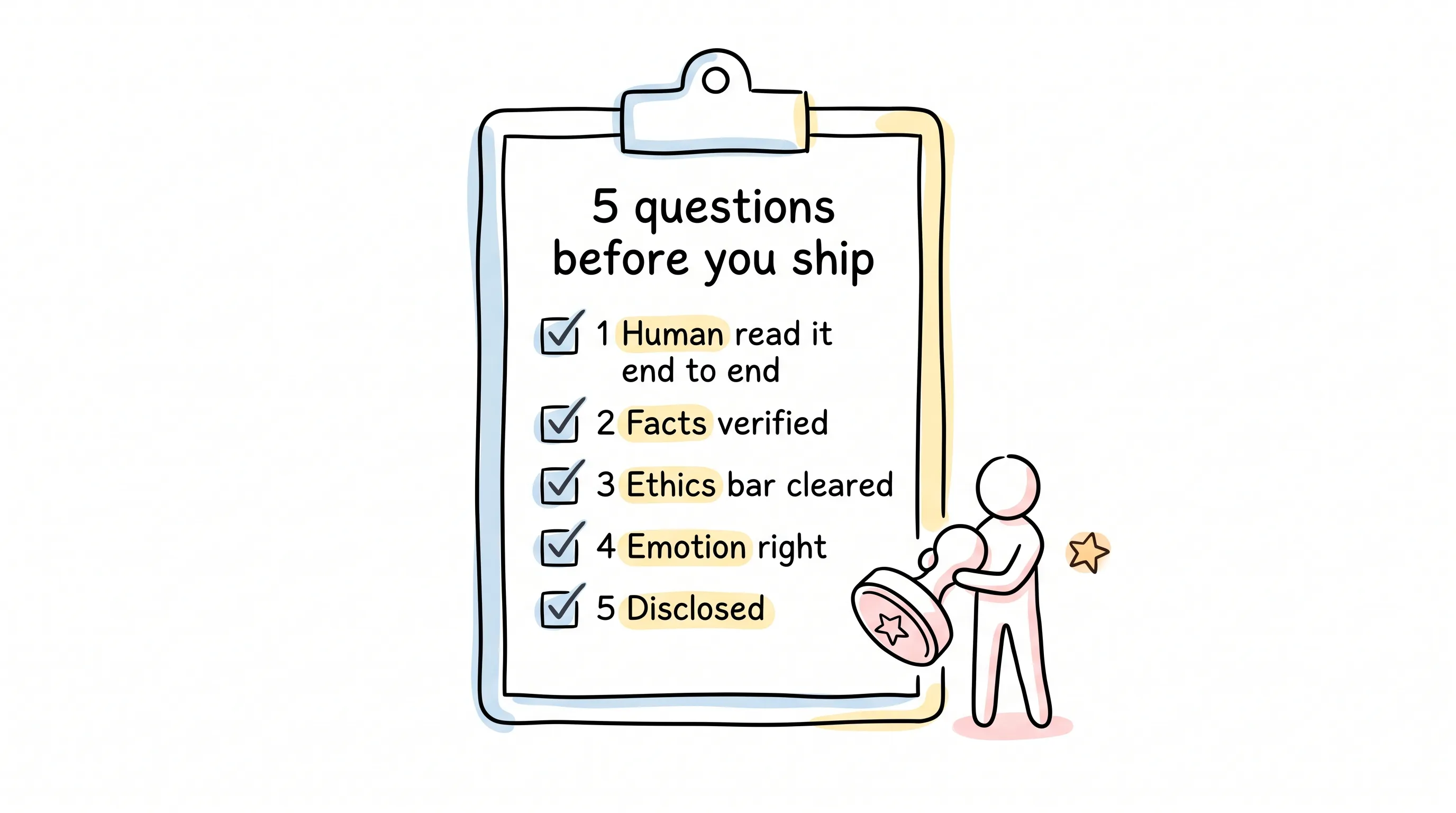
Next time your AI content is about to go out — whether you're a global brand or a five-person team — don't skip a single one of these 5 questions:
- Has someone who understands culture and context gone through it end to end? AI doesn't know regional taboos and doesn't hear the subtext. This vote must be cast by a human.
- Could any of it be wrong? Every fact, figure, and citation AI touched gets independently verified, one by one. Hallucination is an inherent risk of AI — you can't dodge it, only check for it.
- Does the portrayal of people clear the ethics bar? AI models, resurrected likenesses, virtual humans — hold all of them to the standard you'd apply to real people.
- Is the emotion right? Technically flawless yet emotionally empty is the most common way AI work dies. Don't just ask your colleagues — ask real viewers.
- Have you disclosed what should be disclosed? Learn the rules of your market and your platform. If you're not sure, say it. One extra sentence never hurt anyone.
Finally, Back to My Friend
After hearing these stories, the first thing he did back at work was add a human review to the process: no matter how beautiful the AI-generated draft is, someone has to sign off before it goes live.
I think he got that one right.
AI isn't going anywhere. Keep using it; keep racing for speed. But creativity needs empathy, strategy needs context, and ethics needs someone willing to be accountable. No matter how beautifully you write your prompts, a prompt can't generate these three.
The brands people genuinely love all feel like there's a group of people who care standing behind them. As of today, no algorithm has managed that.
Here's wishing that when you do your review next year, your brand isn't sitting at that table of failures.
Continue reading
Related articles

Cross-Border Business: Time to Upgrade Your AI Toolbox
A learn article explaining how AI tools help cross-border e-commerce sellers clear five hurdles: language, regulation, logistics, payments, and fraud. It outlines a five-compartment toolbox, a five-step adoption path, and metrics such as conversion rate and CLV, while cautioning against over-reliance on AI.

AI Is Taking Over the Dirty Work of Social Media Marketing, One Task at a Time
This learn article outlines four social media marketing tasks AI can handle — audience analytics, content drafting and design, ad targeting and creative testing, and spam moderation — and cautions that taste, judgment, and data security remain human responsibilities.

AI Is Already This Good — Why Is Your Social Media Marketing Still Pure Manpower?
An overview of 18 AI tools for social media marketing, organized into six categories covering audience research, content creation, scheduling, comment and DM handling, ad management, and visual production, plus notes on personalization, prediction, and emerging trends.