
The Boss Asked Again How Much Revenue AI Brought In? Start by Reporting Your Floor
A learn article on why AI productivity gains are easy to prove while revenue attribution is hard. It proposes a three-floor reporting framework — foundation, construction, payoff — plus guidance on budget requests, narrow agents, and running lab and factory tracks in parallel.
A few days ago I had dinner with an old friend. He runs marketing at a large company — not a junior seat by any means — yet halfway through the meal, he was visibly wilting.
I asked what was wrong.
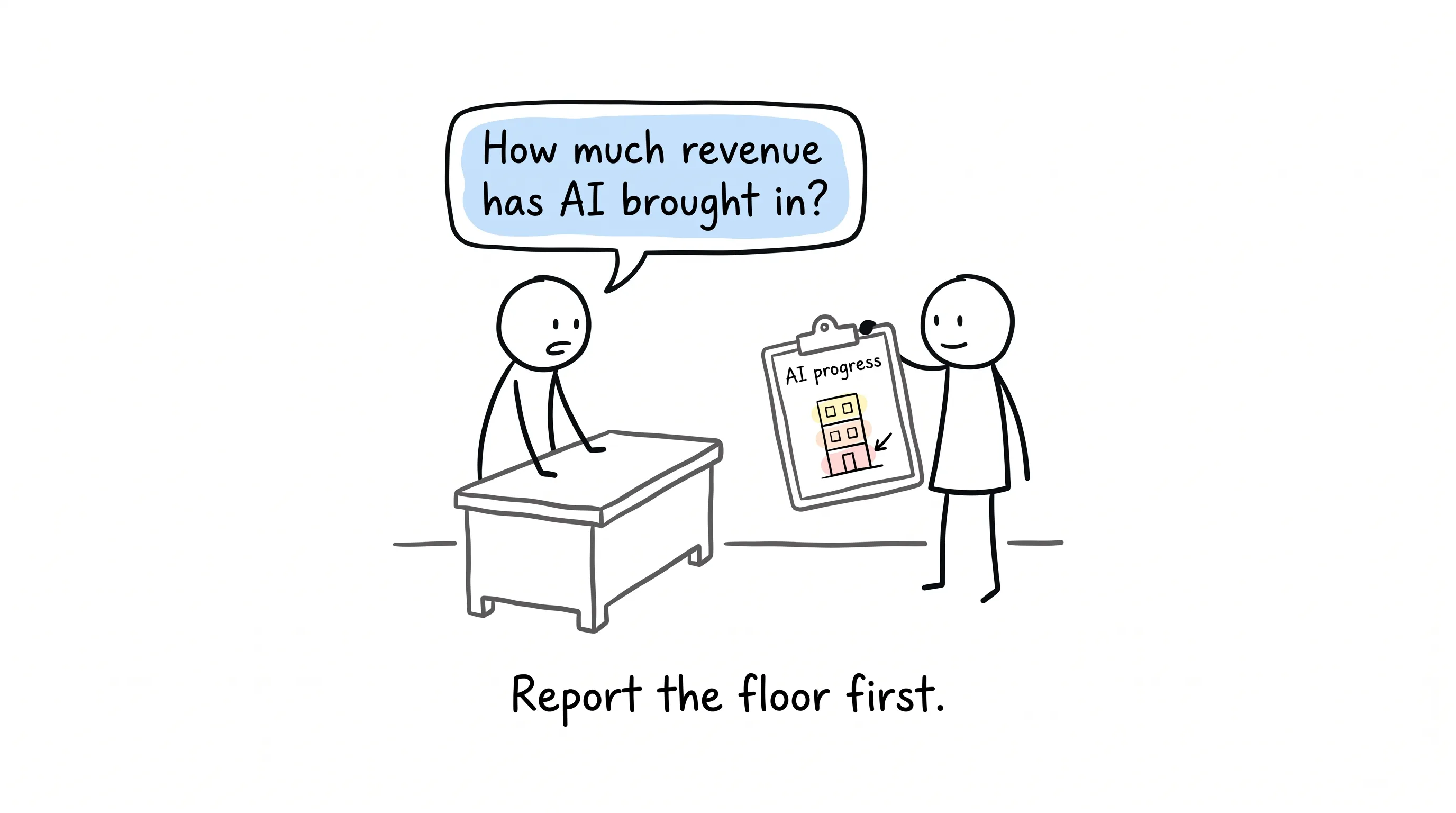
He said the hardest part of his month isn't the overtime — it's the half-hour he spends reporting AI progress to the CEO. Over the past six months, his team has obviously gotten more done with AI, and the output has visibly gotten faster. But every time, the CEO asks one question: after all this investment, how much revenue has AI actually brought in?
He said that's the moment he starts steering the conversation toward "efficiency," "enablement," "signals." And halfway through, even he can hear the bluff in his own voice.
I told him: you're not short on work. You're measuring with the wrong ruler.
AI's productivity is easy to prove; AI's revenue is hard to prove. These two things don't belong on the same answer sheet.
Let's start with the half that's easy to prove.
The Productivity Half of the Exam Was Answered Long Ago
What are productivity gains? The work you had to do anyway, now finished faster and cheaper.
The receipts are sitting right there. The National Bureau of Economic Research (NBER) ran a study: give customer service reps a generative AI assistant, and the number of issues each resolves per hour rises 14% on average. GitHub tallied its own numbers: developers using Copilot complete the same coding task 55% faster than those who don't. And Stanford's AI Index, released in 2026, added it all up: from 14% in customer service, to 26% in software development, to 50% in marketing content production — the productivity line has been climbing the whole way.
Impressive, right? Very.
So why does everyone start hemming and hawing the moment the subject turns to revenue?
Because revenue is too far from AI. Too many people stand in between.
Think about the question marketers have been arguing over for years: an order comes in — who actually brought it in?
The customer first sees you in an ad he happens to scroll past — that ad makes the introduction. Two days later, a retargeting ad nudges him again — that one does the reminding. When he's ready to buy, an email pulls him back to his abandoned cart. Finally he searches a word, clicks an ad, and the deal closes.
Introduction, reminder, recall, and the final kick over the line. Four bearers, one sedan chair.
Who gets the credit? Attribution models have been argued over for more than a decade without producing an answer everyone accepts.
Yes, AI is in the carrying line now. But most of the time it isn't the only bearer. You can't credit the whole chair to a single bearer.
So what's the picture inside real companies? A few numbers that sting.
In 2025, MIT published a report titled State of AI in Business: at large companies, 95% of generative AI pilots show no return whatsoever on the profit-and-loss statement. Note — that's with adoption still climbing.
McKinsey's 2025 survey: 88% of organizations already use AI somewhere in the business. But only 39% can name a quantifiable impact on their income statement. And only 5.5% can attribute more than 5% of EBIT (earnings before interest and taxes) to AI.
BCG's research cuts harder: 75% of C-suite executives list AI among their top three priorities; yet only 25% believe their organization has actually captured meaningful value from it.
Everyone is using AI. Hardly anyone can convert AI into money.
I've marinated in operating reviews for years and sat through a hundred-plus AI progress reports. CMOs who clearly keep the two ledgers apart — productivity gains on one side, revenue attribution on the other — I could count on both hands.
Where's the problem? My read: a shared language is missing — the kind of language that explains what AI is doing, floor by floor.
Three Floors: Foundation, Construction, Payoff
Put plainly: divide a company's AI building into three floors.
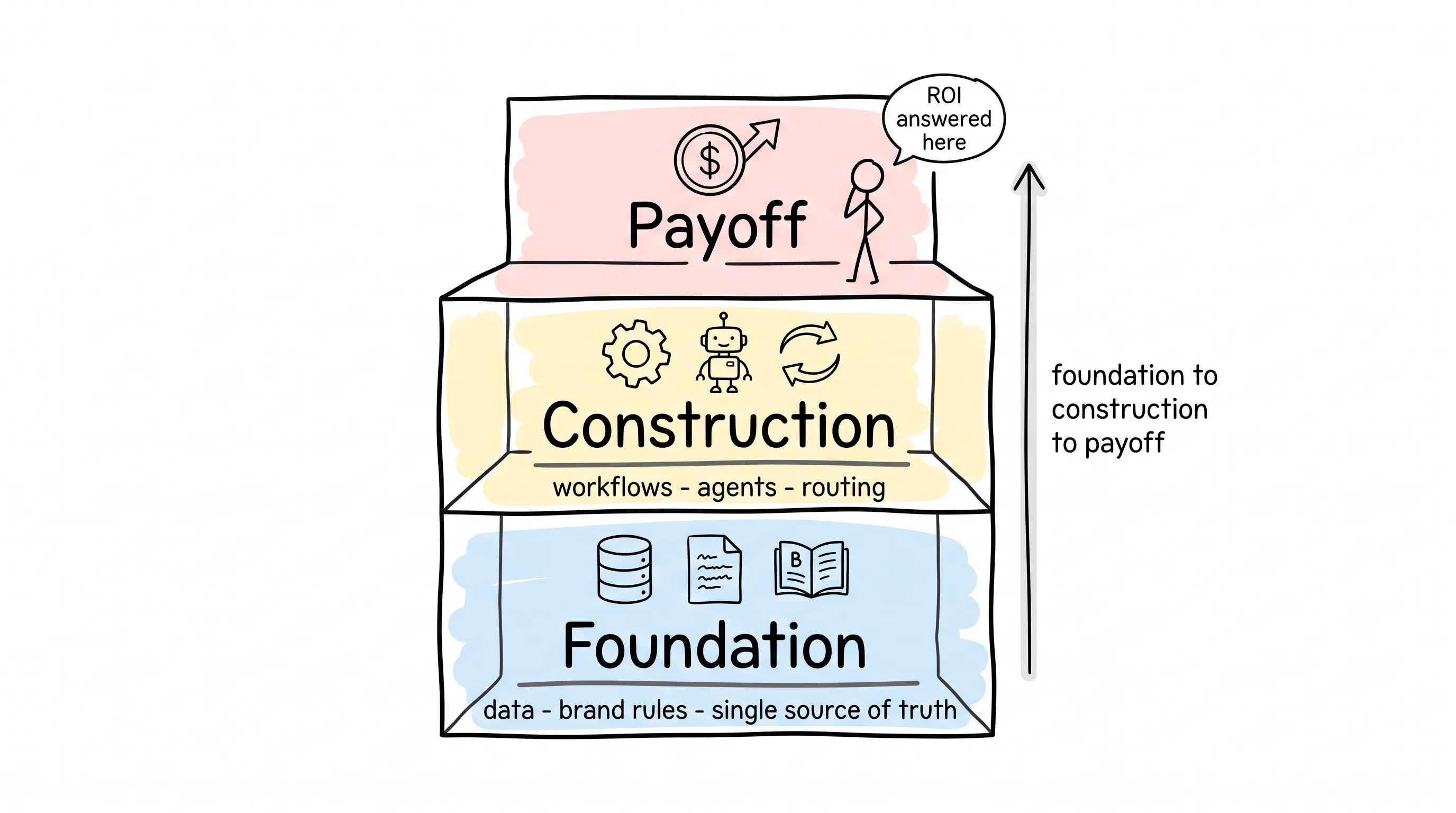
What is the foundation?
It's everything you don't usually see but every system stands on: data kept in one unified place, clearly written brand guidelines and policies, stable platforms, and a record of "why we decided this back then."
One example. The terms of an offer, a brand handbook, a piece of content — these should live in one place everyone goes to fetch them. Not scattered across five project folders, three versions of a slide deck, and a pile of emails, where every copy looks similar and no two are the same.
What does the foundation decide? Whether what you build on top six months from now can still stand.
Can you skip it? You can, and you'll move fast. But that agent you plan to ship next quarter — flawless in the demo — starts answering questions wrong with a perfectly straight face the first time it hits real business.
What is the construction floor?
It's where actual building happens: workflows, agents, routing logic, automation. An audience-segmentation workflow that decides who should receive which email; a routing agent that decides which ticket must be handed to a human.
A construction-floor report answers only two questions: is this machinery getting more reliable? And are the boundaries holding — not quietly sprawling wider?
It doesn't answer the revenue question. But it is the stretch of road that leads there.
What is the payoff floor?
It's where the business genuinely feels the change: shorter turnaround, higher throughput, lower cost to serve each unit. And once in a while, a little incremental revenue.
Only from the payoff floor are you entitled to answer the ROI question.
How do the three connect? The foundation makes construction possible; construction scales up the payoff. And the loop never rests: platforms upgrade, data improves, expectations rise. The next project starts climbing from the foundation all over again.
The most direct use of this language: every progress update opens by reporting its floor.
A foundation update speaks of stability. Data definitions unified; the single source of truth standing.
A construction update speaks of reliability and restraint. Workflows steadier; boundaries held.
A payoff update is the one that talks money. How much faster the turnaround, how much lower the cost, how much more the revenue.
The grammar of an AI progress report: first declare which floor you stand on, then declare what you're worth.
Report the floor clearly, and you no longer sound like you're bluffing — and the boss no longer thinks you're going in circles.
How to Ask for Resources? Lay Out the Unglamorous Work First
At this point you may ask: I get the logic, but how do I ask the boss for budget to do foundation work? It sounds like raising money to buy air.
The way to ask is to lay the unglamorous jobs out, one by one. They look unimpressive, but they decide life and death.
First, stand up the core documents and the data definitions. Every agent and workflow will one day drink from the same well. That single source of truth has to exist first.
Second, think through where things live. Information serving a single team is fine with lightweight retrieval. Anything meant to be used across teams and applications needs a shared context layer. Otherwise you'll watch five teams build the same knowledge base five times.
Third, keep apart "what loads first" and "whose word wins." Context has a loading order; it also has an authority ranking — two different things. And leave behind a context graph that records why each decision was made the way it was.
Fourth, set a rule for quarrels: when two data sources fight, whose side do we take?
Without that rule you'll meet a disease that's hardest to cure: output that oozes confidence while behavior contradicts itself from one day to the next. Preventing it is ten times cheaper than treating it.
Beyond the foundation, two more things when it's time to scale.
One: treat agents as products. Each needs an owner, a version number, and a succession plan for the day it retires. It's software, not a spell.
Two: rein in the reflex to reach for general-purpose tools. A narrow agent that does one thing well almost always beats a do-everything giant.
Why? When the house leaks, you call the plumber — not the handyman who knows a little of everything, even though the handyman is cheaper and shows up faster.
And one more calculation: a generalist who's right 80% of the time across five domains, versus a specialist who's right 98% of the time on a single thing — which one would you dare hand the business-critical work?
Generality is the natural enemy of trust. Narrow is what makes a system reliable, explainable, and safe to entrust.
Lab and Factory: Design the Rhythm Too
There's one more dilemma almost everyone collides with on the AI road: you want results now, and you also want to take your time building the thing that's actually right.
This dead knot has an answer: the lab-and-factory dual track.
What is the lab? A lab is optimized for learning fast. Its output isn't judged by production-line standards; rough is allowed.
What is the factory? A factory is optimized for running steady. Standards are strict, and sloppiness won't pass.
The key is to write the graduation criteria in advance: what must a project satisfy before it moves from the lab into the factory. It could be foundation stability reaching a certain threshold, a pattern proven out on the construction floor, or accuracy holding above a set bar for a prescribed stretch of time.
Without that gate, teams are left with two extremes: everything stays "still in experiment" forever, or everything gets rushed onto the production line and picked before it's ripe.
Both extremes land in the same place: trust ruined, KPIs wrecked.
And here's a counterintuitive twist: run the lab and the factory in parallel, never in series. It's not "everyone buries themselves in foundation work for three years, then we all start building." It's the lab sprinting on one project while the factory goes deep on another. That way you always have a visible directional win in hand: a process in production, a pilot carrying real numbers. Meanwhile the invisible foundation work hasn't missed a single day.
A framework on paper is boring. Let me give you three cases.
Adobe. For several years now they've been doing one thing: unifying brand guidelines, metadata, and review processes into a single system that agents can draw on directly. That is pure foundation engineering. Foundation first; company-wide generative workflows after.
Coca-Cola. Together with OpenAI and Bain & Company, they built a generative platform called Create Real Magic, letting outside creators and internal teams produce on-brand content through a living pipeline. That is a textbook piece of construction-floor work.
Duolingo. Honestly, just look at this number: by their own public account, AI lifted course-content output from roughly 7,100 units a quarter to more than 20,500. In its investor communications, Duolingo has tied that acceleration straight to double-digit revenue growth. That is a complete pathway from foundation to payoff floor.
And one final ledger. BCG's From Potential to Profit study: companies focused on an average of 3.5 AI use cases earned 2.1 times the ROI of companies that sprinkled their investment thin everywhere.
Depth beats breadth. And the sequence — foundation first, then construction, then payoff — is the very road that makes depth possible.
Next Time You're Asked, Answer Like This
Back to my friend.
Later I told him: when the boss asks how much revenue AI brought in, the question itself isn't wrong. There will always be a boss asking it. What needs fixing is the way you answer. Don't rush to defend numbers, and don't apologize for numbers that don't exist yet.
Next time you walk into the review room, say it plainly: for the past six months our work has been at the foundation level. The single source of truth is standing; the data definitions are unified. Next, the construction floor takes three workflows live. After that, the payoff floor will produce its first numbers fit to put on the table.
See? You didn't dodge, and you didn't overpromise.
What the boss really wants is a judgment he knows isn't conning him. The numbers, as it turns out, come second.
The person who can say exactly which floor they're on and how many steps remain to the money is the one who gets the next budget.
Here's to your next report — may you never have to overpromise again.
Continue reading
Related articles

Cross-Border Business: Time to Upgrade Your AI Toolbox
A learn article explaining how AI tools help cross-border e-commerce sellers clear five hurdles: language, regulation, logistics, payments, and fraud. It outlines a five-compartment toolbox, a five-step adoption path, and metrics such as conversion rate and CLV, while cautioning against over-reliance on AI.

AI Is Taking Over the Dirty Work of Social Media Marketing, One Task at a Time
This learn article outlines four social media marketing tasks AI can handle — audience analytics, content drafting and design, ad targeting and creative testing, and spam moderation — and cautions that taste, judgment, and data security remain human responsibilities.

AI Is Already This Good — Why Is Your Social Media Marketing Still Pure Manpower?
An overview of 18 AI tools for social media marketing, organized into six categories covering audience research, content creation, scheduling, comment and DM handling, ad management, and visual production, plus notes on personalization, prediction, and emerging trends.