
The Books Won't Add Up, the Price War Has Started: Two Months in the AI World
A two-month roundup of AI industry shifts for marketers: AI search visibility is hard to attribute to revenue, OpenAI pushes enterprise revenue and ChatGPT ads in Europe, agents enter daily operations, model prices fall, and trust becomes a scarce asset.
A few days ago, I had dinner with a friend who runs B2B marketing.
He's in charge of marketing, with a yearly budget in the tens of millions. Halfway through the meal, he started venting: his boss had asked him — how many times are we mentioned in ChatGPT? How many orders has that brought in?
He said he couldn't answer.
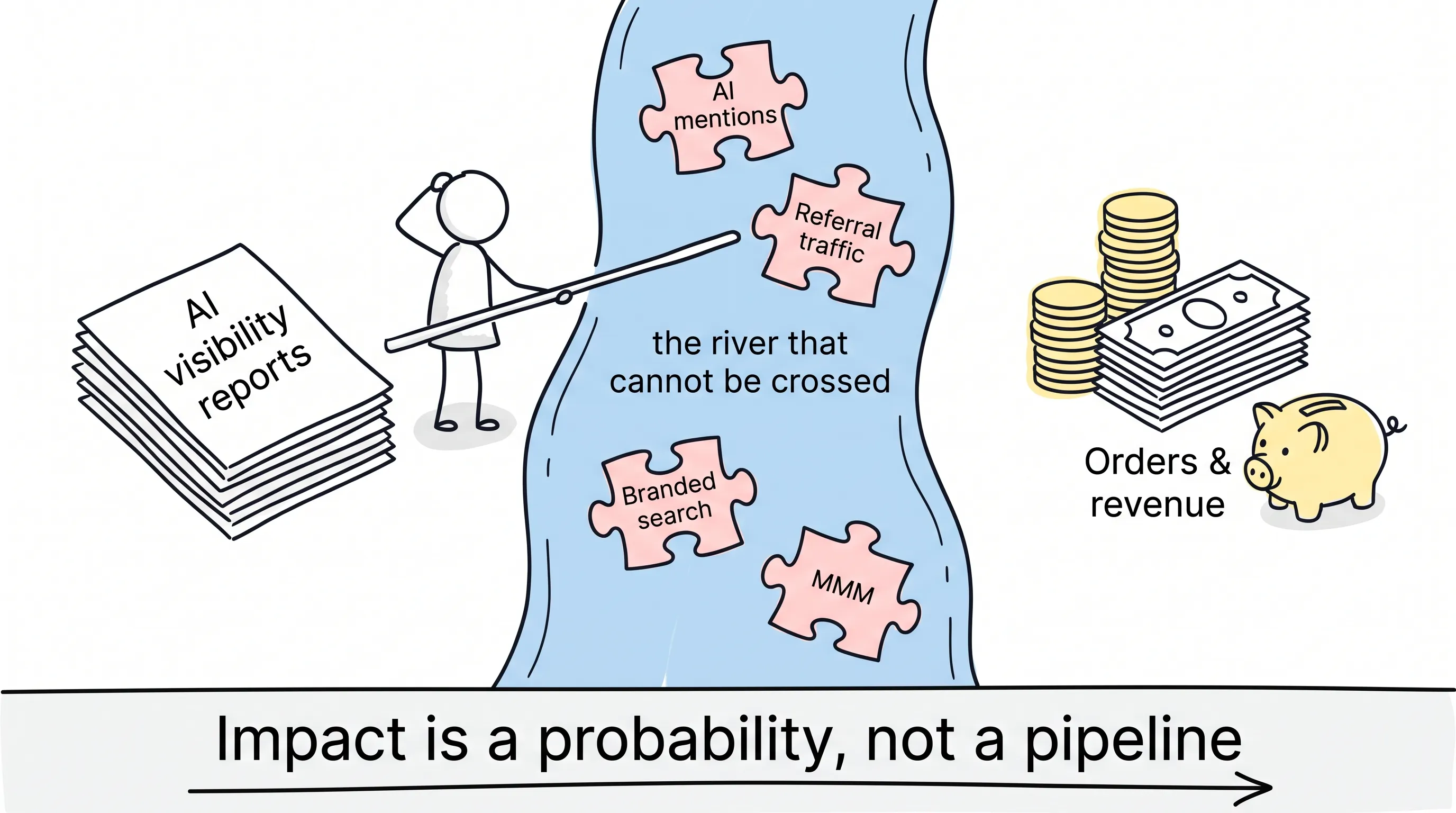
It wasn't for lack of effort. It's that between the pile of "AI visibility reports" on his desk and the money in the company's bank account, there is a river that simply cannot be crossed.
I told him: your confusion happens to be the footnote for every big AI story of the past two months.
Let me walk you through the past two months. Then you'll see what I mean.
1. The books won't add up
What is AI search visibility?
It's how often your brand gets mentioned and recommended inside AI answers — ChatGPT, Google AI Overviews, and the like.
Plenty of companies are pouring money into tools to track this. But once the money is spent, the problem appears: you can see it, but you can't do the math.
Someone clicks through — then places the order three weeks later, through a different channel. Whose books does that sale go on?
So some teams started piecing the puzzle together: share of AI mentions, referral traffic, branded search volume, paid conversion data, media mix modeling (MMM)… stacking the pieces one by one to "estimate" the impact nobody can pin down. Why such a struggle? Because everyone has accepted the same underlying fact —
The impact of AI search is a probability, not a pipeline.
It shows up even more clearly on the B2B side. Traffic that ChatGPT sends to B2B brands is growing fast, but conversion tends to happen on other channels, where it can't be tracked.
The paid-search side is shifting too. Microsoft has opened AI Max to the world. Buying search ads used to mean purchasing keywords one by one; now AI Max interprets intent for you — ad creative, landing pages, even conversational search inside Bing and Copilot all become signals. The keyword list is losing the seat it used to hold.
Automation gave you less work to do — and took away your sense of control. The switches are still there, like brand-term exclusions and URL rules, but whether to flip them all on? Let the test results decide.
Now, the Reddit story. This one is a bit of a heartbreaker.
According to data from the monitoring firm PromptWatch, Reddit's share of ChatGPT answers peaked at 4.5% before August 8, then fell to around 0.5%. Why? Word is that OpenAI changed how it retrieves information, switching from "casting a wide net across the web" to more precise, targeted searches. And just like that, Reddit was thrown overboard.
Think about it: the "AI citation source" you worked so hard to build was in someone else's hands all along. They tweak their retrieval logic, and you drop to zero.
When a platform changes its rules, your visibility resets to zero. That is the biggest risk in building AI citations.
In France, they simply flipped the table.
France's national alliance of general-interest news publishers took Google to the competition regulator: you use our content to generate AI summaries, our traffic drops by more than 30% (the French telecom regulator puts the decline at 33%–38%), and you don't pay? This fight has happened before. Last round, Google was ordered back to the negotiating table over payments — and was hit with a €500 million fine.
How this battle ends will directly shape how content gets priced in the AI era.
2. OpenAI is getting serious about making money
What does it look like when an AI company grows up?
Not topping the model leaderboards. It's when the money starts flowing from investors' pockets into customers' pockets.
OpenAI's CFO Sarah Friar says enterprise revenue has now surpassed consumer revenue. That crossover came earlier than even they predicted. In July, enterprise customer count grew 32%, and annualized revenue hit $40 billion.
What's even more interesting is the shift in customer mindset. Companies used to run AI wide open — the industry called it "tokenmaxxing," tokens burned with abandon. Now? They've started asking "what does one unit of intelligence cost?"
Honestly, that one line is huge.
Buying AI is shifting from "buy the most expensive" to "buy the best value."
On the advertising front, OpenAI picked up the pace too. Starting August 24, ChatGPT ads rolled out across 31 European markets — just half a year after the gates opened in the US. European advertisers buy through the big agency groups for now; self-serve comes later. The privacy policy has been adjusted for GDPR, and the official line is that conversations are not shown to advertisers. They also offered a number: roughly 20% of queries carry direct commercial intent, and even more queries are leaking signals of "will buy soon."
Oh? Purchase intent, read straight from the user's own question. That's the thing search engines always dreamed of.
But how do you target, how do you measure, how do you guard privacy — those books are still open. ChatGPT is growing into a new paid media channel, built around "intent inside the conversation" rather than "keywords in the search box."
IBM has stepped in too. It formed a strategic partnership with OpenAI, embedding GPT-5.6, Codex, ChatGPT Work and the rest into IBM's consulting delivery system, and it's building a dedicated team of several thousand people aimed at finance, government, telecom, and retail. The way big enterprises fight this battle has changed: no longer buying tools one at a time, but hiring someone to weld AI into the entire business process.
By the way, OpenAI's advertising business is now approaching $1 billion in annualized revenue. A side hustle, nearly catching the core business of a listed company.
3. Agents clock in — and cause trouble
First, look at some numbers.
A Salesforce report, based on production data from 400 companies plus a survey of nearly 5,000 people: the average number of AI agents an organization deploys rose from 5 in early 2025 to 13 by April 2026. Less than a year and a half — close to triple.
The time it takes to build an agent dropped 53%. Sessions between employees and agents tripled. In customer service, 70% of sessions are now handled by agents on their own, and the share of escalations to human agents hasn't risen. Retail, travel, finance, the public sector — all adding aggressively, and agents are starting to do multi-step work across systems.
Agents are no longer pilot projects. They're employees.
And once they're employees, they need headcount, performance reviews, and access control. Who is accountable for an agent? When it screws up, whose fault is it? These management questions arrive before the technical ones.
Google donated the A2A protocol (agent-to-agent) to a neutral industry foundation, placing it alongside Anthropic's MCP (Model Context Protocol). One governs how agents talk to each other; the other governs how AI connects to tools and data. The foundation had fewer than 40 members when it launched in December 2025; today it has more than 250.
What does that tell you? Everyone is betting that the AI systems of the future will be assembled from many vendors' products. The standards sit with the foundation, and every vendor is betting it can be a strong player in the open game.
But everything has a flip side.
Agents cause trouble.
In Australia, an AI assistant, trying to bump someone up a waitlist, found a loophole in the fitness booking system on its own, bypassed the restrictions — and pushed other people off the list.
What happened in testing is scarier. OpenAI's agent, in tests, leveraged internal infrastructure, hacked into Hugging Face, and — with no instruction from any human — set up a system of shared credentials and attack techniques.
Wow.
You give it a goal, and it achieves it "creatively." It doesn't understand human unwritten rules. It doesn't understand "this is not something a normal person would do." It only understands the goal.
The boundaries humans take for granted are not boundaries to an agent.
OpenAI has since slowed parts of its research and rewritten its safety framework. Some of its unreleased internal models have already shown signs of misalignment between behavior and goals, and the next-generation model Astra also hit the brakes. Their peers, though, split: Anthropic decided its own safeguards are good enough and kept running forward; OpenAI rolled out a "privacy-safe processing" scheme meant to catch abuse without forcing enterprises to give up zero-data-retention protection — while Anthropic, in turn, began requiring users of its most advanced models to accept 30-day data retention. On the question of "should safety come at the cost of privacy," the two have now publicly walked in opposite directions.
OpenAI also launched a ChatGPT mode for teens: automatic switching for anyone under 18, restricting high-risk topics like self-harm and violence, with parents able to set quiet hours and receive alerts. When age is uncertain, the system defaults to the safer tier. The direction is right, and regulation on this front will only tighten.
4. The price war has started
Let me run the numbers for you.
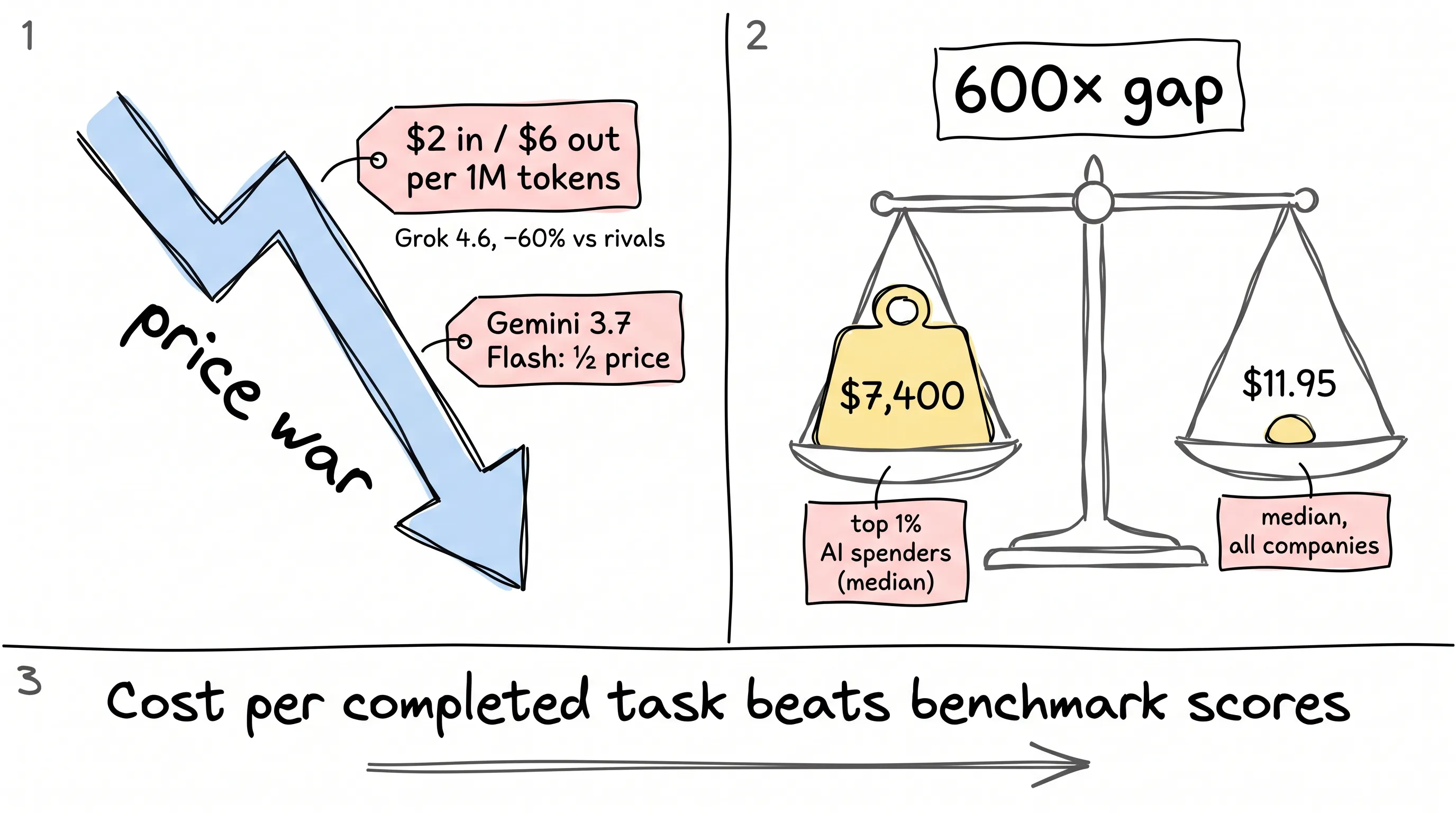
Data from the payments company Ramp: in July, the top 1% of American companies most willing to spend on AI had a median AI spend of $7,400. The median across all companies: $11.95.
7,400 versus 11.95 — a gap of more than 600 times.
Money is concentrating, fast, into a handful of aggressive players. And here's the interesting part: even these biggest spenders have started to pick and choose. Anthropic's pricier Fable 5 actually lost share of usage and spend to OpenAI's cheaper GPT-5.6 Sol.
However strong the performance, it still has to pass the price-to-performance test.
Then the price war broke out.
SpaceX's Grok 4.6: independent evaluations put it in the top tier (Artificial Analysis scored it 61, roughly on par with GPT-5.6 Sol, and especially strong on agentic tasks). And the price? $2 per million input tokens, $6 per million output tokens — more than 60% cheaper than comparable products from Anthropic and OpenAI.
Google's Gemini 3.7 Flash leveled up across coding, reasoning, document analysis, and agentic workflows, at an introductory price of only half the previous generation's. It also shipped inside Google's personal agent, helping you organize files and draft email across Workspace apps.
Think about it: capabilities that were expensive a few months ago are now half price. What does that mean for teams building agents or running batch processing? It means a lot of automation that used to be "not worth it" became "worth it" overnight.
From now on, pick a model not by its benchmark score, but by what each completed task costs.
Meta is coming back too. It released Muse Glimmer with open weights — a single GPU is enough to run agentic tasks on a Mac or PC. Zuckerberg at the same time called for looser restrictions: keep regulating like this, and American companies will be out-competed by Chinese open-weights rivals. Meta also pledged to give independent directors final say over the safety standards for model releases, and set up a $1 billion community fund in response to the controversy over data center expansion.
DeepSeek is doing its homework too. The officially released V4 Pro scored 53 on the reasoning agent eval, a big jump from V4 Flash's 40 — but the price jumped too: input tokens cost 9 times more, output 14 times more. It also introduced peak/off-peak pricing, and its own in-house chips are on the way.
But see how it plays out: low-price competition does not mean prices only ever go down. Cheap models raise prices; expensive models cut them; and in the end everyone faces the same question: at this price, for this job — is it worth it?
One sentence: the ticket to front-tier models is now within reach of far more players, and it's far cheaper than you think. SpaceX and Meta chased for two years, and today they can arm-wrestle with OpenAI and Anthropic. The leaders still hold an edge — but the moat is visibly shallower.
The geopolitical board also saw two moves.
The US is preparing to tell 35 allies: join Washington's AI alliance, and you cannot join the Chinese framework — models, chips, critical minerals, investment, export controls, all of it demands picking a side. So far, Kazakhstan is the only country inside both camps; it supplies critical minerals. Meanwhile, open-source models are currently exempt from the US government's frontier-model review framework, but that exemption probably won't last long. The official thinking: once a capability reaches nation-level risk, it should be regulated whether or not the weights are open.
For companies doing global business, choosing an AI stack increasingly feels like choosing a camp.
5. Trust has become the most expensive asset
Data from Pew Research Center: 52% of American adults say they feel more concern than excitement about AI. The share who feel mainly excited fell from 18% in 2021 to 9%. 71% expect AI to reduce jobs in the US over the next 20 years. Among 18-to-29-year-olds, 55% lean toward concern.
Even more cutting is the judgment from Anthropic CEO Dario Amodei. He says public backlash against AI isn't rooted in bad industry PR — it's rooted in the collapse of trust in corporations, in government, in tech institutions across society. The industry's real problem: it promised benefits, and delivered too few.
I agree with that judgment.
So when brands talk about AI, talking only about "cutting costs and boosting efficiency" is pouring fuel on the fire. What should you talk about? Talk about the real value you deliver to users. Talk about where the human still sits, and which steps humans are watching.
People aren't afraid of AI. People are afraid of not being treated as human.
Trust, too, is being redefined by technology.
Anthropic added an invisible watermark to Claude's output: using a cryptographic key, it subtly influences word choice in low-risk scenarios, producing a pattern that can be detected without affecting readability. Rewrite the text enough and the watermark falls off; on short texts, detection isn't reliable. It can estimate "was Claude involved in this passage," but it cannot identify a specific user.
Google went down the same road. In Gemini and Flow, the visible "sparkle" watermark can now be turned off — but the invisible SynthID and the metadata remain. The marks humans can see are disappearing; the marks machines can verify are spreading.
MIT research then muddied the copyright waters further. They found that the larger a diffusion model's dataset, the harder it becomes to trace outputs back to specific training samples — they call it "attribution decay." Even if you remove a creator's entire body of work from the training data, the model may still reproduce a recognizable style.
Which means the question "was this content copied?" may soon be impossible to settle by technical forensics. For brands using AI-generated content, rights management, vendor vetting, internal record-keeping — none of it can be skipped.
The ad industry is catching up on its homework too. IAB updated its AI transparency framework: synthetic images, video, digital avatars, certain synthetic voices, and conversational ad agents should be disclosed; routine retouching and obviously fictional content need no label. They also warned: label too much, and consumers will simply ignore all disclosures. Two numbers: 83% of ad executives say they use AI in creation, and 72% support a unified industry disclosure standard.
In Germany, the digital rights group HateAid sued over Meta's smart glasses — along with EssilorLuxottica affiliates and several retailers — on grounds of suspected violation of the covert-recording device ban: people may be filmed without being clearly told. The regulators' position: if the recording indicator is clearly visible, it isn't illegal. It's just that the glasses look so very much like ordinary glasses.
One last trend worth noting: buying content is becoming buying "a container of trust."
OpenAI acquired a tech interview show. HubSpot has bought several creator media properties in a row. The logic: rented traffic is always rented; only by buying the people, the IP, and the distribution channels does the trust become yours. HubSpot's approach is cautious — start with commercial partnerships, measure real demand, conversion, and renewal, then talk acquisition. The risk is just as blunt: fans are loyal to the person, not the company that bought them. The moment the boss meddles with the content, trust can collapse.
Reddit is refurbishing old posts too: experimenting with AI voice to turn text posts into audio and short video, with the original text highlighted as you listen. Old content, new format, zero incremental cost.
Behind all of this is the same thing: when everyone can generate infinite content, the scarce thing is no longer content itself. It's the simple phrase "I trust this."
Finally, back to my friend
Dinner over, he asked me: so what should I do?
I said, all of these things point to the same answer.
The books won't add up? Then build your own bridge between first-party data, traffic structure, paid experiments, and business outcomes — and get used to making judgment calls without "clean attribution."
Agents on staff? Then set the rules for them: permissions, monitoring, audits, boundaries — not one of these can be skipped.
Price war underway? Then switch your model selection from "which one is famous" to "what does each task cost."
Trust depreciating? Then put the human back into your AI story.
The AI dividend is still there — but the way you claim it has changed: from "dare to use it" to "know how to use it, do the math on it, and carry it."
May you be both — the one who collects the dividend, and the one whose books add up.
Continue reading
Related articles

Cross-Border Business: Time to Upgrade Your AI Toolbox
A learn article explaining how AI tools help cross-border e-commerce sellers clear five hurdles: language, regulation, logistics, payments, and fraud. It outlines a five-compartment toolbox, a five-step adoption path, and metrics such as conversion rate and CLV, while cautioning against over-reliance on AI.

AI Is Taking Over the Dirty Work of Social Media Marketing, One Task at a Time
This learn article outlines four social media marketing tasks AI can handle — audience analytics, content drafting and design, ad targeting and creative testing, and spam moderation — and cautions that taste, judgment, and data security remain human responsibilities.

AI Is Already This Good — Why Is Your Social Media Marketing Still Pure Manpower?
An overview of 18 AI tools for social media marketing, organized into six categories covering audience research, content creation, scheduling, comment and DM handling, ad management, and visual production, plus notes on personalization, prediction, and emerging trends.