
The Biggest Pitfall in Cross-Border E-Commerce Isn't Far Away — It's at the Checkout
A learn article on cross-border e-commerce checkout friction, covering AI-assisted localization, landed-price calculation, fraud detection, and vendor selection considerations.
A while back, a friend of mine who runs a cross-border e-commerce business took me out to dinner. He spent most of the meal venting: he'd spent plenty on ads, bought a pile of traffic, and still his conversion rate wouldn't budge.
I asked: where's the bottleneck?
He said: the checkout.
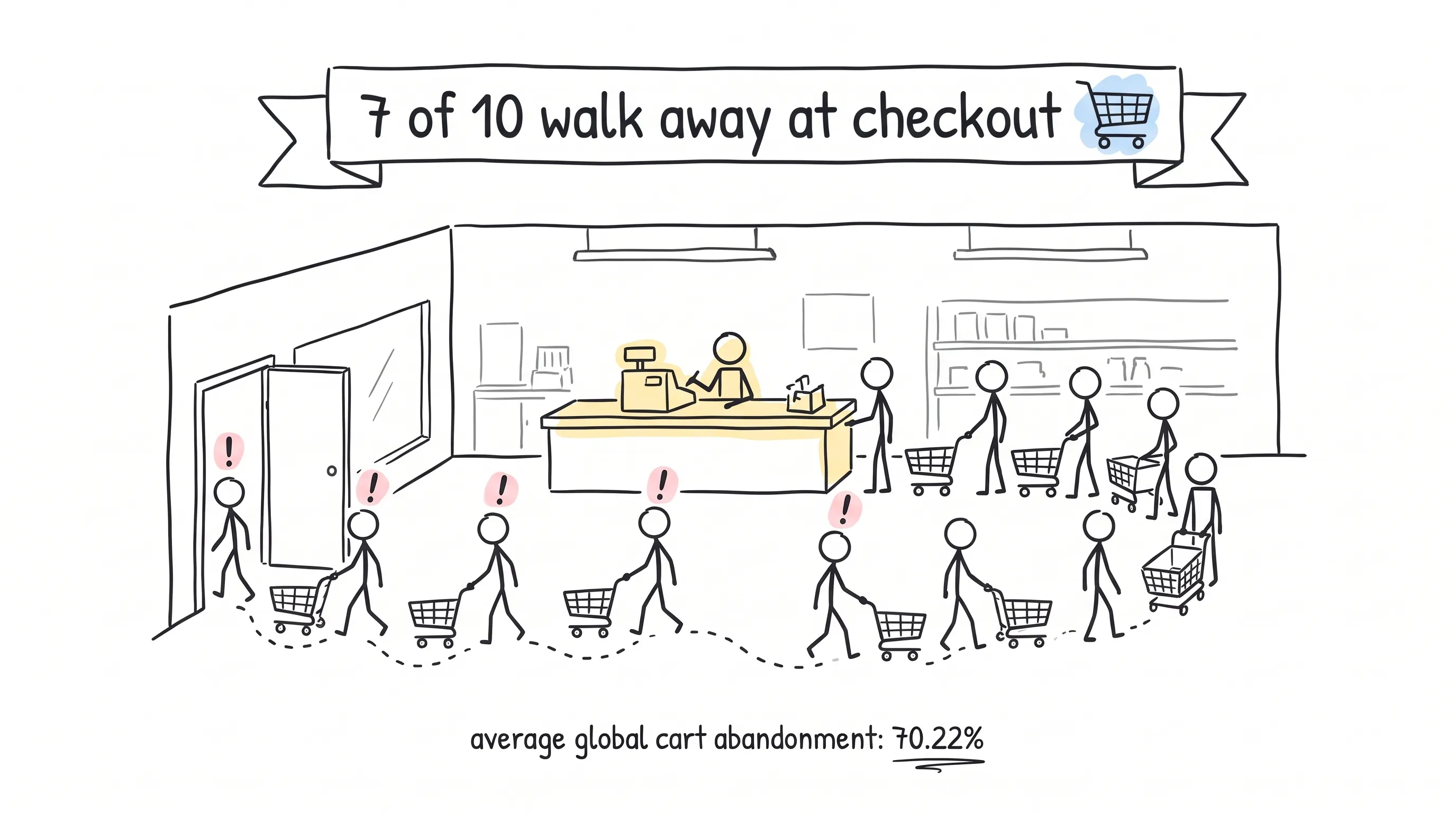
I told him — the pit he'd fallen into had already been measured, by 2026, with a number from the Baymard Institute: the average global cart abandonment rate is 70.22%. What does that mean? Out of every 10 people who put something in their cart, 7 turn around and walk at the very last second before paying. And a cross-border checkout looks even worse than that number.
Why?
Think about it. An overseas shopper spends half an hour picking out products, gets to the payment step — and finds the platform doesn't take the payment method they always use. Or the price looked lovely on the page, but at checkout a tariff suddenly appears, costing more than the shipping.
Be honest — would you have stayed?
Let's do one more round of math. In 2022, PYMNTS and Citcon surveyed 500 business executives across the US, UK, and Canada. They found that among merchants who hadn't set up local payment methods for Asia-Pacific consumers, 41% were losing more than 60% of their orders — abandoned in shopping carts.
Sixty percent. Gone, just like that.
The hard part of cross-border e-commerce isn't getting goods to another country. It's keeping a person at the checkout.
A bit of background, while we're here. Cross-border online shopping itself is booming: Precedence Research estimates the global cross-border e-commerce market at roughly $551.1 billion in 2025, growing about 15% a year over the next decade. A 2026 study by Capital One Shopping shows that cross-border accounts for roughly a fifth of global e-commerce sales, and 59% of shoppers have bought from retailers in other countries. In 2024, the hottest-selling category was apparel and accessories, followed by consumer electronics.
The market is this big, and the checkout leaks this badly. So what do you do?
First: Swap the "Feeling"
What is localization, exactly?
A lot of people assume localization is just translation.
It isn't. Translation swaps out the words. Localization swaps out the feeling. On the very same product page, for an American buyer it's all about "fast"; for a Japanese buyer it's "meticulous" — the position of a single emoji can decide whether they check out.
So how does AI do on this front? A 2024 study cited by SEAtongue reported that companies using AI for localization saw content delivery speeds improve by 60% and localization costs drop by 40% to 50%. The new generation of neural machine translation delivers quality 35% higher than the previous generation of AI engines.
That's real money saved — actual cash.
Here's a real scorecard. In September 2023, a fast-fashion e-commerce company added 12 local Indian languages to its app. Engagement among users in India's tier-2 and tier-3 cities jumped 44%.
See? Buyers aren't placing an order — they're placing trust in a platform that gets them.
But — however fast AI translates, there's one thing it can't quite catch: culture. Slang, puns, holiday easter eggs — for high-stakes marketing copy, a human still needs to make the final call.
My advice is a slogan of two halves: Machines draft; humans sign off.
Second: Get the "Landed Price" Right
What a buyer actually pays is called the landed price. Product cost, shipping, duties, local taxes — all of it, added up.
AI's job is to watch exchange-rate swings, tax rules in every country, and competitor prices in real time, and adjust prices dynamically. A 2025 study by Onramp Funds found that companies using AI-driven pricing saw gross margins improve by 5% to 10% across the board — some as much as 22%.
AI can also assign each product its HS code automatically (HS code: the customs tariff number that decides how much duty your goods owe when they land in a given country). This used to be a manual, look-it-up-in-the-tables job. Now AI calculates the landed price right at the checkout, so the buyer sees "this is everything you'll pay."
Instead of getting ambushed by the bill after they've already paid.
There's a real scorecard here too. In January 2024, a leading Chinese e-commerce platform put an AI-powered customs clearance system into production — document verification and tariff classification fully automated. Average cross-border package clearance time dropped from 72 hours to 18. Three days became less than one. The smart logistics network it later rolled out in Malaysia, Thailand, and the Philippines also squeezed regional delivery down to within 72 hours.
See? Friction gets stripped away one layer at a time.
Third: Keep the Fraudsters Outside the Door
Cross-border e-commerce has another ghost it can't dodge: fraud.
Convera's 2026 numbers: in 2023, 25% of companies lost more than €1 million to cross-border payment fraud. Global financial-crime losses that year were estimated as high as $485 billion.
Fraudsters don't carry passports. So what about fraud prevention?
AI models look at transaction patterns, device fingerprints, and behavioral biometrics. Put plainly: your typing cadence, the way you swipe your screen — all of it is your "face." Local risk control is like a neighborhood security guard who recognizes every familiar face. Cross-border risk control is like airport security — nothing but strangers, every day — so the models have to be retrained constantly. The AI fraud detection at one large payment network, analyzing billions of data points, cut card-testing attacks by 80%. What is card testing? Fraudsters take a stolen card number and probe it a cent at a time, to see whether the card still works.
Strong.
But there's a pitfall to flag: in emerging markets with thin transaction data, AI fraud detection tends to over-block. Stopping a real customer because you mistook them for a fraudster is a loss too. This isn't a plug-and-play job — you have to keep feeding it data.
So what happens when everyone's data sits in its own silo, and you can't learn across institutions? In 2025, Swift ran an experiment with 13 global financial institutions using federated learning: each institution trains the model on its own data, sharing only the "lessons learned" — never the customer data.
Catch fraudsters across borders, without leaking anyone's privacy. Clever. Genuinely clever.
Fourth: Put the Goods Where the Buyer Is, Ahead of Time
Predictive fulfillment: machine learning picks your shipping routes, chooses your stocking warehouses, preps your customs paperwork — pulling delivery times and landed costs down together.
Honestly, though, this one demands serious data foundations. If your inventory systems, carrier networks, and customs data aren't connected, even the best AI can't cook without ingredients. That's why I ranked it fourth — not because it doesn't matter, but because it has the highest bar to entry.
When You're Choosing Vendors, What Do You Look At?
Cross-border tools on the market fall into a few buckets. End-to-end platforms like Global-e cover everything from the localized checkout through fulfillment; ESW runs a merchant-of-record model (merchant of record: they legally stand in as the seller, shouldering the transaction responsibility for you); modular engines like Zonos and Avalara specialize in duties, taxes, and HS codes, plugging into your existing systems; and Adyen, Stripe, and Digital River form the backbone of multi-currency payments plus AI fraud detection. Flow Commerce's pricing optimization has already been folded into Global-e.
Don't memorize the list. Remember three questions:
One: for the markets you're entering, how many currencies and local payment methods does it cover?
Two: how accurate is its landed-price calculation in the tax jurisdictions you're headed for?
Three — and this is the one everyone overlooks: have its AI models been trained on transaction data from your target markets? Model accuracy drops noticeably in data-thin regions. If you're going to sell into Southeast Asia, look at its track record in Southeast Asia.
In March 2026, a cross-border technology services provider moved its duty, tax, and international checkout systems onto CoreWeave's dedicated AI cloud — all so real-time compliance decisions across dozens of countries and currencies could come a few milliseconds faster. See — compliance decisions have become a race measured in milliseconds.
Finally, Back to My Friend
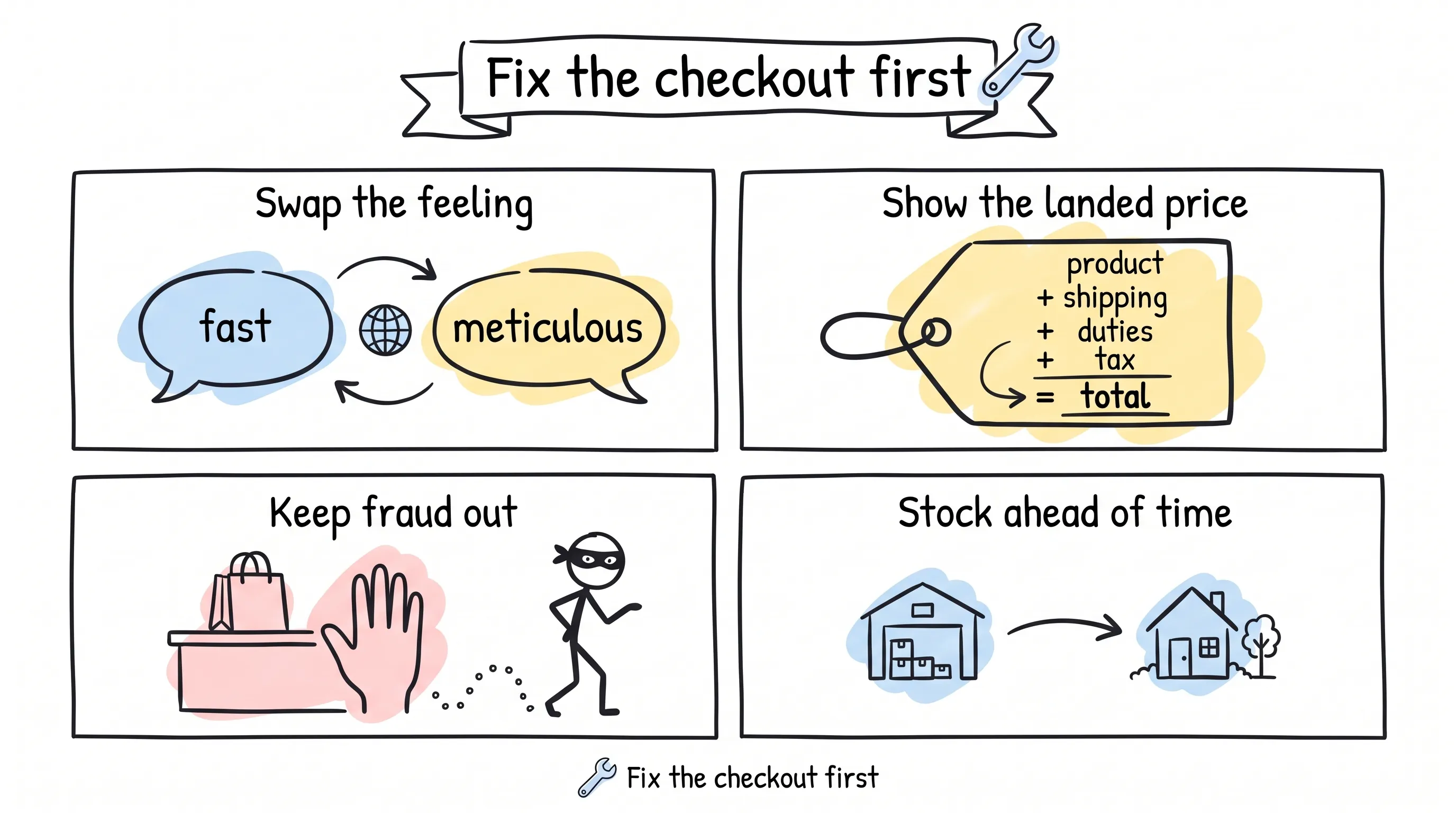
That night, after dinner, my advice to him came down to one sentence: stop pouring money into traffic. Fix the checkout first.
Swap out the language and the feeling. Show the total you'll actually pay. Keep the fraudsters outside the door. Put the goods in the warehouse nearest the buyer.
Traffic gets people to the door. Whether they stay is decided inside.
Here's to your cross-border business — and to one fewer person turning away at your checkout.
Continue reading
Related articles

Cross-Border Business: Time to Upgrade Your AI Toolbox
A learn article explaining how AI tools help cross-border e-commerce sellers clear five hurdles: language, regulation, logistics, payments, and fraud. It outlines a five-compartment toolbox, a five-step adoption path, and metrics such as conversion rate and CLV, while cautioning against over-reliance on AI.

AI Is Taking Over the Dirty Work of Social Media Marketing, One Task at a Time
This learn article outlines four social media marketing tasks AI can handle — audience analytics, content drafting and design, ad targeting and creative testing, and spam moderation — and cautions that taste, judgment, and data security remain human responsibilities.

AI Is Already This Good — Why Is Your Social Media Marketing Still Pure Manpower?
An overview of 18 AI tools for social media marketing, organized into six categories covering audience research, content creation, scheduling, comment and DM handling, ad management, and visual production, plus notes on personalization, prediction, and emerging trends.