
The AI Table Is Being Reshuffled: Fewer Gates, More Employees
A roundup of early-April AI news arguing that entry points are consolidating into super-apps while AI agents shift from answering questions to completing goals. It also covers how different AI search engines cite content differently and why SEO playbooks need rebuilding by intent.
A while back, I sat down and went through all the AI news from the first few days of April this year.
A dozen-plus major stories, all crammed into a single week.
When I finished, I sat there stunned for a long while. Not because any one story was explosive, but because I noticed something: these companies that look totally unrelated — OpenAI, Microsoft, Salesforce, Anthropic, Google — were all doing the exact same thing.
What's the play?
One direction: collapse every entry point into a few big gates.
The other: turn AI into employees who never sleep.
Fewer gates, more employees. Stack those two changes together, and you get the table we in marketing will really be playing at next.
Let me walk through it from the top.
What's a super-app? It means fewer gates
Start with the biggest story.
OpenAI confirmed a massive funding round at an $852 billion valuation. At the same time, it laid out ChatGPT's ambition: chat, search, coding, agents — all packed into one app. They call it the "super-app."
The number it disclosed itself: 900 million people use ChatGPT every week.
Think about it. Used to be, you searched on a search engine, wrote in a document app, coded in an IDE. Now one chat box does it all.
Why do the giants fight to be that box?
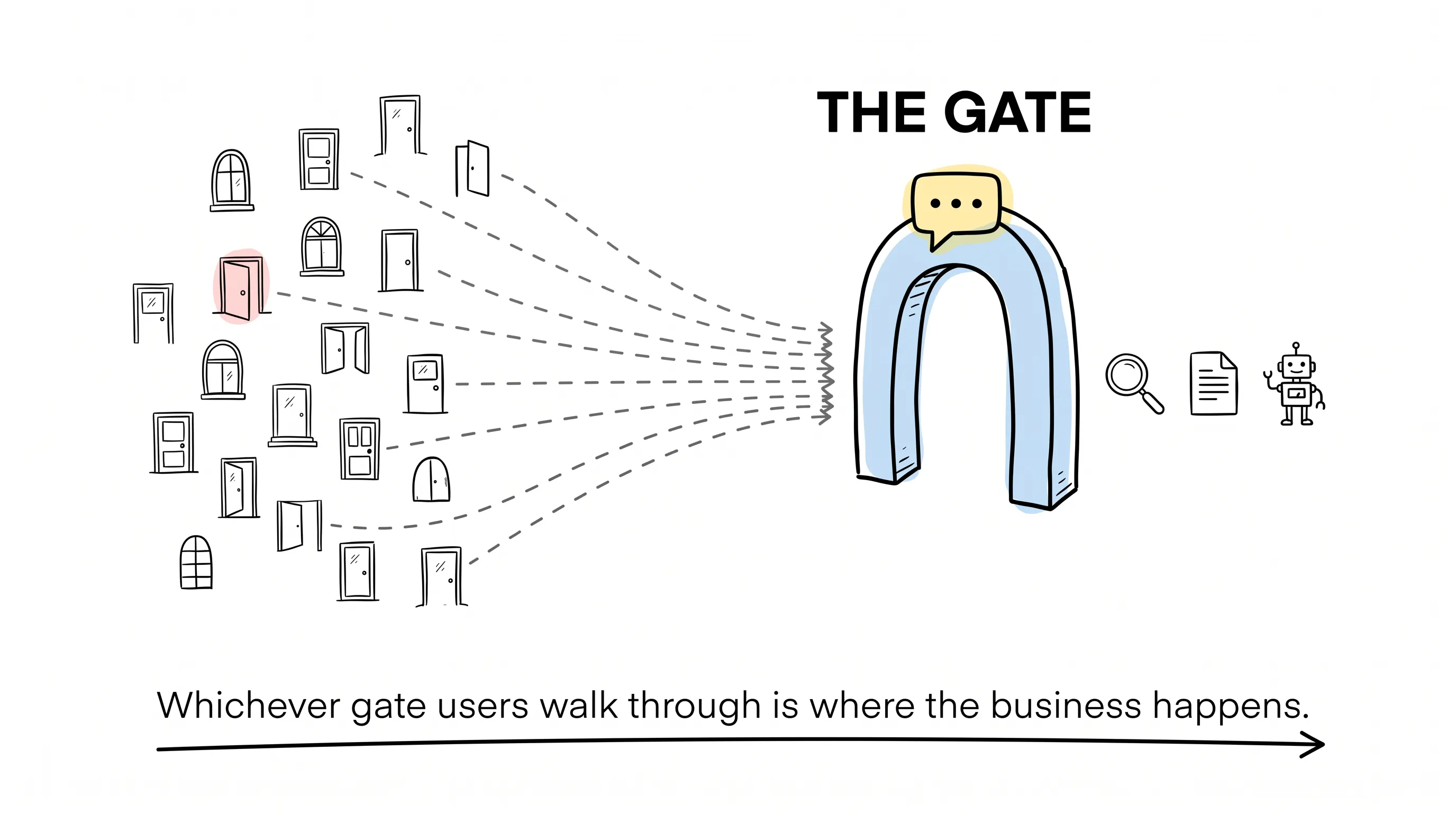
Because the box is the gate. Once users come in through your gate, the searching, the content, the transactions all happen inside.
Some refuse to buy it. Yahoo launched an AI answer engine called Scout, trying to storm back into search on the traffic of its old franchises — news, finance, email. But next to Google, the gap is still obvious. A gate isn't something you can just will open.
Google isn't giving up its gate either. Gmail is rolling out an AI inbox for premium users, using Gemini 3 to sort mail into priorities and organize it into cards. The marketing email you send now has to get past the AI's filter before a human ever sees it.
Oh, and one detail that says a lot: while building the super-app, OpenAI has quietly been cutting experimental consumer features, pulling its focus toward the enterprise business and preparing for a possible IPO. Even companies riding the crest of the wave have started doing the math.
Whichever gate users walk through is where the business happens.
What's an agent? It means employees who never sleep
Gates consolidating is only half the story. The other half is fiercer.
Microsoft upgraded Copilot: GPT and Claude now collaborate inside a single workflow. One model writes, another model's whole job is to find fault — that feature is called Critique. Still unsure? Line up several models and compare them face to face. That's called Model Council.
Think about that. We used to have people reviewing people's work. Now we have models critiquing models.
Salesforce took that old bot inside Slack and rebuilt it into an "autonomous work assistant," adding 30 AI features in one go. It can manage your CRM, summarize meetings, run processes, and even reach across all the software on your desktop to get the work done for you.
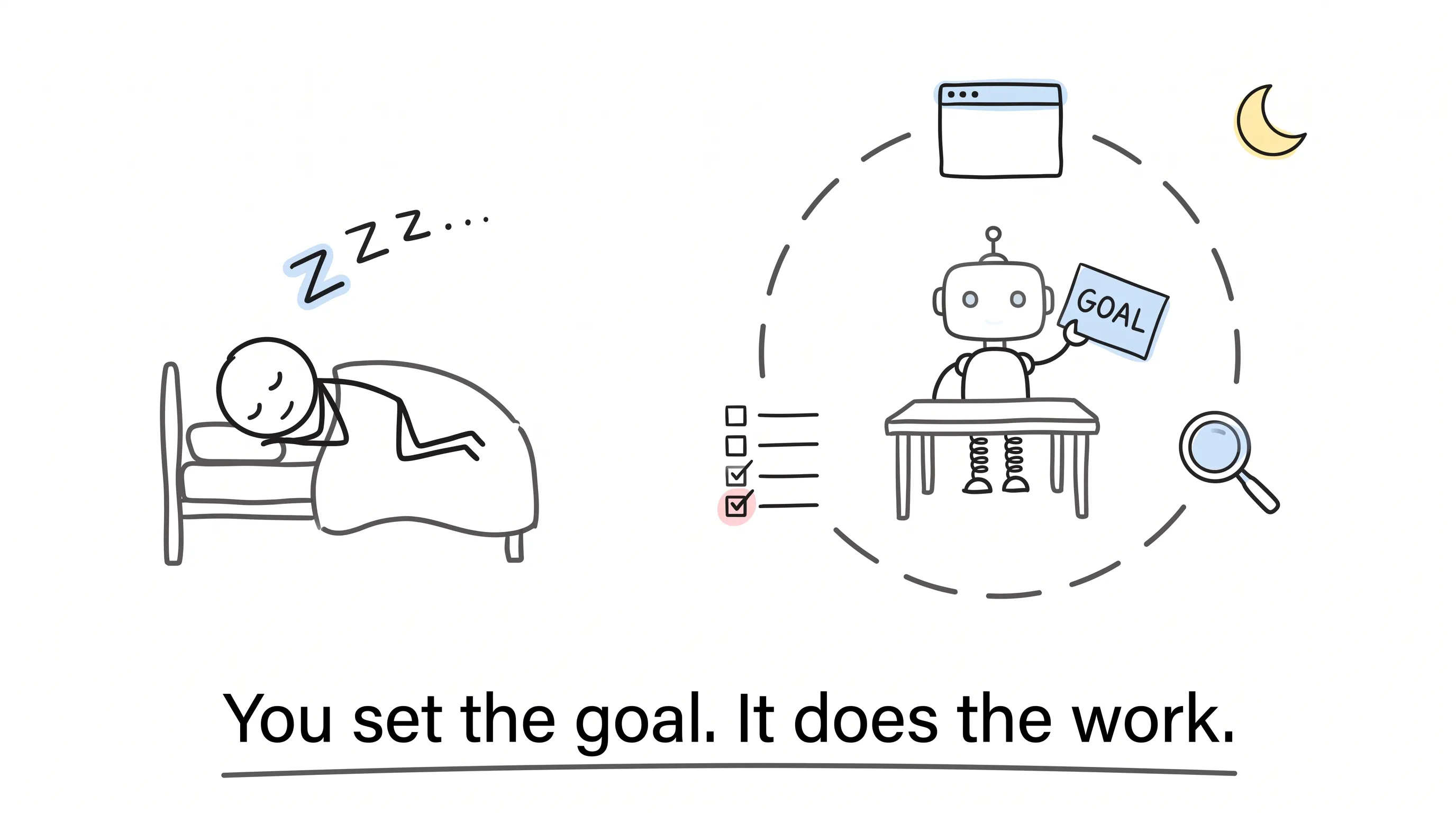
Anthropic went further. It's beta-testing an agent called Conway — not a chatbot, but an employee that lives in the background: you give it a goal, and it opens the browser itself, digs up the material itself, runs the process itself, then comes back to deliver.
On the coding side, Cursor 3 simply rebuilt the programming tool around "assign the work to an agent first": developers no longer write code — they write tasks, spin up several agents at once, monitor progress, and sign off on results. It's taking aim squarely at Anthropic's Claude Code and OpenAI's Codex.
Look at these moves together: Microsoft, Salesforce, Anthropic, Cursor — four rivals, marching in eerily the same direction.
AI is shifting from "you ask, it answers" to "you set the goal, it does the work."
But hold the applause.
Employees who never sleep, like Conway — once nobody's watching them, who's responsible when they err? Who vouches for brand safety? Once the data walks out the door, who owns it?
The UK regulator published a report grading AI autonomy on five levels, noting that most current systems are still sitting at levels two and three. But it also warned: investment is shoving this field forward at full speed, and the risk list already includes new terms like algorithmic collusion and prompt injection.
Capable employees still need managing. That part never changes.
How does content get seen by AI? Grow by intent, don't stack by template
Gates changed, employees changed. What about content?
Someone analyzed more than 10,000 search queries and found a pattern that stings: different AI searches cite in completely different ways.
ChatGPT is best at knowledge questions; Google's AI Overviews cites best on commercial and transactional queries; Claude is the most well-rounded.
What does that mean?
It means there is no universal formula for "getting cited." Knowledge content, commercial content, conversion pages — each has to be optimized for its own intent. The old SEO playbook needs to be taken apart and rebuilt.
There's also a hands-on guide to AI search that offers two concepts I find especially valuable.
One is "grounding budget": each time an AI answers, the amount of content it can retrieve is capped. If your content is thin, your allowance gets eaten by someone else.
The other is anchor-ready sentences: write every sentence as a standalone, complete fact that can be lifted out whole. Because what the AI cites isn't your article — it's the few sentences in your article that can be carried off on their own.
Put plainly, articles are written for people to read; sentences are written for machines to lift.
And Bluesky offers yet another vision. It released an AI assistant called Attie, powered by Claude under the hood, letting users customize their feeds in plain language — and eventually build apps without writing code. The algorithm stops belonging to the platform. It becomes yours.
If users define their own algorithms, the old game of feeding the platform's algorithm for reach is over.
Costs are collapsing
One more thing that's easy to miss but enormous news for small and mid-sized businesses: the cost of using AI is collapsing.
Google released Gemma 4, a set of open-weight models under the Apache 2.0 license, explicitly cleared for commercial use, covering everything from phones and edge devices to data centers. The 31-billion-parameter version landed in the world's open-source first tier. Before this, the top of the open-source leaderboards had long been held by Chinese models — with Gemma 4, Google is coming straight for their seats.
Microsoft hasn't been idle either: three in-house foundation models in one drop, covering text, speech, and image, priced directly below competitors.
Cohere open-sourced its speech-to-text model Transcribe — 14 languages, runs on a consumer-grade computer, free.
Google Research built a compression algorithm called TurboQuant that cuts the memory needed for large-model inference to one-sixth, with almost no loss in accuracy.
And a team at Loughborough University in the UK went further, building a brain-inspired chip that fuses memory and compute — on some AI tasks it saves up to 2,000 times the energy. Still lab-stage, but the direction is now lit up in neon.
Put all of this together and the conclusion is one sentence: the threshold for affording AI is vanishing fast.
But cheap alone gets you nothing. SAP acquired the data company Reltio precisely to fuse the scattered data inside enterprises into one clean "golden record." Think about it: however cheap the model gets, if the data you feed it is a mess, the results coming out are just as much of a mess.
Video got cheap — just don't look like everyone else
Content production, meanwhile, is being repriced too.
ByteDance put its Seedance 2.0 video model into CapCut. Prompts, reference images, reference clips — all can be used to generate video, with invisible watermarks and real-face restrictions baked in, rolling out gradually in select markets first.
Google released Veo 3.1 Lite — quality close to the high-end version, less than half the price — wired straight into YouTube Shorts and Gemini.
The cost of producing a watchable video is being pressed to the floor.
But there's a trap here, and FLORA stepped on it for us. Its creative agent FAUNA rests on a single conviction: AI-generated content all too easily grows the same face. It lays the whole generation process out on a canvas so you watch every step and knead your own taste into it. Brands like Nike, Netflix, and Pentagram are already using it.
This hits exactly right. The more widespread the tools, the more uniform the content — and differentiation is the only asset still going up in price.
Your job won't be taken. It will be rewritten
Last, the question everyone cares about most: will AI actually take our jobs?
MIT's lab analyzed 11,500 tasks and 17,000 AI outputs, and the conclusion disappointed the doomsayers: AI won't replace anyone overnight — it is slowly rewriting every task. By their estimate, AI can already handle about 65% of text-based tasks at a "minimum acceptable standard," and by 2029 that number could touch 95%.
Note the phrase: "minimum acceptable standard."
Writing that passes, and writing that makes you slam the table — those are two different things. Reliability and true quality are still hills the machine can't climb.
So don't bet on "will AI replace me." Think instead: "How do I work better with AI at my side?"
Finally
Back to that moment at the start, when I sat there stunned.
One and the same week: gates shrinking, employees multiplying, costs caving in, rules being written. Four changes, all pointing to the same ending:
The admission fee to AI will soon be cheap to the point of irrelevance. What's truly valuable is judgment no gate can replace — and a one-of-a-kind look no face can collide with.
More and more people will make it through the gates. But once you're inside — what can you put on the table that no one else can?
That's the question worth staying up late for.
And my wish for you: may you always have sentences no machine can copy.
Continue reading
Related articles

Cross-Border Business: Time to Upgrade Your AI Toolbox
A learn article explaining how AI tools help cross-border e-commerce sellers clear five hurdles: language, regulation, logistics, payments, and fraud. It outlines a five-compartment toolbox, a five-step adoption path, and metrics such as conversion rate and CLV, while cautioning against over-reliance on AI.

AI Is Taking Over the Dirty Work of Social Media Marketing, One Task at a Time
This learn article outlines four social media marketing tasks AI can handle — audience analytics, content drafting and design, ad targeting and creative testing, and spam moderation — and cautions that taste, judgment, and data security remain human responsibilities.

AI Is Already This Good — Why Is Your Social Media Marketing Still Pure Manpower?
An overview of 18 AI tools for social media marketing, organized into six categories covering audience research, content creation, scheduling, comment and DM handling, ad management, and visual production, plus notes on personalization, prediction, and emerging trends.