
The AI Marketing Math: I Stayed Up All Night Doing It for You
A learn-style roundup that compiles AI marketing statistics from industry reports, covering adoption rates, content production, B2B usage, tool choices, and the gap between AI penetration and reported business results.
Lately, I've been going through a dozen-plus reports and datasets on AI marketing.
Adobe's. Salesforce's. Shopify's. Statista's. Plus a pile of surveys scattered across the web.
The more I read, the less I could sleep.
Not because the numbers are scary. What really got to me is that, put together, they tell a story most people haven't caught up to yet.
Let's start with the first number.
The First Number: Six Years, Five Times Over
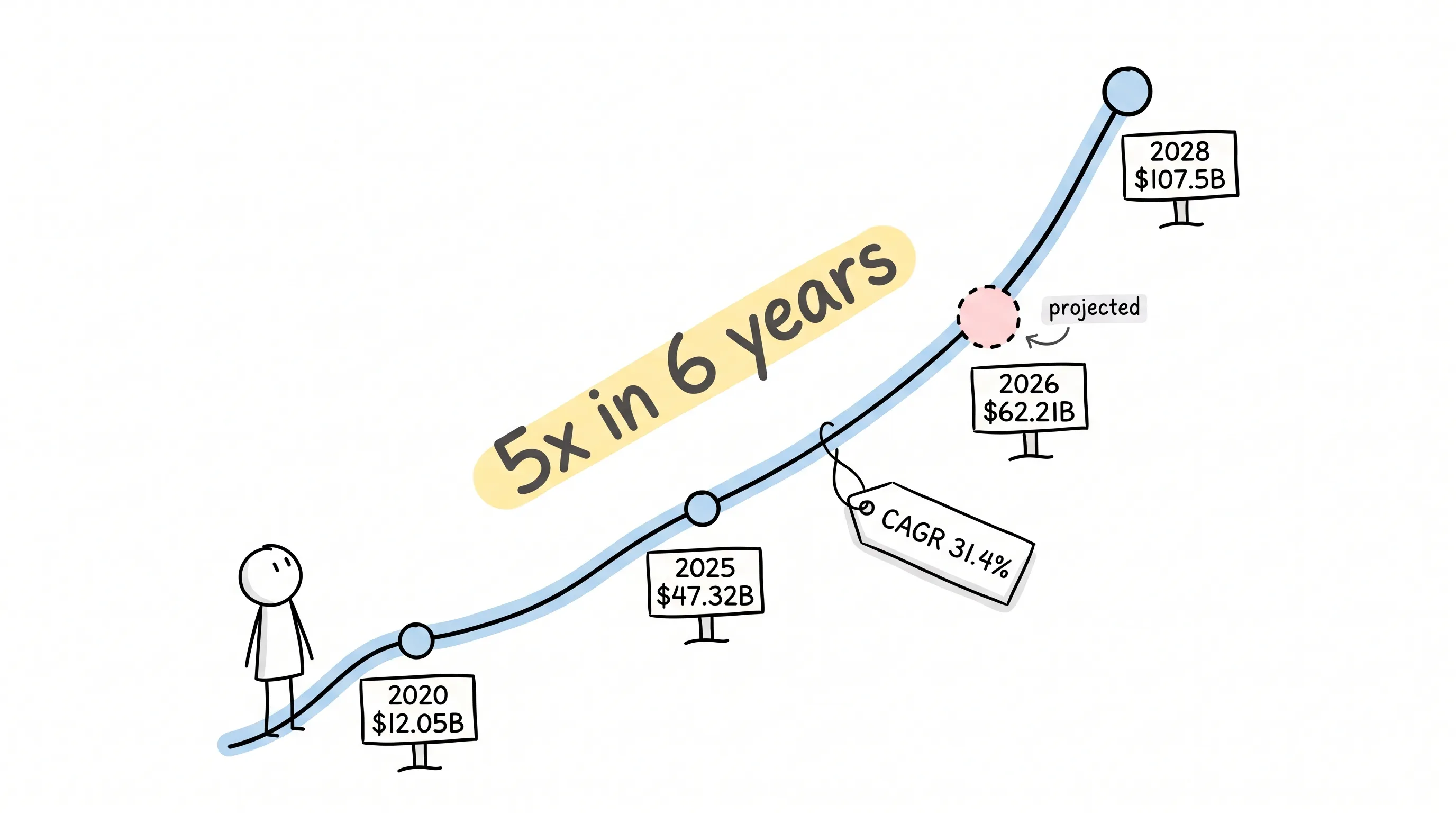
Statista puts the global AI marketing market at about $12.05 billion in 2020.
By 2025, that figure had grown to $47.32 billion. By the end of this year, it's projected to hit $62.21 billion.
What does that mean? Six years, more than a fivefold increase, a compound annual growth rate (CAGR) of 31.4%. At this pace, it will reach $107.5 billion by 2028.
Think about it: an industry growing a steady 30%-plus every year, for six years running. Growth at this scale isn't riding a hype wave anymore. It's laying the foundation.
The Second Number: Almost Everyone Is Using It, But…
What does adoption actually look like?
Adobe's report says 67% of small and midsize businesses are already using AI in their marketing. Salesforce's data cuts even deeper: 75% of marketers have adopted AI, and 60% use it every single day. 92% of companies plan to invest in generative AI tools within three years.
Good grief — isn't that everyone getting on the bus?
Not so fast. Here's another number: 37% of companies don't use AI, for a very plain reason — they don't understand how it actually works.
On one side, 75% have squeezed onto the bus. On the other, 37% haven't even found the door.
The dividing line in AI marketing isn't on the budget sheet. It's in your head.
Using It and Using It Well Are Two Different Things
Salesforce has a set of figures worth chewing on.
78% of marketers need more personalized content, and 75% use AI to create it. Sounds right, doesn't it?
But 83% of consumers expect brands to hold a two-way conversation with them, while 69% of marketers can't respond fast enough.
The customer is waiting for you to speak. You're using AI to mass-produce words addressed to everyone and no one.
So where's the gap? The data explains it: among marketers with well-unified customer data, 93% say AI improved their work. Among those without it, only 82%. As for actually using AI: 80% versus 67%.
AI isn't a plug-and-play appliance. Whatever data you feed it is the level you get back.
The B2B Opportunity Hides in the 39%
Now B2B. Only 29% of B2B marketers use AI. Another 32% plan to. And 39% — neither use it nor plan to.
39%. Nearly four in ten, standing still.
Meanwhile, among those already on board, 63% say AI brought in higher revenue. Among US B2B marketers using chatbots, 26% saw lead volume climb 10%–20%.
Opportunity is never where the crowd is.
A quick word on C2C (customer-to-customer), because one number stuck with me: Digital Commerce 360's survey shows 66% of consumers are already comfortable letting AI manage reselling. On DHL's side, 29% of shoppers are willing to let AI make the purchase decision outright — 33% for Gen Z, 36% for millennials.
The younger you are, the more willing you are to hand over the decision.
Yet within that same group, 48% worry about privacy and trust. Every ounce of trust you hand over has to be paid back.
The Content Paradox
93% of marketers use AI to speed up content production. Ahrefs counted: companies using AI publish 42% more content per month. 74% of new web pages now contain AI-generated content.
More. Faster. Cheaper.
And then?
On social media, 89.7% of marketers use AI every week, but 78.4% make moderate-or-heavier edits before publishing. Only 44.7% think AI-assisted content performs better.
In plain English: everyone is using it, and everyone is fixing it. AI's job is to make the thing. Your job is to make it right.
As for the tools themselves, ChatGPT runs away with it at 72% usage. Canva AI sits at 58%, Claude 41%, Midjourney 36%, Gemini 22%, Perplexity 17%.
Now, the Money
Everything above is process. Marketing, in the end, comes down to money.
IAB (Interactive Advertising Bureau) reports that 30% of media agencies and brands have wired AI into their full campaign workflow. AI managing PPC bidding can cut wasted ad spend by about 37% and lift ROI by nearly 50%. AI-built email marketing sees open rates rise by as much as 41%. And 75% of US marketers say AI has lowered their organizational costs.
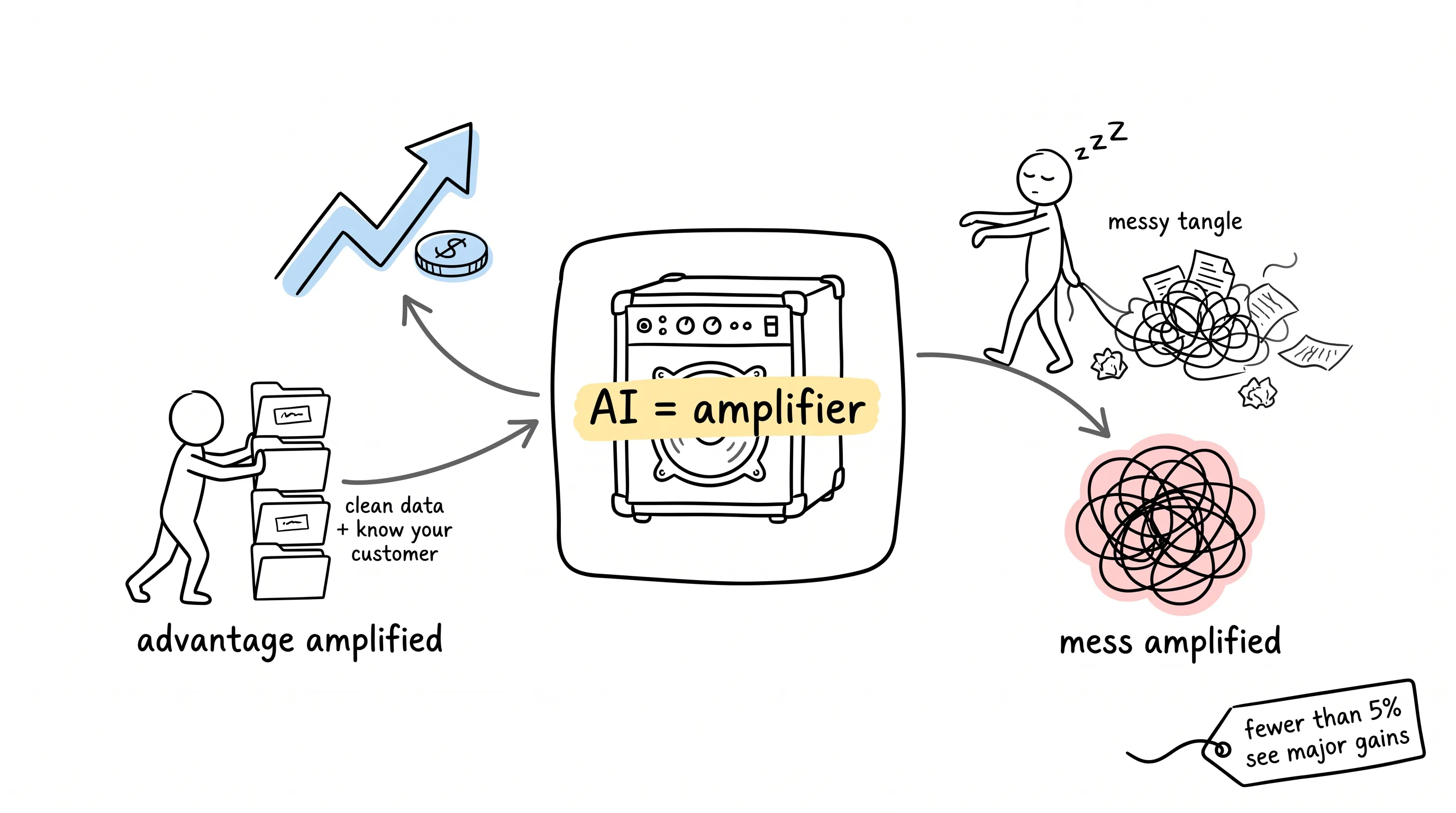
But there's one number I stared at for a long time: among marketing leaders using generative AI as a standalone tool, fewer than 5% report major business gains.
Fewer than 5%.
Penetration is at 75% — so why do so few actually make money?
Shopify's survey offers a sideways answer: 65% of CMOs believe AI will significantly change their role, yet only 31% of employees believe leadership truly understands the AI technology they're pushing.
The people at the top are chanting slogans. The people in the middle are watching the show. The people actually using it are figuring it out alone. Money leaks out through those cracks.
So What Should You Actually Do
Adobe's study this year interviewed 3,000 customer-experience executives and 4,000 consumers, and it contains a number I especially like: 50% of consumers say an email, an ad, or a social post has 2 to 5 seconds to grab their attention.
Two to five seconds.
AI can produce ten thousand pieces of content for you. But what decides those 2 to 5 seconds is still how well you understand people.
So my call is simple: AI is an amplifier. For teams with clean data and a real grasp of their customers, what gets amplified is advantage. For teams sleepwalking through it, what gets amplified is the mess.
Tools won't replace marketers. But marketers who use the tools will.
Back to that stack of reports that kept me up.
Whether AI is powerful — honestly, I'm not that anxious about it. What keeps me up at night is this: the opportunity in these numbers has grown this large, and most people are still stuck somewhere between "I don't get it" and "I'll just use it however."
I hope you're the one who uses it seriously.
Continue reading
Related articles

Cross-Border Business: Time to Upgrade Your AI Toolbox
A learn article explaining how AI tools help cross-border e-commerce sellers clear five hurdles: language, regulation, logistics, payments, and fraud. It outlines a five-compartment toolbox, a five-step adoption path, and metrics such as conversion rate and CLV, while cautioning against over-reliance on AI.

AI Is Taking Over the Dirty Work of Social Media Marketing, One Task at a Time
This learn article outlines four social media marketing tasks AI can handle — audience analytics, content drafting and design, ad targeting and creative testing, and spam moderation — and cautions that taste, judgment, and data security remain human responsibilities.

AI Is Already This Good — Why Is Your Social Media Marketing Still Pure Manpower?
An overview of 18 AI tools for social media marketing, organized into six categories covering audience research, content creation, scheduling, comment and DM handling, ad management, and visual production, plus notes on personalization, prediction, and emerging trends.