
The AI Answer Sheets from 681 Marketers Hide a Big Plot Twist
Analysis of Social Media Examiner's July 2026 survey of 681 marketers: veterans with three-plus years of AI experience now favor Claude over ChatGPT, video is the most-wanted skill to learn, and only 30% can show measurable AI results while data privacy concerns climb.
A few days ago, I finished reading a survey — and sat there stunned for a good while.
For the third year running, Social Media Examiner has published its AI marketing industry report — in July 2026, they surveyed 681 marketers. The headline finding is no surprise: everyone is using AI. The surprise is the plot twist buried inside.
What plot twist?
Marketers with three years of AI experience have swapped out the industry's default workhorse tool.
The Veterans Have Switched Weapons
Let's start with that twist.
For the past two years, ask any marketer "which AI do you use?" and nine times out of ten the answer is ChatGPT. It was the default option — like the office water cooler.
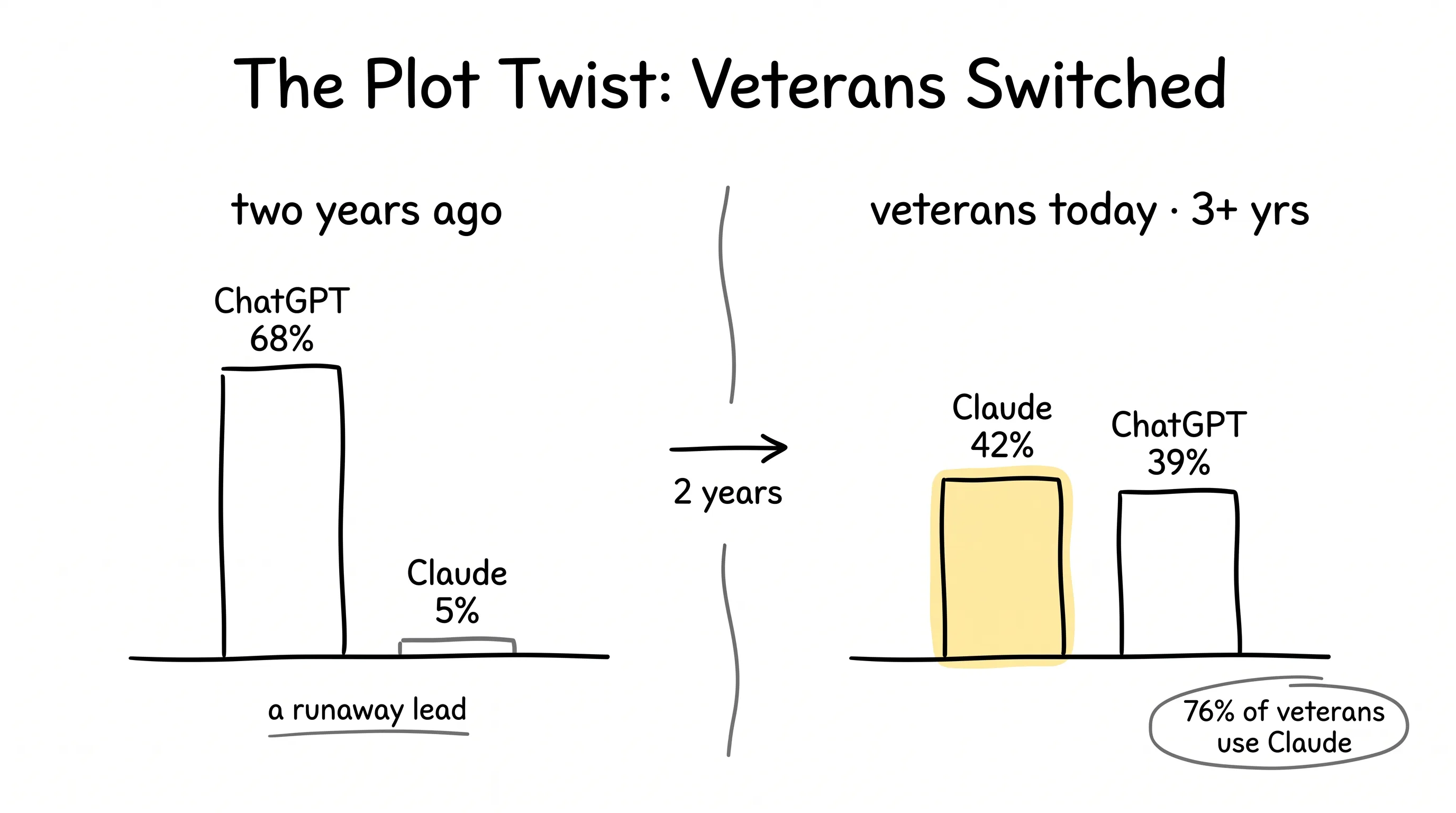
But among the most experienced marketers, Claude now takes 42%, and ChatGPT only 39%.
The veterans have switched weapons.
Keep in mind: two years ago, ChatGPT led Claude 68% to 5% — a runaway lead. Now it's been overtaken.
Two years. That's all it took.
Did Claude suddenly turn into a miracle worker?
No.
Think about it: the people who started two years ago have now been at this for three. Beginners want "an easy place to chat"; veterans want "a tool that fits their hand." So among people with less than a year in the field, 68% still cluster around ChatGPT — while among veterans with three-plus years, tool choices scatter, and Claude has taken the biggest slice: 76% of them use it.
Plain and simple: the tools barely changed — the people did. The longer you use AI, the better you know what you actually want.
Those Who Can Write Won't Learn; Those Who Want to Learn Can't Do
Now for a number that stings even more.
95% of marketers use AI to write. Practically everyone can do it.
What about video?
37%.
Less than half. And here's the interesting part: ask what they most want to learn, and 74% say: video.
Video creation has climbed from 25% in 2024 to 37% — doubled, yet still a low base. Images moved faster: two years ago 39% used AI to make images, now 67%, but the appetite to learn still runs ahead of the doing. Writing is the most "meh" of all: 95% already know how, and only 52% still want to learn it.
See, this is a capability map: where they're already strong, they don't care to learn; where they're weak, they're desperate to. The 37-percentage-point trench down the middle is where the next battle gets fought.
If you're an agency-side provider serving marketers — say, a print service provider — let me give you a heads-up: your clients are staring at that trench, anxious to make AI videos with no idea where to start. This is a gap in the market. Whoever fills it first owns it.
Feels Useful. Can't Prove It.
But what really made me sit up straight was a different question.
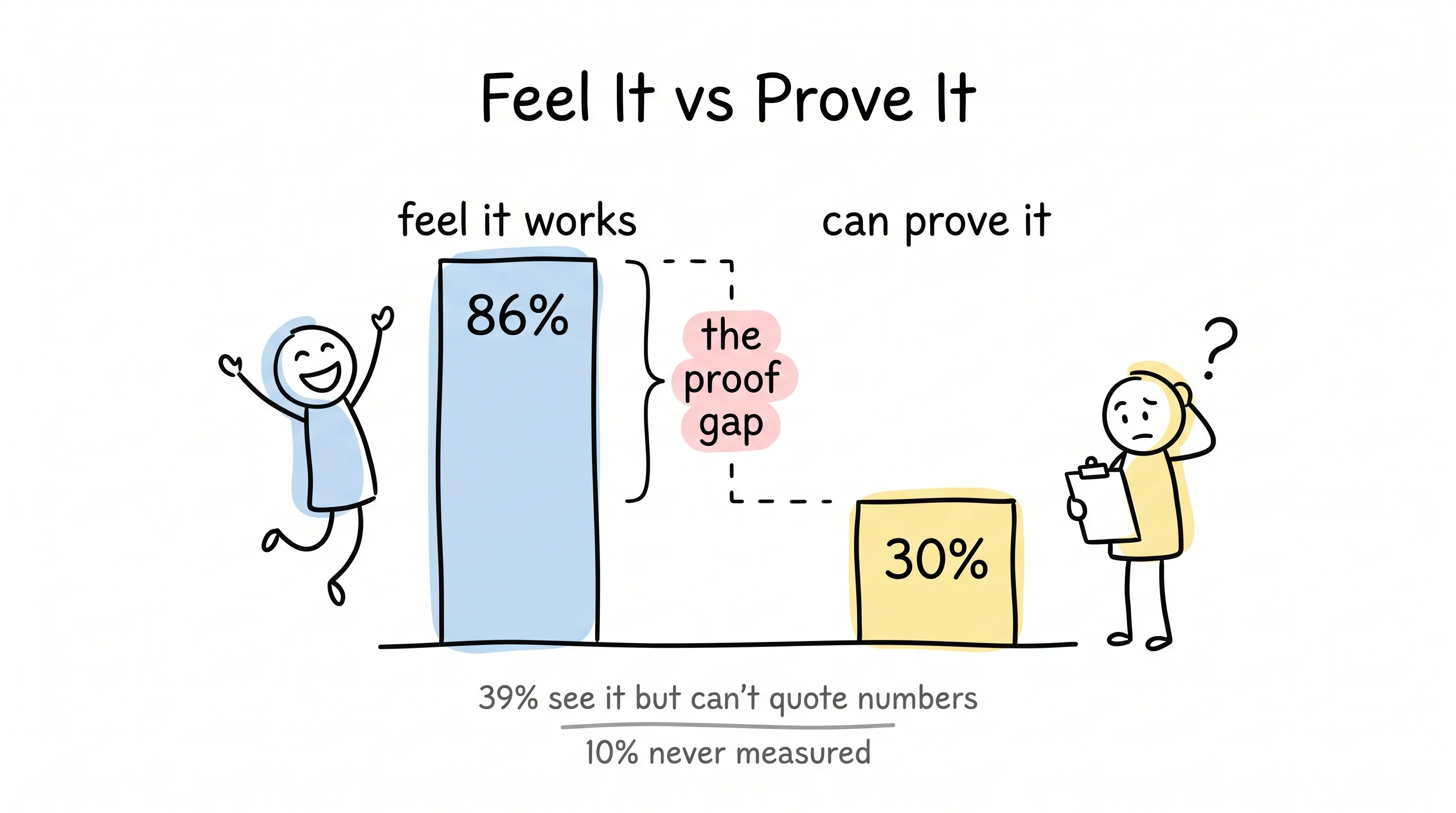
86% say AI saves them time. 86% say AI makes them more productive.
Sounds like everything's going great, right?
But only 30% can put significant, measurable results on the table. Another 39% can see the effect but can't quote the numbers. And 10% never measured anything at all.
86% feel it's useful. 30% can prove it.
It's like someone who works out every day and feels light as a feather — ask them for their fitness-test numbers, and they have nothing to show. The day the boss asks, "We've spent all this budget on AI — where's the ROI?" they'll be left stammering.
The report calls this "discipline waiting to be established." In plain words: whether you saved money, you know in your gut; where you saved it and how much — it's not on the books.
And if it's not on the books, you can't optimize it. You certainly can't defend your budget the moment someone shouts "should we cut this?"
The problem is even sharper in AI search: a customer spots you inside an AI answer, then places an order on your site — if the chain breaks in between, the credit for that sale is lost for good.
The Fear Has Moved House
One more thing, and the weather is quietly changing.
For three years, marketers worried about the same thing: is AI accurate? That anxiety has been rock-steady — 78%, barely moved in three years.
But anxiety over data privacy has sprinted from 67% to 77% in just two years, nearly shoulder to shoulder with "is it accurate." And 42% strongly agree that data privacy is a hidden risk.
The fear has moved house.
It used to be fear that it would talk nonsense; now it's fear of what it does with my stuff once it has it. Client information, company data — once you feed it in, where does it go, who gets to see it? Nobody can say for sure. Picture those AI-generated models with six fingers. Now picture it handling your data. Could you sleep?
To my friends in B2B, here's my call: this anxiety will soon harden into compliance. More audits, more restrictions — they're already on the way.
A Revolution of One
Dig one level deeper, and the problem stops being about AI.
55% of marketers say their company's AI adoption is being pushed by them alone. Only 11% say it's leadership pushing. And just 7% have received any training from their company.
What does that mean?
This transformation is bottom-up — carried by a crowd of the self-taught. 85% figure it out on their own, 61% watch tutorials, 55% pay for courses out of their own pocket. Companies are mostly hands-off.
Self-taught is great — but those skills grow on the person, not on the company. What happens the day that person quits? Or what if they never actually found the knack — and the whole company has been learning to do it wrong right along with them?
A lone charge is fast, but it doesn't go far. How to turn one person's experience into a whole team's capability — few companies have seriously asked that question.
From Writing for Me to Working for Me
The next wave is called agents.
Right now, only 11% of marketers have put AI agents into their daily workflow. But 44% plan to, and 24% are trying them out. Add it up: 79%.
74% rank "AI agents" as the topic they most want to learn — number one on the list.
For the past few years, AI helped you write. Next, AI will do the work for you: you set up the workflow, hand off whole batches of repetitive tasks, and humans just do the acceptance check. B2B is running a bit faster — 31% experimenting versus 17% in B2C — but the direction is the same. In the report's words, the next 18 months are the road from 35% to 79%.
Oh, right — that 35% counts using plus experimenting. 79 minus 35: the 44 points in between are everyone getting ready to squeeze in.
The Most Humbling Answer
The report also has one open-ended question I care about most: what's your biggest challenge in using AI?
I expected answers like "it doesn't work well," "I don't trust it," "it's too expensive" — that's what people complained about a few years ago.
No.
The most common answer: I don't know how to use it well.
Number two: how to make it sound like me. Number three: how do I trust its output.
Sit with that a second. The tools are in everyone's hands — and the people are the ones panicking. 86% say AI makes them more efficient, yet the time saved gets spent, in the blink of an eye, on checking line by line, rewriting, polishing, and confirming it isn't talking nonsense. The time saved is being eaten back, bite by bite, by the job of verifying it deserves trust.
This is the real battlefield. Problems with tools always find someone eager to solve them. Problems of judgment are only just beginning. Marketers figured out long ago how to get AI to write smooth sentences. But how to make it sound like your brand, your voice — and how to make clients believe you take their data seriously —
Nobody has turned in an answer sheet for that one yet.
681 marketers turned in their answer sheets, and it turned out everyone was holding the same pen. What they wrote, though, still isn't in their own hand.
So — have you trained your own hand yet?
Continue reading
Related articles

Cross-Border Business: Time to Upgrade Your AI Toolbox
A learn article explaining how AI tools help cross-border e-commerce sellers clear five hurdles: language, regulation, logistics, payments, and fraud. It outlines a five-compartment toolbox, a five-step adoption path, and metrics such as conversion rate and CLV, while cautioning against over-reliance on AI.

AI Is Taking Over the Dirty Work of Social Media Marketing, One Task at a Time
This learn article outlines four social media marketing tasks AI can handle — audience analytics, content drafting and design, ad targeting and creative testing, and spam moderation — and cautions that taste, judgment, and data security remain human responsibilities.

AI Is Already This Good — Why Is Your Social Media Marketing Still Pure Manpower?
An overview of 18 AI tools for social media marketing, organized into six categories covering audience research, content creation, scheduling, comment and DM handling, ad management, and visual production, plus notes on personalization, prediction, and emerging trends.